
 Ishan Crawford
 Nvidia has committed to returning 50% or more of its free cash flow to shareholders, CEO Jensen Huang said this month at GTC Taipei, the chipmaker’s annual AI infrastructure conference. The pledge, framed around a fresh $80 billion share buyback authorization and a 25-fold increase in the quarterly dividend, follows a fiscal first quarter in which Nvidia reported record $81.6 billion in revenue. Data center sales hit a record $75.2 billion in the same period, up 92% from a year ago, and management guided to $91.0 billion for the current quarter, a number that excludes any China data center compute revenue.
The first quarter, ended April 26, 2026, marked Nvidia’s third straight period of year-over-year acceleration and its 14th consecutive quarter of sequential revenue growth, per the company’s Q1 fiscal 2027 earnings release. Free cash flow hit a new high on the call that followed, according to a Yahoo Finance account of the session, and the gap between what Nvidia is generating and what it can productively reinvest inside its own operations has become the defining question for the next leg of the AI buildout.
A Record $81.6 Billion Quarter Anchors the Moment
Nvidia reported record revenue of $81.6 billion for the first quarter of fiscal 2027, up 85% from a year ago and 20% sequentially. The quarter, which ended April 26, 2026, marked the chipmaker’s third straight period of year-over-year acceleration, per the same release.
- $81.6B Q1 revenue, +85% YoY
- $75.2B Data Center revenue, +92% YoY
- $1.87 non-GAAP EPS, +140% YoY
- 74.9% GAAP gross margin
- $91.0B Q2 revenue outlook, ±2%
Data Center drove the result, with revenue of $75.2 billion, up 92% from a year ago and 21% sequentially, the largest contributor to Nvidia’s bottom line by a wide margin. The growth came from the ramp of Blackwell 300 products and continued demand for the company’s InfiniBand, Spectrum-X Ethernet, and NVLink solutions, according to the CFO commentary. Hyperscale customers accounted for roughly half of data center revenue, with the rest coming from AI clouds, industrial, enterprise, and sovereign buyers, the company said.
Profitability kept pace. GAAP gross margin was 74.9%, with non-GAAP gross margin at 75.0%. Non-GAAP earnings per diluted share were $1.87, up 140% from a year ago. Operating cash flow reached $50.3 billion, up from $27.4 billion a year earlier. For the second quarter, management guided revenue of $91.0 billion, plus or minus 2%, with no China data center compute revenue assumed in that figure. Jensen Huang, in written remarks alongside the release, said the buildout of AI factories is “accelerating at extraordinary speed” and that agentic AI has arrived to do “productive work” across companies and industries.
Huang’s 50% Free Cash Flow Pledge
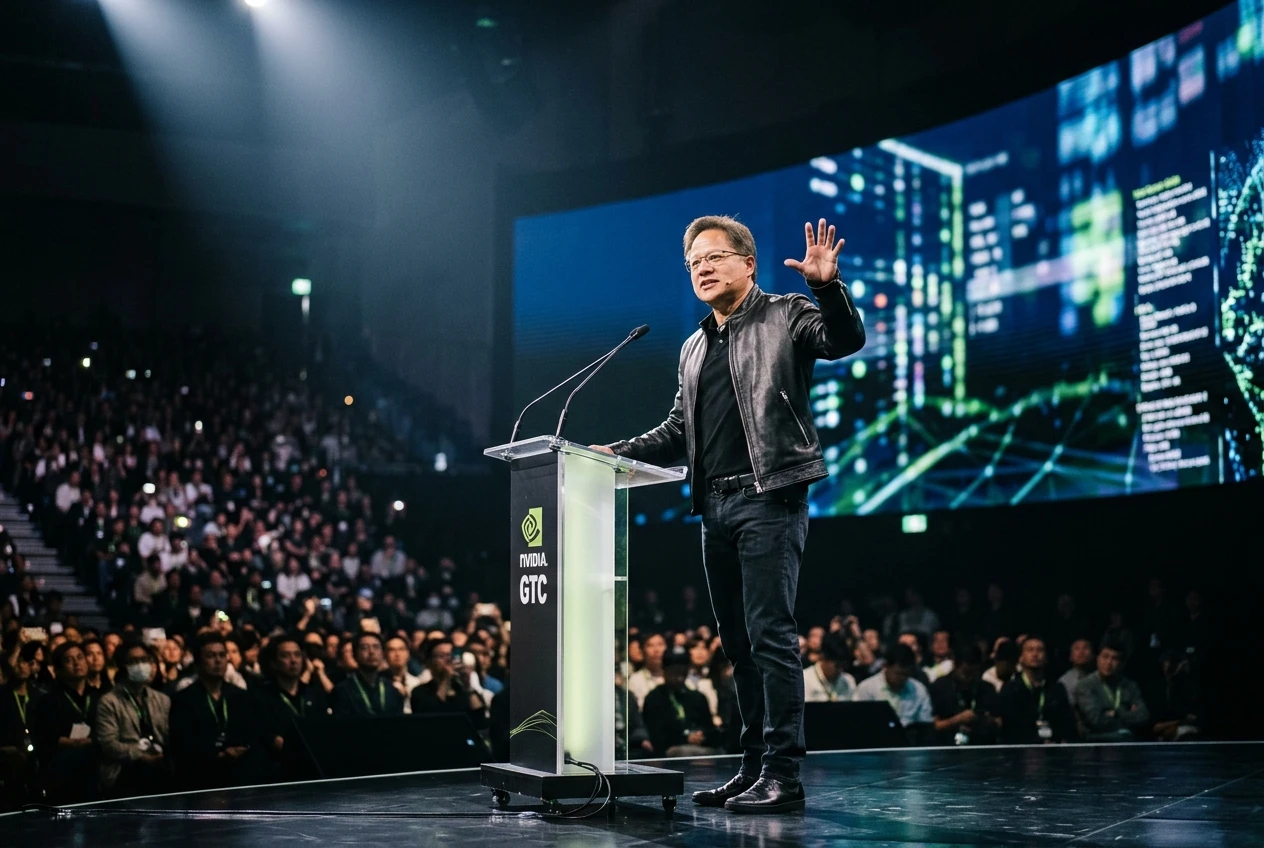
At GTC Taipei, an analyst and investor session that ran alongside the COMPUTEX trade show, Huang made the cash return figure explicit. He reminded attendees that Nvidia had already announced the $80 billion buyback and the 25-fold dividend increase, then committed the company to returning the majority of its free cash flow to shareholders for the foreseeable future. The framework, he said, applies to this year, next year, and beyond.
50% or more of free cash flow to our shareholders this year, next year, and beyond.
That pledge came from Jensen Huang, Nvidia’s founder and CEO, at the company’s GTC Taipei session, as reported by Yahoo Finance’s account of the event. It places a hard floor under a capital return story that had been signaling intent for months. Nvidia returned a record $20.0 billion to shareholders in the first quarter alone, split between share repurchases and cash dividends, and had $38.5 billion left under its prior buyback authorization when the quarter closed. The board’s May 18, 2026 authorization of an additional $80.0 billion, with no expiration, roughly tripled the dry powder. CFO Colette Kress, on the conference call that followed the release, described Blackwell as adopted and deployed by every major hyperscaler, every cloud provider, and every major model maker, framing the demand backdrop behind the pledge.
What Funds the 50% Pledge
The capital return gets executed in two main lanes: the $80 billion buyback authorization and a quarterly dividend that the board lifted from $0.01 to $0.25 per share on May 18, 2026. The new dividend is payable on June 26 to shareholders of record on June 4, and the press release frames the move as a structural reset rather than a one-time bump. The combined $100 billion-plus of fresh authorization dwarfs the $20.0 billion the company already returned in the first quarter.
Buybacks can do the heavier lifting. The company had $38.5 billion of authorization left from the prior program at quarter end, and the new $80.0 billion authorization carries no expiration. That gives the board a multi-year runway to reduce the share count if it chooses. Nvidia’s CFO commentary framed the buyback and dividend moves as the visible expression of a broader capital discipline push that has been building since the prior fiscal year.
| Metric | Q1 FY27 | Q4 FY26 | Q1 FY26 |
|---|---|---|---|
| Revenue | $81.6B | $68.1B | $44.1B |
| Non-GAAP gross margin | 75.0% | 75.1% | 60.8% |
| Non-GAAP operating income | $53.8B | $44.5B | $21.8B |
| Non-GAAP net income | $45.5B | $39.0B | $19.1B |
| Non-GAAP EPS | $1.87 | $1.59 | $0.78 |
| Operating cash flow | $50.3B | $36.2B | $27.4B |
Cash, cash equivalents, and marketable debt securities stood at $50.3 billion at quarter end, down from $52.4 billion a year earlier and up from $49.7 billion a quarter ago, per the CFO commentary. The change reflects higher revenue offset by outlays for stock repurchases and strategic investments.
Operating cash flow explains why. Cash flow from operations hit $50.3 billion in the first quarter, up from $27.4 billion a year ago and $36.2 billion a quarter ago. Free cash flow hit a new high, according to the Q1 earnings call highlights and free cash flow record account. The company has been spending aggressively elsewhere too, including more than $40 billion in equity investments in AI companies in the first four months of 2026. Inventory climbed to $25.8 billion and total supply-related commitments reached $119.0 billion, both of which suggest management is also pre-funding the demand cycle for the platforms that follow Blackwell.
The $40 Billion Stake in the AI Ecosystem
The capital return story has a counterpart in Nvidia’s other big-ticket deployment of cash: equity stakes in AI companies, which crossed $40 billion in the first four months of 2026, per CNBC. The single largest check was a $30 billion investment in OpenAI, finalized in late February.
- $30 billion in OpenAI (late February 2026)
- Up to $3.2 billion in Corning (May 2026)
- Up to $2.1 billion in IREN (May 2026)
- $2 billion in Marvell Technology (March 2026)
- $2 billion in Lumentum (March 2026)
- $2 billion in Coherent (March 2026)
- $2 billion in CoreWeave (January 2026)
- $2 billion in Nebius Group (January 2026)
Around that anchor, Nvidia has signed at least seven multibillion-dollar investments in publicly traded companies and roughly two dozen rounds in private companies, according to the Nvidia’s $40 billion in AI equity bets in 2026 tally. Other named deals include the Corning and IREN pacts in May, plus the $2 billion checks in Marvell, Lumentum, Coherent, CoreWeave, and Nebius. Huang has framed the breadth as deliberate, telling a podcast in April that the company tries to back all the major foundation model providers rather than concentrate on a few.
The ecosystem stake is large enough that critics compare the practice to the vendor financing that helped inflate the dot-com bubble. Matthew Bryson, an analyst at Wedbush Securities, wrote in a note that Nvidia’s investments and buildouts fit “squarely into the circular investment theme” driving fears about the market’s durability, though he also said the deals create a “competitive moat” if executed well. Ben Bajarin at Creative Strategies raised a related concern: “The risk is that if the cycle turns, the market starts questioning how much of the demand was organic versus supported by Nvidia’s own balance sheet.” The 50% free cash flow pledge does not directly answer those questions, but it does shift a larger share of Nvidia’s earnings off the table for further ecosystem bets, a tradeoff the next round of analyst questions on the fiscal Q2 call is likely to press.
A $5 Trillion Chipmaker Pivots to Capital Return
Nvidia first crossed the $5 trillion market cap on October 29, 2025, becoming the first company in history to do so, according to Axios. The stock has lifted by more than 11-fold in four years, per CNBC, and the chipmaker is now worth roughly $5.2 trillion as of the latest CNBC reporting, making it the most valuable business in the world. As of June 10, 2026, Nvidia shares closed at $200.42, per the company’s investor relations historical price page. The pace of the climb has put the company in territory that has no public-market precedent, as detailed in the related reading on how Nvidia’s $5 trillion cap compares to GDP.
Vera Rubin, Nvidia’s next platform after Blackwell, remains on track for rollout in the second half of 2026, executives said on the earnings call. Research and development spending reached $6.3 billion in the first quarter, up 58% from a year earlier. The 50% free cash flow commitment, layered on top of that product cadence and the buyback, is the most explicit capital return policy Nvidia has set out, and the next test of it lands with the fiscal second quarter results.
 Scotland vs Haiti: Two Gambles That Could Shape Group C
  RBI’s FCNR(B) Swap Window Returns, but the 2013 Spread Has Halved
  India Drops Out of MSCI EM Top 10 for the First Time in 26 Years
  Flexi-Cap Inflows Halved in May, but Money Is Still Pouring In
  India Waives Central Excise Duty on E22 to E30 Ethanol-Blended Petrol
  Honda Recalls 880,514 SUVs and Pickups Over Rear Subframe Rust