
 Ishan Crawford
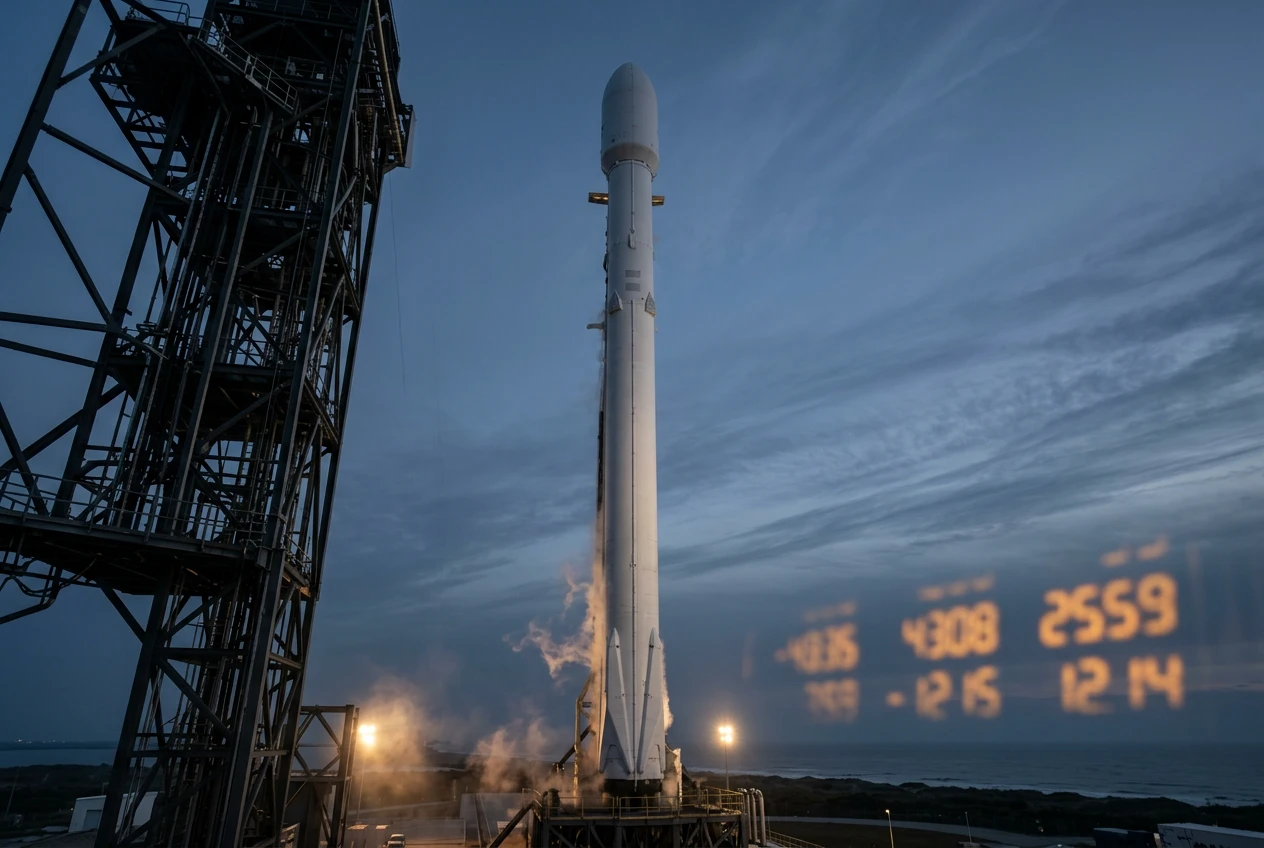
 SpaceX is asking public investors to wire at least $75 billion straight into its own bank account. The SpaceX IPO, set to begin its roadshow Thursday at a target valuation of $1.75 trillion, is built as an all-primary offering: every share is newly issued, every dollar goes to the company, and not one existing shareholder gets to cash out at the opening bell.
That structure is the tell. A company about to claim the largest IPO in history lost $4.94 billion last year, and one of the first independent valuations pins it at $780 billion, well under half the asking price.
Why Every Dollar Lands on SpaceX’s Books
There are two unusual things about a listing this size, and the deal structure is the louder of them. In a typical mega-IPO, a slice of the shares on sale comes from early backers and employees selling down stakes, so that money flows to them rather than the business. SpaceX flipped it. Three people familiar with the plans told Reuters, the wire service that broke the terms, that the offering is assembled entirely from fresh stock.
How an All-Primary Deal Splits the Proceeds
An all-primary offering means every share sold is newly minted. At a target price near $135 and roughly 555.6 million shares, the base raise lands close to $75 billion, all of it on the company balance sheet. A 15% greenshoe lets the underwriting banks issue more stock if demand runs hot, which is part of how the headline figure climbs toward the trillion-dollar zone. The terms sit inside the SpaceX S-1 registration statement filed with the SEC, the U.S. Securities and Exchange Commission, the agency that vets public-offering disclosures.
Stripped to plain terms, the deal does three things a standard listing does not:
- The proceeds fund SpaceX directly, earmarked for AI computing and satellite buildout, not for cashing out early holders.
- Early backers, employees and Musk sell nothing at the open.
- Public buyers absorb all the new shares, taking the dilution in exchange for the first liquid market in the stock.
Why Early Backers Can’t Sell at the Bell
Pure primary deals are not unheard of; they are just rare at this scale. Rivian Automotive ran one in 2021, with Amazon and Ford holding their shares while the carmaker raised cash to expand. SpaceX is making the same call for the same reason. It needs the money, and an all-primary book signals that the raise is a working-capital event, not a payday for insiders.
One Profit Engine Funds Two Cash-Burning Bets
Look past the trillion-dollar headline and the company splits into three very different businesses. Starlink, the satellite broadband arm, is the cash cow. The rocket business loses money on an operating basis. And xAI, the Grok developer folded in this year, is a furnace.
Here is how the segments landed in 2025, per Morningstar’s read of the SpaceX filing financials:
| Segment | 2025 operating result | Detail |
|---|---|---|
| Starlink (connectivity) | +$4.4 billion | $11.4B revenue, about 61% of the company total |
| Launch and space services | -$619 million | The core rocket business |
| xAI (AI) | -$6.35 billion | Added through the February merger |
| Company total | Net loss of $4.94 billion | On $18.67B revenue; EBITDA near $6.58B |
The swing matters. A year earlier the company turned a $791 million profit on $14.02 billion of revenue. The satellite unit’s economics improved sharply, with its adjusted earnings up 86% as subscribers doubled, but the AI loss buried everything. EBITDA, short for earnings before interest, taxes, depreciation and amortization, a rough proxy for cash generation, stayed positive only because the broadband business carried the rest.
Morningstar Pegs Fair Value at Less Than Half
The cleanest counterweight to the roadshow pitch arrived from inside the research industry. Morningstar, the independent fund and equity researcher, opened coverage with a fair-value estimate of $780 billion, against an asking valuation roughly 2.2 times higher. At $1.75 trillion, the stock would trade near 94 times its 2025 revenue, a multiple usually reserved for early-stage software, not a 24-year-old hardware company.
Nicolas Owens, the Morningstar equity analyst who built the model, anchored about $611 billion to the launch and satellite businesses, then layered on roughly $170 billion of probability-weighted value for the AI work. He flagged the related-party nature of the xAI merger, which was not struck at arm’s length, and Musk’s voting grip as reasons to discount the rest.
We think the company has been significantly overvalued and investors will have opportunities to buy the stock at more attractive levels after the IPO.
Owens went further on the AI unit, calling it a material threat of value destruction and writing that the team does not see Grok as one of the leading AI labs today. His breakdown of SpaceX’s spending and losses reads as the bear case the roadshow will spend two weeks rebutting.
How $75 Billion Dwarfs Every IPO Before It
To grasp the scale, set the base raise against the records it would erase. Saudi Aramco’s 2019 debut, the current champion, brought in $25.6 billion. SpaceX is targeting close to three times that, before the greenshoe.
| Company | Year | Amount raised |
|---|---|---|
| SpaceX (targeted) | 2026 | ~$75 billion base |
| Saudi Aramco | 2019 | $25.6 billion |
| Alibaba | 2014 | $21.8 billion |
| SoftBank Corp | 2018 | $21.3 billion |
No recent listing has tried to pull this much capital out of the market at once. Part of the challenge for buyers is that SpaceX has no clean public benchmark. Investors have to assemble a comparison from aerospace, telecom and defense names, then bolt on Starlink’s growth curve and a guess at what orbital data centers might be worth. That gap is exactly why an independent figure can sit so far from the sticker.
Musk Keeps the Votes, Insiders Get an Early Exit
For many buyers the wager is as much on Musk as on the rockets. The prospectus makes sure his grip survives the listing, while bending the usual rules on when insiders can sell.
The Dual-Class Math
SpaceX is adopting a dual-class structure. Class A shares carry one vote each; Class B shares carry ten. That arithmetic leaves Musk with roughly 85% of the voting power even as outside money pours in, plus prospectus provisions locking in his roles as chief executive and chairman. Public shareholders get economic exposure and very little say.
A Lockup Built in Tranches
Musk himself accepted a 366-day lockup, a signal of commitment that the bankers will lean on hard. Other insiders move sooner. Under the staggered schedule in the tiered SpaceX lockup design, holders can sell up to 20% of locked stock once the first post-listing quarterly report drops, with another 10% freed if the price sits more than 30% above the offer. Smaller slices unlock on a rolling calendar after that, with the bulk clear by 180 days.
The Nasdaq-100 Tailwind
One more quirk works in early buyers’ favor. A Nasdaq rule effective May 1 lets an ultra-large debutant enter the Nasdaq-100 just 15 trading days after listing, and SpaceX qualifies on size alone. The moment it joins, every passive fund tracking the index has to buy, manufacturing a wave of forced demand right as insiders are still locked out.
SpaceX Opens a Trillion-Dollar IPO Wave
This deal is the front of a queue. SpaceX, OpenAI and Anthropic together could pour close to $4 trillion of fresh market value into public hands, and they will compete for the same pool of investor dollars. A listing this size soaks up capital that index funds, pensions and retail traders would otherwise spread across hundreds of names.
The pitch reaches well past launch manifests. SpaceX is selling a future of satellite communications and AI infrastructure, including data centers in orbit, positioning itself to ride the same spending boom lifting every chip and cloud company. The February tie-up with xAI valued the rocket business at $1 trillion and the Grok developer at $250 billion, a combined $1.25 trillion that the IPO now asks the market to mark up by half a trillion more.
The roadshow opens Thursday, with Goldman Sachs, Morgan Stanley, BofA Securities, Citigroup and J.P. Morgan running the book. A Nasdaq debut under the ticker SPCX could come as early as June 12. By then, public investors will have decided how much of Musk’s space-and-AI vision they are willing to bankroll up front.
Frequently Asked Questions
When does the SpaceX IPO start trading?
The investor roadshow begins Thursday, June 4, and a Nasdaq debut could come as early as June 12 under the ticker SPCX, after the company pulled its timeline forward. The dates can shift as bankers gauge demand during the roadshow.
What is the SpaceX IPO price and how many shares are on offer?
SpaceX is targeting a fixed price around $135 per share across roughly 555.6 million new shares, with a 15% greenshoe that lets underwriters release extra stock if orders exceed supply. That math drives the base raise near record territory.
Can existing SpaceX shareholders sell in the IPO?
No. The deal is all new shares, so no early backer, employee or founder sells at the bell. Musk accepted a 366-day lockup, while other insiders unlock stock in tranches starting after the first post-listing quarterly report.
Why is Morningstar’s valuation so much lower than the IPO target?
Morningstar analyst Nicolas Owens used a discounted cash flow model to reach $780 billion, anchoring most value to the launch and Starlink businesses and heavily discounting xAI. The $1.75 trillion target implies about 94 times 2025 revenue, a multiple he views as unsupported.
Will SpaceX join the Nasdaq-100 index?
Yes, it qualifies. A Nasdaq rule effective May 1 allows very large new listings into the Nasdaq-100 just 15 trading days after their debut, which would force index-tracking funds to buy the stock soon after it starts trading.
Disclaimer: This article is for informational purposes only and is not investment advice. Initial public offerings, and pre-listing shares in particular, carry substantial risk of loss, including from valuation uncertainty, governance concentration and lockup dynamics. Consult a qualified financial professional before making any investment decision. Figures are accurate as of publication on June 3, 2026, and the deal terms may change during the roadshow.
 One UI 9’s Privacy Display Fix Reaches Just One Galaxy Phone
  Samsung Drops Its Own Exynos Chip for the Galaxy Watch9 and Ultra 2
  Marathon’s Vault Breaker Arrives as Bungie’s Bigger Bet Keeps Faltering
  Sony’s PlayStation Disc Cutoff Erases the Last Proof of Ownership
  Tesla’s Summer Update Hands Grok the Keys, and Musk’s Empire More Reach
  Apple’s $634 Million Masimo Payment Is Final After Appeal Denial