
 Ishan Crawford
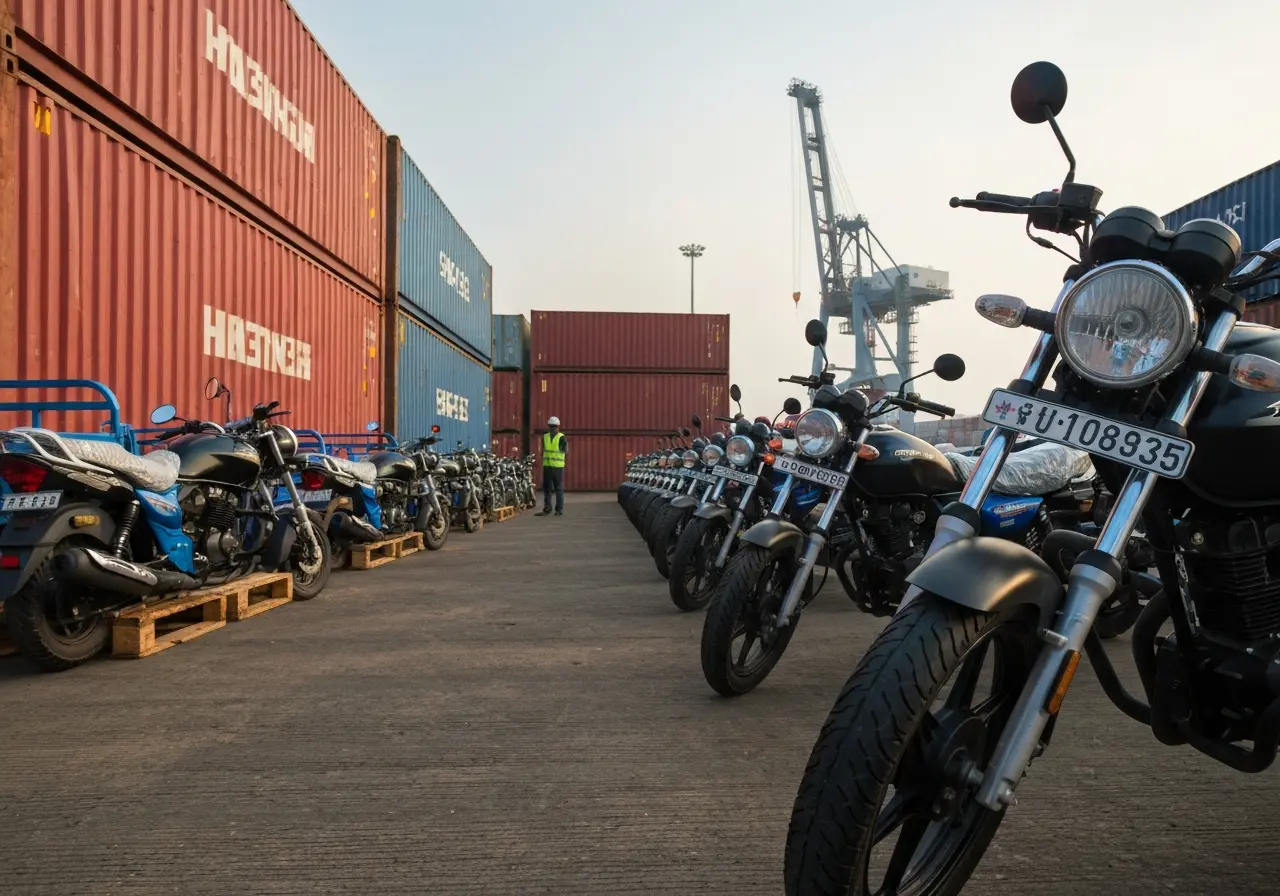
 Bajaj Auto shipped 461,257 vehicles in May 2026, a 20% jump from the 384,621 it moved a year earlier, with overseas dispatches doing most of the heavy lifting. Bajaj Auto May 2026 sales show exports rising 34% to 213,226 units while domestic volumes grew a slower 10% to 248,031, leaving the home and overseas books almost level for the month.
Pull the totals apart and a structural change shows up. Overseas shipments accounted for roughly 46% of everything Bajaj shipped last month, the closest the export ledger has come to matching home sales in years, and the trend is even sharper across the opening stretch of the new financial year.
Exports Now Carry Nearly Half the Monthly Load
For a company long read through its Pulsar and domestic motorcycle numbers, the shape of May tells a different story. Domestic growth was steady but unremarkable. The acceleration came entirely from ports, not showrooms.
The gap widens over the first two months of FY27 (the financial year that began in April 2026). Cumulative volume reached 975,049 units, up 30% on the 750,431 sold in the same window of FY26. Domestic sales rose 11% to 496,241. Exports climbed 57% to 478,808 units, which works out to just over 49% of total dispatches. On a two-month view, Bajaj is now close to selling as many vehicles abroad as it does at home.
The segment split makes the divergence plain.
| Segment (May 2026) | Domestic YoY | Export YoY |
|---|---|---|
| Two-wheelers | +9% | +30% |
| Commercial vehicles | +12% | +65% |
| Total volume | +10% | +34% |
Every line in that table tilts the same way. The company’s own monthly volume disclosures have shown the export share creeping up for several quarters, but May is the point where it stopped being a side note and started defining the headline number.
Commercial Vehicles Outran the Motorcycle Book
The two-wheeler division is still the giant, contributing 393,204 units in May and growing 18% overall. But the faster engine sat in the smaller business. Bajaj’s commercial vehicle arm, which builds three-wheelers and small four-wheel goods carriers, posted the punchier numbers.
- 68,053 commercial vehicles sold, up 30% year on year
- 29,550 CV exports, up 65% from a year earlier
- 38,503 domestic CV units, up 12%
A 65% jump in three-wheeler and small-truck exports is the kind of figure that moves when whole markets reopen rather than when a single model lands. These vehicles are working assets in their destination countries, used for last-mile freight and passenger transport, so demand tracks local credit conditions and fuel costs more than fashion. That makes the CV export surge a useful read on the broader health of Bajaj’s overseas markets, and right now it is flashing green.
The domestic side held up too, helped by tighter safety rules that are pushing buyers toward better-equipped models. Suppliers have been racing to keep pace; Endurance Technologies, for one, is adding capacity ahead of India’s new anti-lock braking mandate for two-wheelers, a shift that nudges average selling prices higher across the home market.
Where the Overseas Volume Is Coming From
Bajaj does not sell into one export market. It sells into dozens, and the recovery has been uneven by design. The lift in May and across early FY27 traces back to a handful of regions where demand has turned after a long drought.
Latin America Sets the Pace
Latin America has been the standout, with Colombia and Brazil leading the regional rebound. The company has flagged record export revenue from the region for a third straight year, driven heavily by the Pulsar range, which competes in the mid-displacement segment where margins are richer than entry-level commuter bikes.
Africa Turns the Corner
Africa, the region that dragged Bajaj’s export book through a near three-year slump when local currencies collapsed and dollar liquidity dried up, is finally mending. East Africa and parts of Southern Africa are showing renewed growth, though the recovery is patchier than in Latin America. The markets that hurt the most on the way down are now the swing factor on the way up.
Three threads run through the regional picture:
- Latin America, where Colombia and Brazil anchor record regional revenue and premium Pulsar demand lifts the mix
- East and Southern Africa, recovering after years of currency-driven weakness that gutted shipments
- Commercial-vehicle markets across Asia and Africa, where three-wheeler exports jumped 65% on improving credit and freight demand
An Export Rebound the Whole Industry Is Riding
Bajaj is not alone in catching this wave. The export recovery has been broad across India’s two-wheeler makers, which spent much of the prior three years watching overseas shipments stall while the domestic market did the work. The pendulum has swung back.
| Company | Latest sales signal | Period |
|---|---|---|
| Bajaj Auto | Exports +34%, total +20% | May 2026 |
| TVS Motor | Total sales +31% | May 2026 |
| Hero MotoCorp | Exports near-doubled, up about 99% | April 2026 |
TVS Motor Company posted a 31% rise in total May sales, with its electric two-wheeler business up 56% to 43,632 units. Hero MotoCorp, the volume leader at home, nearly doubled its exports in April. The pattern across India’s two-wheeler dispatch figures points to a sector-wide rebound rather than a Bajaj-specific story, which matters when you try to judge how durable the run is.
The shared tailwind also means a shared exposure. When African and Latin American demand softens, it tends to soften for everyone shipping into those corridors at once.
The Record FY26 That Set the Stage
This momentum did not appear from nothing. Bajaj closed FY26 with its strongest year on record, crossing 5 million units in total volume for the first time, up 10% year on year. Exports for the full year rose 21% to about 2.25 million units, lifting the overseas contribution toward 44% of the annual book.
Revenue for FY26 landed at roughly Rs 58,732 crore (about $6.9 billion at the year-end exchange rate), with the export business setting fresh dollar-revenue highs. The electric Chetak scooter and the KTM-badged premium range added to the domestic mix, and the company has leaned further into electrification as policy support builds. India is weighing fresh sweeteners for clean transport, including a proposed billion-dollar electric-fleet incentive plan that signals how aggressively the home market is being pushed toward batteries.
Against that backdrop, the May figures read less like a one-month spike and more like the export recovery compounding on a record base.
A Half-Export Mix Cuts Both Ways
Here is the part the headline growth rate hides. A business that earns nearly half its volume abroad is a different, riskier animal than one anchored to home demand, and Bajaj has lived through the downside of that exposure before.
The same African markets powering the current rebound were the ones that cratered Bajaj’s export book when their currencies lost value and importers could not source dollars. Volumes that once topped 200,000 units a month fell away and stayed depressed for the better part of three years. That history is the reason a 65% export jump should be read with one eye on the risk ledger, not just the growth column.
Currency swings, dollar liquidity in frontier economies, and shipping costs all sit outside Bajaj’s control, and all of them feed straight into an export mix that now rivals domestic volume. The premium Pulsar push into Latin America cushions some of that by lifting per-unit value, but it does not change the underlying concentration. The richer the overseas mix gets, the more a single region’s downturn can swing a quarter.
For now the math is firmly in Bajaj’s favour, with exports up 57% across the first two months of FY27 and commercial vehicles compounding the gain. If African demand holds and Latin America keeps setting records, the export engine carries the company to another record year. If the currency picture in those frontier markets turns again, the same engine that is driving today’s 20% headline becomes the line investors watch first.
 FPIs Pull Rs 2.25 Lakh Crore From India as Asia’s AI Rally Wins
  Rupee Opens Higher at 94.97 as Asian Peers Slide on Dollar
  China’s Oil Stockpile Is Cushioning It Through the Iran War
  Why RBI Is Reviving the Plastic Banknote Plan It Once Shelved
  Gold Stays Flat as Fed Rate-Hike Bets Outweigh Iran War Risk
  Godrej Properties Wins ₹7,000 Crore Greater Noida Land Bid