
 Ishan Crawford
 Oil prices climbed roughly 3% on Monday after the United States struck Iranian military sites over the weekend and Tehran hit back, snapping a brutal stretch of selling. Brent crude futures for August delivery rose 2.8% to $93.63 a barrel, while West Texas Intermediate added 3.1% to $90.05, as traders weighed the risk that fresh fighting could disrupt shipments through the Gulf.
Here is the part most of the headlines skip. A 3% bounce after the world’s largest military bombs Iran is a small move, and it lands right after both contracts shed close to 10% the week before. That gap between the size of the threat and the size of the reaction tells you what the market is really betting on.
A 3% Spike That Reads as Restraint
Monday’s gain reversed only a slice of the prior week’s collapse. Both Brent and WTI had tumbled about 10% from May 18, their sharpest weekly drop in months, after President Donald Trump said he had called off an imminent wave of strikes to give negotiators more time. So Monday’s rally was a partial rebound, not a panic.
The muted scale matters because oil is the asset that should move most when the Gulf catches fire. When a single weekend brings US air strikes, an Iranian counterattack on a base used by American forces, and intercepted missiles over Kuwait, a 3% tick higher is the market shrugging, not screaming. Traders have seen this script before and are pricing the ending they expect.
That read fits the broader pattern of the past month, when prices swung on every diplomatic headline yet kept drifting back toward the low $90s. You can see the same logic in oil’s near 10% slide the week before, when the tape moved on a ceasefire that nobody had actually signed.
- $93.63 per barrel for Brent, up 2.8% on the session
- $90.05 per barrel for WTI, up 3.1%
- Nearly 10% lost across both contracts the previous week
- About 20% of the world’s oil passes the Gulf chokepoint at the heart of the fear
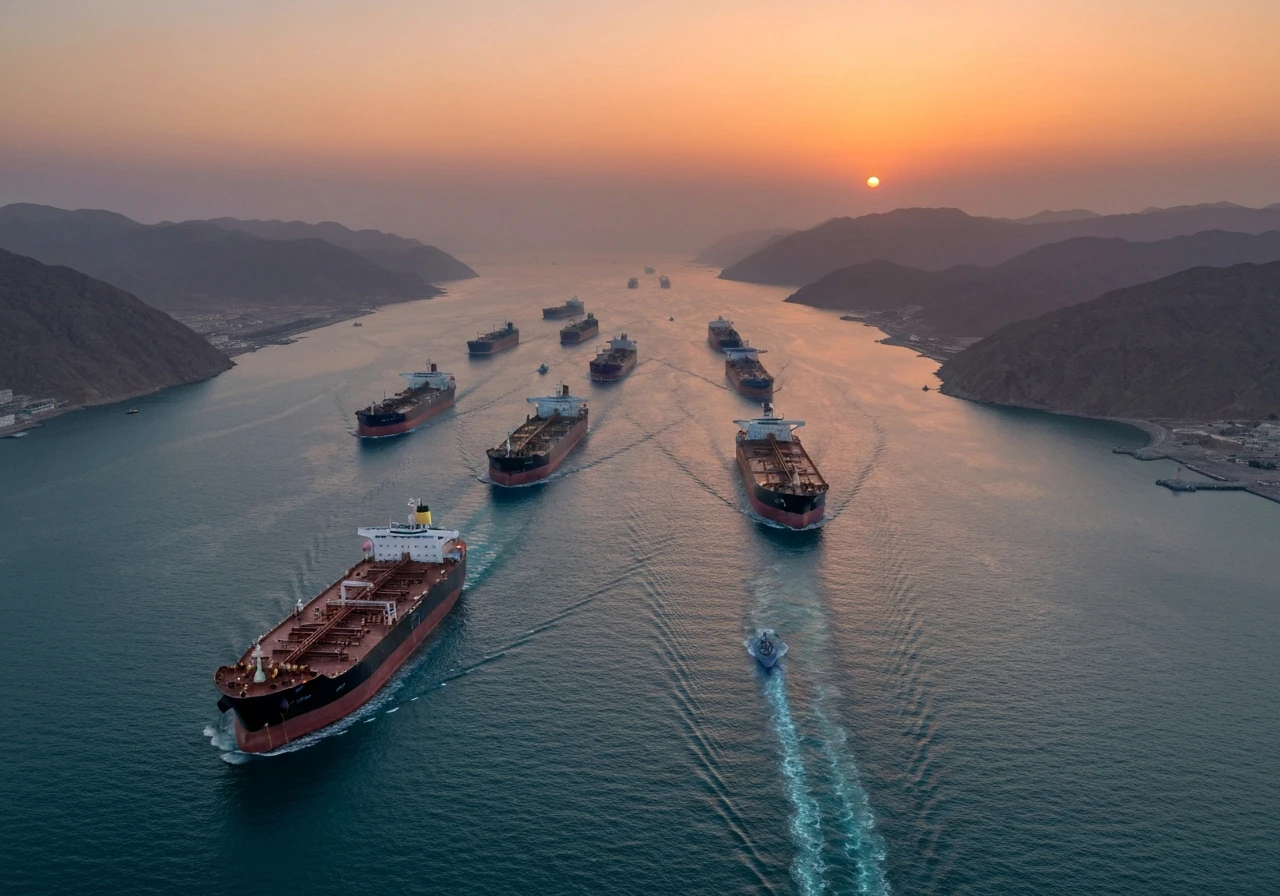
Why the Strait of Hormuz Sits at the Center
Every spasm in this conflict eventually points to one narrow waterway between Iran and Oman. The Strait of Hormuz is the busiest oil passage on earth, and any hint that Iran might close it sends Brent higher because so much barrelage has no other way out.
How Much Crude Moves Through
Oil flow through the strait averaged 20 million barrels a day in 2024, according to the Strait of Hormuz oil-flow data from the US Energy Information Administration (EIA, the statistics arm of the Department of Energy). That equals roughly 20% of global petroleum liquids consumption and more than a quarter of all seaborne oil trade. Around a fifth of the world’s liquefied natural gas, mostly from Qatar, takes the same route.
Who Depends on It
The buyers sit overwhelmingly in Asia. EIA figures show China, India, Japan, and South Korea took 84% of the crude and condensate that crossed the waterway, which is why a Gulf scare is felt fastest in refineries thousands of miles east of the fighting. The International Energy Agency tracks the same vulnerability in its work on the chokepoint’s role in oil security.
| Party | Role at the strait | Key figure |
|---|---|---|
| Saudi Arabia | Largest supplier shipping through it | 38% of Hormuz crude flows, about 5.5M b/d |
| Asia (China, India, Japan, South Korea) | Main destination | 84% of crude and condensate volumes |
| Qatar | LNG exporter using the route | Around 20% of global LNG trade |
Every Threat to Shut the Strait Has Failed
Iran has threatened to close the passage many times. It has never done it. The waterway has never been truly shut, not even during the 1980s Tanker War, when Iran and Iraq attacked oil ships during their eight-year conflict.
The record there is blunt. Even at its most violent point, that campaign disrupted less than 2% of the vessels moving through the Gulf, and the real price of oil drifted lower across the decade rather than higher, as documented in the 1980s Tanker War record kept by the University of Texas. Traders who lived through that, or read about it, treat a closure threat as a bargaining line rather than a plan.
Several structural reasons keep the oil moving even when the rhetoric peaks:
- Iran’s own crude exports leave through the same lane, so a full blockade would choke Tehran’s main source of cash
- The strait is wide and deep, which makes it hard for one country to seal off for any sustained period
- The US Fifth Fleet, based in Bahrain, patrols the Gulf and has cleared mines before
- Asian buyers and Gulf producers share a powerful interest in keeping cargoes flowing
What the Weekend Strikes Targeted
The military picture behind Monday’s move was real enough. US forces said they hit Iranian military sites over the weekend, aiming at air defenses, drone command facilities, and related infrastructure, after Iran allegedly shot down an American drone over international waters. Iran’s Revolutionary Guards answered by striking an air base used by US troops, and Kuwaiti air defenses intercepted incoming missiles and drones.
The exchange came with ceasefire talks going nowhere fast. Trump said Iran still wanted a deal, but the hard questions over regional security, sanctions, and maritime access remained unresolved.
There was a second front pulling at sentiment. Israel ordered troops deeper into southern Lebanon, widening its campaign against the Iran-backed group Hezbollah despite earlier ceasefire efforts. That escalation revived fears the conflict could spread and eventually reach energy infrastructure or shipping routes, even though no oil facility had been hit.
None of it changed the one number that counts for prices: actual barrels moving through the Gulf. Crude loadings inside the region have stayed depressed for weeks, but the cargoes that do sail are still sailing.
The Risk Premium Traders Are Still Pricing
Low-to-mid $90s oil is not a calm market. It carries a clear war premium, just a contained one, and analysts are split on whether it holds.
The market looks caught between short-term nerves over renewed hostilities and a lingering hope that both sides still have enough incentive to get energy flows moving.
That was Matt Britzman, senior equity analyst at Hargreaves Lansdown, summing up the standoff between fear and faith. Callum Macpherson, head of commodities at Investec, put the same idea more plainly, saying markets were “finding ways of muddling through for now” while it stayed “very hard for the markets to know how to react to all of this.”
The bear case for prices rests on supply that has not actually been lost and inventories that are already tight, a squeeze laid out in the case for draining global oil inventories. The bull case rests on the chance that the next strike lands on a port or a pipeline rather than a missile depot, which is why the premium has not vanished even as prices fell, a tension visible across recent moves around US-Iran talks and the Hormuz question.
If Israel’s push into Lebanon widens or Gulf loadings fall further toward a genuine shortfall, the premium rebuilds fast and Monday’s 3% looks like a down payment. If the ceasefire framework finally takes shape and tankers refill, the fade that defined the prior week simply resumes. For now, the tape is betting on the second outcome, and history is sitting on that side of the table.
Frequently Asked Questions
How much did oil prices rise after the US strikes on Iran?
Oil rose about 3% on Monday. Brent crude for August delivery gained 2.8% to $93.63 a barrel and West Texas Intermediate added 3.1% to $90.05, recovering part of the near 10% both contracts had lost the previous week.
How much of the world’s oil passes through the Strait of Hormuz?
Roughly 20%. Oil flow through the strait averaged 20 million barrels a day in 2024 per EIA data, equal to about a fifth of global petroleum liquids consumption and more than a quarter of all seaborne oil trade, plus around a fifth of global LNG shipments.
Has the Strait of Hormuz ever been closed?
No. The waterway has never been fully shut, not even during the 1980s Tanker War, when Iran and Iraq attacked ships. At that conflict’s peak, less than 2% of vessels passing through the Gulf were disrupted, and Iran depends on the same route for its own exports.
Why did oil fall nearly 10% the week before the strikes?
Prices dropped after Trump said he had called off an imminent wave of strikes to allow more time for negotiations, and reports of progress toward a US-Iran ceasefire framework raised hopes that traffic through the strait would normalize.
What could push oil prices higher from here?
An actual disruption to traffic through the Gulf, a strike on a port or pipeline rather than a military site, a wider spillover from Israel’s campaign in Lebanon, or a further drop in Gulf crude loadings toward a real supply shortfall would all rebuild the risk premium.
Disclaimer: This article is for informational purposes only and does not constitute investment advice. Commodity and energy markets are highly volatile and prices can move sharply on geopolitical events. Consult a qualified financial professional before making trading or investment decisions. All figures are accurate as of publication on June 1, 2026.
 ONGC licence frees Venezuela cash and operatorship talks
  Anthropic Hits $65 Billion Run Rate and Flips the AI Cash Test
  Supreme Court grounds the fare free-for-all with three-week clock
  Gold Nears $4400 as Soft Data Meets Oil Inflation Risk
  Nifty Slips as Zaggle Circuits and Dhoot Debuts Big
  Diesel Crack Tops $100 as Iran Rhetoric Lifts Crude