
 Ishan Crawford
 The Reserve Bank of India’s rate-setting panel meets from June 3 to 5, and almost nobody in the bond market expects the benchmark repo rate to move from 5.25%. The decision that will be read line by line sits elsewhere, in how the central bank now talks about a rupee at record lows and a reserve buffer that has shrunk by roughly $47 billion since late February.
Economists polled before the RBI Monetary Policy Committee (MPC, the six-member panel that sets interest rates) meeting expect the bank to lift its inflation projection toward 5% and trim growth to around 6.5%. Those revisions are the visible headline. The harder call for Governor Sanjay Malhotra is whether a currency he himself has described as undervalued is worth spending reserves to defend.
The Rate Decision Few Are Contesting
The repo rate has sat at 5.25% since the committee’s April meeting, when it kept a neutral stance and pencilled in consumer price index (CPI) inflation of 4.6% for 2026-27. Most forecasters see little reason for the panel to touch the rate when it announces its decision on monetary policy on June 5.
A cut is off the table while the rupee is sliding and imported costs are rising. Easing now would widen the gap with US interest rates and pile more weight on the currency. A hike, on the other side, would knock an economy that is already losing some momentum, which is why analysts treat it as an extreme step rather than a live option.
That leaves a hold dressed in cautious language. For all the focus on the number, the committee’s tone will do more work than its rate decision, and the market wants to know how worried the bank really is.
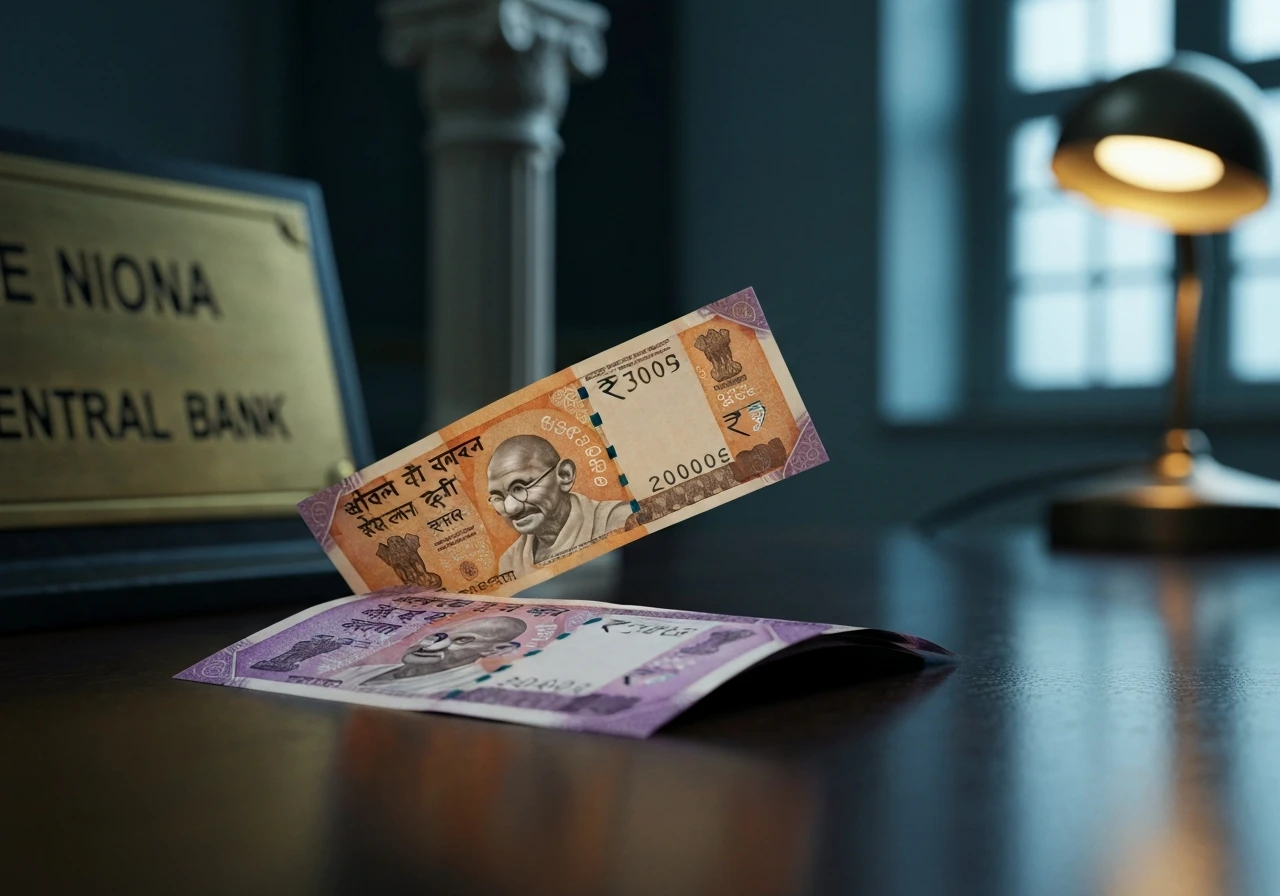
Forecasts Climbing Toward 5% as Growth Slips
The figures most likely to move are the forecasts. With the West Asia conflict now near its 100th day, the central bank can no longer treat the oil-price shock as short-term noise it can look through; the disruption has to enter both the growth and the inflation math.
Bank of Baroda expects the revisions to land without any move on rates.
We do not expect any change in repo rate or stance this time. However, the tone will be cautious, leaning towards being hawkish. We can expect RBI to increase its inflation forecast towards 5% and lower that for GDP to around 6.5% from 6.9%.
That was Madan Sabnavis, chief economist at Bank of Baroda, writing ahead of the meeting. The State Bank of India’s (SBI, the country’s largest lender) economic research desk goes further, putting full-year 2026-27 inflation at 5% to 5.1% with risks tilted up, and flagging that May’s imported inflation may have jumped to 7.3%. It pegs gross domestic product (GDP) growth at 6.6%, subject to revision as the geopolitical picture shifts. The table below sets the likely changes against the April projections; the World Bank’s India growth outlook still frames the year as positive even at the lower figure.
| Forecast (2026-27) | RBI’s April stance | June expectation |
|---|---|---|
| Repo rate | 5.25% | 5.25% (hold) |
| CPI inflation | 4.6% | ~5.0% |
| GDP growth | 6.9% | ~6.5% |
The Rupee Has Become the Meeting’s Pressure Point
The currency is where this meeting departs from routine. The rupee has slid in calendar 2026 to consecutive record lows, its sharpest run in more than a decade, and in an interview before the meeting Malhotra said one could argue the rupee “has become undervalued, both in nominal as well as in REER (real effective exchange rate, a trade-weighted measure against major partners) terms.” Such a comment on valuation is unusual for an RBI governor.
He paired it with a steadier line on the external account, calling the balance of payments situation “not an undue concern yet” even with crude prices pushed up by the conflict. The numbers behind the slide explain why the market is not fully reassured.
- 7.04% rupee depreciation against the dollar in calendar 2026, the worst in 13 fiscal years and steeper than the 2013 taper tantrum.
- 96.96 per dollar the all-time intraday low the currency touched in May.
- 6% an annual slide some economists now treat as the rupee’s new normal rather than a one-off.
A $680 Billion Buffer Drawn Down by $47 Billion
The cushion the bank would draw on is large, but it is no longer growing. India’s foreign exchange reserves stood at $681.4 billion in the week to May 22, a $7.5 billion fall in seven days, and are down by roughly $47 billion since late February even as the headline figure hovers near $680 billion.
That drop is the cost of defence. The bank has been selling dollars in the spot and forward markets, and a $5 billion dollar-rupee swap auction in May drew bids of about $9.8 billion, a sign of strong demand for the central bank’s currency-management tools.
Much of the outflow traces back to foreign portfolio investors (FPI, overseas funds in Indian stocks and bonds), who have pulled an estimated $17 billion to $18 billion this year as the US-India rate gap narrowed and tariff uncertainty lingered.
The reserve level still buys time. The weekly tally is published in the bank’s own weekly statistical supplement on reserve assets, and on import-cover terms it remains comfortable.
What economists warn against is leaning on it indefinitely. Sustained dollar selling during an external shock chips at reserve adequacy, and a buffer spent defending a level the market keeps testing can drain faster than it looks.
What a Balance of Payments Package Would Include
SBI’s research desk argues that intervention alone is the wrong tool for the job. It wants the reserves deployed in a calibrated way, mixing scheduled and surprise sales, sitting inside a wider balance of payments (BoP, the record of a country’s transactions with the rest of the world) package rather than standing in for one.
The components it sketches out are these:
- Calibrated reserve deployment that combines timely and surprise interventions to check excessive volatility.
- Selective capital controls to slow the most speculative outflows.
- Liquidity management to ease pressure inside the banking system.
- Policy nudges aimed at drawing in dollar inflows.
None of that is likely to appear in the June statement as hard measures. Sabnavis expects an explanation of currency developments rather than a specific foreign-exchange step. The package is the direction of travel that economists are urging, not the menu the bank has committed to.
Why a Weak Monsoon Sharpens the Inflation Risk
One more lever is tilting the wrong way. The India Meteorological Department (IMD, the national weather agency) cut its 2026 southwest monsoon forecast on May 29 to 90% of the long-period average, the bottom of the below-normal band, with a 60% chance of a deficient season.
The onset has also been slower than expected, and forecasters flag a risk of El Nino conditions developing during the season. Both add to the food-price worry, since a poor and patchy monsoon lifts the cost of staples that carry heavy weight in the CPI basket.
Stack that on top of dearer crude and a weak rupee, and the path back toward the bank’s medium-term target gets longer. That is the case for the hawkish hold the market is pricing.
If the rains recover and the rupee steadies through the summer, the cautious hold reads as caution well spent. If the monsoon disappoints and the currency keeps sliding, the same $680 billion that looks ample today starts to look like a number the market wants to test.
Frequently Asked Questions
When will the RBI announce its June 2026 policy decision?
On the final day of its three-day meeting that runs June 3 to 5. The MPC, headed by Governor Sanjay Malhotra, is widely expected to leave the repo rate unchanged and keep its neutral stance, with attention on the revised forecasts and the commentary on the rupee.
Why might the RBI raise its inflation forecast?
Three pressures point up: higher crude prices from the West Asia conflict, a weak rupee that lifts the cost of imports, and a below-normal monsoon that threatens food prices. SBI’s research desk sees 2026-27 inflation at 5% to 5.1%, with May imported inflation projected near 7.3%.
How much has the rupee fallen in 2026?
About 7.04% against the dollar in calendar 2026, the steepest decline in 13 fiscal years. The currency hit an all-time intraday low of 96.96 per dollar in May, and some economists now treat a 6% annual slide as the new norm.
Could the RBI cut interest rates later in the year?
It is possible if inflation cools and the rupee stabilises, but the near-term bias is hawkish. With imported costs rising and the currency under pressure, a cut would risk widening the rate gap with the US and adding to the rupee’s slide, so markets see no easing at this meeting.
 One UI 9’s Privacy Display Fix Reaches Just One Galaxy Phone
  Samsung Drops Its Own Exynos Chip for the Galaxy Watch9 and Ultra 2
  Marathon’s Vault Breaker Arrives as Bungie’s Bigger Bet Keeps Faltering
  Sony’s PlayStation Disc Cutoff Erases the Last Proof of Ownership
  Tesla’s Summer Update Hands Grok the Keys, and Musk’s Empire More Reach
  Apple’s $634 Million Masimo Payment Is Final After Appeal Denial