
 Ishan Crawford
 Two numbers say all you need about Monday’s session in Mumbai. India’s BSE Sensex closed at 75,315.04, up 77 points, and the Nifty 50 added 6 to 23,649.95 to settle flat. Both came back from a 330-point intraday plunge in the Nifty that lasted most of the day, until heavyweight IT names sprinted in the final two hours and pulled the indices off the floor.
The rupee told a different story. It slid to a record 96.39 against the dollar, its fifth straight session at an all-time low. Brent crude moved through $111 a barrel after Donald Trump, the US president, warned overnight that the clock was ticking on Iran, the kind of line oil traders read as ‘no ceasefire this week.’ That is the bar Indian equities have to clear when trading resumes.
Behind the Flat Close, a V-Shape and a Record Low
The Nifty 50 opened more than 160 points lower and fell to 23,317.10 in early trade. The selling came from Power Grid Corporation, off 3.69% to ₹294.55, Tata Steel down 2.97% to ₹210.41, and Maruti Suzuki down 2.18% to ₹12,933. Every one of those is a stock with a direct line to fuel costs, base metals, or both.
From the low, the Sensex recouped roughly 1,135 points before the closing bell. The recovery was led almost entirely by information technology shares, which rallied as the rupee sank. By 3:30 pm IST the headline indices were unchanged on the day, even though the wider market story had moved in two opposite directions at once.
Here is what the session actually printed.
| Indicator | Monday close | Move | Note |
|---|---|---|---|
| BSE Sensex | 75,315.04 | +77.05 / +0.10% | Recovered ~1,135 points from intraday low |
| NSE Nifty 50 | 23,649.95 | +6.45 / +0.03% | Intraday low 23,317.10 |
| Nifty IT index | up 2.43% | strongest sector | Tech Mahindra, Infosys top gainers |
| USD/INR | 96.39 | record low | Fifth consecutive all-time low |
| Brent crude (Jul futures) | above $111/barrel | ~+2% session, +8.1% week | Strait of Hormuz still effectively closed |
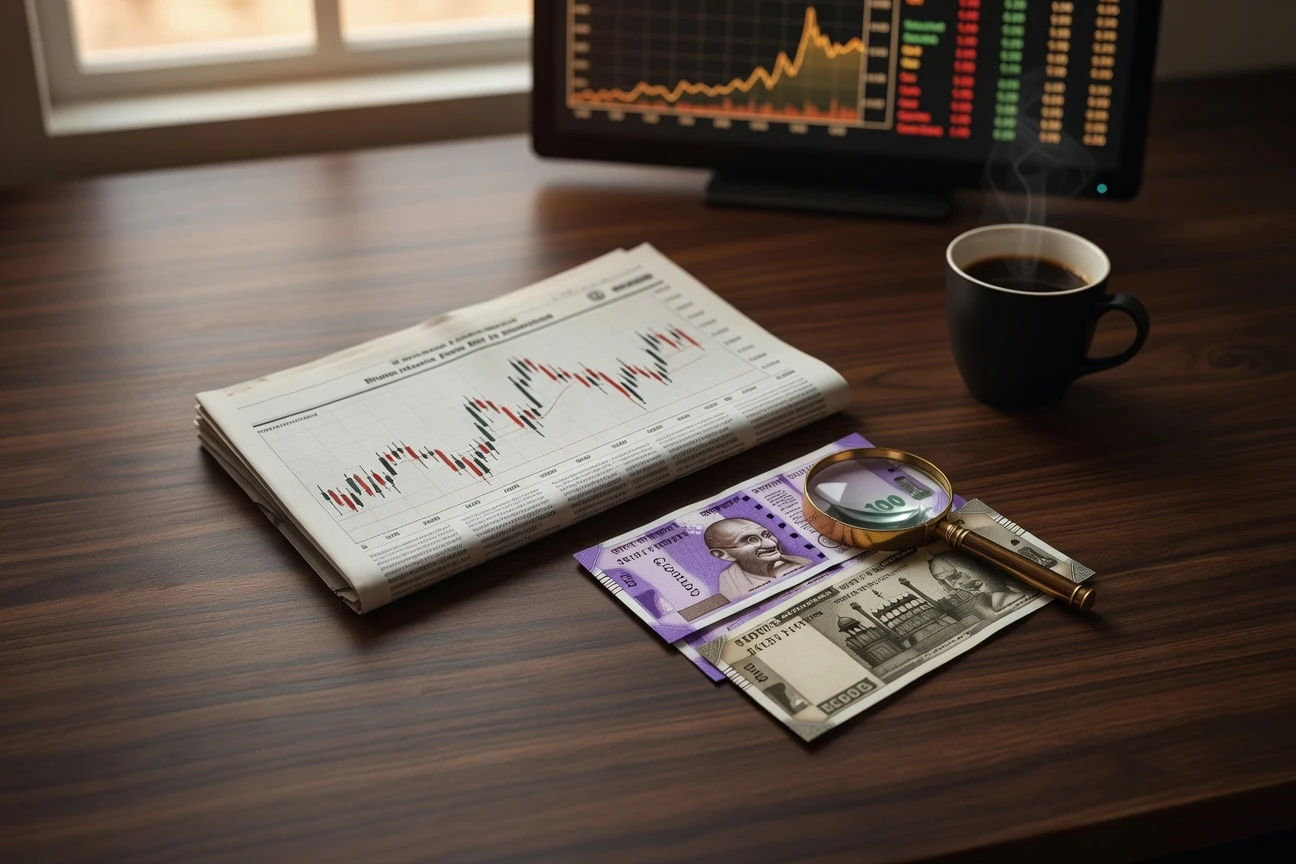
The IT Bid Was a Currency Trade in Disguise
The Nifty IT index closed up 2.43%, outperforming every other sectoral gauge on the National Stock Exchange. Tech Mahindra, Infosys, Bharti Airtel and Bajaj Finserv were among the top Sensex gainers. To an outside observer this looks like a bounce in an oversold sector, the IT pack having been hit last week on fresh worries about generative AI eating into outsourced services revenue.
That reading misses what actually moved buyers in the afternoon.
The Currency Math Behind the IT Bid
India’s top-five IT services exporters book the bulk of their revenue in US dollars and most of their costs in rupees. A weaker rupee mechanically lifts the rupee value of every dollar invoiced, with the gain dropping almost entirely to operating margin. Sell-side desks usually rule of thumb a 100 basis-point rupee depreciation as worth 30 to 40 basis points of operating margin on a one-quarter lag for the larger names.
So when the rupee printed 96.39 by lunchtime, a fund manager looking for a hedge against further oil-driven INR weakness had a ready trade. Buy Infosys, buy Tech Mahindra. The flows are visible in the price tape: IT outperformed the broader index by roughly 240 basis points on the day, almost exactly the move you would expect if the desk was running an FX overlay through the sector.
Crude Sensitivity Took the Other Side
What the IT bid covered up was a fairly violent rotation out of anything exposed to crude on the import side. Auto, PSU bank, media and consumer durables sub-indices all sold off. Oil marketing companies and airlines came in for fresh selling. Tata Steel’s 2.97% drop on a weaker Q4 print sat inside a broader metals weakness; Power Grid’s near 4% slide was tied to capex-cost worries as imported equipment prices reset higher against a falling rupee.
The headline flat close is the average of those two trades. It is not the picture of a calm market.
Trump’s Iran Post and the $111 Oil Bid
The catalyst for the morning sell-off arrived overnight on Truth Social.
For Iran, the Clock is Ticking, and they better get moving, FAST, or there won’t be anything left of them. TIME IS OF THE ESSENCE!
That was Trump, posting late Sunday US time as the administration waited on a response to its latest demand that Tehran hand over close to 400 kilograms of enriched uranium and confine nuclear work to a single site. Combined with a weekend drone strike on the Barakah nuclear power plant in the United Arab Emirates, the tone was enough to push Brent up another 2% in Asian hours and lock in a weekly gain of 8.1%.
Crude has now risen for three consecutive weeks. Brent and WTI are both up more than 45% since coordinated US and Israeli strikes on Iran opened the war on February 28, according to the International Energy Agency’s May Oil Market Report. The Strait of Hormuz, which carries roughly a fifth of seaborne crude and a third of seaborne liquefied natural gas, has been effectively shut for almost three months, the longest sustained disruption to the chokepoint in its modern history per the US Energy Information Administration’s chokepoint briefing.
Why $111 Brent Hits India Harder Than Anyone Else
India is unusually exposed to this specific price shock because it buys 88% of the crude it consumes from abroad and ships nearly half of those imports through the strait. The Indian crude basket already ran from $69 a barrel in February to a March peak of $157 before settling near the current $111 range.
The Import-Bill Arithmetic
The country’s published sensitivity is brutal in its simplicity. Every $1 sustained move in the Brent price changes India’s annual crude import bill by roughly $2 billion. The move from the pre-war $69 basket to Monday’s $111 print, if it holds for a full year, mechanically adds something on the order of $80 billion to the import bill before any rupee adjustment. With the rupee 5.5% weaker since the war began, the rupee cost of that bill is higher again.
The pressure has already shown up in real-time trade data. India cut crude imports by roughly 760,000 barrels a day in the most recent IEA reporting period as state refiners stretched stockpiles and switched to discounted Russian and Atlantic Basin grades where they could find cargoes at workable freight rates.
The Path to Headline CPI
Where this story moves from market price to political price is the consumer index. Work published by the Observer Research Foundation on the Hormuz disruption and Indian inflation sketched out the transmission channels India is now living through.
- Pump-price passthrough lifts transport and logistics costs across the rural-supply chain, with a lag of six to ten weeks.
- Fertiliser subsidy bills inflate as natural-gas-linked urea feedstock costs rise, with the fiscal impact concentrated in the kharif season.
- Imported edible-oil and pulses prices rise on freight, even where the underlying commodity has not.
- The current-account deficit widens, draining the rupee even before fund flows are added in.
None of those channels are operating at full force yet. Most show up in the print only a quarter after the spot move. That lag is exactly why the equity tape is not panicking today.
The Rupee at 96.39 Is the Session’s Loudest Number
The currency is doing the worrying that the index isn’t. At 96.39, the rupee is Asia’s worst-performing major currency this year and has lost roughly 5.5% against the dollar since the war began on February 28. Five straight sessions at fresh record lows is not a market in equilibrium; it is a market still searching for one.
The Reserve Bank of India has been visible in the spot market and has tightened import curbs on precious metals and tightened limits on speculative positioning, but the central bank’s bigger problem is the gap between its policy stance and its FX defence. Aggressive intervention drains rupee liquidity at the same time that a slowing domestic economy is asking for cuts. Several published forecasts now place the dollar-rupee at 100 if the conflict drags into the third quarter.
The same currency move that put a bid under Infosys is the move that is hollowing out fuel retailers, the airlines, and a fiscal arithmetic that depends on subsidy bills not breaking out. A Midwestern advisor recently described episodes like this as ‘things are on sale’ for long-horizon equity buyers, which is fair on the index, but says nothing useful about the currency or the inflation bill the index sits on top of.
What the Next Session Has to Price
Three things have to settle before Indian equities can put a real direction on the tape. Whether Iran formally responds to the US demand on enriched uranium handover, since the Trump warning was conditional on a clock the market cannot see. Whether the Strait of Hormuz situation evolves toward any kind of escort or convoy arrangement, since incremental loadings out of the Gulf would do more for crude than any peace headline. And whether the Reserve Bank moves from defending the rupee on the spot market to a formal step on rates or reserve requirements, since the current setup is unsustainable into a slowing growth print.
If the answer on all three is ‘not yet,’ the next session reopens with the same trade that ran Monday afternoon, a long-IT short-rest-of-market rotation that keeps the indices roughly where they are while the rupee and Brent do the visible damage. If even one of the three breaks the other way, Monday’s flat close will look like the cheapest exit anyone got all month.
 Jio Financial’s Profit Doubles as Wipro Posts a Q1 Miss
  New Toyota Hilux Teaser Reveals Bolder Look Before July 28 Launch
  Reliance Industries’ Q1 Surprise Is Hiding in Its Refining Numbers
  Apple’s Back to School Gift Cards Still Leave Students Paying More
  MG’s ADAPT Platform Hedges Its EV Bet With Hybrids and PHEVs
  NotebookLM Is Now Gemini Notebook, With New Power and New Confusion