
 Ishan Crawford
 Tata Capital reported consolidated net profit of ₹1,547 crore for Q1 FY27, up 56% from ₹990 crore a year earlier, while assets under management reached ₹2.90 lakh crore. Revenue from operations rose more than 15% and the lender simultaneously announced it will scale its newly acquired gold-loan book fivefold within three years.
The April-June numbers show operating leverage kicking in across retail, SME and housing even as the motor-finance clean-up continues. The Yogloans deal adds a high-frequency secured product that management expects to turn into a meaningful franchise.
Profit Rose Faster Than the Loan Book
Net interest income climbed 25% year-on-year to ₹3,571 crore. Net total income grew 23% to ₹4,455 crore. Pre-provisioning operating profit advanced 24% to ₹2,835 crore. The official release put consolidated PAT of ₹1,547 crore at a 56% increase, with sequential growth of about 3% from Q4 FY26.
Annualized return on assets improved to 2.3% from 1.8%. Return on equity rose to 13.7% from 12.5%. Cost-to-income ratio eased to 36.4% from 36.8%. Headcount rose only around 5% while AUM expanded 22%, a productivity signal management attributes to AI and digital tools in origination, underwriting and collections.
| Metric | Q1 FY27 | Q1 FY26 | YoY |
|---|---|---|---|
| AUM (₹ cr) | 2,90,502 | 2,37,508 | 22% |
| Ex-Motor AUM (₹ cr) | 2,66,057 | – | 28% |
| Net Interest Income (₹ cr) | 3,571 | 2,866 | 25% |
| PAT (₹ cr) | 1,547 | 990 | 56% |
| ROA (ann.) | 2.3% | 1.8% | +50 bps |
| ROE (ann.) | 13.7% | 12.5% | +120 bps |
| Cost-to-Income | 36.4% | 36.8% | improved |
Net loan book stood at roughly ₹2.81 lakh crore, up 23%. Unsecured retail remained contained at 10.3% of net AUM, keeping the overall book relatively conservative while still allowing margin room.
Credit Costs Fell and Stage-3 Ratios Tightened
Gross Stage 3 assets improved to 1.9% from 2.1% a year earlier and 2.0% in the prior quarter. Net Stage 3 stood at 0.8%. Provision coverage ratio was 56.9%. Annualized credit cost dropped to 1.0% from 1.6% in Q1 FY26.
Management guided full-year credit costs below 1.0%. Loan losses and provisions declined 26% year-on-year to ₹676 crore. The housing subsidiary showed even cleaner metrics: credit cost near 0.05%, GS3 at 0.7% and NS3 at 0.3%.
- GS3 1.9% (vs 2.1% YoY)
- NS3 0.8%
- PCR 56.9%
- Credit cost 1.0% annualized
Collection efficiencies stayed healthy and underwriting remained prudent, according to the company. Retail plus SME now form 85.4% of net AUM.
Yogloans Gives an Instant Southern Gold Platform
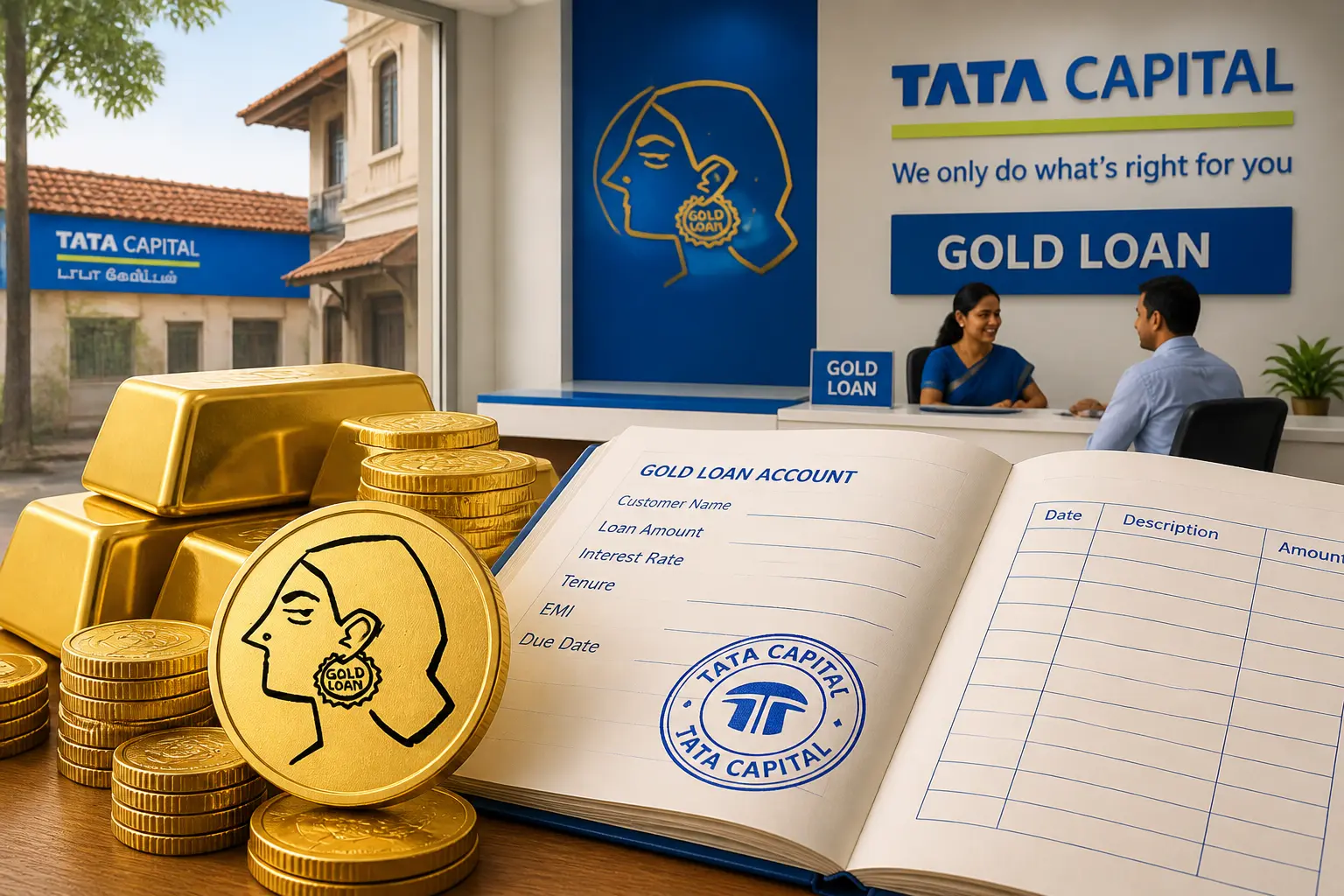
Alongside results, Tata Capital confirmed the acquisition of 88.6% stake in Yogloans, an RBI-registered NBFC focused on gold loans. The all-cash deal rests on a pre-money equity valuation not exceeding ₹318 crore plus a primary infusion of about ₹93 crore to fund growth. Closing remains subject to regulatory approvals, expected by calendar-year end.
Yogloans brought roughly ₹708 crore AUM as of March 2026, of which about 85% is gold loans, 162 branches across Kerala, Karnataka, Tamil Nadu and Andhra Pradesh, and more than 32,000 gold-loan customers. Promoter Unnikrishnan Idicharm Veetil stays on to lead the unit.
Our entry into the gold loan business marks an important step in further diversifying Tata Capital’s retail lending portfolio. This business complements our existing product suite and offers significant long-term growth potential, supported by increasing customer preference for high-frequency, secured credit.
Managing Director and CEO Rajiv Sabharwal made that comment in the results release. On the conference call he set an explicit target: grow the gold AUM to around ₹4,000-5,000 crore in three years, a fivefold rise, and expand the branch network toward 500. The company will overlay Tata Capital’s brand, funding advantage, technology stack and risk frameworks onto Yogloans’ operating know-how.
India’s gold-loan market has expanded sharply in recent years as households unlock jewellery for short-tenure credit. Specialists such as Muthoot Finance and Manappuram Finance still dominate, but a deep-pocketed, AAA-rated entrant with pan-India distribution changes the competitive map in the south and beyond.
Retail and SME Still Carry Most of the Weight
Home loans stood at ₹46,052 crore (15.9% of net AUM), growing 15% year-on-year. Loan against property reached ₹41,250 crore with 33% growth. SME AUM hit ₹80,567 crore. Corporate lending was ₹42,456 crore. Personal and business loans together were about 9% of the book. Motor finance, after the earlier merger with Tata Motors Finance, accounted for 8.4% at ₹24,445 crore and continues to shrink as the book is cleaned.
| Segment | AUM (₹ cr) | Share of Net AUM | Notes |
|---|---|---|---|
| SME | 80,567 | 27.7% | Strong growth engine |
| Home loans | 46,052 | 15.9% | +15% YoY |
| Loan against property | 41,250 | 14.2% | +33% YoY |
| Corporate | 42,456 | 14.6% | – |
| Motor finance | 24,445 | 8.4% | Still rightsizing |
| Unsecured retail | – | 10.3% | Contained risk |
Tata Capital Housing Finance, the wholly owned subsidiary, delivered AUM of ₹89,416 crore (+24% YoY) and PAT of ₹532 crore (+29%). Its ROE held at 18.4% and ROA at 2.5%. The unit now runs roughly 350 branches and balances prime, affordable and developer finance.
These core engines, not the new gold book, still drive the bulk of near-term earnings. Gold is additive and high-velocity once scaled.
Motor Finance Keeps Getting Smaller by Design
Motor AUM fell further from earlier peaks as the company de-risked after the Tata Motors Finance integration. Quarterly depletion slowed. The mix now emphasizes heavy commercial vehicles new, used vehicles and lighter commercial segments. Non-Tata OEM share of new disbursements rose to 28%. Branches were rationalized and headcount cut. Management still targets 2% ROA for the segment by FY28, with growth expected to resume later in FY27.
The group’s broader commercial-vehicle ambitions appear in the separate Tata Motors commercial vehicle roadmap, but Tata Capital’s own motor book is deliberately being put on a healthier footing first.
Balance Sheet Leaves Room to Grow
Total equity reached ₹46,237 crore. Capital adequacy ratio stood at 18.5%, comfortably above the 15% regulatory floor, with Tier I at 15.6%. Borrowings totalled about ₹2.45 lakh crore at an average cost of 7.3%. The funding mix remains diversified across banks, NCDs, ECBs/MTNs, NHB refinance and commercial paper. Liquidity buffer was ₹29,039 crore. Domestic ratings stay AAA stable; international ratings are BBB stable from S&P and Fitch.
The network now covers 1,491 branches across 27 states and union territories. Customer franchise is around 8.8 million. Digital onboarding, scorecard disbursements and digital collections all sit near 98-99%. More than 12,000 employees have received AI training.
Shares closed around ₹355 on results day, up more than 1%, and saw further strength in subsequent sessions. One brokerage, Nomura, reiterated Buy and lifted its target to ₹415, citing sustained growth and healthy asset quality. The pattern fits a broader results season that has also thrown up other large-cap Q1 earnings surprises.
Three-Year Path Looks Clearer After This Quarter
The next stretch rests on three simultaneous tracks. First, keep retail-SME and housing growing at the mid-20s pace while holding credit costs near current levels. Second, finish the motor clean-up so that segment stops being a drag and eventually contributes. Third, integrate Yogloans, inject the planned capital, roll out common systems and push the gold book toward the ₹4,000-5,000 crore target with several hundred branches.
If gold scales as planned it becomes a high-frequency, secured, relatively short-duration product that improves customer stickiness and fee potential without heavy unsecured risk. AI-driven productivity already shows in the opex line; that advantage should widen as volumes rise. External uncertainties remain, yet domestic credit demand and liquidity conditions stay supportive, Sabharwal noted.
Full Q1 FY27 investor presentation materials and the detailed press release are available on the company site. Execution on the gold integration and continued asset-quality discipline will decide how quickly the ROE moves further above 14% and whether the franchise compounds at the upper end of its guidance range.
Frequently Asked Questions
What were Tata Capital’s exact Q1 FY27 profit and AUM figures?
Consolidated PAT was ₹1,547 crore, up 56% from ₹990 crore. Net AUM stood at ₹2,90,502 crore, up 22% year-on-year; excluding motor finance the AUM was ₹2,66,057 crore, up 28%. Net interest income reached ₹3,571 crore and net total income ₹4,455 crore.
How is the Yogloans acquisition structured and valued?
Tata Capital is buying approximately 88.6% through a mix of primary capital infusion of about ₹93 crore and secondary purchase from existing shareholders. Pre-money equity valuation is capped at ₹318 crore. The deal is all-cash and remains subject to regulatory approvals expected by the end of calendar 2026. Yogloans’ March 2026 AUM was about ₹708 crore with 162 branches.
What gold-loan growth targets has management set?
On the post-results call, CEO Rajiv Sabharwal said the company aims to grow the gold AUM fivefold to roughly ₹4,000-5,000 crore over three years and expand the branch network toward 500 from the current 162, focusing first on identified southern states and then adding more.
How did the housing finance subsidiary perform in the quarter?
Tata Capital Housing Finance reported AUM of ₹89,416 crore (up 24% YoY) and PAT of ₹532 crore (up 29%). Annualized ROA was 2.5% and ROE 18.4%. Gross Stage 3 was 0.7% and credit cost just 0.05% annualized, among the cleanest metrics in the group.
What is Tata Capital’s current capital and liquidity position?
Total equity is ₹46,237 crore. Capital adequacy ratio is 18.5% (Tier I 15.6%). Liquidity buffer stands at ₹29,039 crore. Average cost of borrowings is 7.3% and the borrowings-to-equity ratio is about 5.3 times. Domestic ratings remain AAA stable.
Disclaimer: This article is for informational purposes only and does not constitute investment advice. Past performance is not indicative of future results. Consult a qualified adviser before making financial decisions.
 Scotland’s Facial Recognition Push Sparks Mask Ban Call
  Galaxy Z Flip 8 Hits $799 Only If Your Trade-In Qualifies
  If England Had Kept Water Public Like Scotland
  Samsung Smart Switch Now Moves Passwords and eSIM From iPhone
  Old Firm Spend Pulls Clear as Premiership Rivals Patch Squads
  Chinese Studios Quietly Seize the Gamescom Stage