
 Ishan Crawford
 TagEnergy has secured planning approval for its first two UK wind farms, adding 75MW of onshore capacity across Ayrshire and Caithness that can supply the equivalent of roughly 78,000 homes.
The 54MW Sclenteuch project and 21.5MW Cairnmore Hill site are two of four mid-stage developments the global clean-energy firm bought from RES in November 2025. RES stayed on to finish development to consent. The wins turn a portfolio purchase into shovel-ready generation at a moment Scotland still needs roughly another 10GW of onshore wind to hit its 2030 ambition.
The Farms, Turbines and Home Equivalents
Sclenteuch sits about 3km southwest of Patna in East Ayrshire. Nine turbines will deliver 54MW, enough renewable power for around 50,000 homes. Scottish Ministers granted consent in December 2025 through the Energy Consents Unit.
Cairnmore Hill lies near Thurso in Caithness. Five turbines will produce 21.5MW, matching the output needed for about 28,000 homes. The Highland Council refused a revised application in January 2025. A successful appeal to the Directorate for Planning and Environmental Appeals delivered approval in July 2026.
| Project | Capacity | Turbines | Homes equivalent | Key local forecast |
|---|---|---|---|---|
| Sclenteuch (Ayrshire) | 54MW | 9 | ~50,000 | £9.6m economic activity; >£29m business rates |
| Cairnmore Hill (Caithness) | 21.5MW | 5 | ~28,000 | £1.4m local investment; £8.75m rates over 35 years |
| Combined | 75MW | 14 | ~78,000 | Tailored community benefit packages both sites |
Both schemes sit outside major landscape or nature designations. Cairnmore Hill also targets a 16% biodiversity net gain and carbon savings of roughly 23,700 tonnes a year versus fossil generation.
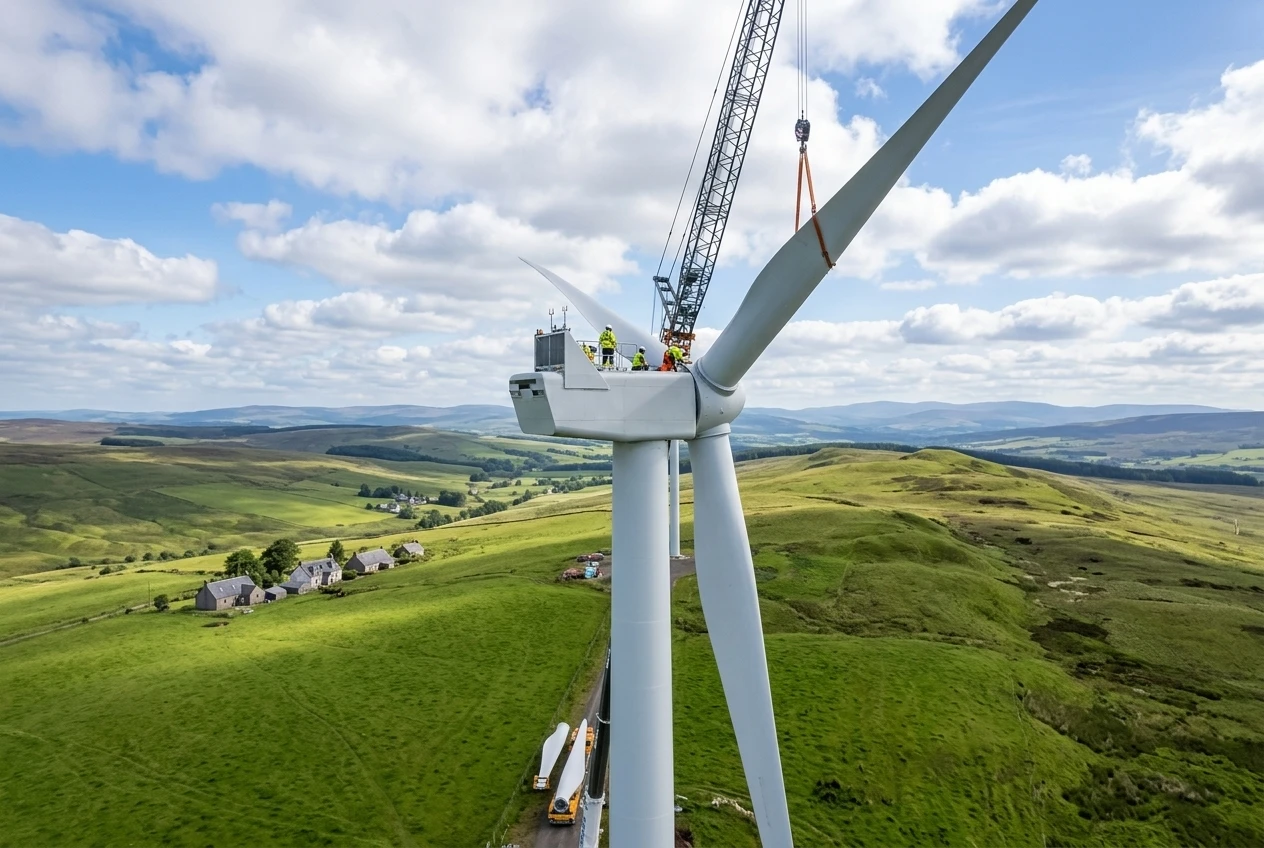
TagEnergy’s First UK Wind Move
In November 2025 TagEnergy acquired four mid-stage Scottish projects totaling nearly 270-300MW: Cairnmore Hill, Sclenteuch, Glenburnie in the Borders and Torfichen in Midlothian. The deal marked its first UK wind investment after building a 320MW operating battery storage portfolio across six sites.
CEO Franck Woitiez called the move a step toward becoming a multi-technology independent power producer. “Onshore wind is critical to delivering the UK’s clean energy future. It is one of the easiest and fastest technologies to build and deploy,” he said at the time. RES continues to supply development services, the same model used on earlier TagEnergy battery assets.
Managing partner UK Ricardo Folgado framed the latest consents in similar terms. The projects will contribute to generation and emissions goals “at a time when additional wind capacity is urgently needed.”
Cairnmore’s Path from Refusal to Consent
The Caithness scheme began larger. RES cut it from eight turbines to five after earlier feedback, aiming to ease landscape and visual concerns while holding generation capacity. Highland Council still refused the revised bid under delegated powers in January 2025.
RES lodged an appeal in May 2025. Over 200 support letters had already entered the planning file. The DPEA decision in July 2026 overturned the refusal.
- January 2025, Highland Council refuses redesigned five-turbine application.
- May 2025, RES submits Statement of Appeal to DPEA (case PPA-270-2316).
- July 2026, Scottish Government appeal body grants planning approval.
Euan Hogg, RES development project manager, said the outcome “reflects the quality of the project design and the careful work undertaken to address local considerations while maximising the potential for renewable energy.” The redesigned five-turbine Cairnmore Hill scheme kept its homes and rates forecasts intact.
What Local Areas Stand to Receive
Both projects carry tailored community benefit packages aligned with local priorities. The cash flows sit alongside construction jobs, supply-chain spend and long-term rates.
- Sclenteuch: £9.6 million ($12.8 million) of economic activity in Ayrshire via jobs and local spending; more than £29 million ($39 million) in business rates to South and East Ayrshire councils over the life of the farm.
- Cairnmore Hill: around £1.4 million ($1.9 million) inward investment; roughly £8.75 million ($11.7 million) in business rates across a 35-year operating life.
- Both: ongoing community benefit funds plus skilled roles during build and operations.
Jim Cameron of RES welcomed the Sclenteuch consent for unlocking investment and benefits for East and South Ayrshire. The pattern matches other recent Ayrshire projects, including other East Ayrshire wind developments that pair generation with local returns.
These projects will make important contributions to Scotland and the UK’s renewable energy generation and emissions-reduction goals at a time when additional wind capacity is urgently needed.
Ricardo Folgado, TagEnergy managing partner UK, said after the dual approvals.
Scotland’s Capacity Gap Remains Wide
Official figures show Scotland held just over 10.4GW of installed onshore wind by the third quarter of 2025. That fleet generated 4,440GWh in the quarter. The Scottish Government’s 2022 onshore wind policy statement set a minimum target of minimum 20GW of onshore wind by 2030.
The remaining gap is nearly 10GW. Consented and in-planning projects already total many more gigawatts, yet build rates lag. Onshore wind remains the single largest renewable technology in Scotland and the cheapest bulk generation option alongside solar. Fresh private capital entering via ready projects is one of the few levers that can compress timelines.
TagEnergy’s two consents add a modest 75MW, yet they prove the acquisition-plus-delivery model works. The firm already operates batteries that can firm intermittent wind. Pairing the two technologies inside one portfolio is the second-order shift these approvals quietly advance.
Capital, Pipeline and Local Power Needs
Two more farms from the original package, Glenburnie and Torfichen, remain in the development queue. Success on the first pair strengthens the case for pushing the rest forward. RES stays involved, keeping local knowledge and relationships intact.
Meanwhile electricity demand is rising. Data-centre proposals and industrial electrification are stacking new loads onto the grid. East Ayrshire itself is seeing interest in large digital infrastructure that will need firm clean supply, including a proposed rising power demand from data centers. Every consented megawatt of low-cost onshore wind reduces the pressure on more expensive or slower options.
Visual and landscape objections remain part of the Scottish conversation. Cairnmore Hill’s reduction from eight to five turbines and the package of rates and benefits show the practical bargain now required. National policy continues to treat onshore wind as essential. The DPEA route exists precisely so strategic projects can survive local refusal when design and public interest align.
The 54MW Sclenteuch Wind Farm near Patna and its Caithness counterpart now sit with full planning permission. Construction timelines will depend on final turbine choice, grid connection and financing, but the consent barrier is cleared. For TagEnergy the UK wind chapter has begun with two concrete assets rather than paper pipeline. For Scotland the 20GW clock keeps ticking, and every 75MW that crosses the line matters.
Frequently Asked Questions
What is the total capacity of the two TagEnergy wind farms approved in Scotland?
The combined capacity is 75MW: 54MW at Sclenteuch in Ayrshire and 21.5MW at Cairnmore Hill in Caithness. That is enough renewable electricity for the equivalent of about 78,000 homes once both are operating at their stated capacity factors.
Who owns the Sclenteuch and Cairnmore Hill wind projects?
TagEnergy holds 100% ownership after buying the four-farm package from RES in November 2025. RES continues to provide development services through to construction readiness under the same relationship used on earlier TagEnergy battery projects.
How did Cairnmore Hill receive planning approval after council refusal?
Highland Council refused the redesigned five-turbine application in January 2025. RES appealed to the Scottish Government’s Directorate for Planning and Environmental Appeals in May 2025. The DPEA granted consent in July 2026, recognising the scaled design and strategic renewable contribution.
What community payments are forecast from the two farms?
Sclenteuch is projected to generate £9.6 million in local economic activity plus more than £29 million in business rates. Cairnmore Hill is forecast to bring £1.4 million in local investment and £8.75 million in rates over 35 years. Both also carry separate tailored community benefit funds.
How far is Scotland from its 2030 onshore wind target?
Installed onshore capacity stood above 10.4GW in late 2025. The policy ambition is a minimum of 20GW by 2030, leaving a gap of nearly 10GW that must come from new builds, repowering and extensions already in the consented and planning pipeline.
 Scotland’s Facial Recognition Push Sparks Mask Ban Call
  Galaxy Z Flip 8 Hits $799 Only If Your Trade-In Qualifies
  If England Had Kept Water Public Like Scotland
  Samsung Smart Switch Now Moves Passwords and eSIM From iPhone
  Old Firm Spend Pulls Clear as Premiership Rivals Patch Squads
  Chinese Studios Quietly Seize the Gamescom Stage