
 Ishan Crawford
 India’s largest airline lost money for the first time in years, and it had almost nothing to do with how many seats it filled. InterGlobe Aviation, the parent of IndiGo, reported a net loss of ₹2,536.9 crore (about $260 million) for the March quarter, the marquee name on a long list of stocks to watch on Monday, June 1.
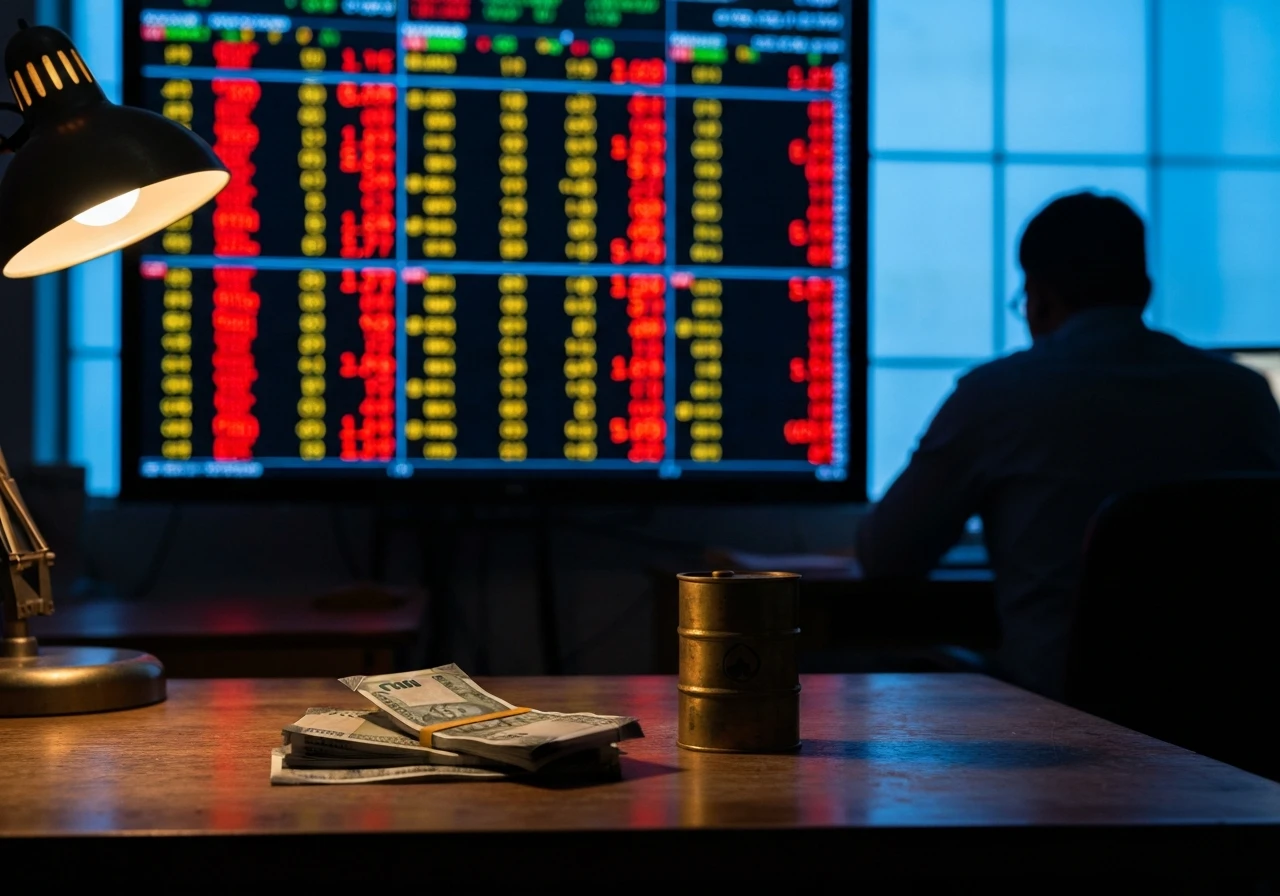
Scroll the rest of that list and the entries look unrelated: oil marketers, fast-food chains, a state steelmaker, a clutch of textile mills, a wind-turbine firm fighting its regulator. One force runs through most of them. A West Asia conflict that flared in March pushed Brent crude above $100 a barrel and dragged the rupee to a record low, and that single move is doing more to set the day’s tone than any one earnings line.
The Rupee and the Barrel Set the Mood
Trading opened on the back foot. The GIFT NIFTY futures pointed to the NIFTY50 starting about 23 points lower, a soft handover after a month in which the macro picture, not company results, called the shots. The trigger sits offshore. Iran’s pressure on the Strait of Hormuz, the chokepoint for roughly a fifth of the world’s seaborne oil, kept Brent above the $100 mark for much of May and revived fears of imported inflation in an economy that buys most of its crude abroad.
That fed straight into the currency. A weaker rupee makes every barrel, every dollar-priced lease and every imported input costlier, and foreign investors headed for the exit as US Treasury yields climbed. The selling was heavy and broad, hitting financials, metals and power names regardless of their individual books.
Here is the backdrop traders carried into Monday’s session.
- 96.96 per dollar – the level the rupee touched in May, a record low that lifts the cost of fuel, aircraft leases and imported raw materials across the board.
- ₹55,963.3 crore – net selling by foreign institutional investors during May, as higher US yields and oil-price risk pulled money out of Indian equities.
- Above $100 – where Brent crude held for much of the month, reviving worries about India’s current account and fuel-led inflation.
None of those numbers belongs to a single company. All of them shape how Monday’s list trades.
IndiGo’s ₹2,536.9 Crore Loss Was Booked on Paper
The airline’s headline number looks alarming until you read the second paragraph of the release. A year earlier, the same March quarter had delivered a net profit of ₹3,067.5 crore, so the swing is large. The cause is not the core flying business.
Where the Forex Hit Came From
The rupee slid around 5% against the dollar during the quarter, and that move produced a foreign-exchange loss of roughly ₹4,820 crore. Most of it is a mark-to-market charge tied to aircraft lease and maintenance liabilities that fall due over the next eight to ten years, money the carrier has not actually paid out. Strip the currency hit and the exceptional items, and the picture flips.
For the quarter ended March 2026, IndiGo reported a net loss of ₹25,369 million. Excluding the impact of foreign exchange and exceptional items, the company reported a net profit of ₹19,206 million.
That language came from the InterGlobe Aviation results statement. In plain terms, the operating airline made an adjusted profit of ₹7,502.5 crore for the quarter, while the reported line went red.
What the Core Airline Did
Underneath the forex noise, demand held up. Quarterly total income rose more than 3% to ₹23,830.7 crore, and for the full 2025-26 year, income grew 6.4% to ₹89,513.4 crore as capacity expanded 9.5%. The full-year reported number was still a net loss of ₹2,393.6 crore, again driven by the currency, against a would-be profit of the same scale once forex and one-offs are removed. So the question for the stock is simple: do you price the paper loss, or the cash-generating airline sitting behind it?
The Same Shock Reaches Fuel, Steel and Cement
IndiGo is the loudest example, not the only one. The crude spike and the soft rupee leave fingerprints across Monday’s list, and the direction depends on which side of the cost line a company sits. State oil marketers got a small cushion from a fresh commercial cooking-gas hike; the businesses that buy that gas did not.
The table below traces how one macro shock splits into very different outcomes.
| Company or sector | Transmission channel | Net effect |
|---|---|---|
| Indian Oil, BPCL, HPCL | 19-kg commercial LPG cylinder raised by about ₹42 in Delhi and up to ₹53.5 in some metros from June 1; domestic rates unchanged | Marginally positive; supports marketing margins on commercial gas |
| Hotels, restaurants, QSR chains | Higher commercial gas bills stacked on rising food input costs | Cost pressure; risk of dearer menus |
| SAIL (state steelmaker) | Limestone bought from Dubai; landed CFR cost rising from about $23-24 to roughly $35 per tonne | Higher input cost; per-tonne steel impact seen at ₹100-200 |
| Prestige Estates | Construction-material prices up after the March conflict | Margin pressure, though demand stays firm |
Real estate shows the tension cleanly. Prestige clocked record sales bookings of ₹30,024 crore in 2025-26, up 76% on the year, and chairman and managing director Irfan Razack told PTI the company is targeting up to 20% growth to ₹36,000 crore in pre-sales this fiscal. Razack also flagged that construction costs have climbed since the West Asia conflict began. Strong demand, fatter input bills: the same split that runs through the whole list.
Cotton’s Duty Window Hands Textiles a Tailwind
One corner of the market got an unambiguous gift. The Ministry of Finance exempted cotton imports from the entire basic customs duty and the agriculture cess for five months, from June 1 through the end of October, removing an effective levy of about 11% on the fibre. With domestic cotton prices still high, that lops a real chunk off raw-material costs for spinners and apparel makers.
The market read it instantly. Arvind jumped as much as 6.44% to a 52-week high of ₹502.25 on the NSE, with other counters rallying alongside as traders priced in zero basic customs duty on imported cotton through the peak buying months.
The names flagged as likely beneficiaries of the waiver include:
- Vardhman Textiles and Trident, large vertically integrated spinners exposed to cotton input costs
- Welspun Living and KPR Mill, home-textile and yarn players that import the fibre
- Arvind, Page Industries, Gokaldas Exports and Pearl Global Industries on the apparel side
The relief is real, and it is also temporary. The duty snaps back at the end of October, so the margin benefit has a clock on it from day one.
Earnings Cut Both Ways Below the Macro
Away from oil and the rupee, company results gave traders plenty to sort through, and they pointed in opposite directions. Consumer demand looked sturdy where pricing power exists, while the wind-energy pack showed how lumpy execution can be.
Asian Paints led the upside, posting a 69.15% jump in consolidated net profit to ₹1,185.49 crore for the March quarter, with revenue up 10.79% to ₹9,228.46 crore and domestic decorative volumes growing 12.4%. Patanjali Foods reported a 46% rise in net profit to ₹523.97 crore on stronger cooking-oil and food sales. Electric-bus maker Olectra Greentech more than doubled quarterly profit to ₹50.60 crore as revenue climbed 45%.
Not every print cheered. A quick scan of the mixed bag:
- Inox Wind saw quarterly net profit fall about 45% to ₹105.68 crore on higher expenses, even as its order book sat at 3.1 GW
- IREDA posted a marginal 1.77% dip in quarterly profit to ₹492.63 crore, yet flagged its highest-ever annual profit of ₹1,874 crore
- Two PB Fintech co-founders offloaded nearly a 1% stake in the Policybazaar parent for around ₹665 crore in open-market deals
The spread tells the story of the tape: results matter, but the macro overlay decides how far a good or bad number actually moves the price.
Suzlon’s SEBI Penalty Reopens an Old File
The day’s regulatory wildcard sits with Suzlon Energy. The company said it will move the Securities Appellate Tribunal (SAT, the forum that hears appeals against market-regulator orders) to challenge a penalty of ₹28.95 crore imposed on the firm, its promoters Vinod R Tanti and Girish R Tanti, and former chief financial officers, over alleged misrepresentation in financial statements between FY14 and FY18. The Securities and Exchange Board of India (SEBI, the country’s capital-markets regulator) passed the order on May 29, setting aside an earlier June 2025 ruling that had cleared the company without penalty.
Markets rarely like a reopened accounting file, however old, and the appeal means the matter stays live for months. If Brent eases back below the $100 line and the rupee steadies, the paper losses that buried IndiGo’s quarter unwind just as quickly and the cost squeeze on steel and cement loosens; if the conflict keeps the Strait contested through the summer, the cotton window will not be the last government lever traders start pricing into this list.
Disclaimer: This article is for informational purposes only and does not constitute investment advice. Securities markets carry risk, and share prices can move sharply on macroeconomic and company-specific news. Readers should consult a qualified financial adviser before making any investment decision. All figures are accurate as of publication on June 1, 2026.
 Scotland Reader Photos Capture Eclipse Week Beyond the Sky
  Scotland’s Rare World Cup Win Over Haiti Still Echoes
  Scottish Morning Roll Campaign Echoes Baguette Path to Unesco
  Samsung Passport Fold8 Turns Apple Fans Into Switchers
  Android’s Quiet Shift to Ambient AI Hardware This Week
  Poco F9 Leak Hands Global Buyers Less Battery for More Money