
 Ishan Crawford
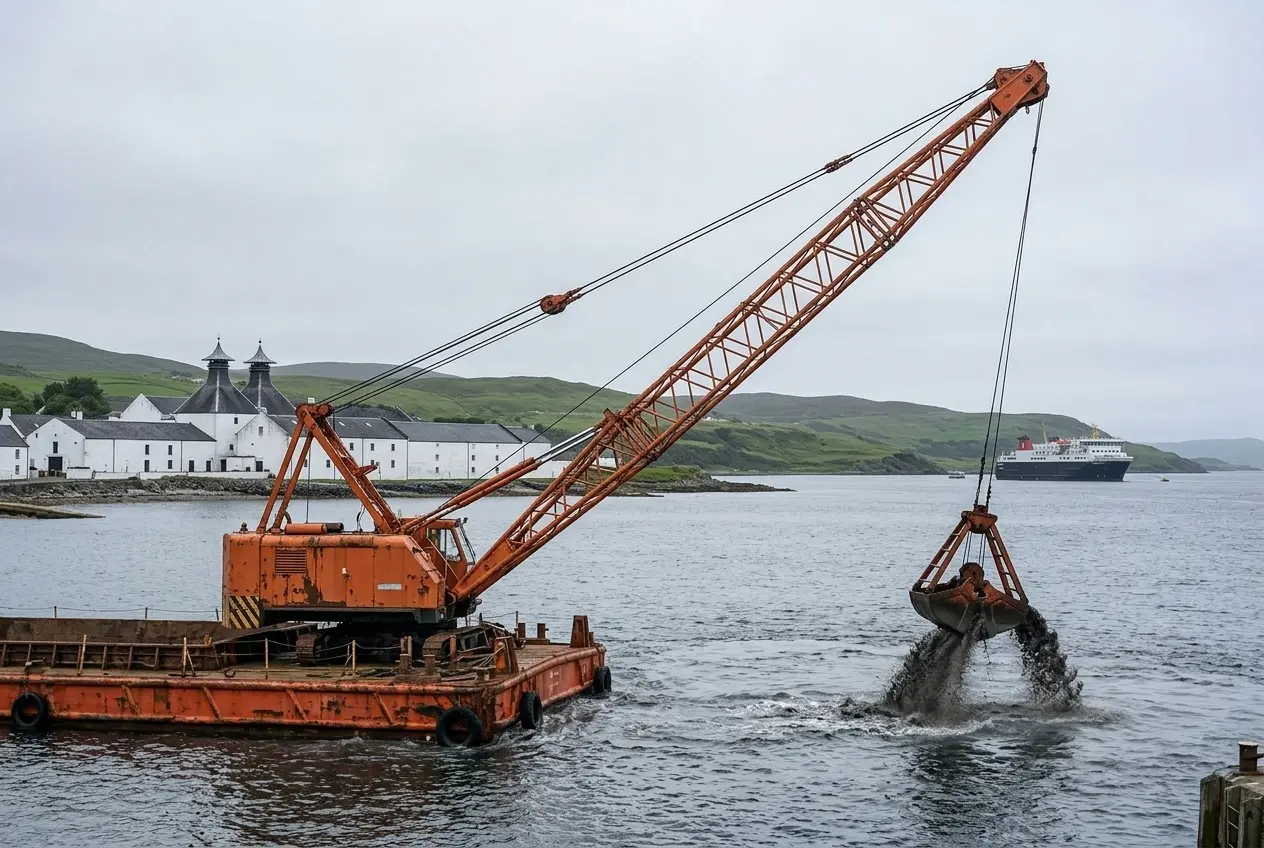
 Dredgers started churning up the seabed at Port Ellen this week, the first physical work in a £107 million (about $136 million) rebuild of Islay’s main ferry harbour. Caledonian Maritime Assets Limited, the Scottish Government-owned ferries agency known as CMAL, says detailed assessments confirm the work will not meaningfully change wave conditions, tides or flood risk in Port Ellen Bay. The new berth taking shape is designed around a class of ferry that has spent its first season in for repairs.
MV Isle of Islay arrived about fifteen months late, then lost weeks of service this summer to a broken bow ramp. Its unfinished sister ships needed an emergency payout just to keep their Turkish shipyard solvent enough to keep building them.
Dredgers Move Into Port Ellen Bay
CMAL confirmed the dredging is underway as part of the Port Ellen Terminal Development, the project meant to give Islay a permanent replacement for its ageing pier. The agency said the works have been carefully planned and are being carried out under approved licence conditions, with environmental controls and monitoring in place throughout.
Scottish Ministers granted marine licences for capital dredging under section 20 of the Marine (Scotland) Act 2010, covering roughly 20,100 square metres of harbour and seabed. The licence also allows the sea disposal of dredged material tied to the project.
That material is heading to the same licensed disposal site used during Port Ellen’s last pier reconstruction, back in 2011 and 2012. An alternative location came up during early stakeholder talks, but CMAL is sticking with the previously approved site, in line with the current licence. Disposal activities are logged and tracked throughout the programme, with post-completion surveys planned to confirm the work matched what was approved.
The licensing review also weighed the dredging’s effect on sediment movement and on local wildlife, including seals, basking sharks and maerl beds, delicate pink algae reefs that grow slowly along Hebridean shorelines. Residents may notice more marine traffic around the bay while the work continues.
The Berth Is Built for a Ferry Still Finding Its Feet
The whole redevelopment exists because of two ships CMAL calls the New Islay Vessels, or NIV. Cemre Shipyard, a Turkish shipbuilder in Yalova, won the contract to build them in March 2022. The public later chose the names through a public vote, picking Isle of Islay and Loch Indaal from a shortlist tied to the islands’ landscape and history.
Isle of Islay was handed over to CMAL in mid-January 2026, roughly fifteen months behind its original October 2024 target. She reached Greenock in late February after a stormy five-week delivery voyage from Turkey, then entered service on the Kennacraig to Islay route on March 31.
The debut didn’t last. Within about three months, the ferry was pulled from service over a faulty bow ramp, the mechanism vehicles use to drive on and off. CalMac had to fall back on the smaller Isle of Arran, which carries just 55 cars against Isle of Islay’s 100, squeezing capacity during peak tourist season. CalMac, the ferry operator that leases its ships from CMAL, has since lodged about 150 warranty claims against Cemre over defects on the vessel.
| Vessel | Shipyard and Contract Year | Entered Service | Status as of Mid-2026 |
|---|---|---|---|
| MV Isle of Islay | Cemre, Turkey (2022) | March 31, 2026, about 15 months late | Sidelined this summer by a bow ramp fault; part of roughly 150 warranty claims |
| MV Loch Indaal | Cemre, Turkey (2022) | Not yet in service | Most complete of the remaining ships; ownership already paid in full |
| MV Lochmor and MV Claymore | Cemre, Turkey (2023, £115m) | Not yet in service | Still under construction; ownership also transferred early |
| MV Glen Sannox | Ferguson Marine (2015) | January 2025, six and a half years late | In service on the Arran route after a troubled build |
Every ship on that list is meant to be part of the same fix. So far, none of them have made it through their first year without a serious complication.
CMAL Pays the Full Price Before the Ships Are Done
Three weeks ago, CMAL disclosed it had paid in full and taken legal ownership of the three remaining Cemre-built ships, Loch Indaal, Lochmor and Claymore, even though none of them are finished. The agency called it a precautionary step tied to what it described as challenging economic circumstances at the shipyard.
It’s an unusual move. Shipbuilders are normally paid in a series of instalments, with the final payment withheld until a finished vessel is delivered. Taking ownership early means CMAL, and by extension the Scottish taxpayer, could still complete the ships itself if Cemre were to collapse before finishing them.
Taking ownership of the vessels at this stage is a precautionary move to reduce risk, protect the investment already made and support our objective of bringing these vessels into service as quickly and efficiently as possible.
Kevin Hobbs, CMAL’s chief executive, said in the statement explaining the decision. CMAL and Cemre signed two contracts worth about £200 million in 2022 and 2023 for the four ferries combined.
What We Know
- CMAL has paid in full for Loch Indaal, Lochmor and Claymore despite none being finished
- CalMac has raised roughly 150 warranty claims against Cemre since Isle of Islay’s delivery
- Dredging at Port Ellen is proceeding under a granted marine licence with monitoring in place
What’s Unconfirmed
- Whether Cemre can finish the remaining three ships without further financial support
- Exact delivery dates for Loch Indaal, Lochmor and Claymore, all described only as due “shortly”
- Whether Port Ellen’s terminal will meet its original completion target now that work started later than first planned
Islay’s Second Big Ferry Promise in a Decade
This isn’t the first time a CMAL vessel order has gone sideways. MV Glen Sannox, built at the state-owned Ferguson Marine yard in Port Glasgow, was ordered in 2015 and entered service on the Arran route in January 2025, six and a half years late. Her sister ship, Glen Rosa, was still under construction as of this year.
The Cemre ships were supposed to be the safer bet, a more conventional, non-experimental design built overseas on a fixed contract. Instead, Scotland hit an even bigger pileup this spring. In late March, CalMac warned of what it called an unprecedented situation, with up to eight major vessels out of action at once, hitting routes to Arran, Barra, Coll, Colonsay, Islay, Mull, South Uist and Tiree simultaneously.
A CalMac circular sent to affected communities at the time put it plainly: the network had been under sustained pressure for years, and the situation it faced that week might have been the most difficult yet. Islay’s ferry committee has raised similar frustrations before, warning that reduced capacity during peak season causes real damage to a tourist and whisky economy that depends on the boats running.
What the Dredged Harbour Will Actually Hold
Set against that backdrop, the physical scope of the Port Ellen project is genuinely large. CMAL awarded the £107 million redevelopment contract to McLaughlin & Harvey, with Mott MacDonald acting as engineering consultant. The scheme has been in planning since 2021.
- A new dedicated ferry berth with fendering and bollards sized for the NIV hulls
- A new linkspan and fixed ramp to speed loading and unloading
- Shore power charging so docked ferries can shut down their engines
- A larger terminal building for passengers and staff
- A commercial quay roughly four times longer than the current one, with separated cargo areas
- Electric vehicle charging bays, bicycle facilities, and upgraded lighting, CCTV and fencing
CMAL says the new vessels themselves will bring close to a 40 percent increase in vehicle and freight capacity on the Islay routes once they are all running reliably, along with lower emissions from their diesel-hybrid propulsion. Port Ellen is one piece of a wider £580 million ferry investment programme that Transport Scotland has described as covering some of the busiest freight routes in the Clyde and Hebrides network.
When Will Ferries Actually Use the New Terminal?
Construction on Port Ellen’s new terminal began in June 2026, after Islay’s whisky festival, Fèis Ìle, wrapped up in late May. CMAL has not published a fresh completion date, though early planning documents had targeted a finish by December 2026, a deadline set well before the redevelopment contract was even signed.
Under that original plan, ferry sailings would divert through Port Askaig for most of the construction period, while grain deliveries and fishing vessel access at Port Ellen continue. CMAL has not said whether that arrangement has changed.
Islay’s ferry committee says it is tracking the works the way most residents are, from the harbour wall, watching the dredgers move back and forth across the bay.
Frequently Asked Questions
What Is the New Islay Ferry Built to Carry?
The Cemre-built vessels are roughly 95 metres long, with capacity for 107 cars and 275 lane metres of HGV space across their main and hoistable decks. They run on a diesel-hybrid propulsion system designed to cut emissions compared with the ferries they replace.
Why Are the New Ferries Called Isle of Islay and Loch Indaal?
CMAL put a shortlist of names tied to Islay and Jura’s landscape and history to a public vote. Isle of Islay and Loch Indaal won, with Loch Indaal launched at the Cemre shipyard in June 2024, a few months after her sister ship.
Could Cemre Shipyard Collapse Before Finishing the Remaining Ferries?
CMAL has not said the shipyard is insolvent. It described its decision to pay in full and take early ownership of the three unfinished ships as a precaution specifically so it could still complete them itself, using another yard if necessary, should Cemre be unable to finish the job.
Will Ferry Sailings Be Disrupted During the Port Ellen Works?
Under CMAL’s original construction plan, most sailings were to be rerouted through Port Askaig for the bulk of the build, while deliveries of grain and access for fishing vessels at Port Ellen continue throughout.
What Happens to the Sediment Once It’s Dredged?
It goes to a licensed disposal site last used during Port Ellen’s 2011 to 2012 pier works. CMAL says disposal activity is recorded and tracked for the duration of the programme, with post-completion surveys to confirm the work matched the approved licence.
 Scotland’s Facial Recognition Push Sparks Mask Ban Call
  Galaxy Z Flip 8 Hits $799 Only If Your Trade-In Qualifies
  If England Had Kept Water Public Like Scotland
  Samsung Smart Switch Now Moves Passwords and eSIM From iPhone
  Old Firm Spend Pulls Clear as Premiership Rivals Patch Squads
  Chinese Studios Quietly Seize the Gamescom Stage