
NEWS
OpenAI’s Navier-Stokes Proof Walks Through a Forced Door
OpenAI posted a Lean-checked Navier-Stokes blowup with a smooth force, Clay statements C and D, and said it will not claim the $1 million prize.

OpenAI said on September 8 that an internal model had proved a finite-time blowup for the three-dimensional Navier-Stokes equations with a smooth force. The company posted an analytical proof and a Lean formalization and said it will not claim the $1 million Millennium Prize.
The Clay Mathematics Institute still labels the Navier-Stokes Equation unsolved. The proof OpenAI is selling as a solution walks through the two official options that already allow an outside push on the fluid.
We’re sharing a solution to the Navier-Stokes Millennium Prize Problem, one of the deepest problems at the frontier of mathematics.
The proof was produced by a group of agents, using an OpenAI next-generation model significantly more capable than GPT-6 Astra.
The problem… pic.twitter.com/8zol3BPTL4
— OpenAI (@OpenAI) September 8, 2026
OpenAI Took the Door That Allows a Force
Charles Fefferman’s official writeup of the prize problem is not one riddle. It is a short menu. One pair of options asks whether every smooth, divergence-free initial velocity, with no external force, stays smooth forever. Another pair asks whether there exist smooth initial data and a smooth force for which the solution breaks down in finite time.
OpenAI says its system proved that an initially smooth fluid at rest can form a singularity in finite time, that a smooth force is applied, and that the energy stays finite all the way to the blowup. The company says that result establishes statement C and also D in the official formulation.
CLAY’S FOUR DOORS, AND WHICH ONE OPENAI CLAIMS
| Statement | Domain | External force | OpenAI claim |
|---|---|---|---|
| A | Whole space R3 | None (identically zero) | Not claimed |
| C | Whole space R3 | Smooth force allowed | Breakdown with bounded energy |
| D | Periodic torus | Smooth force allowed | Breakdown |
That is still a valid prize path. The Clay rules say a resolution of Navier-Stokes in either direction is eligible. It is not the version most people hear, which is whether water or air can tear itself apart with no one pushing.
Jean Leray showed in 1934 that solutions exist in a weaker sense. The smoothness question then sat for decades and was named a Millennium Prize problem in 2000. OpenAI dates the open question at roughly 90 years. Only one of the seven prize problems had been solved before this week, the Poincaré conjecture, and Grigori Perelman declined that million-dollar award.
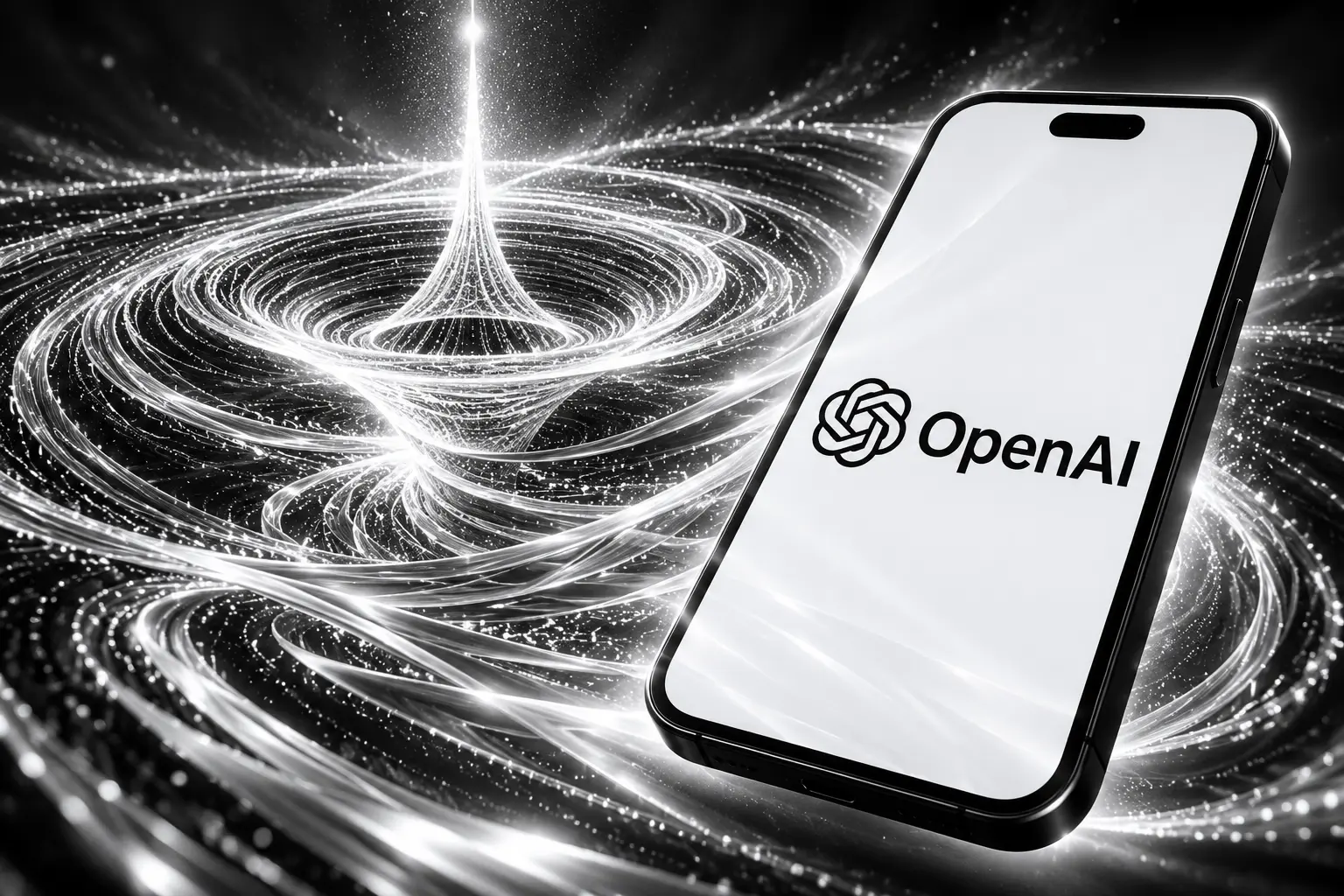
The Blowup Is a Stretching Vortex
The object in the proof is concrete. OpenAI describes a vortex, a spinning swirl that spirals inward and gets longer, “like spaghetti.” The core shrinks and speeds up while the energy stays finite, which is the constraint the equations themselves impose.
The hard part, the company wrote, is getting the breakdown from the fluid’s own motion rather than by inserting an infinite force by hand. Acceleration, pressure, momentum transfer, and viscosity all have to get large and cancel in a tight way, leaving a smooth external force even as the velocity grows without bound.
A real fluid cannot move infinitely fast. If the continuum equations blow up, the model has left the physics and you would have to track particles. Aircraft design, weather codes, and blood-flow models already run on approximations that never wait for this theorem. The claim, if it holds, is about the equations, not about tomorrow’s forecast.
Timothy Gowers, a Fields Medal winner who said he had not yet read the proof, called the result “undeniably a big moment.”
10,000 Agents and 130 Billion Tokens
The run was a compute event as much as a math event. OpenAI said it had been training a new internal model since August 28, a system it calls significantly more capable than GPT-6 Astra, with training still going. On September 1 it heard rumors that two Millennium problems had been resolved and pointed that model at the remaining prize list.
THE NAVIER-STOKES RUN
- Agents: The group on Navier-Stokes used on the order of 10,000 concurrent agents, with isolation and monitoring that OpenAI says it uses on all frontier evaluations.
- Wall clock: The agents reached a resolution on Saturday, September 5, about 88 hours after the first agents launched, then spent 17 more hours on Lean work via GPT-6 Astra.
- Tokens: The Navier-Stokes effort sent 2.7 million messages and used about 130 billion output tokens. Across every attempted problem the totals were 4.9 million messages and about 300 billion output tokens.
- Bill: Mark Chen, OpenAI’s head of research, put the compute cost in the millions of dollars.
The agents could read a cached copy of the internet and run code. Separate groups got versions A and B (a proof of smoothness) and versions C and D (a disproof). They also got easier cousins. One of those was the Euler equations, Navier-Stokes with the viscosity term stripped out.
Nearly 100 agents worked about 50 hours on unforced Euler and, OpenAI says, found a blowup there first. The lab then moved agents off other prize problems, fed them the Euler result, and updated them when a further-trained checkpoint came in. Codex was used to merge useful fragments across groups.
HOW THE WEEK UNFOLDED
- August 28, 2026: OpenAI starts training the new internal model on math and other benchmarks.
- September 1, 2026: After rumors of prize-level work, the lab launches multi-agent runs on open Millennium problems.
- September 5, 2026: The Navier-Stokes group reports a resolution, about 88 hours after launch.
- September 6, 2026: Lean verification finishes. OpenAI contacts Tristan Buckmaster and Levent Alpöge.
- September 8, 2026: OpenAI posts the manuscript and Lean repo. Buckmaster and Alpöge post their own blowup papers the same day.
The public code is on GitHub as Lean 4 formalizations of the results, built with Lean 4.34.0-rc2 and Mathlib, licensed Apache-2.0. The project claims a complete formalization of the main theorems with a sorry count of zero. Its own metadata lists the review status as self-assessed. Anyone can run lake build. That is a machine check of the formal file, not a journal referee.
Buckmaster and Alpöge Spent a Year on That Path
The forced route is not a random door. NYU mathematician Tristan Buckmaster and Levent Alpöge, a mathematician on staff at Anthropic, had been pushing a program opened by Diego Córdoba and Luis Martínez-Zoroa: finite-time blowup under smooth forcing, first on cousin equations, then toward Navier-Stokes.
Buckmaster wrote that options C and D “is the route Luis and Diego opened and the one Levent and I had quietly chosen to attack,” and that almost nobody else he knew was on it. Their collaboration, he said, was personal, not an Anthropic project. They used a mix of models, including Anthropic’s Claude and OpenAI’s Codex, and kept drafts in Codex sessions.
WHAT THEY POSTED ON SEPTEMBER 8
- Incompressible porous media: Finite-time blowup with smooth forcing.
- Boussinesq: The same conclusion for that two-dimensional system.
- Three-dimensional Euler: Smooth, forced blowup for incompressible Euler, with Lean files posted alongside the papers.
They did not post a full Navier-Stokes prize proof. Buckmaster said they likely also had a hypo-dissipative Navier-Stokes blowup and were holding it for Lean. August 15 is the date he gives for their Euler and Boussinesq breakthroughs.
I am not accusing anyone of anything. I am stating what I was told, when, and what was proposed to me.
Tristan Buckmaster, professor of mathematics, NYU, in Buckmaster’s posted statement
Buckmaster’s posted statement says he emailed OpenAI on September 3 to kill a rumor that Anthropic had solved a prize problem, then took two Sunday calls with Sebastien Bubeck, who leads OpenAI’s math work. Alpöge was not on those calls. Buckmaster says he was told an internal model had a roughly 100-page forced Navier-Stokes proof, that human input had been slight, and that the first prompt had gone out only in the past few days, after word of their work reached the lab.
He says that account of a bare problem statement came apart on the call: a team had been on it, Euler had been used as a warm-up, and even the displayed prompt had been written by prompting Codex. He asked whether the model had been trained on their private Codex sessions. He says he was told the model does not look up user data, and that he never got a clear answer on training.
Bubeck Says He Never Asked to Cut Their Paper
OpenAI’s writeup says the effort began September 1 after a rumor the lab later tied to Alpöge and Buckmaster. After Lean verification on September 6, believing they also had Navier-Stokes, the company says it offered a joint announcement, then learned they had forced Euler. “We recognize the priority of their work on forced Euler,” the post says.
The lab says researchers and agents did not see the pair’s work by any means until it was public, and that no specific user data was accessed to solve this problem. In the next sentence it leaves a hole: “While unlikely, we cannot rule out that de-identified data derived from their usage of our products helped improve our models.” It also says the proofs differ, and that even the Euler statements differ (forced versus unforced).
Bubeck told reporters the team did not see the pair’s work until it was released, and that agents were not pointed with the pair’s prompt or proof. “I thought there must be a mistake somewhere,” he said of the internal result. “And on Sunday morning we had the final solution, Lean-formalized and everything.”
WHERE THE TWO ACCOUNTS DIVERGE
- Authorship: Buckmaster says Bubeck twice wanted Alpöge dropped because he works at Anthropic, and that two publication plans were offered, including one in which Buckmaster alone would write up OpenAI’s Navier-Stokes proof.
- Bubeck’s version: He says he never asked that Alpöge be removed from authorship of Alpöge and Buckmaster’s own Euler work. He says the remark was about a possible rewrite of OpenAI’s Navier-Stokes proof, where an Anthropic employee as author felt inappropriate, especially after Anthropic models had been used on Euler.
- The career line: Buckmaster quotes, “Why would you ruin your career?” and “If you don’t want me to be nice, then I don’t have to be nice.” Bubeck says he was asking why someone would risk a career over accusations he calls unfounded, that the wording was a poor choice, and that he retracted it on the spot.
Sam Altman, OpenAI’s chief executive, wrote that he spent much of the weekend with the team and that Bubeck and the others “acted with integrity and generosity throughout.” He said the lab first believed the other team had also solved Navier-Stokes, wanted a joint release, then offered to let them go first and even suggested they should be the ones to get the prize. He said the approaches now look different, and that OpenAI tried the problem because of rumors that Anthropic’s models had solved a millennium question.
I never ever asked for Levent to be removed from authorship of his own work (as indicated by my text). I was surprised to learn during the call with Tristan that they had only solved Euler and not Navier-Stokes.
Sebastien Bubeck, OpenAI researcher, on X
Ravi Vakil, president of the American Mathematical Society, and John Meier, the society’s chief executive, put the human chain in order: Navier, Stokes, Leray, Ladyzhenskaya, then Córdoba and Martínez-Zoroa, then Alpöge and Buckmaster with new tools, “with the final steps taken by OpenAI mathematicians.” They added that the purpose of mathematics is human understanding. Steve McCormick, a mathematician answering OpenAI’s announcement post, asked why Buckmaster and Alpöge were not named in the main tweet that claimed the result.
The live objection among people who actually read Fefferman is narrower than lab gossip. It is whether a forced blowup, reached after a rumor about a year-long attack on that same obscure path, should be narrated as an isolated model that simply ate the prize statement. The Codex asterisk is what makes that objection stick. Anyone who parks unpublished drafts in a lab’s coding tool now has to treat those logs as part of the scientific record the lab might later train on.
Why Clay Still Lists the Problem as Unsolved
None of the press-conference language moves the Clay needle by itself. The institute’s page for the Navier-Stokes Equation still carries the word Unsolved. Martin Bridson, president of the Clay Mathematics Institute, said the evaluation is “deliberately unhurried” and that the institute will keep it “absolutely rigorous.”
OpenAI is not waiting for that process. “We do not intend to claim the Millennium Prize for this result,” the company wrote. It framed the post as a snapshot of model progress, not a culmination.
WHAT A PRIZE FILE ACTUALLY REQUIRES
- A qualifying outlet: A refereed mathematics journal of worldwide repute, with a named board, a real refereeing process, and MathSciNet listing, unless Clay later relaxes the test.
- Two years: After that publication, at least two years have elapsed of “rigorous examination” by the global community, as Clay judges it.
- Acceptance, then a panel: Clay must find general acceptance, then may name at least three readers, two of them experts on the problem, before it awards, splits, or withholds the million dollars.
- Prior insights: Clay says it will pay special attention to whether a solution depends on earlier published ideas, and may put those authors in the citation or the award.
A company blog and a GitHub repo do not start that clock. Direct submissions to Clay are not accepted. Completeness is Clay’s call alone, and the rules even let the institute decide that no prize will be paid if it cannot settle correctness or credit. For Navier-Stokes, a resolution in either direction still has to survive that machine.
So the public now has a 165-page blowup manuscript, a Lean project that claims statements C and D, a competing set of forced Euler papers, and a training-data sentence OpenAI cannot close. The unforced smoothness question, Fefferman’s statement A, is not part of the claim. The Clay page still reads Unsolved. OpenAI is not asking for the million dollars. Independent mathematicians have the vortex, the Lean files, and a two-year journal bar in front of them.

The BMW iX4 Undercuts Mercedes and Trails Its Twin

Scotland’s Ten Big Supermarkets Already Hold the Weekly Shop

Scotland EMS Faces a State Probe After a Wagram Death

Meritz Signs Ripple to Race Korea’s 2027 Token Rules

Pocognoli’s First Camp Leaves Scotland Third and Exposed

Volkswagen Sells the Osnabruck Plant to Clear a Board Fight

Tata Motors’ Iveco Tender Opens as Holders Still Decide

Saksham Gaur Finds He Is His Own Company’s Client

Onimusha Way of the Sword Preload Hits a Windows 11 Wall

Apple’s Foldable iPhone Hinges on Samsung Display Supply
-
 AUTO1 month ago
Volkswagen Sells the Osnabruck Plant to Clear a Board Fight
-
 AUTO2 months ago
Tata Motors’ Iveco Tender Opens as Holders Still Decide
-
 BUSINESS2 months ago
Saksham Gaur Finds He Is His Own Company’s Client
-
 GAMING2 months ago
Onimusha Way of the Sword Preload Hits a Windows 11 Wall
-
 NEWS2 months ago
Apple’s Foldable iPhone Hinges on Samsung Display Supply
-
 AUTO2 months ago
Simple Wave Chases Range as Ather Konarc Cuts Price
-

 NEWS1 month ago
The Frame Pro’s $1,200 Labor Day Cut Needs a Soundbar
-

 NEWS2 months ago
iQOO 16 Locks 8,400 mAh While 100W Charging Holds