
 Ishan Crawford
 Nvidia reported second-quarter revenue of $96.2 billion, more than double the year-earlier total, and projected roughly 70 percent growth for fiscal 2028, well above the roughly 45 percent analysts had modeled. The same demand surge that produced the numbers is already lifting memory prices enough to squeeze gross margins and pulling the company deeper into customer financing arrangements that some call circular.
Shares closed down 1.6 percent at $209.66 on August 26 before climbing about 4 percent in after-hours trading once Chief Financial Officer Colette Kress delivered the longer-term outlook. Investors have grown used to beats. Nvidia has now topped sales estimates for 16 straight quarters, yet the stock has often slipped the following session.
That pattern frames the entire print. The beat itself was large, but the market treated the longer guide and the margin path as the real variables. Absolute profit remains vast even as percentage margins bend. The tension between those two facts runs through every section of the report.
Record Quarter Tops Every Major Line
The quarter ended July 26. Total revenue rose 18 percent from the prior quarter and 106 percent from a year earlier. Data center revenue reached $89.0 billion, up 117 percent year over year and 18 percent sequentially, driven by Blackwell Ultra. Non-GAAP diluted earnings per share came in at $2.22. Gross margin held at 75.0 percent.
| Metric | Q2 FY27 Actual | Street Estimate | YoY Change |
|---|---|---|---|
| Total revenue | $96.2 billion | ~$92.2-92.5 billion | +106% |
| Data center revenue | $89.0 billion | ~$85.8 billion | +117% |
| Non-GAAP EPS | $2.22 | ~$2.09-2.10 | +120% |
| Non-GAAP gross margin | 75.0% | ~75% | +2.5 pts |
Hyperscale customers contributed $48.7 billion while the AI Clouds, Industrial and Enterprise group added $40.3 billion, up 25 percent sequentially and 138 percent year over year. Edge computing brought in $7.2 billion. Nvidia returned about $26 billion to shareholders in the quarter and still held roughly $99 billion of remaining repurchase authorization. For the current quarter the company guided revenue to $108 billion plus or minus 2 percent, with gross margins near 74 percent, and explicitly assumed zero data-center compute sales from China.
The hyperscale and ACIE split shows how the dollars still concentrate even as the second category grows faster on a percentage basis. Edge remains a smaller slice, yet it keeps the product map from reading as pure training clusters alone. The buyback authorization left after the $26 billion return signals management still sees the balance sheet as a tool for capital return alongside the build-out spend.
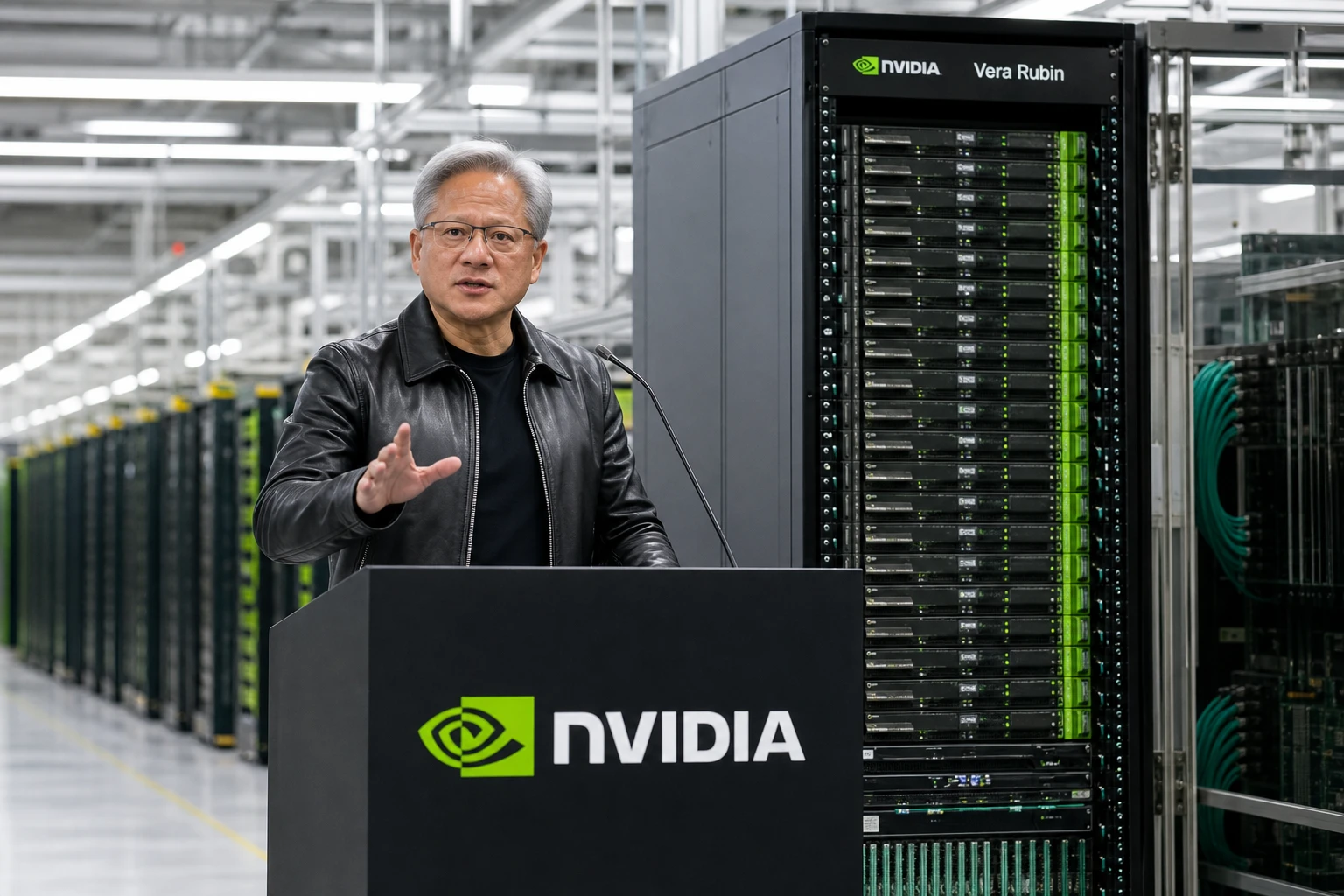
Founder and CEO Jensen Huang framed the moment in the release: “AI has reached its inflection point. It’s doing useful work. Its tokens are productive and profitable. Now, compute is revenue.” He added that demand is accelerating and that Vera Rubin, now in full production, “was built to power exactly this moment.”
AI has reached its inflection point. It’s doing useful work. Its tokens are productive and profitable. Now, compute is revenue. And demand is accelerating. The AI infrastructure buildout is at full steam. Vera Rubin, now in full production, was built to power exactly this moment.
Jensen Huang, founder and CEO, NVIDIA newsroom release
Huang’s line equating compute with revenue is the thesis behind both the 70 percent call and the willingness to stretch financing support. If tokens already pay for themselves, buyers have a clearer case to keep ordering even when component costs rise and payment terms stretch.
The 70 Percent Call and What Supply Still Blocks
Kress told analysts the company expects to grow revenue by approximately 70 percent in fiscal 2028. That figure is supply-constrained. Customer forecasts, she said, point to growth doubling next year if more components were available. “Incredibly, we are seeing demand acceleration even at our scale,” she said. Huang noted the company currently has supply to meet only about 70 percent of demand.
Vera Rubin is expected to account for roughly 20 percent of data-center revenue already in the third quarter. The company also highlighted broadening beyond the largest hyperscalers into sovereign AI, neo-clouds and enterprises. Yet the long guide arrives against a backdrop of investors who have treated outperformance as the baseline rather than a surprise.
The gap between the 70 percent guide and the doubling that customers say they could absorb is the clearest measure of how tight the component chain remains. Meeting only about 70 percent of demand means the printed outlook is a floor set by parts, not a ceiling set by orders. That framing also explains why Vera Rubin’s early mix share matters: each point of new architecture shipped is a point of constrained demand converted into revenue.
- Now: supply covers about 70 percent of demand.
- Q3: Vera Rubin steps up to roughly 20 percent of data-center revenue.
- FY28: company guide calls for about 70 percent revenue growth, still described as supply-limited.
Sovereign AI, neo-clouds and enterprises widen the buyer list on paper. In practice they still compete for the same scarce accelerators and memory. The broadening story and the shortage story are the same story told from two ends of the order book.
Memory Prices Turn Extreme and Margins Bend
The same acceleration that supports the 70 percent outlook is driving memory costs higher than Nvidia itself expected. Kress said the magnitude of the price increases has exceeded prior expectations and is headed still higher into next year. Tighter memory supply, she stressed, is a symptom of the identical demand surge powering Nvidia’s own growth.
- Q2 gross margin: 75.0 percent, held flat sequentially on Blackwell mix.
- Q3 guide: roughly 74 percent, plus or minus 50 basis points.
- Expected trough: 71 to 72 percent in the fiscal fourth quarter ending January.
- FY28 settlement: 72 to 73 percent once Nvidia’s own price increases take fuller effect.
Nvidia has notified customers it is raising product prices to offset the component inflation. Inventory rose to support the Vera Rubin ramp. The memory crunch also lifts the fortunes of suppliers such as SK Hynix, Samsung and Micron, whose own capacity expansions still lag demand by years. For Nvidia the immediate effect is a temporary margin reset even while absolute profits remain enormous.
The path from 75.0 percent down through the 71 to 72 percent trough and back toward 72 to 73 percent is management’s attempt to show the squeeze as timed and reversible. Price increases on Nvidia’s own products are the intended bridge. Until those increases land fully, the company is absorbing part of the memory inflation in the gross margin line while still printing record absolute profit.
Inventory built for Vera Rubin is both a ramp cost and a hedge against further component tightness. The same tightness that bends Nvidia’s margin percentage is what keeps SK Hynix, Samsung and Micron pricing power elevated for years rather than quarters.
Financing Deals Grow Alongside the Chips
To keep the build-out moving, Nvidia has expanded its role beyond selling accelerators. Supply commitments rose to $279 billion from $119 billion the prior quarter, primarily for memory procurement. Total commitments across supply, cloud agreements, data-center leases, equity investments and capital spending reached $366 billion. The company also disclosed AI-cloud agreements and data-center leases for third parties totaling another $56 billion, plus land-power-and-shell guarantees whose maximum exposure now stands at $108.5 billion, including a large phased arrangement tied to SB Energy’s Ohio campus that will host OpenAI infrastructure.
| Commitment Type | Amount |
|---|---|
| Supply commitments | $279 billion |
| Total commitments (supply, cloud, leases, equity, capex) | $366 billion |
| AI-cloud agreements and data-center leases for third parties | $56 billion |
| Land-power-and-shell guarantees (max exposure) | $108.5 billion |
Kress addressed the criticism directly: “We recognize the scale of this support, and we know some will call this circular financing. We see it differently.” The company has lined up partners including Apollo, BlackRock, Blackstone, Brookfield, Goldman Sachs and KKR with the aim of mobilizing more than $500 billion of third-party capital over time. Equity investments focus on model makers and infrastructure financiers. Nvidia has also lengthened payment terms for certain large investment-grade customers, and five customers accounted for a higher share of receivables than a year earlier.
These arrangements sit alongside earlier earlier OpenAI data-center guarantee talks and announcements such as SpaceX AI deployment on Nvidia platforms. Critics argue the structure creates artificial demand; Nvidia counters that the deals simply unlock once-in-a-generation infrastructure that would otherwise stall on balance-sheet limits.
The jump in supply commitments from $119 billion to $279 billion is mostly memory. That single line ties the financing section back to the margin section: Nvidia is locking supply so customers can keep building, then raising its own prices so the memory inflation does not permanently own the gross margin. Lengthened payment terms and higher receivables concentration are the working-capital face of the same choice.
Partner names from Apollo through KKR are the bridge to the more than $500 billion third-party capital target. Equity stakes in model makers and infrastructure financiers put Nvidia on both sides of selected deals, which is precisely the feature critics flag and the company defends as necessary scaffolding.
Customer Base Widens While Concentration Persists
Nvidia has pushed hard to show it is less dependent on a handful of tech giants. The ACIE category’s sequential jump and the inclusion of sovereign and enterprise buyers support that claim. Yet hyperscalers still dominate the absolute dollars, and the receivables concentration underscores how much volume still flows through a short list of names. Custom silicon efforts by those same customers, including OpenAI’s recent Jalapeño processor claims, remain a longer-term share risk even if near-term GPU demand stays robust.
China remains a constrained market. Shipments of Hopper products there were less than 1 percent of data-center revenue in the quarter, and the third-quarter outlook assumes none. Washington has limited export licenses while Beijing keeps a tight rein on purchases. Building a durable position there is viewed as both a growth path and a way to keep domestic Chinese chipmakers from gaining further ground.
The ACIE sequential gain and the sovereign-enterprise push are real. They do not yet overturn the dollar dominance of hyperscalers or the receivables pattern that shows five customers mattering more than a year ago. Diversification here is directional, not complete.
- Hyperscalers still supply the largest absolute revenue block at $48.7 billion.
- ACIE at $40.3 billion is the faster-growing percentage story.
- China Hopper shipments stayed under 1 percent of data-center revenue, with Q3 guided at zero.
- Custom silicon such as OpenAI’s Jalapeño effort is the longer-cycle share question.
On China, the less-than-1-percent Hopper print and the zero assumption in the $108 billion guide remove any near-term dependence on that market from the model. The strategic case for staying engaged still runs through the risk of ceding ground to domestic Chinese chipmakers, not through current revenue.
How Price Pass-Through Meets the Memory Tax
The margin trough guided for the fiscal fourth quarter is the accounting expression of memory costs moving faster than Nvidia’s own list prices. The company has already told customers that product prices are going up. The FY28 band of 72 to 73 percent is the numerical claim that those increases will eventually catch the component inflation.
Until they do, absolute profit can keep rising on volume while the percentage margin dips. That combination is unusual enough that management spelled out the sequence in public: hold near 75 percent, guide 74 percent, trough at 71 to 72 percent, then settle higher once pricing lands. Investors who treat every quarter as a pure margin story will read the next two prints as deterioration. Investors who follow the pass-through logic will read them as a timed reset.
The same demand surge that lifts SK Hynix, Samsung and Micron is the surge that forces Nvidia into this sequence. Memory is both proof of demand and a tax on the seller of the accelerators that consume it. Price pass-through is the attempt to keep the tax from becoming permanent.
Third-Party Capital Becomes Part of the Model
Mobilizing more than $500 billion of third-party capital is no longer a side project. It sits in the same sentence as the $366 billion commitment stack and the $108.5 billion land-power-and-shell exposure. Without outside balance sheets, the customer set that can absorb Vera Rubin and Blackwell volumes shrinks to those who can fund campuses unaided.
Kress’s pushback on the circular-financing label concedes the optics while rejecting the conclusion. The company’s view is that the infrastructure would stall on buyer balance-sheet limits if Nvidia and its partners did not extend support. Critics reverse the causal arrow and call the support a source of demand rather than an unlock. Both readings start from the same disclosed numbers; they differ on what those numbers imply for the quality of the 70 percent growth rate.
Lengthened payment terms for investment-grade customers and the rise in receivables concentration are the quiet counterparts to the headline guarantees. They move working capital risk onto Nvidia’s sheet in exchange for keeping large buyers on schedule. The more than $500 billion third-party target is the attempt to push most of that risk back out to Apollo, BlackRock, Blackstone, Brookfield, Goldman Sachs, KKR and peers over time.
What the Numbers Already Price In
Nvidia’s official release listed revenue of $96.2 billion up 106% as the headline. The fiscal 2028 70 percent call is the clearest signal yet that management believes the AI infrastructure cycle has further to run, constrained mainly by parts rather than orders. At the same time the company is openly guiding investors through a multi-quarter margin trough caused by the very memory inflation that validates demand, and it is expanding the financial scaffolding that lets cash-constrained buyers keep building.
The stock’s muted immediate reaction fits the recent pattern: beats are expected, so the market focuses on the quality and durability of the next leg. Whether the financing structures and price pass-throughs fully offset the memory tax, and whether third-party capital continues to flow at the required scale, will determine how cleanly the 70 percent growth materializes into free cash flow. For now the numbers show an industry still sprinting, with Nvidia both supplying the chips and helping underwrite the factories that will use them.
Sixteen straight quarters of topped estimates have reset the bar. The after-hours bounce on the long guide shows what still moves the stock: not another beat, but evidence that supply, pricing and outside capital can carry the cycle far enough for the 70 percent path to turn into cash.
 Hyderabad Gold Dip Freezes Buying as Duty Talk Hits Wedding Season
  India Pushes Japan CEPA Review After 15 Years of One-Way Gains
  HDFC Bank’s US Class Action Turns Deposit Scheme Into Securities Reckoning
  Gold Holds Above $4600 as Treasury Buybacks Fuel Debasement Bid
  Scotland’s Prevention Push Leaves Community Groups Squeezed
  Amazon Locks Three Million Nvidia GPUs Even as Trainium Grows