
 Ishan Crawford
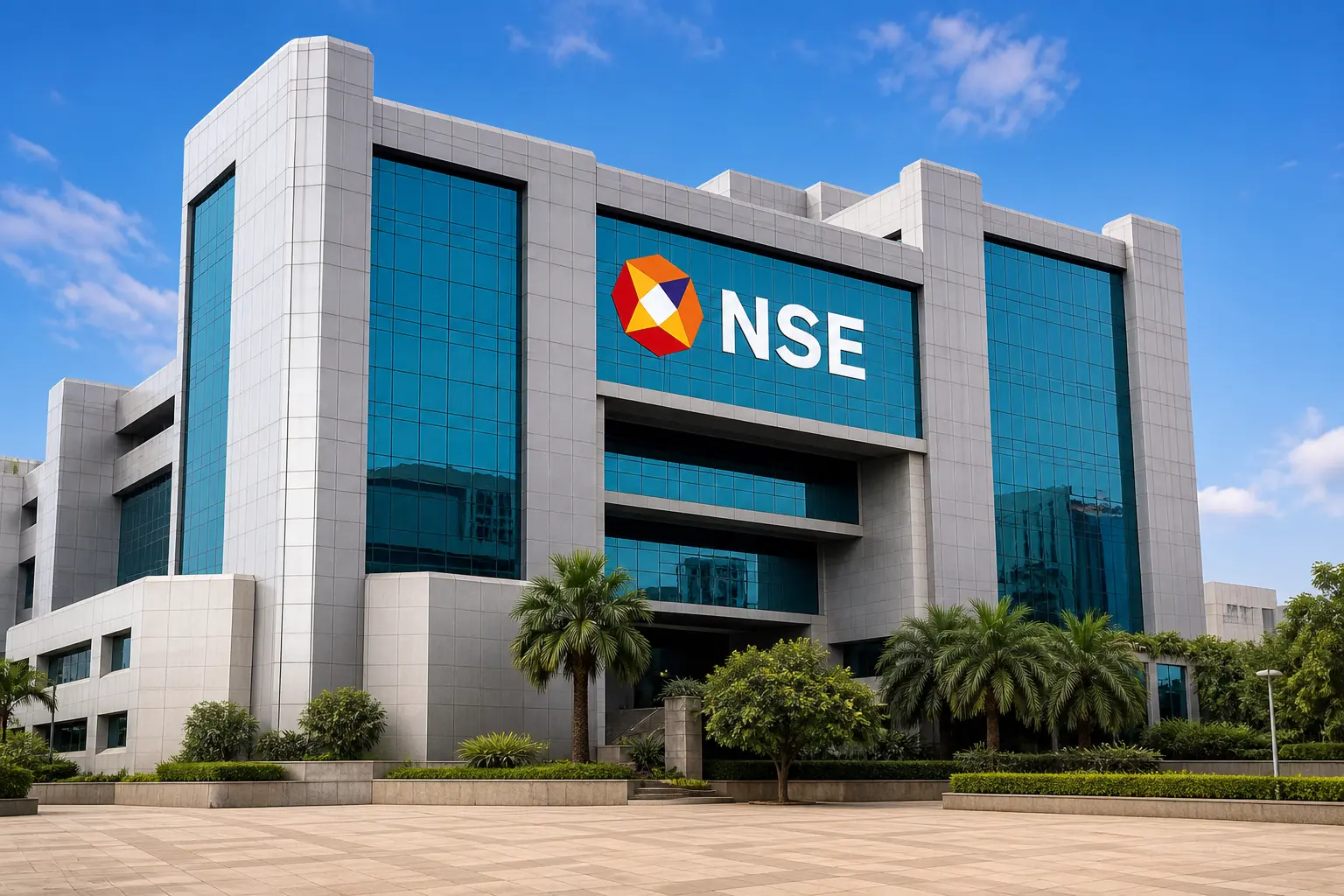
 National Stock Exchange of India posted consolidated profit after tax of Rs 3,120 crore for the June quarter, up 7% from Rs 2,924 crore a year earlier, while total income climbed 9% to Rs 5,252 crore. On the same day SEBI granted in-principle approval to settle the long-running co-location and dark-fibre cases for Rs 1,491.21 crore.
The twin announcements strip away the biggest regulatory overhang that had blocked the exchange’s public listing for years and leave a high-margin franchise ready for a planned offer-for-sale of roughly Rs 30,000 crore.
Clean Numbers Behind the 7% Profit Rise
Operating revenue from the core business reached about Rs 4,560 crore, up 13% year-on-year. Transaction charges, the largest line, rose to Rs 3,623 crore from Rs 3,154 crore. Data connectivity brought in Rs 258 crore, operating investment income Rs 234 crore, and data-feed plus terminal services Rs 150 crore.
Total expenditure increased only to Rs 1,129 crore from Rs 1,053 crore. Operating EBITDA hit Rs 3,594 crore and the margin expanded 119 basis points to 79%. Profit before Core Settlement Guarantee Fund contribution, exceptional items and tax stood at Rs 4,098 crore. The Core SGF took Rs 50 crore. Exceptional items were a modest Rs 20 crore. Tax expense was Rs 949 crore.
| Metric (Rs crore) | Q1 FY27 | Q1 FY26 | YoY change |
|---|---|---|---|
| Total income | 5,252 | 4,798 | +9% |
| Transaction charges | 3,623 | 3,154 | +15% |
| Operating EBITDA | 3,594 | ~3,130 | +15% |
| PAT | 3,120 | 2,924 | +7% |
| EBITDA margin | 79% | ~78% | +119 bps |
Sequential revenue from operations slipped roughly 8% from the March quarter, a point noted across market commentary, yet year-on-year growth and margin expansion remained intact. Adjusted for a one-off in the prior-year base, underlying profit growth looked closer to 11%.
How the Decade-Long Co-Location Case Reached Closure
The co-location dispute dates to 2015-16 allegations that certain brokers received preferential server access and data milliseconds ahead of others. Separate dark-fibre connectivity issues followed. SEBI show-cause notices arrived in 2017-18. A 2019 order demanded disgorgement of hundreds of crores plus interest and briefly barred capital raising. That order effectively froze the first IPO attempt.
- June 2025: NSE filed settlement applications covering both matters for a cumulative Rs 1,387.39 crore.
- March 2026: Revised settlement terms raised the total to Rs 1,491.21 crore.
- 30 July 2026: SEBI email granted in-principle acceptance and demanded the remaining Rs 714.74 crore after adjusting Rs 776.47 crore already deposited. The NSE board approved the payment the same day.
NSE had already booked a large provision in FY26 (on top of an earlier Rs 100 crore). The final cheque therefore hits cash, not the current profit-and-loss account. Q1 earnings stay clean. Reuters reported the settlement removes the biggest legal overhang facing the exchange as it prepares for an IPO later this year.
Transaction Charges Still Power the Engine
Equity derivatives continue to dominate. Of the Rs 18,313 crore in securities and commodities transaction tax collected in the quarter, derivatives accounted for 57%, delivery-based cash trades 37% and intraday cash 6%. NSE’s total contribution to the exchequer, including collections and payments, reached Rs 20,579 crore: STT/CTT Rs 18,313 crore, stamp duty Rs 980 crore, GST Rs 657 crore, income tax Rs 373 crore and SEBI fees Rs 256 crore.
- Trading services still supply the bulk of segment revenue and carry high incremental margins.
- Clearing services and the smaller “others” bucket (indices licensing, data feeds, terminals) grew faster in percentage terms.
- Employee costs rose as the exchange hires ahead of listing, yet overall cost discipline kept the 79% EBITDA margin.
The exchange was the world’s largest derivatives venue by volume in 2025 according to Futures Industry Association data and ranked third globally in equity trades by number, per World Federation of Exchanges figures. That scale underpins the fee engine even after successive SEBI measures aimed at retail options activity.
IPO Terms That the Settlement Unlocks
NSE filed its NSE draft red herring prospectus documents with SEBI in mid-June 2026. The issue is a pure offer for sale of up to roughly 149 million equity shares, about 6% of paid-up capital. No fresh capital is raised; proceeds go entirely to selling shareholders. Market estimates put the size near Rs 30,000 crore, potentially India’s largest IPO.
Unlisted-share platforms have recently quoted NSE around Rs 1,940-2,090 per share. At a round Rs 2,000 and 247.5 crore shares outstanding, the implied market capitalisation sits near Rs 4.95 lakh crore. Annualising the latest quarter’s profit produces a multiple around 40 times. That sits above many global exchange peers yet reflects NSE’s near-monopoly in Indian equity derivatives, 68% net margin on operating revenue and low capital intensity.
Investor roadshows have already begun. Final SEBI observations and pricing will set the calendar; market chatter has pointed to a possible window later in 2026 once the settlement paperwork is fully complete.
Selling Shareholders and the Broader Q1 Backdrop
State Bank of India leads the list of sellers in the OFS; LIC is not participating. Other institutional holders including foreign funds will also exit part of their stakes. The listing will give transparent price discovery and liquidity after years of restricted unlisted trading.
The results land amid a busy Indian earnings season. Readers tracking broader Q1 banking earnings moves have seen mixed bank reactions, while non-bank names such as Tata Capital’s parallel Q1 profit surge have drawn their own attention. NSE’s combination of volume leverage and regulatory clearance stands apart.
Margins That Survive Volume Rules
SEBI’s successive curbs on weekly options and lot sizes have tested the derivatives franchise. Sequential revenue softness in Q1 shows the sensitivity. Yet the 79% EBITDA margin and double-digit year-on-year operating growth demonstrate pricing power and cost structure that few financial infrastructure businesses match.
Full official quarterly financial results filings are available on the exchange’s investor-relations site for anyone wanting the complete notes, including the settlement disclosure and segment break-up. The data-and-indices arm, though still small, is the fastest-growing slice and reduces pure dependence on daily futures and options turnover.
What a Clean Balance Sheet Changes for Listing
With the settlement paid from existing provisions, the P&L remains unburdened and the legal cloud lifts. That combination of proven cash generation and regulatory finality is exactly what large domestic and global funds want to see before committing to a multi-billion-dollar OFS. Grey-market pricing already embeds much of the good news; the remaining variables are final SEBI clearance timing, any last pricing negotiations and the market’s appetite for a pure secondary sale at the implied multiple.
NSE began electronic trading in 1994 and has dominated Indian cash and derivatives markets ever since. The reckoning that began with co-location notices nearly a decade ago is now essentially closed. The exchange that collects more than Rs 20,000 crore a quarter for the exchequer can finally take its own shares public on the same rails it built.
 Scotland’s Facial Recognition Push Sparks Mask Ban Call
  Galaxy Z Flip 8 Hits $799 Only If Your Trade-In Qualifies
  If England Had Kept Water Public Like Scotland
  Samsung Smart Switch Now Moves Passwords and eSIM From iPhone
  Old Firm Spend Pulls Clear as Premiership Rivals Patch Squads
  Chinese Studios Quietly Seize the Gamescom Stage