
 Ishan Crawford
 National Museums Scotland met privately with Taiwan’s top diplomat in Edinburgh and a city councilor over a gallery map that shades Taiwan and China the same color. The sit-down produced no commitment to change anything.
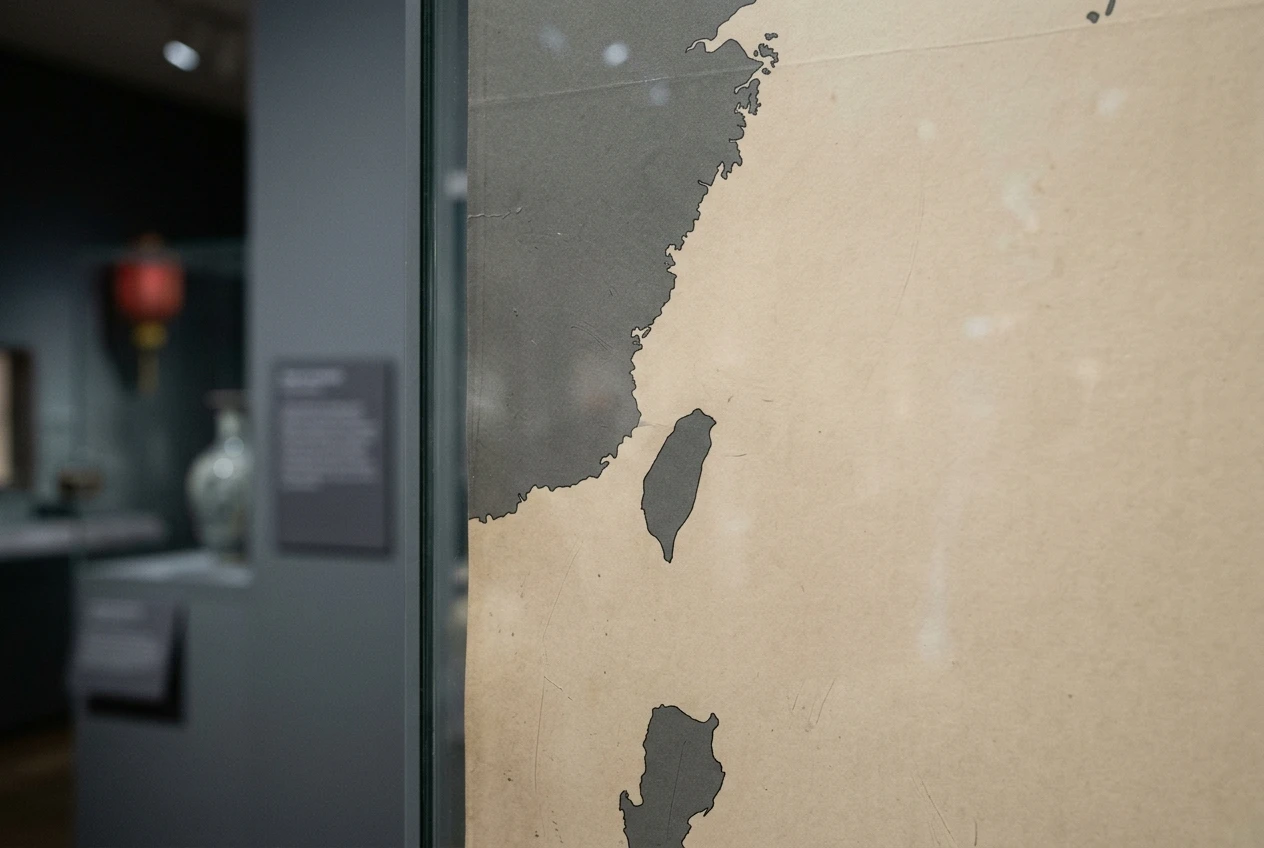
The map has hung, unaltered, in the National Museum of Scotland’s East Asia gallery since 2019. A viral social media post in June forced the museum to explain itself and eventually meet face to face, a pattern that played out almost identically at a London university seven years earlier, ending the same way: with an explanation, not a repaint.
A Gray Line Across the Taiwan Strait
The disputed cartography sits inside “Exploring East Asia,” a permanent gallery at the National Museum of Scotland that opened in 2019. Its collection runs past 23,000 East Asian objects, described in Central News Agency reporting as the largest such holding in the United Kingdom outside London.
The gallery covers three cultures: China, Japan and South Korea. Central News Agency (CNA), Taiwan’s state news service, reported that Japan and Korea each get their own clearly outlined territory in their sections. In the China section, one color covers the mainland and Taiwan together, with no separate boundary drawn at all.
Hideki Nagayama, a pro-Taiwan activist, posted a photo of the gallery map on June 6 and urged followers to complain. The post spread fast among Taiwanese social media users. Then, as Domino Theory later reported, the story went quiet for weeks.
National Museums Scotland’s defense rests on the United Nations geoscheme, a statistical system that groups Taiwan under China for reporting purposes, a label the scheme’s own documentation says reflects statistical convenience rather than political consensus. “There are many areas of contested borders or governance in the world, and it forms a basis for a consistent approach throughout the museum,” the museum said in explaining its approach.
The museum group has had a different kind of year in the headlines. It absorbed nearly 800 newly catalogued tartan samples into its archive, and wrapped a vintage Edinburgh tram in artwork promoting its own galleries to tourists. A map dispute was not on that itinerary.
Behind Closed Doors in June
The meeting happened last month, after the initial burst of criticism had already faded from headlines. Senior museum staff sat down with Ding Chi-hua, director general of Taiwan’s representative office in Edinburgh, and Cammy Day, a Labour Party Edinburgh city councilor.
A spokesperson for National Museums Scotland described the sit-down this way:
This meeting was an opportunity for us to listen and to explain our approach, which is not particular to China and Taiwan.
A spokesperson for National Museums Scotland gave that statement to Domino Theory in writing. A fuller response is planned but has not been issued, the museum said, because its director is currently on annual leave.
Day called the meeting “positive,” describing the museum’s stance as one of listening rather than committing, characterizing it as “we’re listening, we don’t want to offend anybody.” He said he would rather see Taiwan given a different color entirely, but at minimum wants the map annotated to flag the dispute.
Day has been here before. He led Edinburgh council when a planned sister-city agreement with Kaohsiung, in southern Taiwan, collapsed under Chinese pressure in 2024. He welcomed Kaohsiung councillors to Edinburgh last summer instead, under a softer “friendship agreement” the two cities settled for.
Other Voices Weigh In
Three other figures have put their names to the criticism, each from a different angle.
- Chris Law, a Scottish National Party member of parliament and a member of the Inter-Parliamentary Alliance on China, or IPAC, called the shared color choice disappointing and said the museum should be asking itself, “Could I have done something better here?”
- Hsinyen Lai (賴炻廲), an associate lecturer in international relations at the University of St Andrews, said the museum’s UN-geoscheme defense was “unfortunate,” since any geographic classification reflects political and historical narratives rather than neutral fact.
- Ding Chi-hua (丁志華), Taiwan’s director general in Edinburgh, said only that he had “already clearly and explicitly explained our position to the relevant Scottish authorities,” declining to detail what was said inside the meeting itself.
Lai, who was born and raised in Taiwan before moving to Scotland for academic work, put it more personally: “As a Taiwanese born-and-raised scholar working in Scotland, you can imagine how upset I am.”
The underlying dispute long predates this gallery. Taiwan has governed itself separately since 1949, while Beijing maintains the island is an inalienable part of China that must eventually be reunified. Every map that draws a line, or fails to, lands inside that argument.
Edinburgh Isn’t the First Campus to Refight This Color
A nearly identical fight played out at the London School of Economics in 2019, just in reverse. LSE had unveiled a giant globe sculpture by artist Mark Wallinger that colored Taiwan pink and China yellow, treating them as separate countries.
Chinese students complained. Taiwan’s foreign minister at the time, Joseph Wu, wrote an open letter urging the school not to yield, and a counter-petition to keep the original colors gathered more than 10,000 signatures.
Taiwan’s president at the time, Tsai Ing-wen, herself an LSE alumna, publicly criticized the school for even weighing a change. LSE never repainted the globe. It added an asterisk next to Taiwan instead, alongside a sign reading: “LSE is a place where people with different perspectives engage in respectful debate about major issues for the world.”
| Institution | Year | Original Map Choice | Outcome |
|---|---|---|---|
| London School of Economics | 2019 | Taiwan pink, China yellow, on a public globe sculpture | Kept the original colors after backlash; added an asterisk and an explanatory sign nearby |
| National Museum of Scotland | 2019 to present | Taiwan and China share a single color in the East Asia gallery | Held a closed-door meeting in June 2026; a formal response is still pending |
Both disputes took months to reach any institutional response, and in each case only after public pressure and private meetings pushed the matter forward.
A Scottish Map Taiwan Already Prizes
Ding, the Taiwanese diplomat, made one further point during discussion of the meeting. Taiwan already holds a Scottish-made map of its own, and prizes it.
The National Museum of Taiwan History in Tainan displays “Island of Formosa: A Missionary Map,” produced roughly 150 years ago in Edinburgh by a publishing house owned by brothers William and Alexander Keith Johnston.
The irony was not lost on Ding. Unlike the Edinburgh gallery map at the center of the current dispute, the 19th-century missionary map treats Formosa, the historical name for Taiwan, as its own distinct place on the page.
What Happens If the Museum Says No?
Nothing forces National Museums Scotland to repaint anything. The UN geoscheme gives the museum institutional cover to leave the display exactly as it is, and the only firm commitment so far is a promise to respond once the director returns from leave, with no date attached.
What We Know:
- The map has been unchanged since the East Asia gallery opened in 2019.
- Museum staff, Ding Chi-hua and Cammy Day met in June 2026 to discuss it.
- National Museums Scotland cites the UN geoscheme as the basis for a consistent approach across all its galleries.
What’s Unconfirmed:
- Whether the museum will recolor Taiwan, add an annotation, or leave the display untouched.
- When the museum’s director will return and issue the promised written response.
- Whether other UK institutions face similar quiet pressure over China-related displays they haven’t yet made public.
The pattern extends beyond one gallery. The rights group ARTICLE 19 has documented cases where UK institutions, including the Victoria and Albert Museum, agreed to remove maps and images from exhibition catalogues under pressure from Chinese printers.
Prime Minister Keir Starmer’s own office brushed against the same question in January and drew almost no attention for it. A video Starmer posted on X about his trip to Beijing and Shanghai showed China in one shade of gray, with Taiwan and other independent countries rendered in a lighter shade. Almost no one flagged it.
For now, the museum’s only firm promise is a written response once its director returns from leave. No date has been set.
Frequently Asked Questions
Has the National Museum of Scotland Changed the Map Yet?
No. The museum has committed only to issuing a fuller written response once its director returns from annual leave, with no date given. Councilor Cammy Day wants a full recolor of Taiwan or, failing that, an annotation flagging the dispute.
What Does UN Resolution 2758 Actually Say About Taiwan?
Passed in 1971, the resolution transferred China’s seat at the United Nations from the Taipei-based Republic of China to the People’s Republic of China. British Foreign Office officials have told Parliament the resolution never separately addressed Taiwan’s political status, a distinction the museum’s UN-geoscheme defense leaves out.
Does the UK Government Recognize Taiwan as Part of China?
No formal recognition either way exists. The UK government has never publicly endorsed Beijing’s one-China principle, according to Central News Agency reporting on the parliamentary record, leaving individual institutions like National Museums Scotland to set their own cartographic conventions.
Who First Publicized the Museum’s Map, and How?
Hideki Nagayama, a pro-Taiwan activist, posted a photo of the gallery map on X on June 6 and urged followers to email both the museum and Britain’s de facto embassy in Taipei directly, sharing contact addresses for each in the same post.
How Did the Student Population Split During LSE’s 2019 Dispute?
LSE’s Chinese student population that year numbered 1,451 out of 8,161 international students, versus 56 Taiwanese students, according to Hong Kong Free Press reporting at the time. The imbalance shaped how loudly each side could be heard on campus.
How Long Did LSE’s Globe Dispute Take to Settle?
Roughly three and a half months. The sculpture was unveiled in late March 2019, and the asterisk compromise was in place by early July, after Taiwan’s foreign minister, student petitioners and UK parliamentarians all weighed in.
 ONGC licence frees Venezuela cash and operatorship talks
  Anthropic Hits $65 Billion Run Rate and Flips the AI Cash Test
  Supreme Court grounds the fare free-for-all with three-week clock
  Gold Nears $4400 as Soft Data Meets Oil Inflation Risk
  Nifty Slips as Zaggle Circuits and Dhoot Debuts Big
  Diesel Crack Tops $100 as Iran Rhetoric Lifts Crude