
 Ishan Crawford
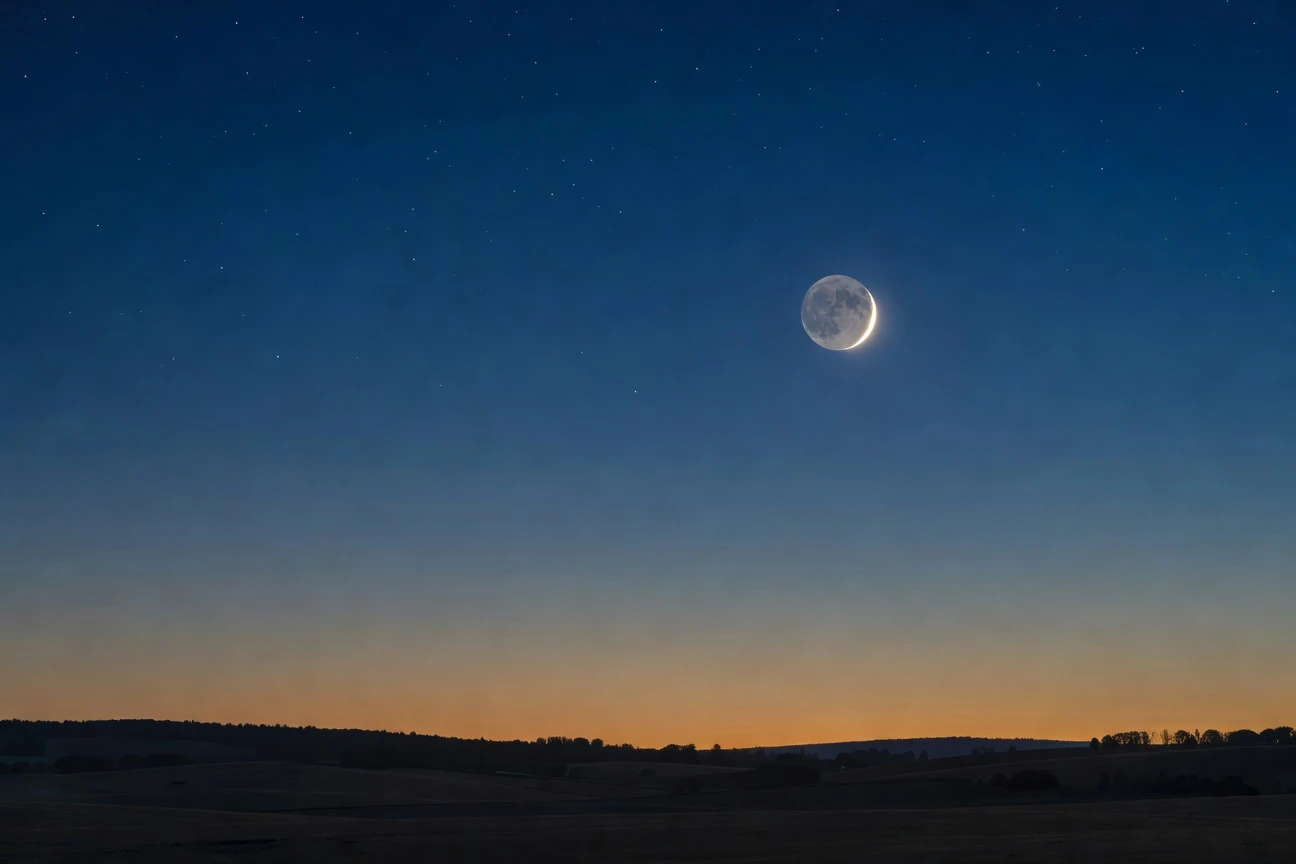
 The Moon hung just 9 percent lit over the Northern Hemisphere on the evening of Tuesday, May 19, 2026, the third night of a fresh lunar cycle. NASA’s Daily Moon Guide (National Aeronautics and Space Administration) places it in the Waxing Crescent stage, a sliver thin enough that most of the disk reads as plain dark sky.
That thin reading lasts only a few nights. By dawn on Sunday, May 31, the same Moon will sit fully illuminated as a Blue Moon, the rarer of two Full Moons crowded into this month’s calendar, and the 12 evenings between now and then walk straight through every phase that links the two.
Tonight’s Sliver and the 12-Night Countdown
Step outside shortly after sunset and look low in the west. The crescent will sit close to the horizon, the lit edge curving to the right for any observer north of the equator. It sets within roughly two hours of the Sun, so the window is short and the sky behind it is still tinged with twilight.
The next two weeks then build the disk back to full. Below is the calendar of major lunar checkpoints between tonight and the next Full Moon, drawn from NASA’s phase data and the published almanac timings.
| Date | Phase | Approximate Illumination |
|---|---|---|
| Tuesday, May 19 | Waxing Crescent | 9 percent |
| Saturday, May 23 | First Quarter | About 50 percent |
| Wednesday, May 27 | Waxing Gibbous | About 80 percent |
| Sunday, May 31 | Full Moon (Blue Moon) | 100 percent |
The illumination figure is published daily by NASA’s moon phase reference page, and it ticks up roughly six to seven points every 24 hours during the waxing portion of the cycle.
Why Only 9 Percent Is Lit Tonight
The Sun always lights exactly half of the Moon. What changes from night to night is how much of that lit half points toward Earth.
Two evenings ago the Moon sat almost directly between Earth and the Sun, with its sunlit side facing away from us. That was the New Moon. Since then it has shifted a few degrees along its orbit, and a slim ribbon of the day side has rotated into our line of sight. Nine percent of the visible disk now catches sunlight; the remaining 91 percent sits in shadow.
The cycle from one New Moon to the next runs roughly 29.5 days, a span astronomers call a synodic month. Within that month the Moon passes through eight named phases, with each one lasting a few days on average.
The geometry produces a few predictable rules of thumb worth remembering tonight:
- A waxing Moon is lit on the right side from the Northern Hemisphere, and on the left side from the Southern Hemisphere.
- A crescent Moon always rides close to the Sun in the sky, so it rises and sets near sunrise or sunset, never overhead at midnight.
- The terminator, the curving line that separates light from shadow, is where craters cast their longest shadows and surface detail looks sharpest.
What to See in the Sliver: Mare Crisium and Earthshine
A 9 percent crescent looks plain to the naked eye, but a cheap pair of 7×50 binoculars turns it into a tour. Two features stand out at this stage of the cycle.
The first is Mare Crisium, the Sea of Crises. It is an oval, dark basaltic plain about 350 miles across, sitting near the upper edge of the crescent. Because it lies close to the Moon’s limb it appears foreshortened into a long ellipse, with its long axis running roughly north to south. BBC Sky at Night magazine lists it as the most obvious target during the early waxing crescent, easily spotted in binoculars two to three days past New Moon.
The second is earthshine. The unlit 91 percent of the disk is not pitch black; it glows faintly because sunlight reflected off Earth’s oceans and clouds bounces back onto the lunar night side. The effect is called Earthshine, sometimes the “old moon in the new moon’s arms,” and it is strongest during crescent phases when the bright crescent does not overpower the eye.
Other features worth chasing tonight:
- The crater Langrenus, a 132 km bowl sitting just south of Mare Crisium with a bright central peak.
- Mare Fecunditatis, the Sea of Fertility, a smaller dark plain immediately west of Mare Crisium.
- The terminator itself, where any small crater throws a shadow many times its own length, the easiest way to spot craterlets that disappear at Full Moon.
The Eight-Phase Cycle in Order
NASA defines eight named stages within each 29.5-day cycle. The list runs in the order any single Moon walks through during a single lunar month:
- New Moon. The Moon sits between Earth and the Sun. The lit half faces away from us, so the disk is invisible.
- Waxing Crescent. A thin lit sliver appears on the right side from the Northern Hemisphere. Tonight’s phase.
- First Quarter. Half the disk is lit, on the right side. The name refers to one quarter of the full cycle, not a quarter of the surface.
- Waxing Gibbous. More than half is illuminated but not yet complete. The bulge widens each night.
- Full Moon. The entire near side faces sunlight. Rises at sunset, sets at sunrise.
- Waning Gibbous. Light begins to retreat from the right side from the Northern Hemisphere.
- Third Quarter. Half-lit again, but now the left side carries the light.
- Waning Crescent. A thin sliver on the left side. The cycle resets back to New Moon within a few days.
The same side of the Moon always faces Earth, a phenomenon called tidal locking. Phases are therefore a story about sunlight and viewing angle, not about the Moon physically rotating its face.
May’s Second Full Moon: The Blue Micromoon on May 31
May 2026 carries two Full Moons. The first arrived on Friday, May 1, the traditional Flower Moon that marks the spring bloom across the Northern Hemisphere. The second peaks twelve days from tonight, in the small hours of Sunday, May 31.
The May 31 event stacks two labels onto a single disk:
- 4:45 a.m. EDT peak illumination, per Sky & Telescope’s almanac timing for the Northern Hemisphere.
- Second Full Moon of a calendar month, which is the popular definition of a Blue Moon coined by Sky & Telescope contributor James Hugh Pruett in 1946.
- Micromoon, because the Moon reaches apogee, its farthest orbital point from Earth, the very next day on June 1. The disk will appear roughly 7 percent smaller and about 15 percent dimmer than an average Full Moon.
The combined label, a Blue micromoon, is unusual but not historic. It does not change the calendar significance of either tag; it simply means the next Full Moon will be both the second of the month and the dimmest of the year so far. For observers used to the bright Wolf and Flower Moons earlier in 2026, the contrast will be the obvious storyline.
How May Stacks Against 2026’s Brightest Lunar Moments
The Moon has already produced two headline nights this year before May 31 arrives. A January supermoon and the May 1 Flower Moon bookend a stretch that has kept lunar photographers busy across the United Kingdom and beyond, including the night skies that turned over Scotland during the Wolf supermoon in early January.
| Event | Date | What Made It Notable |
|---|---|---|
| Wolf Supermoon | January 3, 2026 | Closest Full Moon of winter, roughly 14 percent larger than the year’s smallest |
| Flower Moon | May 1, 2026 | Traditional spring Full Moon, first of two in May |
| Blue Micromoon | May 31, 2026 | Second Full Moon of May, dimmest of 2026 so far |
Lunar tourism has been measurable in the meantime. Tour operators in Scotland reported strong bookings around last autumn’s blood moon eclipse, a reminder that even modestly forecast lunar events can move travel calendars. The May 31 micromoon is a quieter spectacle than an eclipse, but it is the rarer of the year’s remaining Full Moons.
Frequently Asked Questions
What Phase Is the Moon in Tonight?
The Moon is in the Waxing Crescent phase on Tuesday, May 19, 2026, with about 9 percent of its near side illuminated, according to NASA’s Daily Moon Guide. The lit edge curves to the right when viewed from the Northern Hemisphere.
When Is the Next Full Moon?
The next Full Moon peaks at 4:45 a.m. Eastern Daylight Time on Sunday, May 31, 2026. It is the second Full Moon of May, which earns it the popular Blue Moon label, and it also qualifies as a micromoon because it falls within a day of lunar apogee.
Why Are There Two Full Moons in May 2026?
Yes, this happens roughly once every 2.5 to 3 years. A synodic month lasts 29.5 days, so when a Full Moon falls on the first or second of a calendar month, a second Full Moon can squeeze in before the month ends. May 2026 lines up exactly that way, with peaks on May 1 and May 31.
Can I See Mare Crisium Tonight?
Yes, with binoculars. Mare Crisium is the dark, oval plain near the top of tonight’s slim crescent, sitting close to the lunar limb. It is among the easiest features to identify two to three days past New Moon and stays visible through the First Quarter.
What Is the Difference Between a Blue Moon and a Supermoon?
A Blue Moon is a calendar quirk, the second Full Moon within a single month. A supermoon is an orbital one, a Full Moon that occurs near lunar perigee, the closest point of the Moon’s orbit to Earth. The May 31 event is the opposite of a supermoon, a micromoon at apogee, while still carrying the Blue label.
What Time Should I Look Tonight?
About 30 to 60 minutes after local sunset. The crescent will sit low in the western sky and set within roughly two hours, so an unobstructed western horizon and a reasonably dark site make the difference between a clear view and a missed one.
 HDFC Bank Fines CEO Jagdishan Weeks Before Reappointment Call
  Zepto’s IPO Valuation Target Sinks to $3 Billion From $7 Billion
  Man Jailed Under a Rare Lifelong Order for Edinburgh Rape
  Tata Power’s ₹6,675 Crore Bet on Solar Self-Reliance in Odisha
  South Korea and Japan Chip Stocks Crash as China Surges
  Scotland’s Social Work Registration Overhaul Carries a Staffing Cost