
 Ishan Crawford
 Milky Mist Dairy Food’s ₹1,553 crore IPO closed 56.12 times subscribed on 13 August 2026, with a grey-market premium of ₹22 that points to roughly 16% listing upside at the ₹140 upper band. Allotment is due today under the T+3 timetable, with shares set to debut on the BSE and NSE on 18 August.
The rush looks emphatic on the surface. The numbers behind it tell a tighter story: institutions piled in at a valuation that already assumes near-flawless execution of a still-leveraged growth plan.
Final Bid Tallies and the Grey Market Signal
By late on the third day the book stood at 56.12 times overall, according to exchange data cited by LiveMint. Qualified institutional buyers took the QIB portion 155.83 times. Non-institutional investors filled their slice 34.91 times. Retail ended at 8.40 times.
Later tallies on tracking sites edged toward 59 times, with QIB ex-anchor near 164 times. The exact final figure will settle with the basis of allotment. Either way the demand was front-loaded by institutions once anchors locked in ₹465 crore the day before opening.
| Category | Subscription (times) | Key detail |
|---|---|---|
| Overall | 56.12 | As of 5 pm day 3 (Mint) |
| QIB | 155.83 | Strongest institutional pull |
| NII | 34.91 | High-net-worth demand firm |
| Retail | 8.40 | Solid but lottery odds long |
The pattern is familiar for consumer IPOs that clear the anchor book first. Once that ₹465 crore block was in, QIBs treated the remaining institutional portion as a scarce allocation and piled on. Retail’s 8.40 times cover looks healthy in isolation, yet it is a fraction of the QIB multiple and leaves most individual applicants empty-handed under proportional allotment rules.
Grey-market quotes held around ₹22 over the ₹140 issue price into allotment day, implying a potential open near ₹162. That premium has floated between the mid-teens and low-20s through the book-building window. It is real money changing hands off-exchange, yet it remains unofficial and can compress on listing if delivery demand disappoints.
The issue itself mixed a fresh sale of 10.20 crore shares raising ₹1,428 crore with an offer for sale of 0.89 crore shares worth ₹125 crore. Face value is ₹2. The lot size of 107 shares at upper band sets the retail minimum at ₹14,980. Employees received a ₹13 discount on a small reserved portion.
Fresh capital dominates the deal structure. The OFS is small enough that most of the money stays inside the company rather than exiting early holders, which matters for a balance sheet still carrying heavy borrowings.
How the Dairy Engine Scaled So Fast
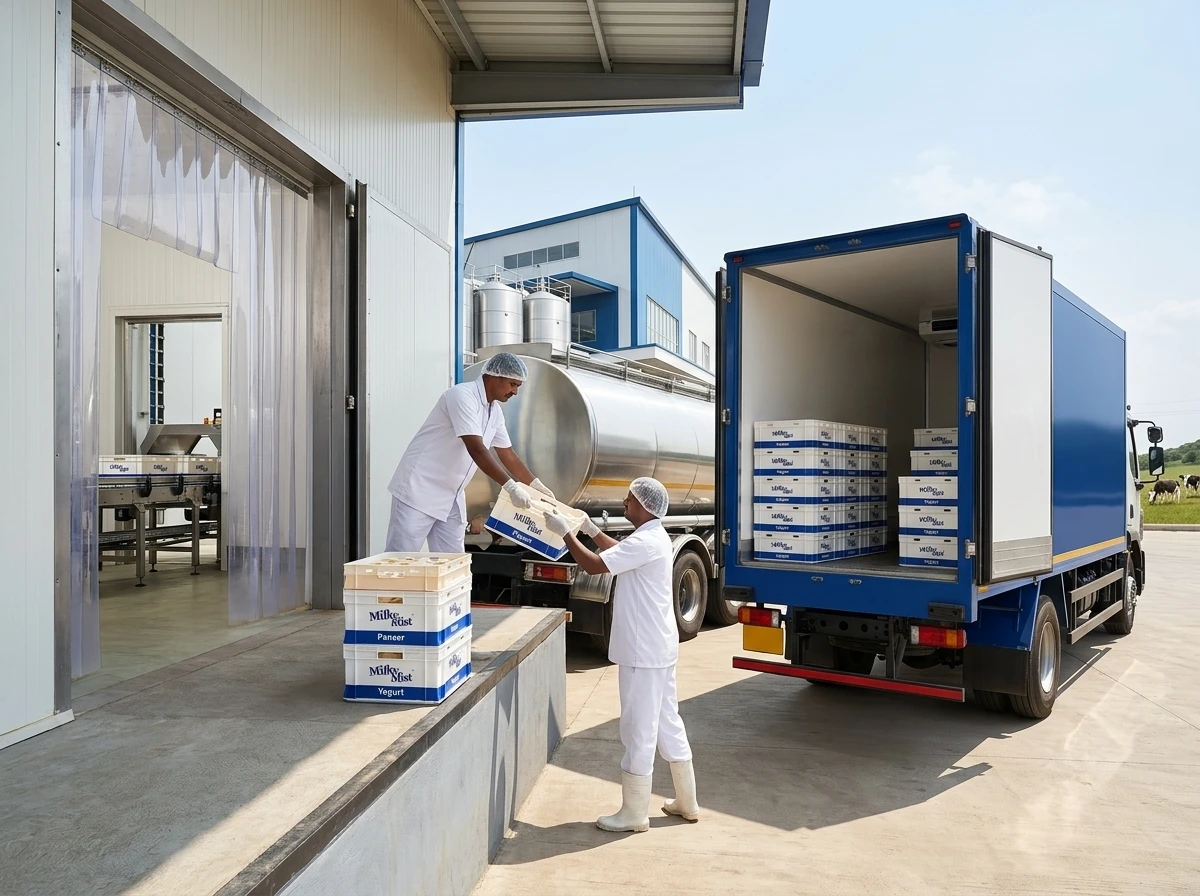
Milky Mist focuses on value-added products rather than liquid milk. Paneer alone contributed 29.4% of FY26 revenue. Cheese, curd and paneer together made up nearly 60%. Greek yogurt, ice cream, ghee, butter and newer frozen and ready-to-eat lines fill the rest.
- Paneer: ₹923 crore, 29.4% share
- Cheese: ₹514 crore, 16.4%
- Curd: ₹416 crore, 13.3%
- Ghee: ₹308 crore, 9.8%
- Ice cream and yoghurt: combined more than 12%
Restated total income reached ₹3,145 crore in the year to 31 March 2026, up 34% from ₹2,355 crore. Profit after tax jumped 176% to ₹127 crore. EBITDA climbed to ₹435 crore. The company claims roughly 19% value share in organised packaged paneer, around 12% in South Indian cheese, 13% in packaged yogurt and 35-40% in Greek yogurt.
That mix is the core of the growth thesis. Liquid milk is volume-heavy and margin-thin. Paneer, cheese and Greek yogurt carry higher realisations per litre of milk intake, so each incremental procurement rupee converts into more revenue and, in a good year, more EBITDA.
Milk comes largely from direct procurement, historically concentrated in Tamil Nadu. An integrated cold chain and multi-channel distribution support the premium positioning. New SKUs introduced in the prior two years already account for a sizable revenue slice, showing the brand can innovate beyond staples.
That growth outpaced listed peers such as Dodla Dairy, Parag Milk Foods and Hatsun Agro Product over the same period. The story is straightforward: more milk turned into higher-realisation packs, sold through an expanding outlet network.
The same concentration that sped the climb also sets the next test. Southern brand strength helped the late retail surge in the IPO book. National scale will require the cold chain and outlet push to work in markets where Dodla, Parag and Hatsun already defend shelf space.
The Valuation Already Prices Perfection
At ₹140 the post-issue market capitalisation sits near ₹10,778 crore. That equates to roughly 85 times reported FY26 earnings, or about 105 times once a prior-year tax credit is stripped out. Enterprise value after planned debt repayment lands near 27 times FY26 EBITDA.
Key valuation markers
- 84.9x FY26 P/E at the upper band (Anand Rathi figure)
- Peer median P/E near 23x (Dodla, Parag, Heritage, Hatsun)
- ROCE 11.7% in FY26, three-year average under 10%
- Debt-to-equity still elevated pre-issue at roughly 3.6 times
| Marker | Milky Mist | Peer reference |
|---|---|---|
| FY26 P/E (upper band) | 84.9x | Median near 23x |
| EV / FY26 EBITDA | Near 27x (post debt paydown) | Not disclosed as a peer median |
| ROCE (FY26) | 11.7% | Three-year average under 10% |
| Debt-to-equity (pre-issue) | Roughly 3.6x | Elevated versus a de-levered peer set |
Anand Rathi labelled the issue “Subscribe, Long Term,” noting the growth and category leadership while flagging that the valuation “appears fully priced.” Equivision and several other brokers also said subscribe, citing operating leverage and market shares, yet warned that rural and semi-urban expansion will face pricing and distribution pressure.
Milky Mist Dairy Food Ltd, at an implied P/E of 84.9x on FY2026 earnings at the upper price band. Given its strong revenue growth, leadership in key value-added dairy categories and premium positioning, the company may command a valuation premium. However, the IPO valuation appears fully priced at the upper band and hence, we recommend a “Subscribe, Long Term” rating to the IPO.
Anand Rathi made that assessment public during the book. The premium to peers is the clear trade-off investors accepted when they bid.
At roughly four times the peer median earnings multiple, the market is paying for continued 30%-plus top-line momentum, further mix shift into high-share categories such as Greek yogurt, and a clean de-leveraging path. Any stall on those fronts compresses the thesis quickly because the starting multiple leaves little cushion.
Balance-Sheet Strain and Concentration Risks
Growth has been capital-intensive. Free cash flow stayed negative across recent years as plant and equipment spending ran well ahead of operating cash generation. Total borrowings stood at ₹1,672 crore at end-FY26, up sharply from ₹1,037 crore two years earlier. Interest cover improved but remains modest.
About 35% of the fresh issue is earmarked for debt repayment. Another large slice funds expansion at the Perundurai facility and retail refrigeration. Further capacity, including a proposed Maharashtra project later in the decade, sits on the horizon and could require additional capital.
- Debt repayment: about 35% of fresh issue proceeds
- Perundurai expansion and retail refrigeration: a further large slice
- Maharashtra project: later in the decade, may need more capital
- Borrowings path: ₹1,037 crore two years ago to ₹1,672 crore at end-FY26
Utilisation on several lines still has headroom: paneer capacity rose sharply during the year, while set curd, ice cream and chocolate lines ran well below full rates. That gives room to grow into existing assets, yet it also means the market is paying for capacity that has not yet been fully proven in cash terms.
Geographic concentration adds another layer. Tamil Nadu has historically supplied the bulk of milk. Any regional disruption hits procurement and production together. Southern states still dominate revenue, so national expansion must clear distribution and competitive hurdles that peers already navigate.
Audit notes in the filings pointed to inventory-statement gaps versus bank reports and incomplete audit trails in earlier periods. Management attributed the differences to adjustments and has filed revisions. Investors will watch whether controls tighten as the company scales.
The IPO proceeds attack the most visible pressure point first. Paying down a portion of the ₹1,672 crore stack should lift interest cover and cut the debt-to-equity ratio from the pre-issue level near 3.6 times. The harder work is turning negative free cash flow positive once the Perundurai spend is absorbed and utilisation on under-run lines rises.
From Partnership Firm to Temasek-Backed Public Company
The roots run to a 1999 partnership in Erode, Tamil Nadu, later renamed and converted into a private limited company in 2014. The firm became a public limited company in May 2025. Promoters are Sathishkumar T, chairman and managing director, and Anitha S, whole-time director. The farm-to-consumer dairy model built since 1999 now includes automated paneer and cheese lines, cold-chain logistics and a range of sub-brands.
- 1985-1997: Milk trading evolves into paneer production and the Milky Mist brand name.
- 2008-2012: Cold storage, distribution and first major advertising push in South India.
- 2016-2019: Mega plant, powder capacity, robotic paneer/curd lines and full cheese plant commissioned.
- 2020-2023: UHT range, Greek yogurt, ice cream, chocolates and frozen/RTE extensions launched.
- 2025-2026: Public conversion, pre-IPO stake sales including to Temasek’s vehicle, and the current IPO.
Singapore’s Temasek participated via pre-IPO investment and as an anchor. Other anchors included the International Finance Corporation and domestic mutual funds. The IPO size was trimmed after those secondary sales. Promoter holding post-issue is expected near 79.5%.
The restated consolidated financial statements show the acceleration clearly, yet they also show how much of that acceleration rode on borrowed money.
A promoter stake still near four-fifths after listing keeps control tight. It also means public float stays thin, so secondary-market liquidity will depend on how freely institutions trade the stock they receive in allotment.
Institutions Locked In the Scarcity Trade
Anchor demand of ₹465 crore the day before opening set the tone. With Temasek’s vehicle, the International Finance Corporation and domestic mutual funds already on the register, remaining QIB paper looked scarce. The 155.83 times QIB cover, and later tallies near 164 times ex-anchor, followed from that squeeze rather than from a broad re-rating of dairy multiples.
Retail and NII money arrived later and in smaller relative force. Brand familiarity in southern supermarkets supported the 8.40 times retail print and the 34.91 times NII print. Those figures still left institutions as the dominant owners of the book and, by design, of the shares that will list.
Grey-market buyers priced a modest open, not a melt-up. A ₹22 premium on ₹140 is real, yet it is far narrower than the gap between the 84.9 times issue multiple and the peer median near 23 times. The off-exchange tape is signalling a listing pop, not a rewrite of the long-term valuation debate.
A Clean Listing Could Stir More Packaged Food Paper
Value-added dairy has been scarce on the mainboard for years. Peers such as Dodla Dairy, Parag Milk Foods and Hatsun Agro Product already trade, but fresh paper in paneer, cheese and Greek yogurt has been rare. A stable debut for Milky Mist would show that investors will fund the category even at a full price.
The reverse also holds. A soft open after a 56.12 times book would remind sponsors that subscription headlines and sustained secondary demand are different things. That signal would travel quickly through the rest of the consumer calendar.
Proceeds discipline will shape the read-across. If debt falls as planned and utilisation on set curd, ice cream and chocolate lines rises without heavy discounting, the growth path that drew institutions becomes easier for the next packaged-food issuer to cite. If margins stall while the multiple stays rich, the window narrows again.
Allotment Lottery and the 18 August Open
Basis of allotment is scheduled for 14 August. Refunds and demat credit follow on 17 August. Listing is set for 18 August on both exchanges. Retail applicants face long odds given the 8.4-times cover; many will receive nothing. QIBs and larger NIIs capture the bulk of the shares by design.
Crowd commentary on X captured the split mood: some celebrated the 56-times print and held GMP near 19-21% into allotment day, while others noted that an 85-times multiple already prices aggressive growth and preferred a multi-year hold over a pure listing flip. Brand familiarity in southern supermarkets clearly helped the late retail surge. Whether that familiarity converts into sustained secondary-market demand is the open question.
This IPO sits inside India’s busy IPO calendar in the same stretch, following other consumer and industrial names. It also recalls another recent IPO that leaned on sector tailwinds. Value-added dairy has been scarce on the mainboard for years; a clean listing could encourage more packaged-food paper. A soft open would cool that enthusiasm quickly.
The modest grey-market premium offers a cushion, yet the real test begins after the first trade. Debt comes down with the fresh capital. Capacity utilisation must rise. Margins need to keep expanding without heavy discounting. If those pieces land, the growth story that drew 56 times the book can still justify the price paid. If they slip, the premium valuation leaves little room for error on either listing day or the quarters that follow.
For now the market has spoken with its bids. The shares will speak next week.
 Hormuz Stalemate Masks Products Squeeze Toward $120 Oil
  Shiprocket IPO Heat Masks Float Risk and Adjusted Losses
  Oil Relief Meets Drone Tariffs as Nifty Turns Macro
  Scotland’s Drug Deaths Drop Then Rebound as Recovery Lags
  FPIs Exit 60% of IPO Anchors in a Year as Domestic Funds Hold Firmer
  Domestic Winners Outrun Tata PV Drag on Friday Focus List