
 Ishan Crawford
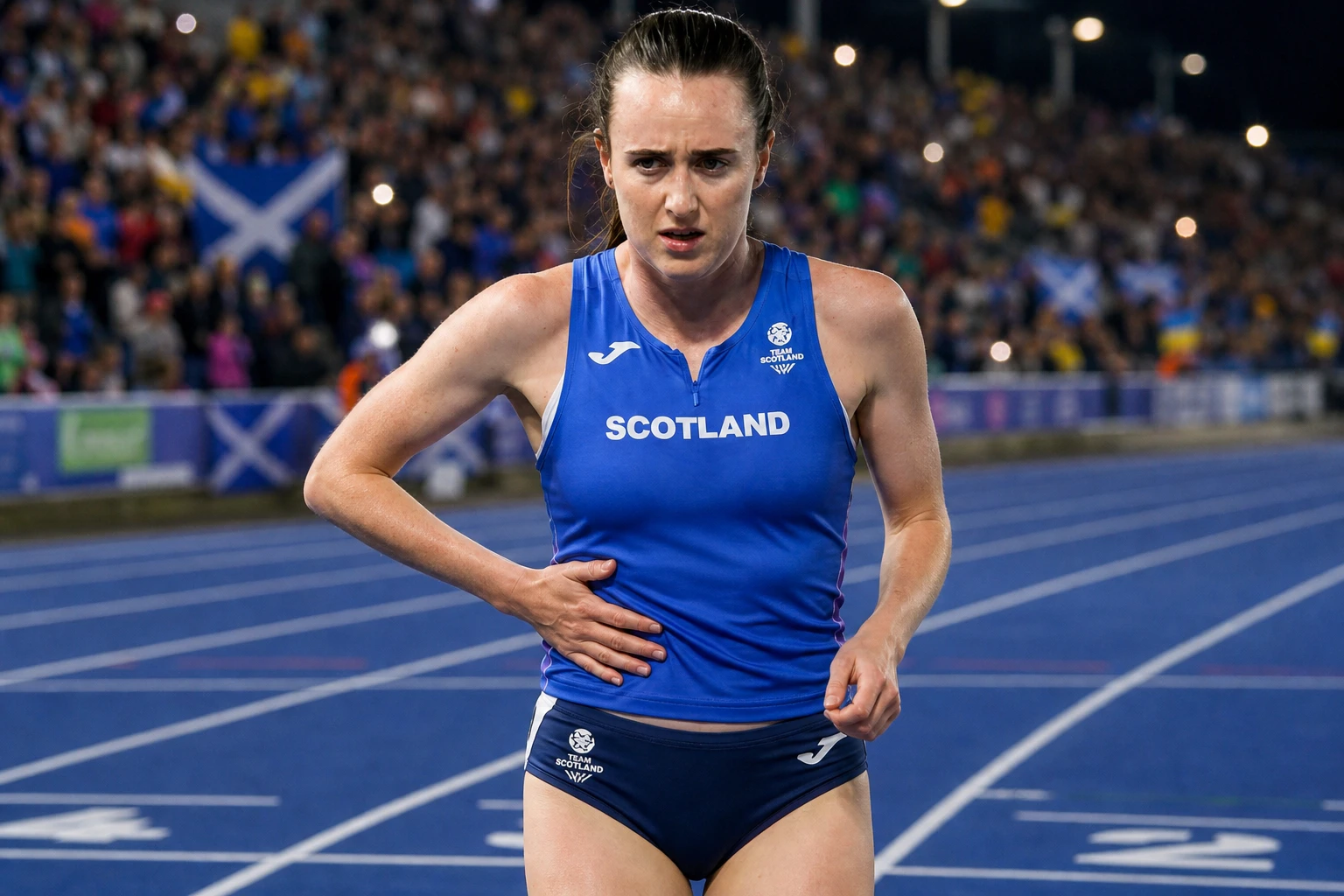
 Laura Muir finished 16th in the women’s 5000m at Scotstoun after a mid-race stitch wrecked her rhythm, collapsing onto the track as Scotland’s Megan Keith took bronze in 14:49.10. The home Commonwealth night was never sold as a medal hunt for the Olympic silver medallist. It was a deliberate step up in distance while the 1500m sat off the programme.
What landed instead was a brutal two-kilometre grind, a teammate’s native-record podium, and a clear data point for the path toward Los Angeles 2028.
Scotstoun Finishes in a Stitch and a Native Record
Australia’s Rose Davies completed a distance double, adding 5000m gold to her 10,000m title. Jessica Hull made it an Australian one-two. Keith, the Inverness Harrier still only 24, held a long lead spell and protected the bronze as the home crowd roared every lap.
Eloise Walker of Edinburgh AC ran a personal best for 15th. Muir crossed one place later in 15:19.75, well outside her outdoor best of 14:48.14.
| Place | Athlete | Nation | Time |
|---|---|---|---|
| 1 | Rose Davies | Australia | 14:44.59 |
| 2 | Jessica Hull | Australia | 14:45.01 |
| 3 | Megan Keith | Scotland | 14:49.10 NR |
| 15 | Eloise Walker | Scotland | 15:13.15 PB |
| 16 | Laura Muir | Scotland | 15:19.75 |
Muir told BBC Sport Scotland she felt strong through the first 2000m. Then the stitch hit at 3km. “Trying to run and breathe properly for another 2km was a bit rough but I just wanted to finish,” she said. “I was like, ‘I don’t care how slow I’m gonna run, I’m gonna finish,’ so I finished but yeah that was a bit brutal and a bittersweet because the crowd were unreal and the atmosphere was phenomenal.”
She tugged at her side after the line. The night’s noise belonged to someone else.
Why Muir Stepped Up to Five Kilometres
Glasgow 2026 brought the Commonwealth Mile back for the first time since 1966, an homage to the Miracle Mile tradition. The standard 1500m for able-bodied women dropped off the programme. Muir’s speciality disappeared with it.
She could have chased the mile. She chose the 5000m instead. Before the Games she told BBC Scotland the longer race would build endurance that should feed back into the 1500m. Athletics Weekly recorded the same logic when Team Scotland named its 39-strong athletics squad in June: a winter of speed-endurance work, a stated wish to test longer distances, and a recent 15:07.02 in Brussels as a marker.
- Outdoor 5000m personal best: 14:48.14 (Paris 2023)
- Recent tune-up: 15:07.02 at IFAM Brussels in May
- Stated aim: stronger endurance to help the 1500m toward the next Olympic cycle
- Home context: only woman from the 2014 Scotland team still competing in Glasgow 2026
Pressure stayed light by design. “I didn’t put a lot of pressure on myself for these Games, I just wanted to enjoy it and soak it all up,” Muir said afterward. The stitch still stole the enjoyment on the track.
Keith Leads When the Crowd Goes Mental
Keith had finished a frustrated ninth in the 10,000m earlier in the week. On Thursday night she flipped the script. She pushed to the front with four laps left, kicked repeatedly, and still had enough to hold third when Davies and Hull came past in the closing stages.
Her Scottish native record of 14:49.10 also counted as a season’s best. Family from Inverness packed the stands, including her 100-year-old grandfather, Dr Murray Kirkwood. Team Scotland’s race report captured the Saltire lap and the release after Monday’s disappointment.
I wasn’t racing for a medal tonight. I was racing to prove to myself what I’m capable of.
Keith said that to Athletics Weekly after the race. She also told Team Scotland the shared Scottish presence helped: three Scots in the field meant the focus was not solely on her as the home hope. “When I made my move the crowd really got behind me… I ran my heart out on the home straight.”
Muir, locked on her own struggle, still felt the surge. “I’m usually really focused on my race but I was aware of how well she was doing because the crowd were going mental,” the 2022 Commonwealth 1500m champion said. “I was looking up at the screens and I was gutted I didn’t see it… it’s amazing for her, she’s such a talented athlete and I think she’s not necessarily had the exposure or been on the podium yet, so what a way to do it, though. I’m proud.”
On X, the official Team Scotland and scottishathletics accounts led with Keith’s bronze and the native record. First Minister John Swinney congratulated her and joked that 14:49.10 sits incomprehensibly clear of his own parkrun best. The public conversation treated the veteran’s stitch as background to a new podium face.
Twelve Years Between Two Glasgow Starts
In 2014 Muir was 21, still building, and left her home Commonwealth Games without a medal. The Team Scotland athlete page for Muir notes that debut and the later choice to skip Gold Coast 2018 for veterinary exams. Birmingham 2022 brought the 1500m gold and 800m bronze that rewrote her Commonwealth record.
- 2014 Glasgow, first senior home Games, no medal, raw potential
- 2020 Tokyo Olympics, 1500m silver that confirmed world class
- 2022 Birmingham, Commonwealth 1500m gold plus 800m bronze; European 1500m title the same summer
- 2022 Eugene Worlds, 1500m bronze
- 2026 Glasgow, only woman from the 2014 Scotland team still on the roster, racing 5000m by choice
Her World Athletics profile lists her medals across Olympics, Worlds, Europeans and Commonwealths. At 33 she arrived in Glasgow as one of the most decorated British middle-distance runners of the decade, carrying little of the weight that once sat on every major final.
“I think there is only five of us from that team [2014] that are here, I’m the only woman, so that’s pretty special, I’m very proud of that,” she said. The stitch stopped her enjoying the lap the way she had hoped.
The Scots Who Finished Behind the Podium
Three Scots started. One left with bronze and a record. Walker’s 15:13.15 personal best in 15th added another clean data point for the domestic depth chart. Muir’s 16th was the expensive lesson.
That spread matters more than any single headline. Keith already owns European 10,000m bronze from Rome 2024, a strong cross-country résumé, and a former junior orienteering background. Walker keeps lowering personal marks. Muir’s presence at 33 still sets the standard the others measure against, even on a night she could not chase the front.
Home Games energy has run through other Scottish stories this fortnight, from Brand Scotland’s home Games campaign to another Scot turning a final into something larger. The 5000m final simply made the succession visible on the track.
Australian depth won the medals. Scottish depth filled the next story.
What This Night Still Gives Her for 2028
Muir came for endurance stimulus and left with incomplete data. A stitch at 3km turns a controlled trial into survival. The finishing time cannot be read as pure fitness. The willingness to start, finish, and stay honest in front of a home crowd still counts.
She has two years to the Los Angeles Olympics. The 1500m remains her event. Longer reps and occasional 5000m races were meant to widen the engine underneath it. One interrupted night in Glasgow does not cancel the winter block or the Brussels marker. It does underline how thin the margin is when breathing fails mid-race.
Keith’s bronze resets the Scottish conversation. The next major championships will ask whether the younger runner can convert home confidence into global finals while Muir sharpens the classic distance again. For one night the laboratory produced a different primary result than the star expected.
Muir still finished. The crowd still stood. The teammate she cheered from the middle of the pack now owns the medal and the record. That is the second-order ledger from Scotstoun: a veteran’s interrupted experiment, and a clearer picture of who carries Scottish distance running next.
 ONGC licence frees Venezuela cash and operatorship talks
  Anthropic Hits $65 Billion Run Rate and Flips the AI Cash Test
  Supreme Court grounds the fare free-for-all with three-week clock
  Gold Nears $4400 as Soft Data Meets Oil Inflation Risk
  Nifty Slips as Zaggle Circuits and Dhoot Debuts Big
  Diesel Crack Tops $100 as Iran Rhetoric Lifts Crude