
 Ishan Crawford
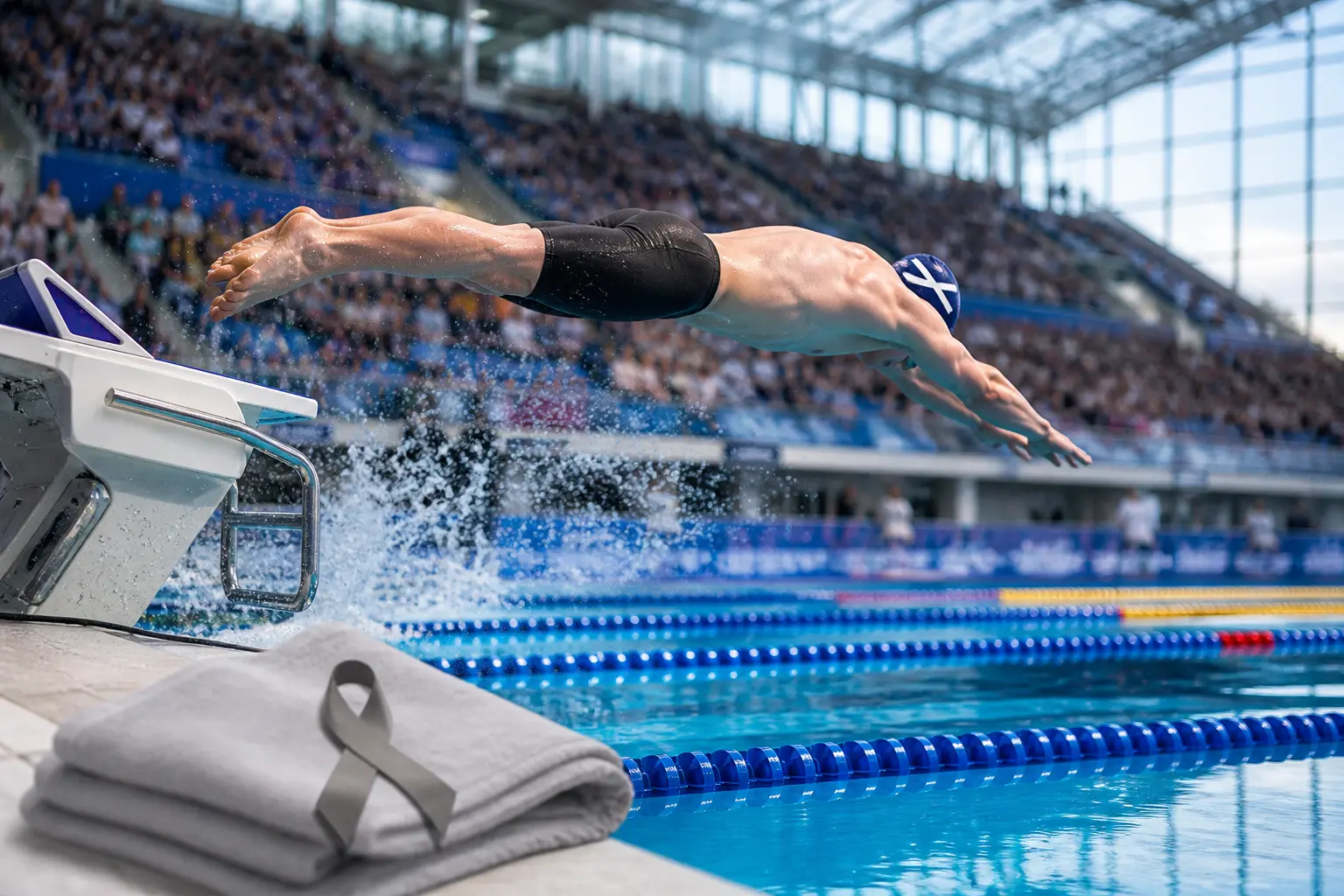
 Archie Goodburn touched the wall joint seventh, and by his own count joint last, in the Commonwealth Games 50m breaststroke final at Tollcross on Monday. Two years earlier, doctors had told the swimmer he might not live to see his 40s.
Afterward he talked less about the medal he missed than about the thousands who share his diagnosis, a cancer that still kills more people under 40 in the UK than any other. Goodburn is 25, holds the Scottish record in his event, and is, by any measure, still here.
Joint Seventh, and the Loudest Ovation of the Week
Goodburn walked out at Tollcross International Swimming Centre to what may have been the loudest ovation of the week. He had qualified for the final a day earlier and, by his own admission, spent the next 24 hours hunting for something more than the achievement of just getting there.
“Last night, I was so overcome to have achieved that primary goal of making the final. Then over the next 24 hours, you look for more,” he told BBC Sport Scotland, the outlet he has spoken to throughout his diagnosis and comeback.
He finished in a tie for seventh. Sam Williamson of Australia took gold, adding it to a 100m breaststroke title won earlier in the Games.
| Position | Swimmer | Nation | Time |
|---|---|---|---|
| Gold | Sam Williamson | Australia | 26.50 |
| Silver | Michael Houlie | South Africa | 26.77 |
| Bronze | Adam Ramsay-Peaty | Great Britain | 26.94 |
| Joint 7th | Archie Goodburn | Scotland | 27.12 national record, set February 2026 |
That 27.12 is his best time, not necessarily what he swam in Monday’s final; results for the tied placings below the medals were not broken out in detail by organisers. Either way, a gap of six tenths of a second separated Goodburn’s fastest swim from the gold medal.
“It’s pretty indescribable,” he said when asked what the past day had felt like. “Usually the words flow easily, but I’m finding myself quite speechless. I was really trying to soak it up, because I didn’t feel like I really got much of a chance to do that after the semi. And the experience was everything I dreamed of and more. But the time, unfortunately, wasn’t there.”
The Missed Call That Changed Everything
Two years ago, Goodburn was chasing a place at the Paris Olympics. Training had felt off for weeks. Seizures. Numbness down his left side. A creeping sense of deja vu he could not shake.
Scans followed, then a missed call. When he rang back, he learned he had brain cancer. He was 22.
A biopsy found three tumours, later identified as oligodendrogliomas, a form of low-grade glioma. Low-grade meant slower growing, not treatable. The tumours had spread too far through his brain tissue for surgeons to remove them. Doctors told him he might not see his 40s.
A Comeback Built One Meet at a Time
What followed was not a single comeback race but a string of them, each one rebuilding his times while his medical team rebuilt his treatment plan around him.
- December 2023: Training sessions begin interrupting themselves with strange episodes, initially mistaken for migraines, that leave Goodburn with left-side numbness and deja vu.
- May 2024: At 22, he is diagnosed with three inoperable oligodendrogliomas after biopsy surgery.
- April 2025: He wins silver in the 50m breaststroke at the British Championships in 27.76 seconds.
- June 2025: Gold follows in the 100m breaststroke at the Scottish Championships, in 1:02.42.
- November 2025: At the British Universities and Colleges Sport championships (BUCS), he takes two golds, including a lifetime-best 57.35 in the 100m breaststroke, ranking him Great Britain’s third-quickest performer in that event’s history.
- February 2026: He lowers his own Scottish 50m breaststroke record to 27.12 seconds.
- July 2026: He qualifies fifth fastest for the Commonwealth Games final at Tollcross and finishes joint seventh.
Somewhere in that stretch, he also finished a chemical engineering degree at Edinburgh University, graduating with a first. Treatment did not pause for exams any more than it paused for training.
Brain Cancer’s Under-40 Problem
Goodburn’s regimen has combined chemotherapy and radiotherapy with newer targeted drugs, access to which he says he had to fight for. Reports since his diagnosis have named the drug as vorasidenib, credited with helping halt further growth in his tumours.
His case sits inside a much larger set of numbers that gets far less attention than the disease deserves, according to data from The Brain Tumour Charity, which tracks the disease’s toll in the UK.
- 13,000: people diagnosed with a primary brain tumour in the UK each year
- 5,400: UK deaths from brain tumours annually, more than any other cancer kills in patients under 40
- 12.9%: five-year survival rate for brain cancer in England, against a 56% average across all cancers
- 27 years: the average reduction in life expectancy after a brain cancer diagnosis
Brain cancer trials also struggle simply to fill their rosters. A charity analysis noted the lowest clinical trial recruitment of any cancer, a gap researchers link directly to chronic underfunding of the field relative to more common cancers.
Fighting for Funding Beyond the Pool
Goodburn has turned that gap into the second half of his public life. Not every athlete recovering from a diagnosis this serious chooses to make the funding fight part of the job, but he has.
That dream didn’t come true, but one of my other dreams is that we see a future where brain cancer isn’t the biggest killer of patients under 40.
Goodburn said it standing at poolside, still in his cap, goggles pushed up on his forehead. He followed it with the plainer version of the same point.
“I advocate to try and extend my own life, but also for the other young patients and adults going through what I’m going through,” he said.
The funding gap he is pointing at is not new. A decade ago it already needed a parliamentary petition debate on the funding gap, according to a House of Commons Library briefing. More recently, campaigners have filed written evidence on the research funding shortfall with a parliamentary committee, arguing the disease’s death toll in young people still is not matched by research spending.
Team-Mates and a Shared Pool Deck
Goodburn did not do any of this alone this week. His girlfriend, Ciara Schlosshan, also a Scotland swimmer, raced in the 100m butterfly just five minutes before his final.
Team-mate Duncan Scott, one of Scotland’s most decorated Olympic swimmers, called Goodburn “inspirational” after the race, a word that undersold it if anything.
Fellow Scotland swimmer Sean McCann, chasing his own shot at LA 2028, was also on the Tollcross deck this week, part of a home squad racing in front of crowds First Minister John Swinney has credited with delivering wider economic benefits of hosting these Games for Scotland. Glasgow built this pool programme to produce moments like Goodburn’s final; it did not expect one quite like this.
What Happens After the Cheering Stops?
Goodburn does not have a tidy answer yet. He is 25, holds a national record, and is still working out whether Glasgow 2026 was the peak of a swimming career or the start of a full-time advocacy one, and for now he is treating it as both.
“With everything that’s going on with my health, it’s been difficult to think, ‘why am I here? Am I here to advocate as a patient advocate, or am I here to just be a professional athlete?’ And it’s kind of turned into a bit of both,” he said.
He does not know how he will feel once the adrenaline of these Games fades. “I wonder how I’m going to feel off the back of this,” Goodburn said. “But I know that I’m going to have memories to last a lifetime.”
Frequently Asked Questions
What Type of Brain Tumour Does Archie Goodburn Have?
He has three oligodendrogliomas, a form of low-grade glioma that grows more slowly than the most aggressive brain cancers but is still incurable once it has spread through brain tissue the way his has, which is why surgeons ruled out removing them.
What Is Vorasidenib, the Drug Goodburn Fought to Access?
It is a newer targeted therapy for his category of tumour that, alongside chemotherapy and radiotherapy, has been credited with helping halt further growth in his case. It is not a cure, and Goodburn has described simply getting access to it as its own battle.
How Close Was Goodburn’s Scottish Record to a Commonwealth Medal?
His Scottish record of 27.12 seconds, set in February 2026, sits about six tenths of a second behind Sam Williamson’s gold-medal time of 26.50 at Glasgow 2026, and would still have missed bronze by a similar margin, a sign of how deep the field was at the top.
Which Charities Lead the Push for More Brain Tumour Research Funding?
The Brain Tumour Charity and Brain Tumour Research are the two most prominent UK organisations on the issue, both publishing survival and funding data and both lobbying government and research bodies for a larger share of the national cancer research budget.
Will Archie Goodburn Keep Competing After Glasgow 2026?
He has not ruled it out. At 25, with a national record and a Commonwealth final already behind him this year, he has said only that he is unsure how he will feel once these Games fade from view, while insisting the memories will last regardless of what comes next.
 ONGC licence frees Venezuela cash and operatorship talks
  Anthropic Hits $65 Billion Run Rate and Flips the AI Cash Test
  Supreme Court grounds the fare free-for-all with three-week clock
  Gold Nears $4400 as Soft Data Meets Oil Inflation Risk
  Nifty Slips as Zaggle Circuits and Dhoot Debuts Big
  Diesel Crack Tops $100 as Iran Rhetoric Lifts Crude