
 Ishan Crawford
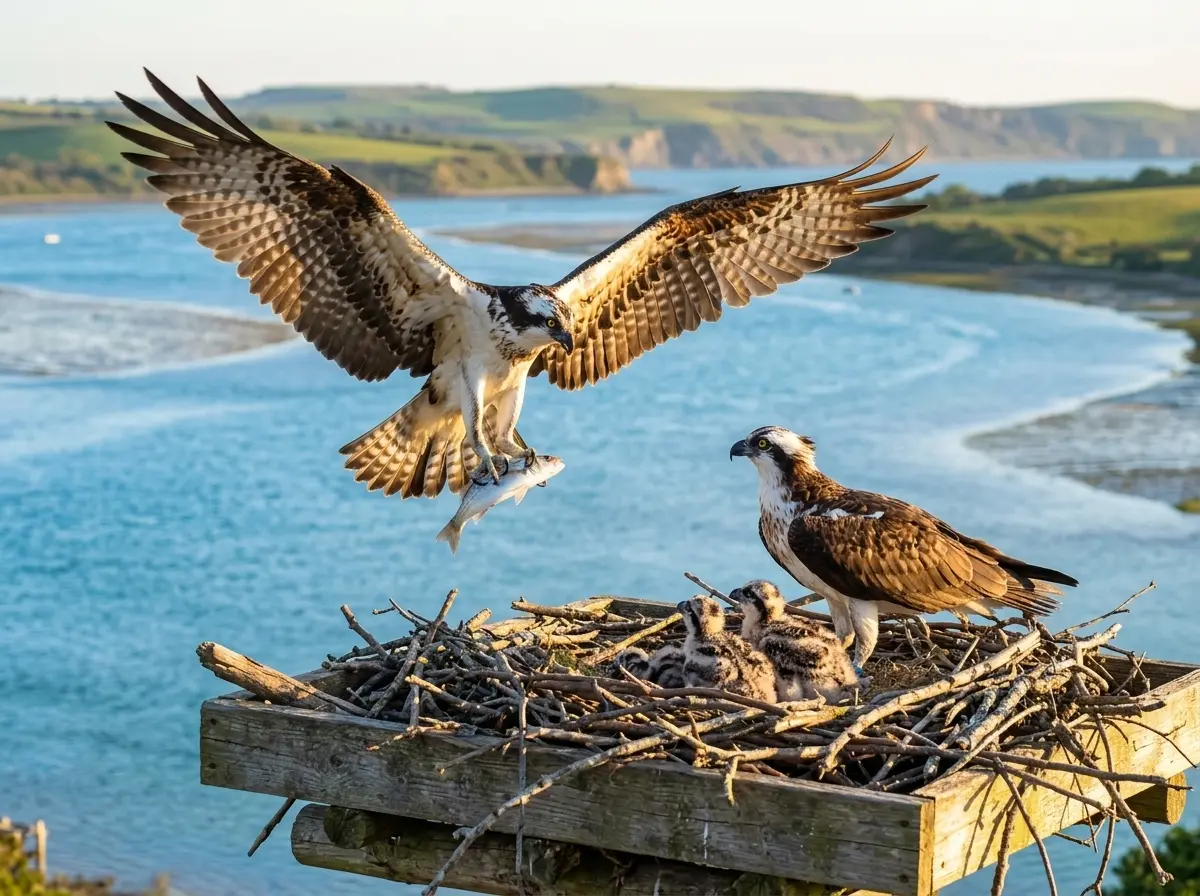
 In 2022 a male osprey ringed 022 and a female called CJ7 raised two chicks at Poole Harbour, the first breeding pair in southern England since 1847. A Bournemouth University study now shows the recovery turned on a handful of long-distance “pioneering pairs” and on the deliberate creation of more of them.
The same patterns that kept the birds bottled up in Scotland for decades also explain why moving a few dozen Scottish chicks compressed a roughly 60-year natural wait into five years of releases.
A 175-Year Absence and a Slow Highland Restart
Ospreys once nested across Britain. Persecution, egg collecting and shooting wiped them out as a breeding species by 1916. The last known British nest was in Scotland.
Natural return began in 1954 when a pair settled at Loch Garten in the Highlands. Protection and public interest followed, yet spread stayed glacial. Most males breed near their birth site. Most pairs also prefer the company of other ospreys, a habit called conspecific attraction. The result is dense clusters and empty country between them.
- 1916: Ospreys gone as a British breeding bird.
- 1954: First modern pair at Loch Garten.
- 1996: Rutland Water translocation begins from Scottish stock.
- 2017: Poole Harbour project starts moving chicks south.
- 2022: First southern England brood since 1847.
- 2025: First Dorset-hatched bird breeds and raises three young.
Scotland now holds well over 200 pairs. England’s return still needed help.
The long gap between the Highland restart and any southern foothold was not a failure of habitat. It was a failure of movement. Birds that stay near natal trees and near other nests leave wide empty belts that later generations must still cross.
That is why the timeline above jumps from a single Scottish pair in 1954 to assisted projects decades later. Without intervention, empty country remains empty.
What 54 Years of Nest Maps Revealed
Doctoral researcher Brittany Maxted led analysis of 54 years of Scottish nest data gathered by the Roy Dennis Wildlife Foundation. The records tracked every new settlement.
Most birds filled in near existing nests. A small minority flew more than 20 kilometres into empty habitat and stayed. Maxted’s team named them pioneering pairs. Those outliers seed new sub-populations and raise the overall speed of range expansion.
- Conspecific attraction: birds prefer neighbours of their own species.
- Natal philopatry: males usually breed close to where they hatched.
- Pioneer threshold: settlements beyond 20 km create separate groups.
- Expansion effect: rare long moves multiply future options for the next generation.
The pattern matches how some invasive species leapfrog across landscapes. Tools already used to forecast those leaps can now guide native recovery.
Ospreys usually like to nest in areas where there are already other ospreys… Together, these factors lead to very slow population spread for such a large bird. However… a small number of pairs were choosing to settle more than 20 km away… We call these ‘pioneering pairs’.
Brittany Maxted, Bournemouth University doctoral researcher and Birds of Poole Harbour species recovery coordinator, said the contrast drives the whole story.
Once a pioneer pair holds a new patch, conspecific attraction begins to work in the opposite direction. Empty ground becomes social ground. Later birds no longer need the same rare long flight. The map fills from the new centre as well as the old one.
That double effect is why a few distant settlements matter more than dozens of local ones. The Scottish records made the arithmetic visible across half a century.
Dorset’s Manufactured Pioneers
Between 2017 and 2021 the Roy Dennis Wildlife Foundation and Birds of Poole Harbour moved healthy seven-week-old Scottish chicks south. Up to 14 birds a year, drawn only from nests that still kept at least one chick, travelled to Poole Harbour. Specially designed hacking pens and daily fish feeds kept human contact low while the young birds finished growing and learned the local landscape.
Radio tags tracked them after release. They fed on outdoor platforms, built strength, then migrated to West Africa. Males that survived returned years later treating Dorset as home territory. That imprint is the artificial pioneer step.
CJ7, a female hatched at Rutland Water in 2015, had already started summering at Poole. The presence of the released chicks held her. In 2021 she paired with returning male 022 from the 2019 cohort. In 2022 they laid three eggs; two hatched.
Without the releases, Maxted calculated Dorset might have waited another 60 years for natural arrival.
The five release seasons therefore did not merely add birds. They reset the natal map. Surviving males now treat a southern harbour as the place they came from, which is exactly the philopatry that once locked the population in Scotland.
| Path | Timescale | Mechanism |
|---|---|---|
| Natural southern arrival | Roughly 60 more years | Rare pioneering flights only |
| Poole releases 2017-2021 | Five seasons | Imprinted males plus attracted female |
| First Poole brood | 2022 | 022 and CJ7 raise two chicks |
| First Dorset-hatched breeder | 2025 | Female 5H1 rears three young |
The Birds That Closed the Gap
The original pair returned every year. They raised four chicks in each of three successive seasons. Young stay dependent on parental fish deliveries until early September migration.
| Bird / Pair | Origin | Key year | Outcome |
|---|---|---|---|
| 022 (male) | Scotland, released 2019 | 2022 | First southern pair with CJ7; two chicks |
| CJ7 (female) | Rutland 2015 | 2022 onward | Attracted by chicks; multi-year breeder |
| 5H1 (female) | Poole 2022 wild | 2025 | Paired with Rutland male 3AY; three chicks in East Midlands |
| Second Poole pair | Local / project | Recent | Breeding away from harbour core |
Other project females settled in Wales and at Llyn Brenig. Four young males of breeding age now prospect along the south coast. A second pair has already nested away from the main harbour site.
Local watchers treat the birds as a summer fixture. Boat trips and nest cameras draw regular crowds while the science explains the sudden foothold.
Each return tightens the local network. Chicks that fledge at Poole carry the same site loyalty the releases first manufactured. The gap that once ran from the Highlands to the Channel now shrinks from both ends and from new midpoints.
Why Invasive Models Fit a Native Comeback
Dr Tim Mackrill, lead ornithologist at the Roy Dennis Wildlife Foundation and co-author, stressed that spatial expansion rests on those rare long moves. Conservation can encourage them with artificial nests or replicate them by translocation.
Dr Roy Dennis OBE, who has tracked Scottish birds since the 1960s, called the long dataset a continuing teacher. The same methods already underpin projects he advised in Spain, Italy and Portugal. Scotland’s parallel efforts on other species, including Scotland’s parallel wild salmon restoration, show the same willingness to intervene when natural pace fails.
The Journal of Animal Ecology paper argues the math developed for invaders transfers cleanly. Density-dependent settlement, leapfrog pioneers and sub-population formation are shared mechanics. Planners can site nests and release points where they will most efficiently seed the next wave.
In short, the biology does not care whether the long-distance settler is an invader or a restored native. The leap still opens a new cluster. The cluster still draws the next birds. Managers who once watched those leaps with alarm can now schedule them on purpose.
Rutland Water Supplied the Critical Link
The Dorset story does not start in 2017. It runs through the earlier Rutland Water translocation that began in 1996 with Scottish stock. That project created a mid-England colony that has since fledged hundreds of chicks.
CJ7 hatched there in 2015. She summered at Poole before any local pair existed. When released Scottish chicks appeared, conspecific attraction gave her a reason to stay. Male 022, himself a 2019 release bird, completed the pair in 2021.
The same Rutland pipeline later supplied male 3AY, who paired with Poole-hatched female 5H1 in 2025. Their three East Midlands chicks shortened the empty stretch between the new southern stock and the established Rutland centre.
- Rutland begins taking Scottish chicks in 1996.
- CJ7 hatches at Rutland in 2015 and later holds at Poole.
- Poole releases run from 2017 to 2021.
- 022 and CJ7 breed at Poole in 2022.
- 5H1, a 2022 Poole bird, breeds with Rutland male 3AY in 2025.
Each step used the same surplus Scotland could spare once it held well over 200 pairs. Translocation did not invent new behaviour. It moved the pioneer step to a chosen map reference and let philopatry and attraction do the rest.
Nests Already Waiting on the South Coast
Artificial platforms stand in Devon and Hampshire. More will follow the study’s guidance. The foundation publishes a practical how to build an osprey nest resource and a detailed artificial nest construction guide for landowners.
Four eligible males are already scouting. Conservationists expect some to become the next pioneers and push the population along the English Channel coast. The East Midlands nesting of 5H1 shortens the empty stretch toward the established Rutland colony, which itself has fledged hundreds of chicks since its 1990s start.
Europe still holds large historic gaps. The Dorset numbers and the Scottish maps together supply a tested shortcut: create the outliers that natural selection produces only rarely, then let attraction and philopatry fill in around them.
Platforms alone do not force settlement. They lower the cost of the long move when a scouting male is ready. Paired with the imprint left by earlier releases, they turn chance pioneers into planned ones.
Single Seasons Replace Generational Waits
The original Poole pair keeps returning. Their chicks keep coming back. The wait that once looked generational is now measured in single breeding seasons.
Four chicks in each of three successive seasons from the founding pair, a second local pair away from the harbour core, project females in Wales and at Llyn Brenig, and four prospecting males on the south coast all point the same way. The bottleneck was never food or nest timber in the south. It was the scarcity of birds willing to cross empty country.
By manufacturing that first crossing, then protecting the pairs that followed, the projects flipped the calendar. What natural spread might have delayed another 60 years arrived inside one study window. The next advances along the Channel will test how far the same shortcut can run.
Frequently Asked Questions
When did ospreys last breed in southern England before 2022?
The last confirmed breeding in southern England before the Poole Harbour pair was in 1847. England as a whole saw no breeding for long stretches after the species was driven out by the early 20th century; Scotland’s 1954 Loch Garten pair restarted the modern British recovery.
What exactly is a pioneering pair of ospreys?
Pioneering pairs are the minority that settle more than 20 kilometres from any other nest, often in empty habitat. Most ospreys cluster near existing birds and males stay close to their birthplace; the long-distance settlers create new sub-populations that accelerate overall range growth.
How does osprey translocation work in practice?
Healthy chicks about seven weeks old are taken from large Scottish broods (always leaving at least one), moved to hacking pens at the release site, fed fish with minimal human contact, fitted with radio tags, and released once they can fly. They imprint on the new landscape before migrating, so surviving males treat it as home when they return to breed years later.
How many osprey pairs breed in Scotland now?
Scotland holds well over 200 successful breeding pairs after steady growth from the three pairs of the mid-1960s and the 147 pairs recorded by the end of the 1990s. That surplus supplied chicks for both the Rutland and Poole Harbour projects.
Did any Dorset-hatched osprey breed successfully yet?
Yes. Female 5H1, hatched at Poole Harbour in 2022, paired in 2025 with a Rutland-origin male and reared three chicks in the East Midlands, the first wild-born Dorset bird known to breed.
 ONGC licence frees Venezuela cash and operatorship talks
  Anthropic Hits $65 Billion Run Rate and Flips the AI Cash Test
  Supreme Court grounds the fare free-for-all with three-week clock
  Gold Nears $4400 as Soft Data Meets Oil Inflation Risk
  Nifty Slips as Zaggle Circuits and Dhoot Debuts Big
  Diesel Crack Tops $100 as Iran Rhetoric Lifts Crude