
 Ishan Crawford
 Community Pharmacy Scotland has called for community pharmacies to be included in national immunisation programmes, after Public Health Scotland data showed adult flu vaccine coverage in Scotland’s most deprived areas running 25.9 percentage points behind the least deprived. For 2025/2026, flu coverage was 41.5% in the most deprived decile, against 67.4% in the least. The PHS report, published 9 June 2026, named the gap. The pharmacy body argues its network is the delivery channel the five-year vaccination framework has so far underused.
The same report shows overall uptake improving. PHS framed the headline as “persistent inequality in vaccine uptake linked to deprivation, ethnicity, sex, and geography.” Community Pharmacy Scotland says the five-year vaccination framework published in 2024 has so far left pharmacies on the outside of the national delivery model.
The Persistent Inequality Map
The 9 June 2026 PHS report covers Scotland’s Vaccination and Immunisation Programme activities in 2025. It is the source Public Health Scotland uses to track its five-year framework. PHS frames the data around four inequality dimensions: deprivation, ethnicity, sex, and geography. The report’s overall message is that vaccination is working, but not for everyone.
The aggregate moved in the right direction. Childhood immunisations by 12 months have stabilised, and there have been improvements by age five. The winter vaccine programme recorded gains. Over 1.8 million flu doses were administered in the latest programme, with uptake highest among care home residents at 82.6% and adults aged 75 and over at 81.0%. Healthcare worker uptake also improved on winter 2024/25.
The average hides a wider spread. PHS said “very remote small towns and very remote rural areas consistently show the lowest coverage across adult vaccinations.” A new data framework is being planned to support delivery and track the impact of the 5-year plan. Dr Sam Ghebrehewet, Head of the Vaccination and Immunisation Division (VAID) at PHS, said the report “provides insight into areas where further focus and sustained effort are required.” The full PHS 2025 annual vaccination report announcement is on the PHS site.
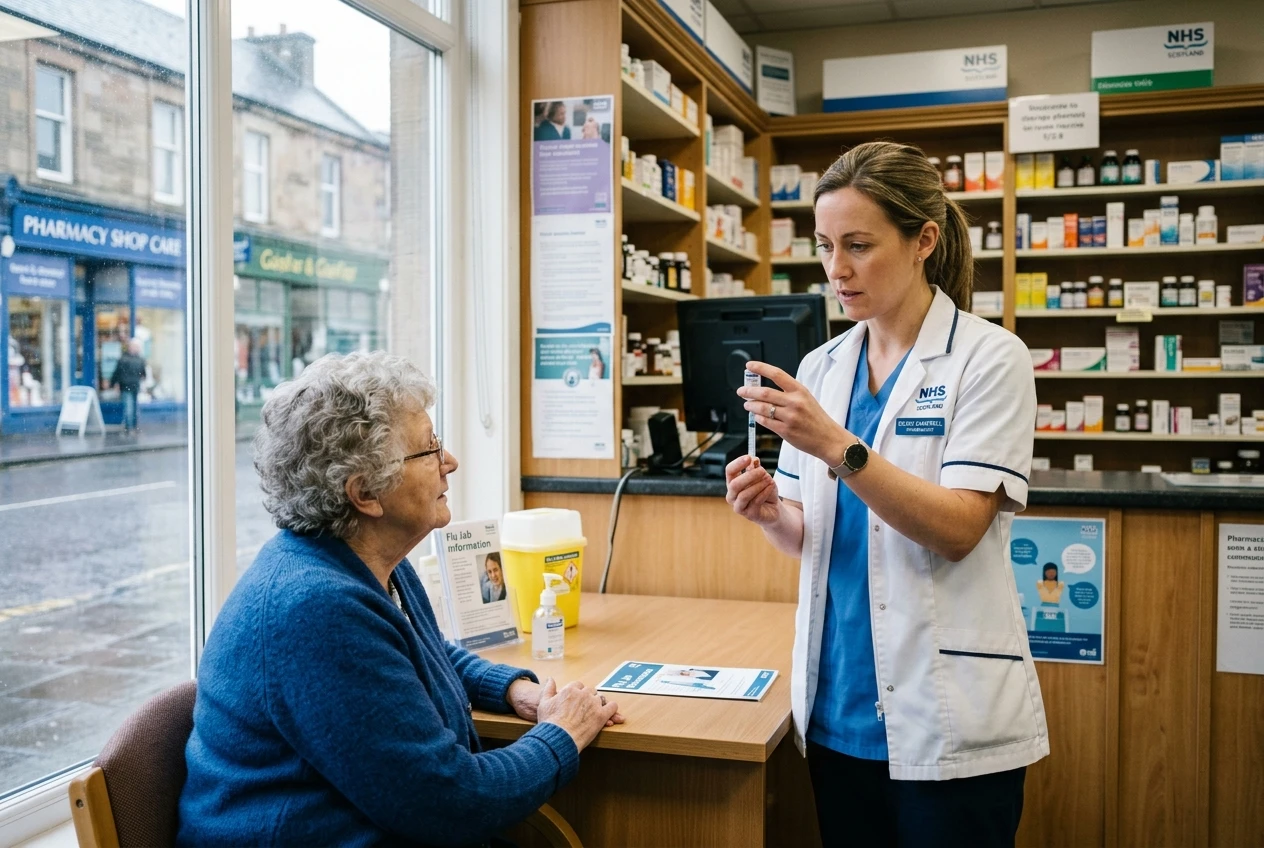
Adult Flu and the 25.9-Point Gap
The adult flu programme is where the deprivation gap is widest. PHS recorded 41.5% adult flu coverage in the most deprived decile for 2025/2026, against 67.4% in the least deprived. The table below shows the figures across the three measures.
The gap between most and least deprived on flu runs to 25.9 percentage points, the largest deprivation signal in the data set. The gap is not a rural-urban artefact. It is measured within the deprivation index, which sorts postcodes across the country. Within a region of broadly similar rurality, people in poorer postcodes are still being left behind on flu.
| Measure | Lowest group | Highest group |
|---|---|---|
| Adult flu 2025/2026 (deprivation) | Most deprived decile, 41.5% | Least deprived decile, 67.4% |
| HPV, school year 2024/2025 (deprivation) | Most deprived quintile, 62.0% | Least deprived quintile, 83.4% |
| HPV, school year 2024/2025 (geography) | Remote small towns, 59.5% | Accessible rural areas, 75.9% |
Teenagers, Geography, and the HPV Split
The school HPV programme shows the same pattern by a different route. Human papillomavirus coverage in school year 2024/2025 was 62.0% in the most deprived quintile, against 83.4% in the least deprived. The 21.4 percentage point deprivation gap is the headline number for the teenage programme.
Geography layers on a second cut. PHS recorded HPV uptake of 75.9% in accessible rural areas, against 59.5% in remote small towns, a 16.4 percentage point gap. Uptake among teenagers also varied by ethnicity and rurality, the report said, with very remote small towns and very remote rural areas showing the lowest coverage across adult vaccinations. PHS did not publish a single headline ethnicity figure in the same form.
Children’s routine immunisations follow the same shape. “Children living in the most deprived areas have lower overall uptake, tend to receive their immunisations later / take up offers later, and are less likely to complete courses (receive all doses),” PHS said. National-level figures can mask local variation. The inequality shows up across multiple programmes.
Why Community Pharmacies Want a Seat at the Table
Community Pharmacy Scotland (the membership body for Scottish pharmacy owners) is the body that issued the call. Its response to the PHS data is to argue that the network is the delivery channel the framework has so far underused. The pitch is built on reach and on the teams already in place.
The pitch, detailed in CPS’s call to join Scotland’s vaccine delivery, is built on reach. CPS points to its network’s presence in both urban and rural areas, often close to where people work and live, and to the expert teams on site in each location. The body argues that a wider inclusion of community pharmacy in the framework could reverse declining vaccination uptake and improve equitable access. The ask is operational, with the network folded into the framework’s delivery model.
Given the broad reach of community pharmacies across Scotland in urban and rural areas close to where people work and live, with expert teams on-site, community pharmacies are excellently placed to play a key role in the delivery of the goals and priorities of ‘Scotland’s five-year vaccination and immunisation framework and delivery plan’. Through the inclusion of community pharmacy in the strong collaborative whole team working, our teams can contribute to the delivery plan, help reverse declining vaccination uptake rates and deliver improved, equitable care to the citizens of Scotland.
The geographic argument is direct: the very remote small towns PHS flags as lowest adult coverage are the same areas where the next professional contact is often a pharmacy counter. CPS is asking the framework to fold pharmacy teams into the collaborative whole-team working the plan already calls for.
The body made the same case in 2025/26, securing a £120 million reimbursement deal with the Scottish Government for the year, the funding context for its current push to be folded into the national immunisation programme. That deal, the £120 million reimbursement agreement for 2025/26, gives CPS the financial base to argue for an operational seat at the table. The ask is a defined role in the framework’s delivery model.
The April 2026 Group Directions
A small regulatory change has shifted the practical ceiling for what pharmacy teams can do. Vaccine group directions, introduced in April 2026, allow the delegation of tasks such as preparation and administration of vaccines to trained staff.
The change matters because community pharmacies have been constrained by what their teams can do under existing direction. With delegation allowed, more of the work that a GP practice nurse does can move to a pharmacy setting, where the patient is already walking in. CPS welcomed the move and framed it as groundwork for the wider inclusion it is asking for in the 5-year framework.
The 5-Year Framework’s Own Test
The 2024 vaccination framework and delivery plan was published in 2024. It sets out four key areas, including ensuring equitable access to vaccines and strengthening capacity and capability of the vaccination workforce. PHS said early engagement with NHS Boards shows a broad range of activities already underway. A new data framework is being built to track delivery against the plan.
A new data framework is planned to support delivery, enhance efficiency, and track the impact of the vaccination programme and its 5-year plan. PHS has the data to measure whether uptake gaps by deprivation, ethnicity, sex, and geography narrow by the end of the framework’s term. The framework’s own test is whether those gaps close by 2030.
The next PHS annual report, in 2027, will be the first checkpoint on whether that is happening. The framework, the regulatory change, the data, and the call have arrived in this order:
- 2024: Five-year vaccination and immunisation framework and delivery plan published
- April 2026: Vaccine group directions introduced, allowing delegation of vaccine tasks to trained staff
- 9 June 2026: PHS publishes 2025 annual vaccination and immunisation report
- 11 June 2026: CPS calls for community pharmacies to be included in national immunisation programmes
Frequently Asked Questions
What did Public Health Scotland’s 2025 vaccination report find?
Public Health Scotland published its annual vaccination and immunisation report on 9 June 2026, covering Scotland’s 2025 activities. The report found that overall uptake improved, with over 1.8 million flu doses administered and care home residents reaching 82.6%, but “persistent inequality in vaccine uptake linked to deprivation, ethnicity, sex, and geography” remained.
How large is the flu vaccine inequality gap in Scotland?
For 2025/2026, adult flu coverage was 41.5% in the most deprived decile and 67.4% in the least deprived decile, a 25.9 percentage point gap. The PHS report said very remote small towns and very remote rural areas showed the lowest adult coverage overall.
What are vaccine group directions and when were they introduced?
Vaccine group directions are rules that allow the delegation of tasks such as the preparation and administration of vaccines to trained staff. They were introduced in April 2026. Community Pharmacy Scotland has welcomed the change as a step that allows pharmacy teams to do more of the vaccination work.
What is Scotland’s 5-year vaccination and immunisation framework?
The 5-year vaccination and immunisation framework and delivery plan was published in 2024. It sets out four key areas, including ensuring equitable access to vaccines and strengthening the vaccination workforce. PHS said early engagement with NHS Boards shows a broad range of activities already underway, and a new data framework is planned to track the impact.
Why is Community Pharmacy Scotland calling for inclusion in vaccine delivery?
CPS argues that community pharmacies have broad reach across both urban and rural Scotland, often close to where people work and live, with expert teams on site. The body says its network can play a key role in delivering the goals of the 5-year framework and in helping reverse declining vaccination uptake rates.
Disclaimer: This article is for informational purposes only and is not a substitute for professional medical advice. Figures are accurate as of publication, 12 June 2026. Consult a qualified healthcare professional for vaccination guidance.
 One UI 9’s Privacy Display Fix Reaches Just One Galaxy Phone
  Samsung Drops Its Own Exynos Chip for the Galaxy Watch9 and Ultra 2
  Marathon’s Vault Breaker Arrives as Bungie’s Bigger Bet Keeps Faltering
  Sony’s PlayStation Disc Cutoff Erases the Last Proof of Ownership
  Tesla’s Summer Update Hands Grok the Keys, and Musk’s Empire More Reach
  Apple’s $634 Million Masimo Payment Is Final After Appeal Denial