
 Ishan Crawford
 China’s crude oil imports jumped 22% in July to an average of 8.45 million barrels per day even as retail sales rose just 0.6% and industrial output slowed to 4.5%, both missing forecasts. The rebound from June’s decade-low came while the economy posted its weakest quarterly GDP growth since 2022 at 4.3% in the second quarter.
The numbers do not point to a demand recovery. They show Beijing still able to manage its buying after months of drawing stocks during the Iran conflict that has constrained the Strait of Hormuz.
The gap between the import bounce and the soft domestic print is the core of the July story. Buying can rise for inventory reasons even when factories, shops and builders are not calling for more fuel. That is the pattern the data describe.
July’s import rebound meets cooler domestic readings
Customs data put July crude arrivals at 35.73 million tons, or 8.45 million bpd, up from the lowest level since October 2016 in June. That volume remains roughly 24% below July 2025 and more than 3 million bpd under pre-war paces near 11.5 million bpd for seaborne cargoes.
The same week, the National Bureau of Statistics released the official July industrial and retail figures. Industrial value-added grew 4.5% year on year, down from 5.3% in June and short of the 4.8% expected in a Reuters poll. Retail sales of consumer goods rose 0.6%, slowing from 1% and well under the 1.5% forecast, even with summer tourism.
| Indicator | July 2026 | June 2026 | Market expectation |
|---|---|---|---|
| Crude oil imports (mbpd) | 8.45 | ~7.12 | n/a |
| Industrial output YoY | 4.5% | 5.3% | 4.8% |
| Retail sales YoY | 0.6% | 1.0% | 1.5% |
| Manufacturing PMI | 49.2 | 50.3 | 50.0 |
Fixed-asset investment contracted 6.7% in the first seven months. New home prices kept falling. The manufacturing PMI slipped into contraction at 49.2. Exports stayed strong, but domestic demand did not.
Every major domestic gauge either slowed or missed. Industrial growth lost nearly a full point from June. Retail sales came in at less than half the expected pace. The PMI cross into contraction territory confirmed that factory activity was no longer expanding. Against that backdrop, a 22% month on month import jump reads as restocking room, not a surge in end use.
Pre-war seaborne paces near 11.5 million bpd remain a distant benchmark. July’s 8.45 million bpd still leaves China more than 3 million bpd short of that earlier rhythm, and roughly a quarter below the year earlier level. The rebound closed only part of the gap opened since the conflict began.
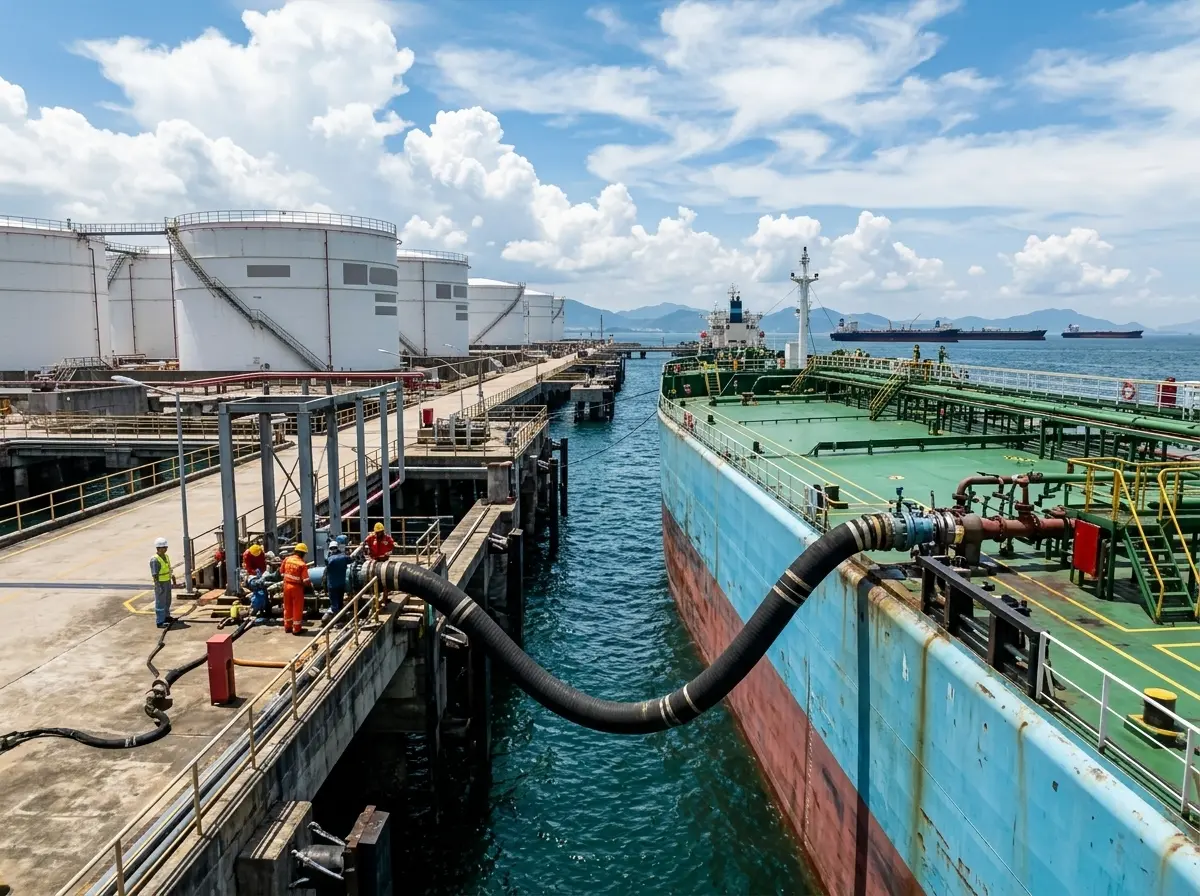
A slim surplus after months of draws
Clyde Russell, Asia commodities columnist at Reuters, calculated that China added about 210,000 bpd to crude inventories in July. Imports of 8.41 million bpd plus domestic output of 4.3 million bpd gave refiners 12.72 million bpd available. Throughput ran at 12.51 million bpd, only a touch above June’s 12.47 million and down 15.8% from a year earlier.
| July balance item | Volume (mbpd) |
|---|---|
| Imports (Russell basis) | 8.41 |
| Domestic output | 4.3 |
| Available to refiners | 12.72 |
| Refinery throughput | 12.51 |
| Implied stock change | +0.21 |
- May draw: roughly 500,000 bpd from stocks
- June draw: about 940,000 bpd
- July surplus: ~210,000 bpd back into storage
- First seven months net: ~480,000 bpd added overall
The May and June draws were large enough to absorb a sharp cut in arrivals. July’s small surplus reversed only a fraction of those two months. On a year to date basis the net build of about 480,000 bpd shows that the earlier stockpile growth still dominates the conflict period arithmetic.
Refinery runs stayed high enough for domestic needs because Beijing had curbed fuel exports earlier in the conflict. July product exports of 4.65 million tons sat only slightly above June. For the year to date they were down 13.1%. Those curbs are now easing for a second month in August, which could lift runs and eventually imports.
Throughput at 12.51 million bpd was barely changed from June and still far below the year earlier level. The system is covering local fuel needs without pushing runs hard. That leaves little immediate pressure to chase every available cargo.
The war chest that let Beijing pause
China entered the Iran conflict, which began with attacks on 28 February, holding the world’s largest estimated crude stockpile. The U.S. Energy Information Administration put total inventories at nearly 1.4 billion barrels by end-2025, after China added an average 1.1 million bpd through that year. Roughly 360 million barrels sat in government strategic reserves and about 1 billion in commercial stocks held by national oil companies and refiners.
Russell puts current holdings at least at 1.2 billion barrels. Either figure dwarfs the U.S. Strategic Petroleum Reserve, which stood near 413 million barrels before coordinated IEA releases. China has barely needed to tap the bulk of that cushion. It cut imports sharply, lowered runs where necessary, and restricted product exports to protect domestic supply. The result is that the world’s largest crude importer has absorbed much of the supply loss from Hormuz without emptying its tanks.
| Holder | Estimated strategic/commercial crude (end-2025) |
|---|---|
| China (total) | ~1.4 billion barrels |
| United States SPR | ~413 million barrels |
| Japan government | ~263 million barrels |
That buffer is the second-order fact. Soft domestic demand reduces the urgency to refill quickly. The July surplus, though small, shows the pause can continue.
China’s end-2025 total was more than three times the U.S. SPR level and more than five times Japan’s government holding. The commercial slice alone, near 1 billion barrels, gave refiners and national oil companies a deep working inventory before any strategic barrels were touched. Months of lower imports and controlled runs therefore did not force an emergency draw on the full stockpile.
The 1.1 million bpd average build through 2025 created the headroom used in 2026. Without that earlier accumulation, the same Hormuz disruption would have required either higher wartime imports or deeper cuts to domestic product supply. Beijing chose neither path in full.
Teapot stocks ran lower while the nation added a little
National math shows a modest rebuild. Regional data tell a tighter story. Independent “teapot” refiners in Shandong province, the main buyers of discounted Iranian barrels, saw inventories drop by about 35 million barrels in July to 360 million barrels, an eight-month low and the largest monthly draw since tracking began in 2016, according to Energy Aspects figures circulated on X and in market notes.
Those plants had been ordered to maximize fuel output earlier in the war and leaned hard on their own stocks. With tanks lower, some buying could return even if overall Chinese demand stays muted. Crowd discussion on X has focused on exactly this split: state firms can wait; teapots may not.
Electric vehicles already displaced about 1.4 million bpd of Chinese oil demand in the first half of 2026, up 42% year on year per Jefferies analysis shared widely. That structural cut sits alongside the cyclical softness.
The national surplus and the Shandong draw can hold at the same time because the two systems are not the same buyer. State firms and the broader commercial pool can post a small build while independent plants drain local tanks to keep runs going. The 35 million barrel July drop at teapots is large against their 360 million barrel end level. It is still small against a national holding measured in well over a billion barrels.
That is why market talk has separated the two clocks. One clock is national and slow. The other is regional and faster. Discounted grades tied to the teapot complex are the barrels most likely to feel any earlier return to the market.
How the lid on prices has held
Global oil prices have stayed below the extremes some feared when Hormuz traffic first seized up. China supplied much of the reason. By staying out or buying lightly, it left more barrels for others and prevented a sharper scramble. Analysts have long noted that when China eventually returns in force, the bid will not be gentle for oil bears.
The current pattern fits that warning. August seaborne estimates from Kpler sit near 7 million bpd, still far below pre-war norms. Fuel-export easing could raise runs and pull more crude. Yet retail and industrial weakness, plus property drag, give policymakers little reason to flood the system with oil. Stimulus talk continues, but so far it has been incremental.
Related pressure points already show in product markets and alternative routes. The products squeeze toward higher oil prices has been one visible channel. Repeated ceasefire collapses have also kept risk elevated, as seen in the latest crude rally after another ceasefire failure.
August estimates near 7 million bpd seaborne would mark another soft month after July’s partial rebound. The path is not a straight climb back to 11.5 million bpd. Each month that arrivals stay light leaves more seaborne supply for other importers and caps the urgency in the spot market. The lid holds only while that restraint lasts.
Who gains time and who waits on the bid
Beijing gains strategic flexibility. It can meet domestic needs from stocks and reduced product exports while avoiding expensive war-priced barrels. State refiners keep operating. Consumers face less immediate fuel-price shock than they might have.
Oil producers and bulls wait. Every month China stays light on imports is another month the market must clear without its largest buyer. Middle East suppliers, already constrained by the strait, lose volume. Russia has gained share elsewhere, including with India, where India’s heavy Russian crude dependence has created its own chokepoint risks in the Black Sea.
Independent Chinese refiners sit in the middle. Lower Shandong stocks raise the chance they step back into the market sooner than the national totals imply. That could support Iranian and other discounted grades first.
- Beijing: flexibility on timing, protected domestic supply, deferred war-price exposure
- State refiners: steady operations from stocks and curbed product exports
- Middle East suppliers: lost volume while the strait stays constrained
- Oil bulls: delayed support from the world’s largest importer
- Teapot plants: earlier buy need if Shandong tanks keep falling
Time is not evenly shared. Policymakers and state firms hold the longer option. Producers that once counted on steady Chinese seaborne demand do not. The teapot layer is the hinge that could move first without a full national restock programme.
- February 28, 2026: U.S. and Israeli strikes on Iran begin; Hormuz traffic faces repeated disruption.
- March-June 2026: China cuts imports sharply, draws stocks in May and June, restricts fuel exports.
- July 2026: Imports rebound 22% MoM to ~8.45 mbpd; national surplus of ~210k bpd; teapot stocks hit multi-month lows.
- August 2026: Fuel export curbs ease further; early seaborne estimates stay subdued; economic data confirm soft domestic demand.
Fuel Export Easing Starts to Change Incentives
Product export curbs were a central tool in the first months of the conflict. By keeping more fuel at home, Beijing could hold refinery runs at levels that met domestic needs even while crude imports fell. July product exports of 4.65 million tons, only slightly above June and still down 13.1% for the year to date, show how long that lid stayed on.
The curbs are now easing for a second month in August. That shift changes the arithmetic inside the refining system. Higher allowed exports give plants a reason to raise throughput above the 12.51 million bpd July pace. Higher runs, if sustained, pull more crude through the gate and eventually lift import needs.
The sequence is mechanical. Curbs protected stocks and limited the call on seaborne crude. Easing reopens an outlet. The outlet does not force an immediate import surge while domestic demand is soft and national inventories remain large. It does shorten the period in which runs can stay suppressed without consequence.
August seaborne estimates near 7 million bpd suggest the market has not yet priced a full reopening. Any lift in runs from easier fuel exports would have to clear that still subdued arrival pace before it shows up as a clear bid for extra barrels.
Electric Vehicles Trim the Floor Under Demand
Cyclical weakness in retail sales, industrial output and property is only one side of the demand picture. The other is structural. Electric vehicles displaced about 1.4 million bpd of Chinese oil demand in the first half of 2026, a 42% year on year rise according to the Jefferies analysis already circulating in the market.
That displacement lowers the floor under oil use even if stimulus later steadies factories and shops. A smaller structural base means the same level of economic activity calls for less crude than it did before the EV fleet expanded. It also means restocking targets can be met with less urgency once tanks are judged adequate.
Set beside the July figures, the EV effect helps explain why a modest national surplus was enough to signal patience. Industrial growth at 4.5%, retail sales at 0.6%, and a manufacturing PMI at 49.2 already pointed to soft cyclical demand. Layer on 1.4 million bpd of displaced oil use and the case for racing back to pre-war import paces weakens further.
The teapot complex still runs on a different clock. Structural demand loss does not refill a Shandong tank that has already dropped 35 million barrels in a month. National planners can lean on the EV trend and the wider stockpile. Independent plants watching eight-month lows cannot lean as long.
The runway is real but not endless. Commercial stocks at teapots have already fallen hard. National holdings remain large, yet continued low runs and any export recovery will eventually require more crude. When that buying returns against still-tight Middle East supply, the price effect will be larger than the July rebound itself suggested.
For now the combination of weak July indicators and a modest stock rebuild simply lengthens the period in which China can choose when to re-enter. That choice remains the quiet swing factor hanging over the oil market.
 ONGC licence frees Venezuela cash and operatorship talks
  Anthropic Hits $65 Billion Run Rate and Flips the AI Cash Test
  Supreme Court grounds the fare free-for-all with three-week clock
  Gold Nears $4400 as Soft Data Meets Oil Inflation Risk
  Nifty Slips as Zaggle Circuits and Dhoot Debuts Big
  Diesel Crack Tops $100 as Iran Rhetoric Lifts Crude