
 Ishan Crawford
 India’s crude oil imports from Russia are running at around 2.6 million barrels per day in July, roughly 55 percent of the country’s total, according to Kpler analysis. The same firm says volumes could climb toward or above 3 million barrels per day if Red Sea or Strait of Hormuz shipments stay disrupted.
That hedge has already rewritten the risk map. Black Sea export hubs now matter more to Indian refiners than the traditional Gulf chokepoints. The shift is visible in monthly tallies, in the ranking of terminals, and in the way refiners plan cover when a route falters.
What began as opportunistic buying of discounted barrels has hardened into structural dependence. Russian grades now set the tone for India’s crude slate in a way no single Gulf supplier has matched in recent months.
July Flows Sit Near Record Levels
Sumit Ritolia, lead analyst for modelling and refining at Kpler, put July Russian arrivals near record highs. Flows have climbed sharply from about 1.0 million barrels per day only months earlier. June hit approximately 2.70 million barrels per day by Kpler and LSEG tracking, more than half of India’s crude slate that month.
Total Indian crude imports hovered near 4.9 million barrels per day in June. Russia’s share crossed 50 percent and has held near 55 percent into July. Saudi Arabia, once a cornerstone, has averaged only about 400,000 barrels per day recently.
The climb from roughly 1.0 million barrels per day to the mid-2 million range compressed into a short span. That pace left little time for the rest of the slate to rebalance. Gulf volumes did not simply hold steady; they lost relative weight as Russian cargoes filled available refining capacity.
| Supplier / Route | Recent Volume (kbd) | Share Context |
|---|---|---|
| Russia (July tracking) | 2,600 | ~55% of India total |
| Saudi Arabia (recent average) | 400 | Far below Russia |
| Saudi East-West / Yanbu cushion | 300-500 | Red Sea alternate |
| Sheskharis (Novorossiysk) to India (June) | ~840 | ~28% of India Russia flows |
Ritolia noted that Russian crude remains the strongest available supply hedge if market conditions and Russian export availability allow further gains. The path to 3 million barrels per day is therefore less about finding new sellers and more about whether existing Russian export channels can sustain or expand current loadings.
June’s 2.70 million barrels per day already tested that channel capacity. July’s 2.6 million barrels per day held near the same elevated band even as overall Russian crude exports slipped by about 400,000 barrels per day against the prior month. Indian offtake proved sticky while the wider export pool tightened.
Black Sea Terminals Outrank the Old Chokepoints
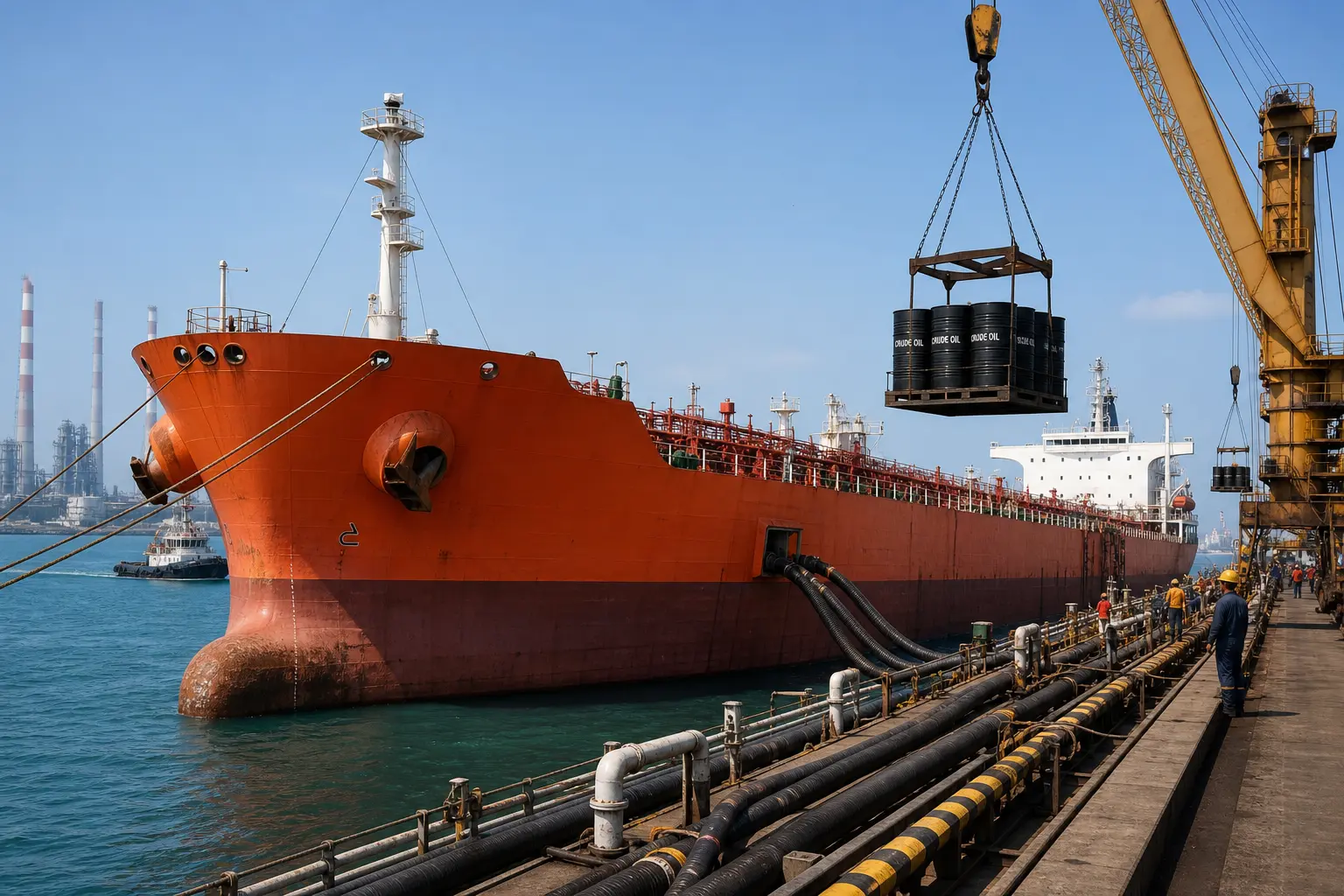
The pivot has inverted priorities. Hormuz and the Red Sea still matter. Yet uninterrupted Russian export infrastructure, especially Black Sea terminals such as Novorossiysk, has become equally or more critical for India’s crude supply.
Ritolia stated the point plainly on X: Russian crude now accounts for about 55 percent of imports, tying security closely to those export nodes. Saudi Red Sea volumes to India average just 400,000 barrels per day, so a prolonged Black Sea outage would hit harder than a Red Sea interruption.
- 2.6 mbd July Russian crude to India
- 55% share of total Indian crude imports
- ~840 kbd from Sheskharis terminal alone to India in June
- 400 kbd drop in overall Russian crude exports July versus prior month
Alternatives for Black Sea crude are limited. Cargoes cannot easily reroute the way Red Sea volumes can via pipeline, SUMED, Suez or around Africa. Novorossiysk also loads CPC crude from Kazakhstan headed for Europe, so any extended halt tightens global flows and hits India’s largest import source directly.
That dual role matters. A stoppage at the complex would not only cut Urals and Siberian Light bound for India. It would also squeeze CPC barrels moving toward European buyers, tightening the wider market into which Indian refiners might otherwise turn for spot cover.
The arithmetic is stark when set beside the Saudi Red Sea average. At roughly 400,000 barrels per day, those Gulf flows are less than half the June volume that Sheskharis alone sent to India. Losing the smaller stream hurts. Losing the larger one rewrites monthly balances.
How the Red Sea Cushion Works
If Red Sea shipping stays open, Indian refiners keep a buffer through Saudi Arabia’s East-West pipeline to Yanbu. That route has recently moved 300,000 to 500,000 barrels per day of crude.
Should security worsen and those volumes vanish in August, refiners would replace them mainly with more Russian barrels plus spot West African cargoes. They would also draw commercial inventories for short-term cover.
- Saudi East-West (Yanbu) pipeline: 300-500 kbd recent cushion
- SUMED pipeline and Suez Canal: reroute options for some Red Sea cargoes
- Cape of Good Hope: longer but open alternative around Africa
- West African spot cargoes: secondary replacement when available
India’s import basket has broadened with more barrels from Venezuela, Africa and the Atlantic Basin. That flexibility lowers the chance of a critical shortage even if Red Sea traffic falters.
The cushion is real but finite. Yanbu’s recent 300,000 to 500,000 barrels per day band is meaningful against a single disrupted Gulf route. It is modest against a Russian slate running above 2.5 million barrels per day. Replacement math therefore still points back to Russian availability and to whatever West African spot barrels the market can free.
Inventory draws buy days, not months. Commercial stocks can bridge a short interruption while new fixtures are arranged. They cannot substitute for a sustained loss of the dominant supplier without a matching lift in other grades.
Recent Halt at Sheskharis Showed the Exposure
In late July 2026, Russia’s largest Black Sea oil terminal suspended loadings after a surge in Ukrainian drone attacks. The Sheskharis facility in Novorossiysk halted tanker loadings for days, disrupting roughly one-fifth of Russia’s seaborne crude exports at the time.
- Mid-July 2026: Surge in Ukrainian drone threats around Novorossiysk oil infrastructure
- Around 20-22 July: Sheskharis loadings stop; satellite and tracking data confirm multi-day pause
- Late July: Partial resumption noted, with some tankers reportedly sailing AIS-dark; analysts call the halt temporary but telling
Of the 1.1 million barrels per day loaded at the terminal in June, around 840,000 barrels per day of Urals and Siberian Light headed to Indian refiners. That single node supplied about 28 percent of India’s Russian crude that month. Pre-Hormuz crisis averages from the complex sat nearer 465,000 barrels per day.
Analysts said the port infrastructure itself stayed undamaged and operators have adapted with shadow-fleet practices. Still, the episode underlined the new concentration of risk.
The jump from a pre-crisis average near 465,000 barrels per day to a June India-bound figure around 840,000 barrels per day shows how heavily the trade has leaned on one complex. When loadings paused for days, the effect was immediate in tracking data even if the physical plant escaped lasting damage.
Partial resumption and AIS-dark sailings restored some movement. They did not erase the lesson. A terminal that accounts for roughly 28 percent of India’s Russian crude in a peak month is no longer a peripheral node. It is a core dependency.
Diversification Did Not Eliminate Single-Supplier Weight
India once took a large share of its oil through the Strait of Hormuz. An IEA factsheet based on 2025 data put total oil flows through the strait at nearly 20 million barrels per day of oil, with roughly 15 million barrels per day of crude, most bound for Asia. China and India together took 44 percent of those crude volumes. Spare pipeline capacity to bypass the strait sits in the 3.5 to 5.5 million barrels per day range, mainly Saudi and UAE lines.
A Kpler note earlier in 2026 recorded that India imports roughly 50 percent via Hormuz at peak exposure periods. The subsequent surge in Russian barrels cut that Gulf dependence sharply. Earlier tracking showed Hormuz’s share of Indian oil imports falling from higher historical levels toward the low 30s percent range before the latest crisis reversed the risk profile.
The result is a broader basket on paper and a heavier single-country weight in practice. Russian volumes now dwarf Saudi deliveries. Developments around Black Sea terminals carry greater near-term significance for Indian refiners than Saudi Red Sea exports.
| Exposure Measure | Figure | Implication for India |
|---|---|---|
| Hormuz total oil flows (IEA 2025 basis) | ~20 mbd | Global chokepoint scale |
| Hormuz crude flows | ~15 mbd | Most bound for Asia |
| China and India share of Hormuz crude | 44% | Joint Asian weight |
| India Hormuz share at peak periods | ~50% | Earlier concentration |
| India Hormuz share after Russian surge | Low 30s % | Reduced Gulf reliance |
| Bypass pipeline spare capacity | 3.5-5.5 mbd | Saudi and UAE lines |
Bypass lines in the 3.5 to 5.5 million barrels per day range offer partial relief for Gulf volumes. They do nothing for Black Sea loadings. Diversification across Venezuela, Africa and the Atlantic Basin widens options at the margin. It has not displaced the Russian core that now supplies about 55 percent of the slate.
Refiners Face Export Limits and Sanctions Friction
The key uncertainty is whether Russia can keep supplying higher volumes. Ukrainian attacks on upstream and downstream energy sites already cut Russian crude exports by about 400,000 barrels per day in July versus the prior month. Further infrastructure hits would constrain the upside to India’s 3 million barrels per day scenario.
Russian crude remains India’s strongest supply hedge, and imports could potentially rise toward or even above 3.0 mbd if market conditions and Russian export availability permit.
Sumit Ritolia of Kpler made that assessment in the analysis carried by multiple outlets this week.
Indian state-owned refiners have stayed more willing to lift Russian cargoes than some private players wary of product-export restrictions into Europe. Discounts have narrowed as competition with Chinese buyers intensified. Shadow-fleet logistics and compliance costs remain part of the trade, as seen in cases such as a Russian navy escort of a sanctioned tanker and earlier sanctions compliance failures on Russia oil.
A disruption to Red Sea shipments would tighten supply but is unlikely to trigger critical shortage under current Russian flows. The larger open question is the durability of those Black Sea loadings themselves.
Narrower discounts raise the landed cost of the hedge even when barrels remain available. State-owned buyers have absorbed more of that friction. Private refiners watching European product-export rules have been more selective. The split inside India’s refining system means any future squeeze would land unevenly across companies.
Russian Barrels Now Crowd Out Gulf Suppliers
The supplier ranking has flipped in plain sight. Russia at about 2.6 million barrels per day in July and roughly 2.70 million in June leaves Saudi Arabia’s recent average near 400,000 barrels per day far behind. The gap is not incremental. It is the difference between a dominant feedstock and a supporting stream.
- Russia June: approximately 2.70 mbd, more than half of India’s slate
- Russia July tracking: about 2.6 mbd, near 55 percent share
- Saudi recent average: about 400 kbd
- Yanbu Red Sea cushion: 300-500 kbd when the route runs
- Sheskharis to India in June: about 840 kbd from one terminal
Months earlier, Russian flows sat near 1.0 million barrels per day. The rise since then absorbed the room that Gulf grades once occupied in monthly programs. Saudi volumes did not vanish, yet their share of the basket shrank as Russian cargoes claimed refining slots and term attention.
Competition with Chinese buyers has reinforced the pattern. When both large Asian importers bid for the same discounted grades, the barrels still move, but the price advantage narrows. Indian refiners keep lifting because the absolute volumes remain hard to replace elsewhere at scale.
Two Disruption Paths Point to Different Stresses
Refiners now plan against two distinct interruption scenarios, each with its own replacement path and severity.
- Red Sea or Hormuz pressure: Yanbu cushion of 300-500 kbd, SUMED and Suez reroutes, Cape of Good Hope sailings, West African spot barrels, and inventory draws provide layered cover. Russian flows at current levels further blunt the shock.
- Black Sea loading halt: Reroute options are thin. A multi-day stop at Sheskharis already showed how quickly India-bound Urals and Siberian Light can stall. CPC loadings for Europe tighten at the same node, limiting alternative supply released into the market.
Under the first path, the existing Russian hedge does much of the work. Under the second, that hedge is the asset under stress. The June share figures make the asymmetry clear: about 840,000 barrels per day from Sheskharis to India alone, set against Saudi Red Sea averages near 400,000 barrels per day.
August planning therefore tracks both maps. Further Red Sea pressure with stable Russian export capacity keeps the 3 million barrels per day upside in view. A fresh Black Sea outage would reverse the logic and force a scramble across smaller streams that cannot match the lost volume quickly.
India’s Energy Security Map Has Already Shifted
The same diversification that cut Hormuz exposure has elevated a different vulnerability. Russian export reliability, particularly at Novorossiysk and related Black Sea facilities, now sits near the top of the risk list for Indian crude buyers. Parallel domestic efforts such as India’s broader push on domestic fuel security address the demand side but do not replace the import volumes at stake.
If August brings further Red Sea pressure and Russian export capacity holds, the 3 million barrels per day mark remains reachable. If Black Sea loadings falter instead, the hedge that looked strongest becomes the constraint. Refiners will keep watching both maps at once.
The balance of risk has moved faster than the physical infrastructure that supports it. Terminals, fleets and compliance channels built around the Russian trade now carry weight that once rested on Gulf chokepoints. That is the map Indian crude buyers are reading today.
 ONGC licence frees Venezuela cash and operatorship talks
  Anthropic Hits $65 Billion Run Rate and Flips the AI Cash Test
  Supreme Court grounds the fare free-for-all with three-week clock
  Gold Nears $4400 as Soft Data Meets Oil Inflation Risk
  Nifty Slips as Zaggle Circuits and Dhoot Debuts Big
  Diesel Crack Tops $100 as Iran Rhetoric Lifts Crude