
 Ishan Crawford
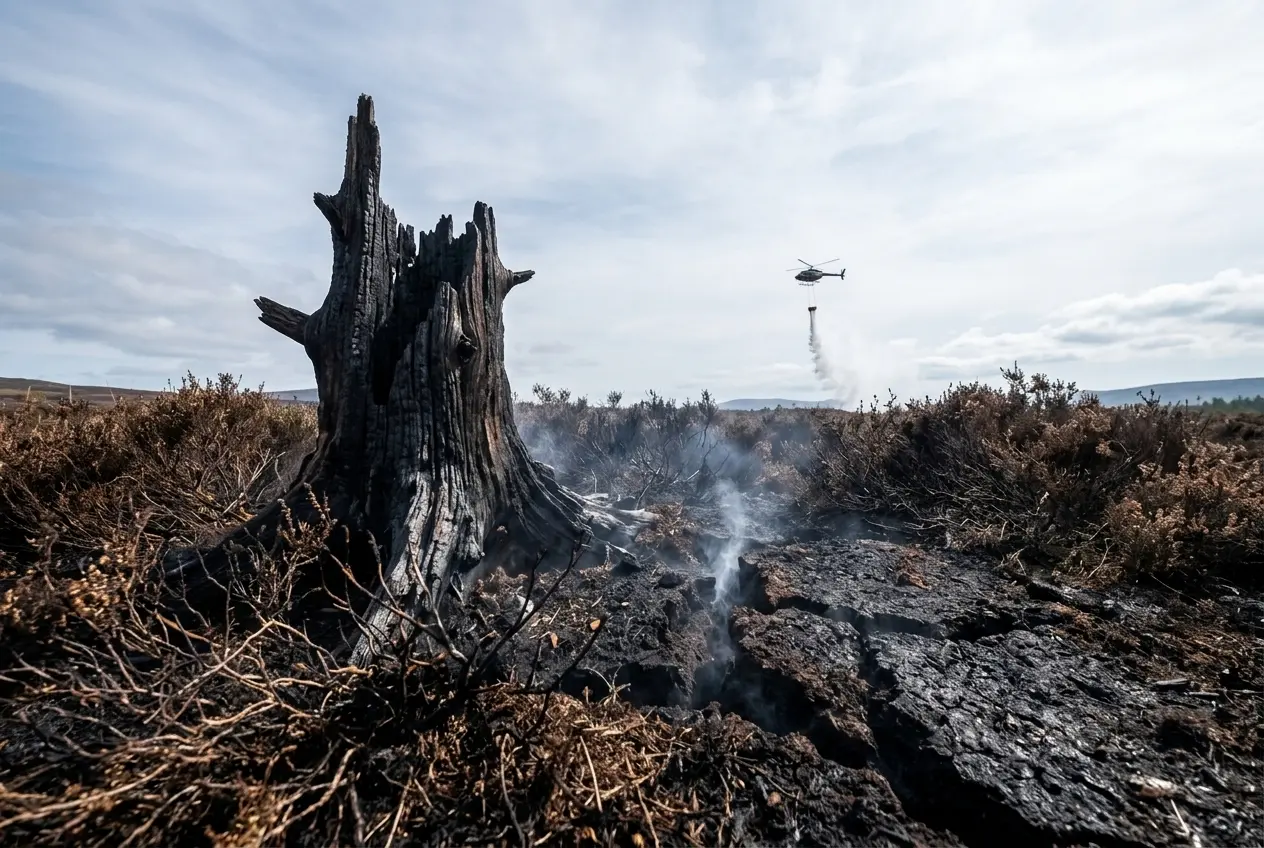
 Firefighters were still working hotspots on 30 July after a two-week wildfire scorched roughly 25 square kilometres of moorland and forest inside Cairngorms National Park. The blaze that began near Aviemore on 15 July forced evacuations, drew more than 500 responders at its peak, and left peat still smouldering underground.
Grant Moir, chief executive of the Cairngorms National Park Authority, linked the conditions directly to a shifting climate pattern. Southern Spain and France, he said, now see weather once typical of North Africa, while the UK is starting to experience the summers those regions knew two decades earlier.
The Front That Reached 25 Kilometres
The fire started near Ryvoan Bothy in the Glenmore area and grew into the worst blaze the park has recorded. At one stage the active front stretched about 25 kilometres wide. Smoke drifted more than 60 miles east to Aberdeen. Police Scotland declared a major incident. Roughly 700 people were evacuated at points, including residents of Nethy Bridge, who later returned once the immediate threat eased.
Scottish Fire and Rescue Service aerial assessment put the burned area at around 25 square kilometres affected by aerial assessment. Two helicopters at peak dropped up to 40,000 litres of water per hour. Later updates put three helicopters on water-bombing runs, delivering hundreds of thousands of litres daily alongside ground crews using high-volume pumps from Loch Morlich.
| Metric | Figure |
|---|---|
| Start date | 15 July 2026 |
| Area affected | ~25 sq km (10 sq miles) |
| Peak responders | More than 500 firefighters and partners |
| Later on-scene strength | ~70 firefighters, 9 appliances, 3 helicopters (late July) |
| Water delivery (peak) | Up to 40,000 litres per hour |
| Casualties | None reported |
By 27 July improved weather and aggressive tactics cut visible flames, yet Deputy Assistant Chief Officer Michael Humphreys warned the incident remained complex and fluid. Smouldering ground spots persisted. Crews expected to stay for some time.
Why the Hills Were Ready to Burn
The Cairngorms sit inside Britain’s largest national park official site, a landscape more often associated with rain and snow sports around Aviemore than with wildfire. Three months of below-average rainfall and temperatures several degrees above normal on the ignition day left heather, grass and peat dry. Elevation-dependent warming has shortened snowpack seasons in mountain regions, stripping moisture from soils earlier.
A national park byelaw introduced in April banned campfires and barbecues across the park for the summer season precisely to cut ignition points. Most UK wildfires still trace to human causes, from discarded cigarettes to abandoned glass. The exact start of this blaze remains under investigation. The byelaw showed the park already treating fire risk as structural rather than exceptional.
That same shift shows up in Scotland’s extreme weather warnings, where heavy rain events and dry spells now arrive in sharper swings. The fire weather that hit the Highlands fits a longer pattern of drier summers across northern peatlands.
Who Held the Line on the Ground
The response was never a single-service job. Scottish Fire and Rescue led, but Forestry and Land Scotland, the park authority, Police Scotland, RSPB Scotland, Highland Council, landowners, estate workers, gamekeepers, ski-resort staff and community volunteers all took roles. Thermal drones mapped hidden heat. Bulldozers cut firebreaks that saved most of the older Caledonian pine stands. Accountants from partner bodies ran errands for water and sun cream when the operation felt overwhelming.
- Scottish Fire and Rescue Service: command, appliances, wildfire tactical advisors, water-bombing coordination
- Forestry and Land Scotland: firebreaks, habitat knowledge, heavy machinery on northern and western edges
- Cairngorms National Park Authority: rangers, thermal drone support, public messaging and path closures
- Estate crews, gamekeepers and volunteers: local ground knowledge, beaters, machinery and continuous presence
- UK and Scottish governments: resource offers, including military support options such as Chinooks if requested
Bill Lobban, civic head of the Highland Council, called the destruction heartbreaking. Local voices on the ground, including retired photographer Sandy McCook in Nethy Bridge, described Friday flames as cataclysmic and pushed for a permanently contracted firefighting helicopter model similar to the air ambulance, arguing early aerial attack could have limited the tennis-court-sized start. Scottish Greens later called for publicly available aircraft in wildfire season rather than a patchwork of private contracts.
This remains a complex and fluid incident and we still anticipate that we will be in attendance for some time, alongside partners and volunteers from all agencies involved.
Michael Humphreys, Deputy Assistant Chief Officer, Scottish Fire and Rescue Service, said that after noting encouraging 24-hour progress.
What the Peat Still Holds
Visible flames dropped with rain and low winds, yet the real fight moved underground. Deep peat and heather beds continue to hold heat. Wind can reignite surface flames days later. Officials and land managers say full extinction may need weeks of rain and repeated water-bombing. The same peat that stores vast carbon stocks becomes a slow-release furnace once ignited.
Earlier Scottish peat fires, including the 2025 Dava Moor event not far from the current burn, showed how organic soils can dominate total fire carbon output, sometimes contributing the large majority of emissions from a single incident. Those numbers remain small against national annual totals, yet they dwarf average yearly fire emissions from previous decades and signal a rising risk class for upland Scotland.
Crowd discussion on X repeatedly returned to this latency: the helicopters can knock down the crown fire, but the peat clock runs on a different scale. That second layer turns a two-week emergency into a multi-month monitoring commitment and a carbon event whose full tally will only become clear after the ground cools.
Ancient Pines and the Decades Ahead
Flames reached stands of Caledonian pinewood that hold Scots pines three centuries old. Firebreaks cut in the first days saved most of the older forest. Younger woodland, heath and rare habitat took heavier losses. Larger animals such as deer largely escaped. Smaller mammals, lizards, insects and ground-nesting birds did not.
Ian Allsopp, Forestry and Land Scotland planning manager for the north, called rare habitat loss a real challenge. Restoration of the damaged landscape is measured in decades, not seasons. Ecologists will only complete full assessments once every hotspot is safe to enter. The blackened scar already covers thousands of acres; the visual and ecological recovery will define the park’s next generation of visitors and managers.
That long horizon sits beside the park’s other governance tests, including the park authority’s earlier development rejection at Loch Lomond that showed how tightly the system guards landscape character. Fire now joins development pressure as a force that can rewrite the same character overnight.
Tourism, Ski Slopes and the Local Economy
Aviemore and Cairngorm Mountain sit at the heart of Scottish skiing and year-round mountain tourism. Resort staff joined fire crews to cut defensive breaks when winds pushed flames toward the pistes. Paths and trails closed across the Glenmore and Strath Nethy zones. Campsites and lodgings emptied during the peak threat. Smoke and access limits hit peak summer trade even as the physical infrastructure largely survived.
The park’s own visitor messaging now carries continuous wildfire updates and path closures. The same landscape that draws walkers for Caledonian forest and open plateaux will show blackened ground for years. Recovery planning will have to balance ecological rest with the economic reality that tourism underwrites many local jobs and services.
The Pattern Already Visible
This was not an isolated shock. Scotland has recorded larger peat and moor fires in recent dry summers. The April byelaw, the multi-agency playbook, and the rapid deployment of private helicopters show systems adapting. Gaps remain: permanent aerial capacity, deeper peat-fire doctrine, and clearer public messaging on ignition risk under hotter, drier spells.
Moir’s climate comparison sets the frame without needing extra labels. The weather that once belonged farther south now reaches the Highlands with enough regularity to rewrite fire expectations. The two-week fight bought time. The peat, the pinewoods and the volunteer networks that answered the call will carry the longer cost.
As of late July the exclusion zone was moving into a phased reduction subject to final safety checks. Hotspots still required attention. The blackened hills will stay visible long after the last helicopter leaves.
 Man Jailed Under a Rare Lifelong Order for Edinburgh Rape
  Amnesty International UK Reels From Backlash Over Anti-Rights Report
  Scotland’s High Court Trial Backlog Triples to 1,000 Cases
  Aberdeen Finally Breaks Record 21-Day Sunless Streak
  Scotland Launches 12 Actions for Offshore Wind Skills Boost
  Scotland’s Top TikToker in 2025 Named