
 Ishan Crawford
 Google rolled out the June 2026 wave of monthly Android System Updates between June 1 and June 22, 2026, shipping four Google Play services builds, three Google Play Store builds, and updates to Android System Intelligence and Private Compute Services. The cycle spans Play services v26.21 through v26.24 and Play Store v51.7 through v51.9.
Inside the cycle, Google Password Manager adds Credential Exchange support for moving passwords and passkeys with third-party managers, Find Hub joins the first-time phone setup flow, and WhatsApp backups move into device Settings. The Play Store also layers on a US state verification rule for new accounts and an Ask Play conversational AI search box. The full changelog sits in the June 2026 Google System Updates rundown.
The June 2026 changelog at a glance
Google’s monthly Google System Release Notes cover Play services, Play Store, and Play system updates across Android phones and tablets, Wear OS, Google and Android TV, Auto, and PC. The June 2026 cycle shipped nine builds across four first-party apps in the “Google System” (Google Play services, Google Play Store, Android System Intelligence, and Private Compute Services), with the first build landing June 1, 2026 and the last on June 22, 2026. Some of the changes hit user devices directly; others target app developers integrating Google’s APIs.
| Component | Version | Date |
|---|---|---|
| Google Play services | v26.21 | 2026-06-01 |
| Google Play Store | v51.7 | 2026-06-01 |
| Google Play services | v26.22 | 2026-06-08 |
| Google Play Store | v51.8 | 2026-06-08 |
| Private Compute Services | B.26 / C.4 | 2026-06-08 |
| Android System Intelligence | V.75 | 2026-06-11 |
| Google Play services | v26.23 | 2026-06-15 |
| Google Play Store | v51.9 | 2026-06-15 |
| Google Play services | v26.24 | 2026-06-22 |
Google warns that a feature appearing in the changelog does not mean it’s widely available; some capabilities take months to fully launch. Each line carries a device tag in brackets, with “[Phone]” meaning phone-only and “[Auto, PC, Phone, TV, Wear]” meaning a cross-form-factor rollout. The June 2026 set leans on phone-only entries; Auto, PC, TV, and Wear appear mostly in system-management and Wallet bug fixes. Developers pick up the largest batch of new integration hooks in v26.21 through v26.24, around Maps and Device Connectivity.
Credential Exchange lands on Google Password Manager
Google Play services v26.21, which landed June 1, 2026, adds Google-side support for the FIDO Alliance’s Credential Exchange standard on Android. The release notes say users can now “import and export passwords and passkeys between Google Password Manager and third-party password managers with the Credential Exchange standard.” Credential Exchange is the cross-vendor data format defined under the FIDO Alliance’s Credential Exchange Format (CXF) specification, hosted publicly on the FIDO Alliance website. Other password-manager vendors including Dashlane have published documentation for the protocol.
The v26.21 release does not name the specific third-party managers that will work with the new import and export. The CXF specification on the FIDO Alliance site is published as a draft. For users, the practical effect is that moving a vault between Google Password Manager and a third-party manager will eventually stop requiring manual CSV exports.
The Credential Exchange entry sits inside the v26.21 Security and Privacy section. May 2026 entries in the same release-notes family added Theft Protection for newly set up devices in the UK and Latin America, plus a default-on flip for Remote Lock and Theft Detection Lock on Android 17 devices. The Credential Exchange addition lands as passkey portability becomes a baseline expectation across password-manager vendors. The release note does not list supported third-party managers, leaving that for individual password-manager apps to publish on their own timelines.
Ask Play puts a conversational AI box on the Play Store
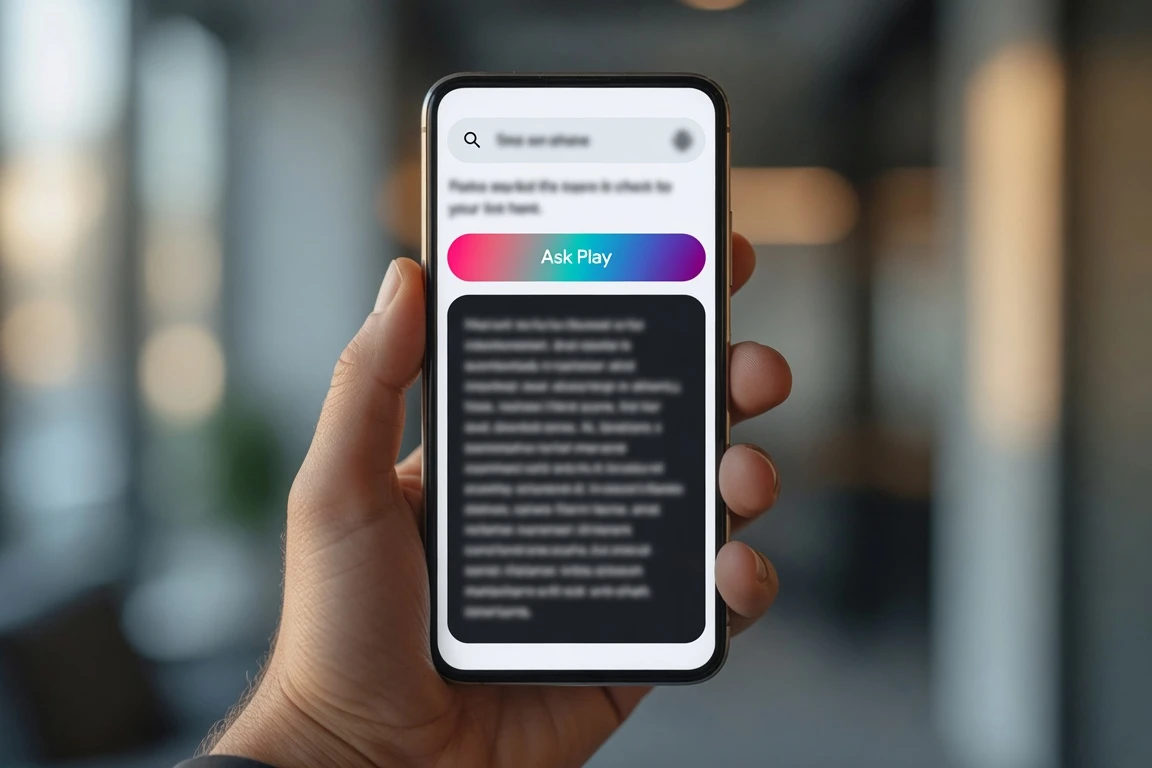
Google Play Store v51.8, which shipped June 8, 2026, adds an “Ask Play” button to the search suggest bar that opens “a full-screen conversational AI search experience” when tapped. The same release also adds Ask Play Highlights on search results, with “faster, real-time streaming, and more flexible response formats,” per Google’s release notes. The new search surfaces are limited to the Play Store app on phones for the v51.8 release; Auto, PC, and TV lines are excluded from the Ask Play entries.
The Ask Play addition lands one week after the v51.7 Play Store release on June 1, 2026, which shipped earlier the same week. v51.7 makes “sales prices and discount details, such as offer and dates, clearer and more visible across the Play Store” and merges pre-registration with auto-install into “a single flow.” v51.7 also adds loyalty notifications and a Play Collections browsing surface on Phone, plus a refreshed dialog design on Auto, Phone, and TV. Ask Play, the AI conversational search box, arrived as the top layer of the same search surface in v51.8 on June 8, 2026.
- “Sales prices and discount details, such as offer and dates, are clearer and more visible across the Play Store.”
- “Pre-registration and auto-install use a single flow.”
- “Notifications about monthly challenges through Play Store pop-up banners.”
- “Notifications for Loyalty MAX challenges via pop-up banners on the Google Play Store.”
- “App content on installed app store listing pages in the Play Store and visit Play Collections to browse similar content.”
- “Refreshed design in Play Store dialogs when you get or buy an app to continue.” (Auto, Phone, TV)
Ask Play’s surface is constrained to the search bar and search results, not the wider app listing or detail pages. Google’s release notes describe the Ask Play button as appearing on the search suggest bar when you enter a query. The release does not specify which devices or accounts receive Ask Play first; Google notes elsewhere that a feature appearing in the changelog does not mean it’s widely available.
Alongside the AI search additions, v51.8 also tightens Play Protect with “additional security verifications for unverified apps” on Auto, PC, Phone, and TV. The same release moves the Play Store one step further toward treating unverified sources as a flagged state rather than a silent background. Ask Play and the Play Protect expansion land in the same build, and the security addition spans four form factors while Ask Play stays phone-only. Users on Auto and TV will get the Play Protect side of the change without any Ask Play exposure.
Find Hub joins the first-time phone setup
Google Play services v26.22, dated June 8, 2026, slips Find Hub into first-time phone setup, with the release note stating it “adds Find Hub configuration to phone setup so you can locate your device remotely.” The change sits inside the v26.22 Security and Privacy section alongside the Quick Share contact-card update and a bug-fix line for Device Connections on Auto. The release notes do not state which OEMs will surface the new setup screen first; Google describes the change at the platform level only.
Quick Share also picks up a phone-only entry in v26.22, letting users “view contact card information when you receive a contact card through Quick Share.” That contact-card feature is part of Quick Share’s standard share flow. Separately, cross-platform AirDrop-compatible Quick Share has been rolling out to Pixel 10, Galaxy S26, and OnePlus 15. v26.22 also archives “stale achievements” so they no longer appear in game and developer interfaces on Phone and TV. The three v26.22 user-facing changes sit across Security and Privacy, Device Connectivity, and System Management, with no single dominant theme.
Find Hub configuration in phone setup is a one-time switch rather than a recurring prompt, and the release notes do not specify whether the screen is shown on every device reset or only on first activation. The Find Hub network is the cross-device tracking mesh that powers Google’s “Find My Device” experience, with the configuration surface enrolling a device into the network. The setup-time toggle is one of three June 2026 entries that shift a Google feature from a buried Settings menu to a surface most users will encounter.
WhatsApp backups, Contacts sync, and Wallet gain Settings hooks
Google Play services v26.23, dated June 15, 2026, puts a string of common tasks inside Android Settings that previously required opening a separate app. Phone users can now “manage your WhatsApp backups through device settings,” per the v26.23 Utilities section. The same release improves “the experience when you view or update the Google Contacts sync setting,” again in Utilities. v26.23 is the first June 2026 Play services build that places three different one-tap Settings hooks inside a single release.
v26.23 also touches cross-form-factor system management, with “updates to system management services that improve Device Performance” on Auto, PC, Phone, TV, and Wear, plus bug fixes for “System Management and Diagnostics related services” across the same five form factors. The Wallet section of v26.23 lists “bug fixes for Wallet related services” on Phone and Wear, and an additional phone-only line on Google’s official support page to “improve Wallet transaction history experience.” Auto gets only the system-management lines, and PC gets the system-management lines plus the Wallet bug fixes. The Wallet transaction-history improvement appears only on Google’s official release notes and not on third-party changelog summaries, a discrepancy that reflects how Google’s notes feed downstream coverage with some lag.
Play Store rules tighten: Trusted badges, content restrictions, US verification
Google Play Store v51.9, dated June 15, 2026, layers new rules onto the storefront that affect both reviewers and new account holders. Phone users can now get a “Trusted” badge on Play Store reviews if “eligible for the Trusted Contributor program and opt in,” per Google’s release notes. The same build lets phone users “manage content restrictions on Google Play using your Android Parental Controls PIN.”
The most consequential new rule sits in a line that only Google’s official release notes carry: new users on Google Play in applicable US states must “complete a verification or set up supervision” to comply with recently passed verification laws. The US state verification line is the only v51.9 entry that does not appear in third-party changelog summaries. Google’s release notes describe the new requirement as compliance with “recently passed verification laws,” without naming the specific states or statutes. The line is phone-only and applies to new users, not to anyone with an existing Play Store account.
- “Trusted” badge on Play Store reviews for users eligible for the Trusted Contributor program.
- Manage content restrictions on Google Play using the Android Parental Controls PIN.
- Try the latest features in Play Labs and share feedback.
- US state verification or supervision setup for new users in applicable states.
The Trusted Contributor program and the Play Labs opt-in are separate flags, and Google’s release notes do not say whether users can hold both at once. v51.9 is a phone-only release; Auto, PC, and TV users do not see the Trusted badge, content restrictions PIN, or Play Labs changes. The new US state verification rule, by contrast, applies at account creation rather than in the store UI, and so reaches every device a new user signs in on.
Google’s separate June 2026 Android Drop announcement covers Circle to Search outfits, fake call detection via Phone by Google, and Quick Share interoperability with AirDrop, none of which sit inside the System Updates changelog. The Android Drop blog post is dated June 2, 2026. The Ask Play addition sits inside v51.8, while the Android Drop announcement covers Circle to Search and other Pixel-tier features that ship through Google Play services. The two streams run in parallel: System Updates through Google Play services and Play Store, and Android Drop features through standalone apps and Pixel updates.
What isn’t live yet, and how to check
Google warns in its release notes that “a feature appearing in the changelog does not mean it’s widely available. Some capabilities take months to fully launch.” Most of the June 2026 entries carry no rollout window. Several, including the Credential Exchange password import and export and the Ask Play conversational AI box, are device- and account-gated.
To trigger a manual check, Android users move through five steps in the Settings app on a Pixel. The path uses standard Android menus; other OEMs may vary:
- Open the Settings app.
- Tap your name at the top for “Google services” (on a Pixel; the path varies on other OEMs).
- Open the All services tab.
- Tap Privacy and security.
- Tap System services.
From there, the Google Play system update screen exposes the current build of Play services, Android System Intelligence, and other components. Play Store updates install through the Play Store app itself rather than the System services screen. The June 2026 cycle ends with v26.24 on June 22, 2026, which has had the shortest runway so far to reach user devices.
Frequently Asked Questions
What changed in Google’s June 2026 System Updates?
Four Google Play services builds (v26.21 through v26.24), three Google Play Store builds (v51.7 through v51.9), Android System Intelligence V.75, and Private Compute Services B.26/C.4 shipped between June 1 and June 22, 2026. Credential Exchange for passwords, Find Hub in phone setup, and Ask Play AI in the Play Store headline the user-facing additions.
How do I update Google Play services on Android?
On a Pixel, open Settings, tap your name at the top to reach Google services, open the All services tab, then tap Privacy and security, then System services. The path varies on other Android OEMs. Play Store updates do not flow through this menu; the Play Store app installs them through its own update channel.
What is the Credential Exchange standard?
Credential Exchange is a cross-vendor data format defined under the FIDO Alliance’s Credential Exchange Format (CXF) specification, designed to let password and passkey vaults move between password managers without manual CSV exports. Google Play services v26.21 is the Google release that adds support for the protocol on Android.
What is Ask Play?
Ask Play is a button on the Google Play Store’s search bar that opens a full-screen AI-driven search experience. v51.8 also adds Ask Play Highlights on search results for faster, real-time streaming responses. Both surfaces stay on the phone.
Will I get these features right away?
Not necessarily. Google’s release notes warn that a feature appearing in the changelog does not mean it’s widely available, and some capabilities take months to fully launch.
 ONGC licence frees Venezuela cash and operatorship talks
  Anthropic Hits $65 Billion Run Rate and Flips the AI Cash Test
  Supreme Court grounds the fare free-for-all with three-week clock
  Gold Nears $4400 as Soft Data Meets Oil Inflation Risk
  Nifty Slips as Zaggle Circuits and Dhoot Debuts Big
  Diesel Crack Tops $100 as Iran Rhetoric Lifts Crude