
 Ishan Crawford
 ADM will add storage and berthing capacity at Peel Ports Group’s Port of Greenock later this year, pairing the deep-water site with its existing King George V Dock base in Glasgow to form a single River Clyde logistics network for imported animal feed ingredients.
The move lifts handling volume and route options for Scottish customers just as the wider UK feed industry leans harder on overseas raw materials.
Two Ports Now Share the Clyde Load
The Greenock facility sits downstream from King George V Dock and gives ADM a second berth on the same river system. Jonathan Lane, managing director of ADM Agriculture Ltd and ADM UK country manager, said the extra footprint helps the company “operate more efficiently, strengthen supply chain resilience and support our customers’ evolving needs across Scotland.”
David Huck, chief operating officer for ports and marine at Peel Ports Group, called ADM a “valued strategic partner” and said the investment shows the Clyde’s role as a gateway for agricultural imports serving Scotland.
Together the sites raise flexibility. A vessel can discharge at the deeper Greenock quay when draft or timing suits, then feed product into the Glasgow distribution hub, or reverse the flow when local demand spikes.
- Higher combined handling capacity across two river locations
- More berthing options for larger or differently timed ships
- Shorter internal transfer distances inside the Clyde catchment
- Direct access for feed buyers from the Central Belt to the Highlands
ADM already sells about 2.5 million tonnes of feedstuffs a year from 450,000mt of total UK storage spread across several ports. The Scottish pair now forms a dedicated northern arm of that network.
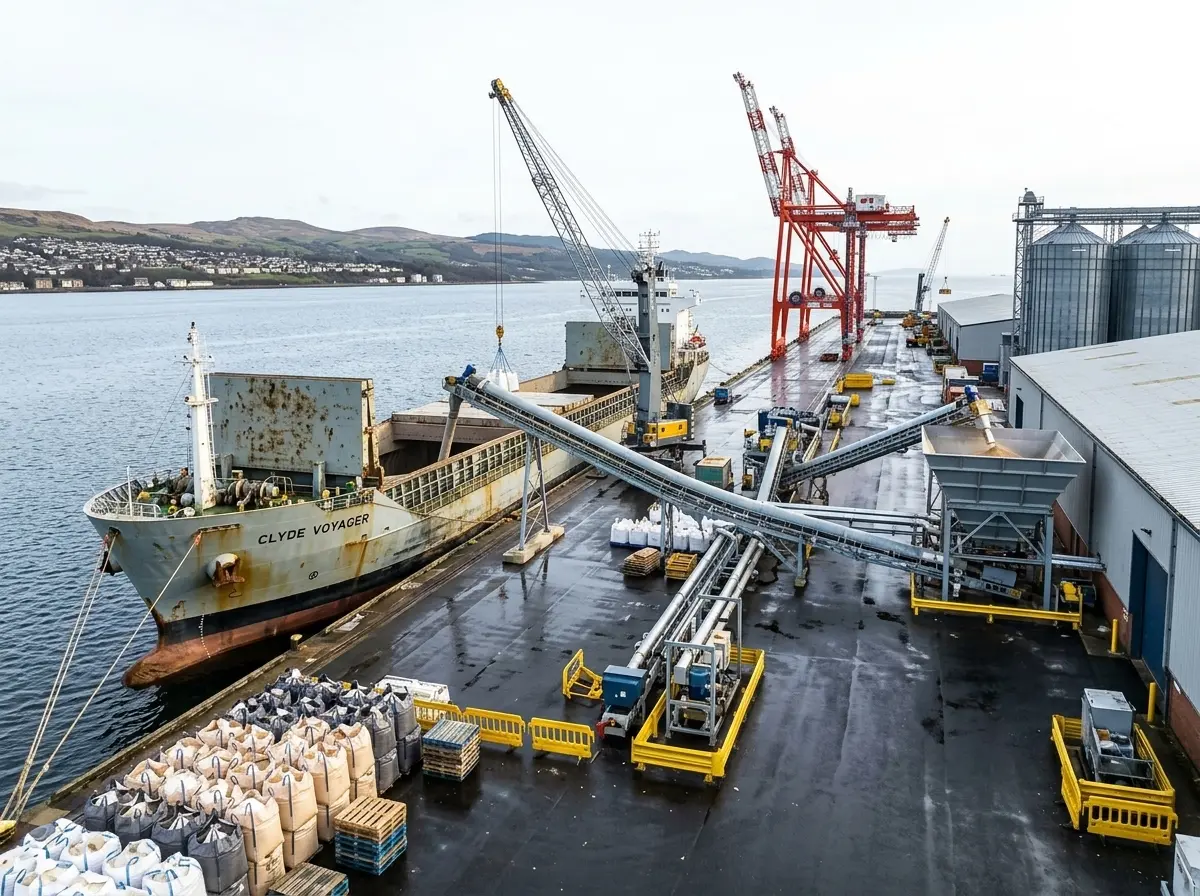
Why Greenock’s Depth Matters More Than Extra Sheds
King George V Dock offers a 529 m riverside quay with 8.5 m depth. Greenock’s terminal is built for bigger ships.
| Feature | Port of Greenock | King George V Dock |
|---|---|---|
| Quay length | 372 m | 529 m |
| Draft / depth | 12.6 m | 8.5 m |
| Site size | 16 hectares | City-centric river berth |
| Key edge | Scotland’s deepest water terminal | Close to Glasgow distribution |
That 12.6m draft and 372m quay lets larger bulk carriers arrive without lightering. Fewer ship calls and larger parcels cut per-tonne freight cost and free truck miles that would otherwise run from English east-coast ports. Peel Ports has already put £25 million into new ship-to-shore cranes at Greenock and expanded reefer capacity; the ADM deal simply fills more of the multi-user warehousing and laydown space with agri-bulk.
Import Share Climbs While Forage Stays Short
The UK feed sector needs roughly 16 million tonnes of raw materials every year. Local arable and co-product supply covers 54 percent; the other 46 percent is imported, mainly soya, palm kernel expeller, soya hulls, maize and sunflower meal. AIC head of animal feed James McCulloch noted in the Winter 2025/6 outlook that dry weather left many dairy, beef and sheep farms short of grass and forage, pushing compounders toward imported fibre and protein earlier than usual.
Deforestation rules and trade uncertainty have further tightened forward offers for soya into early 2026. The result is longer lead times and higher reliance on ports that can take big parcels on short notice. Scotland’s livestock base still runs large even after recent declines: the June 2025 census recorded 1.65 million cattle in 2025 and 6.54 million sheep. Dairy cow numbers rose while beef breeding stock fell, yet total feed demand remains substantial.
UK feed raw materials: 16 million tonnes a year
Imported share: 46 percent
Scotland cattle: 1.65 million
Scotland sheep: 6.54 million
The Partnership That Started With One Maize Ship
ADM and Peel Ports began working the Clyde in 2018. That June the first agri-bulk vessel, the 90 m Arklow Ruler, discharged more than 4,000 tonnes of maize at King George V Dock under a long-term contract. Peel Ports had refurbished the agri-bulk sheds to TASCC and ATEX standards and installed new handling kit. Graham Atkinson, then managing director of ADM Arkady, said the arrival opened the Scottish market and could help push combined northern throughput, including Liverpool, toward 1 million tonnes a year.
- 2018, First ADM agri-bulk vessel arrives at King George V Dock with 4,000-plus tonnes of maize; facilities upgraded for long-term use.
- 2018-2025, Steady growth of Scottish distribution hub under Peel Ports management.
- August 2026, ADM announces additional storage and berthing at Port of Greenock, operational later the same year.
Eight years later the same partners are simply extending the model downstream. The Clyde now holds two complementary nodes instead of one.
What Travels Through the New Network
ADM’s UK feed range covers the main imported proteins and fibres that Scottish compounders and farmers buy:
- Soybean meal, soya hulls, sunflower meal, rapemeal, palm kernel expeller
- Corn DDGS, wheat DDGS, corn gluten feed, whole maize, wheatfeed pellets
- Sugar beet pulp pellets, citrus pulp pellets
These products arrive in bulk, move into covered storage, and leave by road to mills and farms. The dual-port set-up shortens the last leg for buyers north of the Central Belt and gives ADM a hedge if one berth is congested or under maintenance.
Expanding our footprint from Glasgow to Greenock is an important step for ADM’s operations in the region. The additional capacity and logistics capability will help us operate more efficiently, strengthen supply chain resilience and support our customers’ evolving needs across Scotland.
Jonathan Lane, managing director, ADM Agriculture Ltd and ADM UK Country Manager
Local Reaction Sees a Clyde Gateway Gain
Public conversation on the announcement stayed quiet. ADM Agriculture’s own account posted the news with images of the sites. The Scottish Farmer carried the story to its farming readers. Paisley and Renfrewshire North MP Alison S Taylor amplified a related Scottish Farmer post, treating the expansion as another piece of Clyde economic activity. Older posts about Greenock capacity upgrades often framed the port as a Scottish alternative to longer hauls through English gateways. That framing fits the new ADM deal: more tonnes stay on the west coast instead of travelling by road from the south or east.
Operational Later This Year
ADM and Peel Ports have not released exact tonnage figures or capital spend for the Greenock addition. The companies say the facility will be ready before the end of 2026. Once live, the integrated Clyde network will sit inside ADM’s wider UK import system and give Scottish livestock producers one more reliable route for the proteins and fibres they cannot grow at home. In a year when forage stocks are already tight and global soya offers carry policy premiums, that extra berth and shed space arrives as practical insurance rather than headline expansion.
 Scotland’s Facial Recognition Push Sparks Mask Ban Call
  Galaxy Z Flip 8 Hits $799 Only If Your Trade-In Qualifies
  If England Had Kept Water Public Like Scotland
  Samsung Smart Switch Now Moves Passwords and eSIM From iPhone
  Old Firm Spend Pulls Clear as Premiership Rivals Patch Squads
  Chinese Studios Quietly Seize the Gamescom Stage