
 Ishan Crawford
 Abhilasha Purwar, a Delhi-based investor at Hunch Ventures and former founder of Blue Sky Analytics, spent two weeks in Bengaluru and declared the city’s short hops had annihilated her health for 2026. Every founder, product manager and engineer she met sat “miles ahead” of her Delhi-Gurgaon network, yet 15-minute stretches inside Koramangala left her exhausted.
The Yale-educated climate-tech builder posted the contrast on X on 17 August, drawing tens of thousands of views and a stream of local replies that treat the jam as a fixed fact of life rather than a temporary nuisance.
Talent That Outruns Every Other Indian Catchment
Purwar did not hedge. “Every single event, every single conversation, was miles ahead of what I have in Delhi/ Ggn,” she wrote. The product, tech, growth, marketing, revenue and business-development fluency of the people she met topped even the top 10 percent of her usual founder pool.
She stayed inside the Indiranagar-Koramangala-HSR-APR loop, the dense core where much of the city’s startup activity concentrates. RMZ Ecoworld impressed her with its amenities and familiar brands. The people, she said, were the reason she still wants to be there.
That density is the point. Bengaluru continues to rank among India’s strongest startup ecosystems precisely because experienced operators, engineers and investors keep clustering. For someone coming from Delhi-NCR, the gap felt immediate and large.
The fluency she described is not scattered across a wide metro. It is packed into a few neighbourhoods that function as a single labour market. An investor on a short trip can stack meetings without leaving the loop. That same packing is what later shows up as road friction.
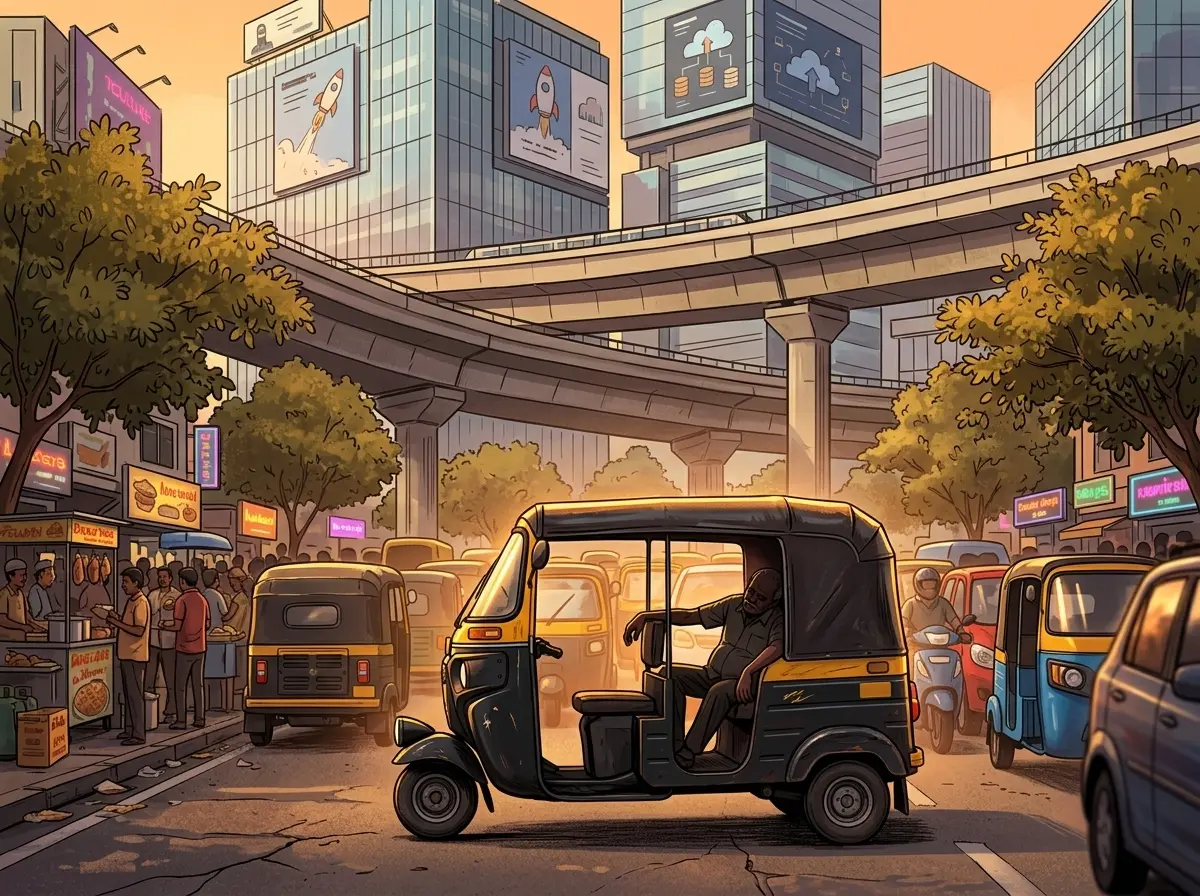
Even Non-Peak Hops Inside Koramangala Wrecked Her
The physical cost arrived just as fast. “Any commute whatsoever, even the 15 mins within Koramangla to Koramangla or 20 mins of Kora to HSR has killed me,” Purwar wrote. Getting in and out of the Ecoworld area “annihilated” her despite the pleasant surroundings.
She compared the damage to longer Indian and international routes. “Jaipur – Delhi – Dehradun or Delhi – SF corridor doesn’t kill me as much as Bangalore corridors killed me.” In a follow-up she noted she avoided peak hours entirely, yet evening 5-7 km stretches still took 40-46 minutes.
Official numbers match the lived experience. TomTom’s latest Traffic Index, drawing on 2025 data, placed Bengaluru second globally for congestion with a 74.4 percent congestion level in 2025, up 1.7 points from the prior year. Average speed in free-flow conditions is far higher; real-world conditions drag it down hard.
| City | Congestion level 2025 | Key metric |
|---|---|---|
| Mexico City | 75.9% | Most congested overall |
| Bengaluru | 74.4% | 168 hours lost per year in rush hour |
| Dublin | 72.9% | Third globally |
| Pune | Top 5 India | Faster average than Bengaluru |
Local reporting on the same TomTom release put the city’s rush-hour average at a rush-hour average of 13.9 km per hour, one km/h slower than 2024. A 10 km trip averaged 36 minutes 9 seconds. Time lost doing a typical peak 10 km round-trip on working days hit 168 hours a year.
Her own timings line up with that picture even when she stayed off the worst windows:
- Internal Koramangala hops billed as about 15 minutes still left her exhausted.
- Koramangala to HSR stretches around 20 minutes carried the same toll.
- Evening runs of only 5-7 km stretched to 40-46 minutes.
- A standard 10 km city trip, per the TomTom-linked reporting, averaged 36 minutes 9 seconds.
The gap between free-flow speed and real-world speed is where the health cost accumulates. Distance on the map stops being a useful planning unit.
The Pull That Makes Everyone Choose the Suffering
Also man the pull effect of talent – that everyone in BLR is choosing to suffer through BLR simply to be close to everyone else in BLR
That line from Purwar’s post sits at the centre of the irony. The same concentration that produces superior product and tech conversations also generates the traffic that extracts a physical toll. People stay because the network is denser here than anywhere else in the country. Leaving would mean trading the conversations for easier roads.
Replies on the thread made the trade-off concrete. One resident described building an entire daily routine around avoiding peak windows: showering at the gym, eating breakfast at the office, weighing bike versus car against rain probability and Monday lake-road jams. Another noted that almost no one is “bullish” on the city itself; they are here for the network and the jobs, then discover high rents, poor garbage collection and roads that punish the body.
The density rewards proximity and punishes movement. Once enough high-skill people cluster, the rational individual choice is to absorb the jam rather than exit the cluster. The collective result is a city that feels unlivable to a fresh arrival yet remains sticky for those already inside.
Each person who stays thickens the network for everyone else. That feedback loop is why the suffering does not clear the room. It becomes the entry fee.
How Long-Time Residents Game the Daily Constraint
Purwar ended her post by asking what supplements people take and what hacks keep them functional. The replies supplied the operating system rather than vitamins.
- Shift all personal hygiene and meals into office or gym windows so the car never hits the worst 90 minutes.
- Keep a mental map of overbridges, u-turn penalties and side-street cut-throughs that change with the day of the week.
- Accept that a “15-minute” hop is a planning fiction and block 45-60 minutes for every short internal trip.
- Treat the Outer Ring Road and Silk Board as permanent variables that decide whether a meeting is worth the energy cost.
These are not lifestyle upgrades. They are survival protocols for a network that has outgrown its roads. The same founders and engineers Purwar found impressive spend cognitive load every morning solving a logistics puzzle before they can start actual work.
The hacks do not remove the jam. They only move personal tasks into buildings that already sit inside the cluster, so the worst road minutes are faced fewer times per day.
Metro Lines Keep Coming but the Jam Remains the Default
Namma Metro continues to expand. Phase 2 sections, including parts of the Pink and Blue lines that will eventually link tech corridors and the airport, are scheduled to open through 2026. Additional kilometres are expected to come online this year. The network already ranks as India’s second-longest.
Yet the TomTom numbers and the lived reports show the road network still carries the bulk of daily movement. Vehicle growth has outpaced road expansion for years. Delayed projects, narrow corridors and the simple geometry of a city that grew around lakes and tech parks rather than a grid keep average speeds low even outside classic peak hours.
Purwar’s circuit, the very neighbourhoods that concentrate talent, sits inside some of the most pressured zones. New elevated and underground stretches will help specific corridors. They have not yet rewritten the daily experience of moving five kilometres inside the core.
Until the metro takes a larger share of short internal trips, the default mode for founder meetings and office hops remains the same road surface that produced the 74.4 percent congestion reading and the 13.9 km/h rush-hour average.
Short Stays Reveal What Locals Already Price In
Two weeks was enough for Purwar to call the outcome the worst health and fatigue stretch of her year. Residents do not get a clean before-and-after. They amortise the same friction across months and years, so the bill never arrives as a single shock.
That difference in exposure explains the tone of the thread. She registered damage. Locals replied with routines. Both sides were describing one system from opposite clocks.
| Corridor or hop | How it landed for her |
|---|---|
| 15-minute Koramangala internal moves | Left her exhausted |
| Koramangala to HSR in about 20 minutes | Same physical toll |
| Getting in and out of Ecoworld | “Annihilated” her despite amenities |
| Jaipur – Delhi – Dehradun | Does not kill her as much |
| Delhi – SF corridor | Does not kill her as much |
The table is qualitative, not a speed study. It still shows why a visitor’s body keeps the score faster than a resident’s calendar does. Longer routes she already knows cost less than short Bengaluru ones she had to repeat inside the core.
The Network Stays Sticky When Roads Stay Slow
Easier movement exists in other Indian cities. Purwar’s own comparisons make that plain. What those cities do not currently match is the concentration of experienced builders in product, tech and growth that she found inside the Indiranagar-Koramangala-HSR-APR loop.
So the individual calculation stays lopsided. Exit and the roads improve. Stay and the conversations stay dense. Replies on her post said almost no one is bullish on the city as a place; they are bullish on the people who already chose it.
High rents, weak garbage collection and body-punishing roads appear in that same thread as discovered costs, not as deal-breakers. The network still clears the bar. That is why the jam can remain the default without emptying the cluster.
For an investor sampling the market, the question becomes how many intensive days the body can fund before the talent premium is offset by fatigue. For people already inside, the question is only how to keep the daily protocol running.
The Health and Energy Bill Nobody Budgets For
Purwar framed the outcome in blunt personal terms: worst health and fatigue of the entire year after only two weeks and only the central loop. She is not a first-time visitor to difficult Indian cities. The comparison to Jaipur-Delhi-Dehradun and the Delhi-San Francisco corridor makes the point specific: Bengaluru’s particular mix of density and road friction extracts more than other routes she knows.
Crowd replies treat that extraction as normal. People redesign sleep, exercise and meal timing around it. The energy cost is paid before the first meeting starts. For an investor or founder flying in for a short intensive stretch, the cumulative drain becomes visible fast. For residents it is simply the price of staying inside the network that makes the city valuable.
That is the irony in full. The talent density that makes Bengaluru the place Purwar “really need[s] to be and want[s] to be” is the same force that locks the traffic in place and turns short hops into health events. Other Indian cities offer easier movement. None currently offer the same concentration of experienced builders in product, tech and growth.
Purwar’s post, which she expanded in her full post on the two-week stay, ends with an open question rather than a verdict. She wants the talent. She is still looking for the operating system that lets people stay healthy while they chase it. Locals already run that system every day. It just happens to consume a large share of their physical and mental budget.
The same pressure shows up in broader conversations about India’s tech workforce, including the questions India’s newest IT graduates face about timing and location. For some the answer is to leave the core entirely, a path taken by another Indian founder recalibrating life abroad. Most stay, keep optimising, and accept the fatigue as the cost of remaining in the densest room in the country.
 ONGC licence frees Venezuela cash and operatorship talks
  Anthropic Hits $65 Billion Run Rate and Flips the AI Cash Test
  Supreme Court grounds the fare free-for-all with three-week clock
  Gold Nears $4400 as Soft Data Meets Oil Inflation Risk
  Nifty Slips as Zaggle Circuits and Dhoot Debuts Big
  Diesel Crack Tops $100 as Iran Rhetoric Lifts Crude