
 Ishan Crawford
 Apple will put its first foldable iPhone on stage on September 9, but third-quarter assembly is only 0.5 to 1 million units. The iPhone 18 Pro and iPhone 18 Pro Max are the phones with inventory. The foldable is the one still waiting on someone else’s factory.
That factory sits in the display business of Samsung, Apple’s main rival in phones. Samsung Display is the exclusive maker of the inner and cover OLED panels, under a three-year exclusive deal, and the hinge that folds those panels was still making noise in assembly in June. The keynote can show the product. The panel lines and the hinge decide who gets one.
“Surprise and Shine” Is the Easy Part
On August 26, Greg Joswiak, Apple’s senior vice president of worldwide marketing, posted the invite with the line “Surprise and shine!” The company told viewers to watch a special Apple Event on 9/9 at 10 a.m. Pacific Time on its site and the Apple TV app, from Apple Park in Cupertino.
The expected phone slate is the iPhone 18 Pro, the iPhone 18 Pro Max, and the foldable, which supply-chain notes often call iPhone Ultra. A standard iPhone 18 is not expected this fall. Apple Watch Series 12 and Apple Watch Ultra 4 are also on the rumor list. Apple has not named the foldable, set a price, or published a ship date.
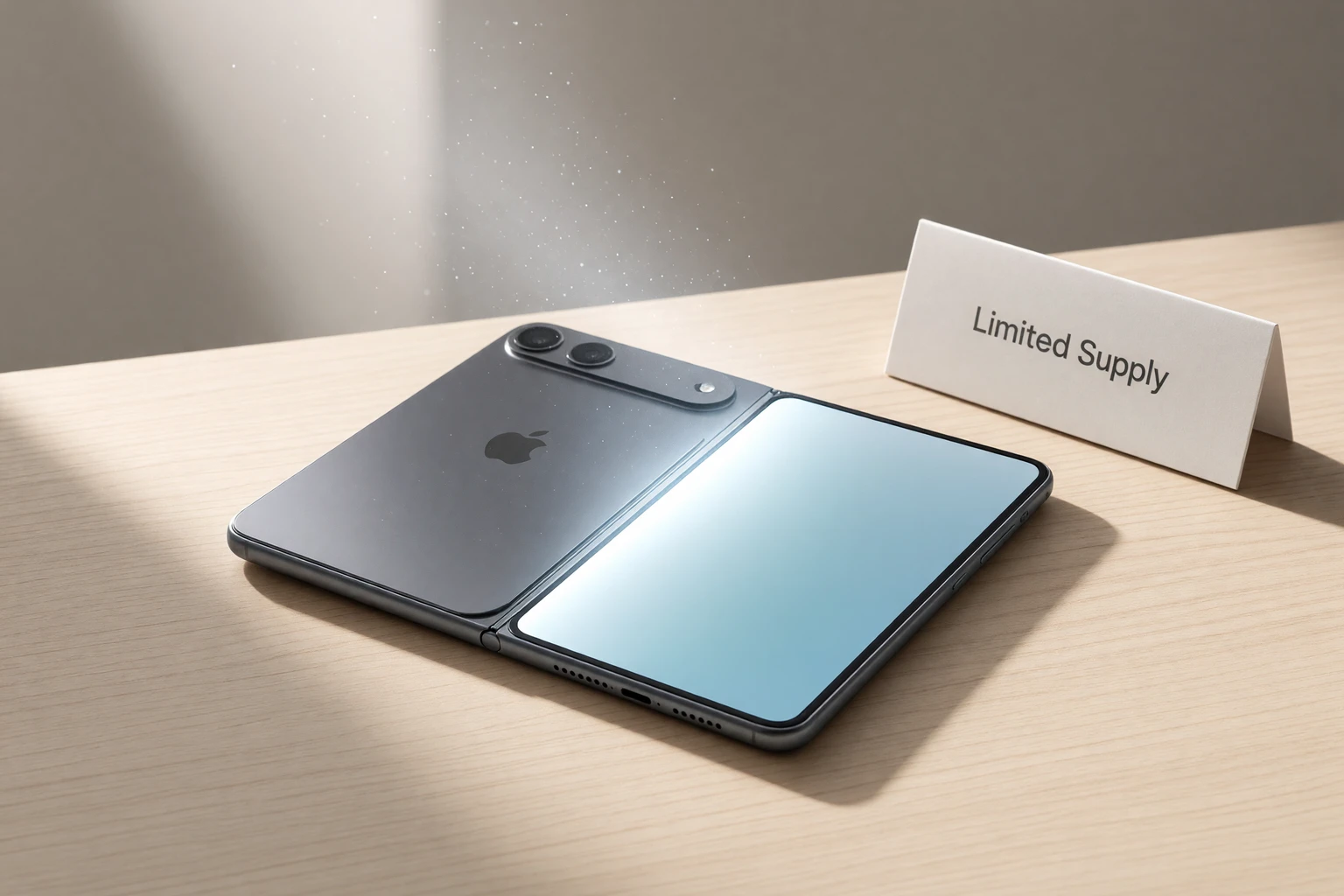
The hardware everyone wants to see is a book-style fold, about 5.5 inches on the cover and about 7.8 inches inside, with a 4:3 inner panel closer to an iPad mini than to a tall Android folder. Unfolded it is about 4.5 mm thick. Folded it is about 9 to 9.5 mm. The thin stack is why several analysts expect a side Touch ID button instead of Face ID. Those details are still leaks. September 9 is when they stop being leaks.
Samsung Display Holds a Three-Year Lock
In late June, Korean display-industry sources said Apple had cleared Samsung Display to start foldable OLED module output after yields at the Vietnam back-end site moved above 80 percent. Apple’s usual bar for that approval is 70 percent. The first shipment for the year was put at about 3 million panels.
THE PANEL DEAL
- The lock: Samsung Display is the sole foldable OLED supplier to Apple for three years, covering both the cover screen and the inner fold.
- The first order: About 3 million panels are slated for 2026, a cautious open rather than a full flagship run.
- The plant: Back-end work, driver chips, flexible boards, and final inspection, runs in Vietnam, where about 50 of roughly 80 lines were already active.
- The stack: The panels are described as using Color Filter on Encapsulation, which drops the polarizer, and Samsung Display’s new M16 organic materials.
- The overlap: The same supplier is also building foldable panels for Galaxy Z Fold 8, likely on an older material set.
That last point is the awkward one. Samsung’s phone group already sells a wide book-style foldable. Its display group is sending Apple a newer material set under a contract that bars Apple from buying foldable OLEDs anywhere else. If yields dip, Apple has no second panel source for the life of that deal.
Why Only One Million Units Are Ready for Launch
Ming-Chi Kuo of TF International Securities posted his latest factory survey on July 5. He put foldable iPhone assembly at 7 to 8 million units in the second half of 2026, with only 0.5 to 1 million of those in the third quarter, or about 10 percent of the half. He put iPhone 18 Pro and Pro Max third-quarter assembly at 20 to 22 million, enough, in his words, to meet the inventory bar for an official launch.
Q3 ASSEMBLY, KUO SURVEY
| Model | Q3 2026 assembly | 2H 2026 assembly |
|---|---|---|
| Foldable iPhone | 0.5 million to 1 million | 7 million to 8 million |
| iPhone 18 Pro and Pro Max combined | 20 million to 22 million | Not given |
The 3 million panel order and Kuo’s 7 to 8 million assembled phones are not the same number. One is an early display buy. The other is a second-half build plan that still leaves the third quarter thin. Kuo’s read is that the foldable does not have the stock Apple wants for a normal September first sale.
The foldable iPhone is likely to repeat what happened with the iPhone X in 2017: it may be announced alongside the other new models, but with pre-orders and official sales both coming later.
Ming-Chi Kuo, TF International Securities, on X
He still expects demand to hold through the end of 2026 at $2,300 to $2,500. He also expects the phone to sell out when pre-orders open, with delivery estimates stretching to 4 to 6 weeks or longer into December, and a short-term resale premium of 50 to 100 percent above the list price. Scarce supply at that price is a gift to anyone standing in the middle with a spare unit.
The iPhone X Playbook Apple Already Ran
Apple has done this exact split before, with a new screen technology and a new body that the factories could not fill in time for the usual Friday sale.
THE 2017 SPLIT LAUNCH
- September 12, 2017: Apple announces iPhone X with iPhone 8 and iPhone 8 Plus.
- September 15, 2017: iPhone 8 and 8 Plus pre-orders open.
- September 22, 2017: iPhone 8 and 8 Plus go on sale.
- October 27, 2017: iPhone X pre-orders open at 12:01 a.m. Pacific Time, six weeks after the 8.
- November 3, 2017: iPhone X goes on sale in more than 55 countries and territories, starting at $999.
Apple’s own newsroom later set pre-order on Friday, October 27 and store availability on November 3. Kuo notes that iPhone X second-half 2017 shipments still reached about 30 million once the line caught up. His foldable forecast of 7 to 8 million in the second half of 2026 is a much smaller bet. The 2017 phone was a delayed volume flagship. This one is a delayed halo product.
How Much Will the Foldable iPhone Cost?
Kuo’s working range is $2,300 to $2,500 in the United States, which would make the foldable Apple’s most expensive iPhone. Samsung already sells the closest rival. Galaxy Z Fold 8 starts at $1,899 for 256 GB, then $2,099 for 512 GB and $2,499 for 1 TB, and it has been on sale since August 7.
PRICE AGAINST THE FIELD
| Phone | U.S. price in play |
|---|---|
| Galaxy Z Fold 8, 256 GB | $1,899, on sale since August 7 |
| Galaxy Z Fold 8, 1 TB | $2,499 |
| Foldable iPhone, Kuo range | $2,300 to $2,500 |
| What surveyed U.S. adults would pay, average | $781 |
A YouGov poll of 2,605 U.S. adults, taken online from August 13 to 17, found that 75% were not interested in buying a foldable Apple device. Interest was weak in every age band: 83 percent of Boomers said no, as did 77 percent of Gen X, 69 percent of Gen Z, and 68 percent of millennials. People who named a price they would pay landed at $781 on average, just under the $799 starting price of iPhone 17. Gen Z would spend $919, millennials $859, Gen X $690, and Boomers $572.
A quarter of adults still flag some interest, which is a large pool for a niche body style. The number that matters for Apple is the $781 they attach to that interest. That is a third of Kuo’s floor, and it is below a normal iPhone. The Q3 build of 0.5 to 1 million units starts to look less like a disaster and more like a match for the group that will actually pay $2,300. The panel exclusive still caps how fast Apple can grow out of that niche if the software on iOS 27 makes the inner 7.8-inch sheet feel like a small iPad people want.
The Hinge Still Makes the Noise
Samsung Display’s side of the program was the part that cleared. The mechanical side was not. Industry sources told the Korean display trade in June that Apple’s first foldable uses a 3D-printed hinge, and that the module made unwanted noise after it was put together. They put the hit to mass-production timing at two weeks to one month.
WHAT WE KNOW
- Panels: Samsung Display has Apple’s module approval, yields above 80 percent, and an initial 2026 order of about 3 million units.
- Contract: Apple cannot buy foldable OLEDs from another panel maker for three years.
- Event: September 9 at 10 a.m. Pacific Time is on the calendar, with the Pro phones expected beside the foldable.
WHAT IS UNCONFIRMED
- The name: iPhone Ultra is a supply-chain label, not an Apple one.
- The price: $2,300 to $2,500 is an analyst band, not a store listing.
- The button: Touch ID in place of Face ID follows from the thin stack, and it is still a leak.
- The first sale: A same-week pre-order with the Pro models is the hope. A fourth-quarter open is Kuo’s base case.
One unnamed source put the split in plain language: there were no issues on Samsung Display’s side, and the launch schedule depended on Apple’s readiness with device parts, especially the hinge. That was June. Apple still sent the September 9 invite in August, which is a bet that the noise got solved. It is not proof that the line can fill stores in the same week as iPhone 18 Pro.
Pre-Orders May Slip Into the Fourth Quarter
Kuo’s comparison is the useful one. Twenty to 22 million Pro units in the third quarter is a launch. Half a million to a million foldable units is a preview that happens to carry a $2,300 tag. He thinks Apple announces all three together, then lets the Pro models take the September sale and holds the foldable for later pre-orders, the way iPhone X sat behind iPhone 8.
If that holds, the people who watch on September 9 will learn the name, the price, the cameras, and whether the crease is as faint as the dummy units suggest. They will not, in his survey, get a same-week order button that actually ships. Delivery estimates of 4 to 6 weeks, stretching through December, are the path he sketches once the cart does open, with resellers trying 50 to 100 percent over list while stock is thin.
On September 9 Apple will show the foldable iPhone. Pre-orders may wait until the fourth quarter, because panel output and hinge yield have not yet built the inventory Apple uses for a normal iPhone launch.
 Adobe Bets on Experience Cloud’s Anil Chakravarthy as CEO
  The Quiet Architect Behind Akshay Oberoi’s Karjat Home
  PaperCut Rushes a Third Patch as Print Servers Fall
  Farah Calls the Evoluto F355 Restomod a Costly Triumph
  Onimusha Way of the Sword Preload Hits a Windows 11 Wall
  Nothing Ear 3A Hits $79 and Repeats the Slide