
 Ishan Crawford
 Perplexity launched Portable Computer on August 25, 2026, a fully local version of its agent platform that runs the orchestrator, models, harness and sandbox on Nvidia hardware you own. Local work burns no credits. Cloud steps require explicit user approval and leave only approved text.
The product starts on the DGX Spark and Linux systems with RTX cards holding at least 24 GB of VRAM. Windows support arrives in September. Pro, Max, Enterprise Pro and Enterprise Max subscribers can install it now.
What the Local Stack Ships
Portable Computer packages the complete agent runtime so users avoid assembling inference servers, tools and connectors themselves. Nate, Perplexity’s vice president of engineering for infrastructure and enterprise, told a briefing the company “brought the exact same UI to a fully local app” that incorporates the full harness and inference needed for local work.
- Local models at launch: Qwen 3.8 27B or Perplexity’s post-trained PPLX 27B; Nvidia Nemotron 3.5 Lightning (30B) arriving soon
- Deterministic orchestrator, planner, tool router and skills that load only when needed
- OS-level sandbox for code and tool execution with restricted filesystem and network access
- Connectors for Gmail, Outlook, Slack, GitHub and Google Drive that stay under local control
- Local speech via Nvidia Nemotron 3.5 ASR; context compaction when trajectories exceed the model’s effective window
- No per-token charge for any work that stays on device
The Portable Computer local-first agent stack keeps the entire trajectory, conversation and files on the machine by default. Sensitive data never leaves without permission.
Hardware That Can Run It
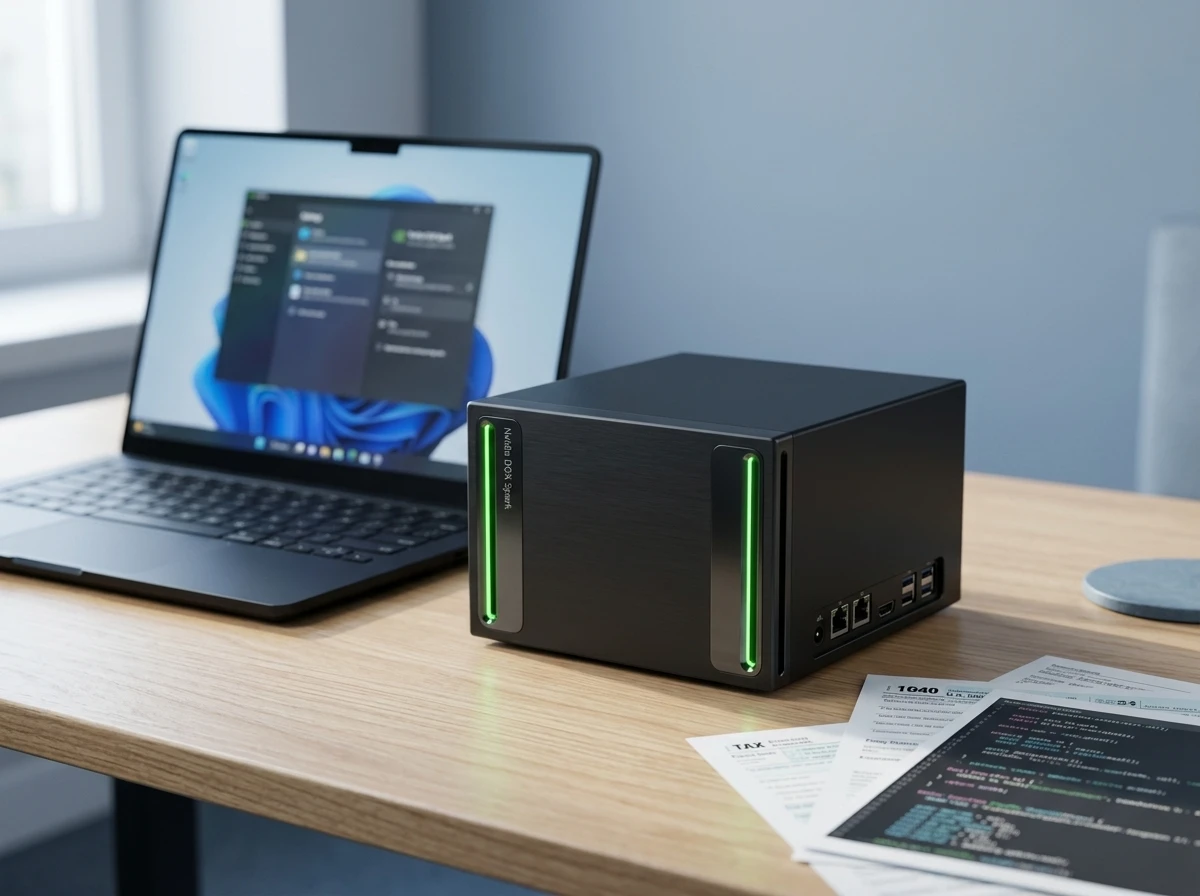
The entry hardware is Nvidia’s DGX Spark, a compact desktop unit built around the GB10 Grace Blackwell superchip. It delivers up to 1 petaFLOP of sparse FP4 AI performance, a 20-core Arm CPU, 128 GB of coherent unified LPDDR5x memory and roughly 273 GB/s bandwidth. The chassis measures about 150 mm on a side and weighs 1.2 kg. Power draw sits near 240 W for the system.
Nvidia raised the Founders Edition price from the original $3,999 launch point to $4,699 earlier in 2026, citing memory supply constraints. Retailers sometimes list lower. Any Linux machine (DGX OS or Ubuntu on Arm or x64) with an Nvidia RTX GPU carrying 24 GB or more of VRAM also qualifies. That floor roughly matches a GeForce RTX 3090 or newer. Apple silicon is absent from the current roadmap.
| Component | DGX Spark Spec | RTX Path Minimum |
|---|---|---|
| AI performance | 1 PFLOP FP4 sparse | RTX 3090-class or higher |
| Memory | 128 GB unified LPDDR5x | 24 GB VRAM |
| CPU | 20-core Arm (X925 + A725) | Host system Arm or x64 |
| Form / power | 1.2 kg, ~240 W | Desktop GPU power |
| Price range | $3,999-$4,699 | $1,500+ for used/new 24 GB cards |
The DGX Spark 1 petaFLOP desktop specs position the box as an always-on agent machine rather than a pure training box. Two units linked over ConnectX-7 can handle larger open models. Crowd reaction on X quickly flagged the price as the practical gate: free tokens arrive only after a four-figure hardware outlay plus a paid Perplexity plan.
Harness Co-Design Beats Generic Local Stacks
Perplexity argues that open harnesses built for frontier models overload smaller on-device models. Qwen 3.8 27B advertises a 256k-260k context window yet begins to struggle past roughly 100k tokens in practice. The company therefore built a minimal core prompt, a tight tool set and modular “skills” that load and unload. Context compaction summarizes older steps. Connectors became compact command-line tools instead of token-heavy MCP servers. Self-verification hooks monitor trajectory health.
On Perplexity’s internal Local Knowledge Work Bench of 53 knowledge-work tasks, the same Qwen 3.8 27B model scored 82.6% with the Computer harness on a DGX Spark, versus 77.6% for the open-source Pi harness and 74.0% for Hermes. PPLX 27B lifted the score to 85.4%. The company plans to open-source the bench.
| Benchmark | Computer + Qwen 27B | Pi | Hermes | Computer + PPLX 27B |
|---|---|---|---|---|
| Local Knowledge Work Bench (53 tasks) | 82.6% | 77.6% | 74.0% | 85.4% |
| BrowseComp (1,266 tasks) | 66.7% | 50.2% | 43.9% | – |
| ParseBench-100 multimodal | 65.1% | 13.9% | 34.6% | – |
Computer also used less wall time and fewer tokens than the alternatives on the public benches. The co-designed harness and model paper details the principles and the numbers.
Cloud Escalation Recovers Most of the Gap
Fully local performance still trails the strongest frontier models on the hardest coding and reasoning tasks. The harness therefore exposes an optional advisor tool. The local model can request help; the orchestrator selects context, runs a PII classifier, shows the user exactly what would leave the device, and awaits approval. The remote model returns text guidance only. It never touches local files or tools.
On Terminal Bench 2.1 the local Qwen path scored 59.6% at near-zero marginal cost. Escalation to a Claude Opus-class advisor raised the score to 73.0% at an estimated $0.415 per task. Running the frontier model alone reached 82.4% at roughly $0.65. Escalation recovered about three-fifths of the performance gap at about two-thirds of the pure-cloud cost. More than fifteen cloud models sit behind the permission gate.
- Local default: zero token cost, full privacy, state held across sessions
- Escalation: user-gated, PII-flagged, text-only return
- Hybrid result: most of the frontier lift at lower spend than pure cloud
Nader, Nvidia’s director of developer technology, said local AI has reached an inflection point because new open models are finally practical rather than heavily quantized hobby toys. Agents want to stay always-on and consume large volumes of tokens; owned hardware removes the meter.
We’ve basically brought the exact same UI to a fully local app. This incorporates the entirety of the agent harness and inference and everything needed to do work locally.
Nate, VP of engineering for infrastructure and enterprise, Perplexity, press briefing
Who Benefits First
Power users who already burn thousands of dollars a month on cloud agent loops gain immediate relief. Enterprises in law, healthcare and finance that refused to send sensitive documents to external APIs gain a usable agent path. Demo tasks included reviewing folders of 1099s and tax returns entirely on the Spark, then optionally posting a summary to Slack after approval. Another demo analyzed a local CSV and pushed findings externally only after the user allowed the connector step.
Aravind Srinivas, Perplexity’s cofounder and CEO, posted that a good chunk of agentic inference needs to move to local hardware in a compute- and power-constrained world. He also noted that Jensen Huang gifted the company a DGX Station after seeing an early demo, a larger local box capable of serving frontier-class open models. The second-order shift is economic: once the fixed cost of the hardware is paid, the marginal cost of another hour of agent work collapses to electricity. Long-running repo migrations, batch document reviews and multi-step research become practical instead of budget-line items.
The same X conversation that celebrated privacy also noted the barrier. A $4,700 desk unit plus a $20-$200 monthly Perplexity subscription is not a casual upgrade. Most consumer PCs lack 24 GB VRAM. The product therefore targets the high end of knowledge work rather than every laptop.
Sandbox Rules and Local Speech
Code and tools run inside isolated environments that limit operating-system access and block unauthorized network connections. External services never receive direct access to local files. If the sandbox cannot start, the harness disables itself rather than falling back to unprotected execution. That stance differs from several open-source harnesses that default to the user’s full permissions.
Speech transcription uses Nvidia Nemotron 3.5 ASR and can stay entirely on device, then feed into the same local file-processing pipeline. Pre-configured skills cover online research (when allowed), data science and programming. A reliability-verification layer sits on top of answers.
The Local Knowledge Work Bench scores and related public benches give the first public evidence that a purpose-built local harness extracts more useful work from a 27B model than generic stacks.
Availability and Next Hardware Steps
Portable Computer is live today for Pro ($20/month or annual equivalent), Max ($200/month), Enterprise Pro and Enterprise Max subscribers who have a DGX Spark or qualifying Linux RTX machine. Install uses a standard apt repository on supported systems. Users download the chosen local model after setup. Bring-your-own inference endpoint is supported in advanced mode.
Windows support is scheduled for September 2026. RTX PCs meeting the 24 GB floor will join the Spark as first-class targets. Nemotron 3.5 Lightning is listed as coming soon. Perplexity has not announced macOS support. Local runs continue to consume no credits; only approved cloud portions count against the existing credit pools that Max and Enterprise seats already carry.
The launch extends a multi-year Nvidia-Perplexity collaboration that previously focused on sovereign AI models for European customers. For Nvidia the product supplies a concrete agent workload that makes the compact desktop supercomputer more useful out of the box. For Perplexity it opens a privacy-sensitive enterprise wedge whose economics no longer depend solely on metering every token.
Portable Computer is available now on the stated hardware for paid subscribers. The first version runs on Linux; Windows follows next month.
Frequently Asked Questions
What local models does Portable Computer support at launch?
Users choose between Qwen 3.8 27B and Perplexity’s post-trained PPLX 27B variant optimized for the DGX Spark and multi-token prediction. Nvidia’s Nemotron 3.5 Lightning 30B model is scheduled to arrive next. Advanced users can point the system at their own inference server.
What is the minimum hardware for Portable Computer?
An Nvidia DGX Spark or a Linux machine running DGX OS or Ubuntu (Arm or x64) with an Nvidia RTX GPU that has at least 24 GB of VRAM. Windows support with the same VRAM floor is planned for September 2026. macOS is not on the current roadmap.
Do local tasks consume Perplexity credits?
No. Work completed entirely by the local models and harness carries zero token or credit cost. Only the portions a user explicitly approves for cloud escalation or external connectors count against the Pro, Max or Enterprise credit allocations.
How does the hybrid cloud escalation protect private data?
Before any advisor call the harness selects relevant context, runs a PII classifier, displays exactly what would leave the device, and waits for user approval. The remote model receives only that approved text and returns guidance only; it has no access to local files, tools or the full conversation.
How does Portable Computer compare with open-source local harnesses?
On the same Qwen 3.8 27B model and DGX Spark hardware, Perplexity’s harness scored 82.6% on its 53-task Local Knowledge Work Bench versus 77.6% for Pi and 74.0% for Hermes. Gaps were larger on BrowseComp and ParseBench-100. PPLX 27B reached 85.4% on the internal bench.
 Scotland’s Facial Recognition Push Sparks Mask Ban Call
  Galaxy Z Flip 8 Hits $799 Only If Your Trade-In Qualifies
  If England Had Kept Water Public Like Scotland
  Samsung Smart Switch Now Moves Passwords and eSIM From iPhone
  Old Firm Spend Pulls Clear as Premiership Rivals Patch Squads
  Chinese Studios Quietly Seize the Gamescom Stage