
 Ishan Crawford
 vivo product manager Han Boxiao has detailed the telephoto cameras for the X500 Pro and X500 Pro Max, confirming a sharp hardware split weeks before the series reaches China in September. The Pro Max reuses the 1/1.4-inch 200MP Samsung HP0 sensor from the X300 Ultra. The more compact Pro switches to a custom 64MP Sony LYT-610 with an unusual pixel layout.
Both keep Zeiss APO optics and CIPA 7.0 stabilization. The difference in sensor size and resolution redraws who wins on reach and who wins on everyday carry.
Pro Max Keeps the Ultra Zoom Kit Intact
The X500 Pro Max telephoto matches the X300 Ultra setup. It uses the same 1/1.4-inch 200MP Samsung ISOCELL HP0 sensor paired with Zeiss APO glass. Hardware 4x in-sensor zoom supports lossless steps at roughly 170mm and 340mm equivalent. An improved capture pipeline targets up to 30x snapshots, freezing fast subjects such as stage performers or pets.
The phone also supports the 400mm teleconverter first seen on the X300 Ultra. That accessory turns the native 85mm focal length into about 16.6x optical-quality reach. CIPA 7.0 stabilization carries over for both stills and video.
- Sensor: 200MP Samsung HP0, 1/1.4-inch
- Native focal length: 85mm equivalent
- In-sensor zoom: 4x hardware stages
- Extender: 400mm teleconverter supported
- Stabilization: CIPA 7.0
- Capture: Super Capture Engine up to 30x rate
On X, accounts such as @sondesix quickly noted the continuity with the X300 Ultra kit, calling out the 30x capture speed and converter support as the practical carry-over that matters for long-range shooters.
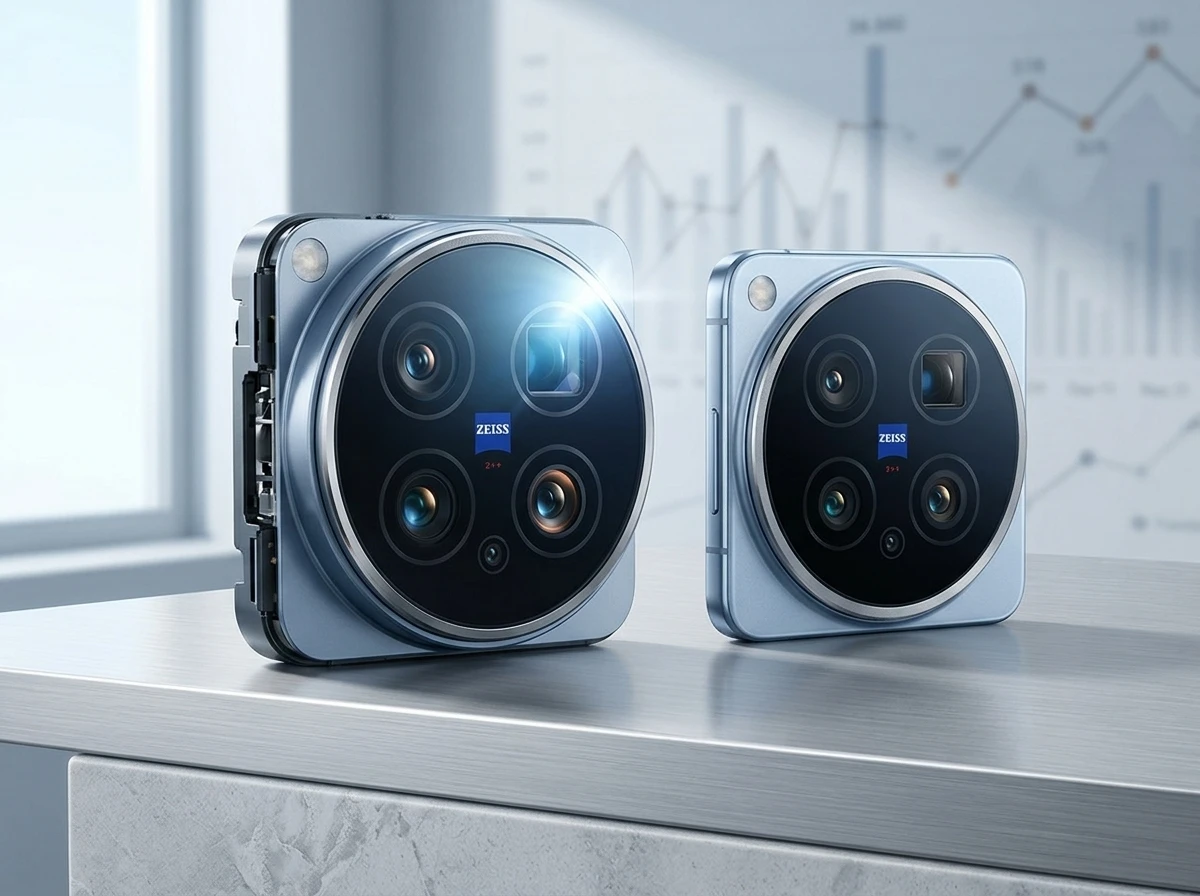
X500 Pro Switches to a Smaller Sony Sensor
The X500 Pro takes a different path. Its Zeiss APO telephoto uses a custom Sony LYT-610 (also called LYTIA 610) sensor at 64MP and 1/2-inch size. That is a clear step down from the 1/1.4-inch 200MP units on recent Pro models such as the X200 Pro and X300 Pro. Focal length stays at 85mm, and full-resolution 64MP stills remain available for cropping.
vivo says the system builds on APO technology from the X100 Pro while solving earlier size limits. The phone still claims CIPA 7.0 stabilization plus 4K 120fps slow-motion and 4K 60fps HDR video. Improved autofocus and tracking are part of the pitch for the smaller module.
Notebookcheck and Smartprix both describe the Pro as the compact flagship this generation, with a rumored screen around 6.3 inches. The sensor choice fits that goal. Previous Pro buyers who wanted the biggest possible telephoto hardware now look to the Pro Max instead.
How the New Pixel Layout Tries to Close the Gap
The LYT-610’s standout feature is its GG 1×1 and RB 2×2 (or RB2×2 OCL) pixel structure. Green pixels use a 1×1 on-chip lens for maximum resolution. Red and blue pixels share 2×2 lenses that act as phase-detection points for faster focusing. Sony’s own announcement says the design, paired with dedicated remosaicing, delivers more than 20% higher spatial resolution than its prior 0.7µm product while keeping strong AF.
The sensor is Sony’s first 1/2-type unit to support 4K 120fps readout. That matches the video modes vivo lists for the Pro telephoto and helps keep quality more consistent when switching lenses.
Sony LYTIA 610 key figures
- Size: 1/2.0-type, 0.7µm pixels
- Resolution: approx. 64MP
- Structure: Quad Bayer with RB2×2 OCL pixel structure
- Video: 4K 120fps and 4K 60fps DAG-HDR
- Claimed gain: over 20% spatial resolution vs prior same-size sensor
Whether the smaller sensor plus smarter optics can match the larger HP0 in real-world light remains the open test for September reviews.
Shared Stabilization and Video Gains
Both phones receive CIPA 7.0 professional-grade stabilization on the telephoto. The Pro Max main camera also gets 3-degree gimbal-style OIS, something the Pro appears to skip according to Notebookcheck. Video focus sits on cinema-grade modes across the Pro models: 4K 240fps slow-motion and 4K 120fps HDR have been teased for the series main cameras built around the custom Phantom 900 (or BluePrint Guangyu 900) sensor that claims 17EV dynamic range.
The telephoto video upgrades on the Pro (4K 120fps slow-mo and 4K 60fps HDR) bring the smaller phone closer to that bar. Shared Zeiss APO tuning aims to keep color and rendering consistent even as hardware diverges.
Who Wins and Who Loses in the New Split
The hardware fork creates straightforward winners and losers inside vivo’s own lineup.
| Feature | X500 Pro | X500 Pro Max |
|---|---|---|
| Telephoto sensor | 64MP Sony LYT-610, 1/2-inch | 200MP Samsung HP0, 1/1.4-inch |
| Focal length | 85mm | 85mm native |
| Lossless zoom tools | Full 64MP crop | 4x in-sensor + 400mm converter |
| Stabilization | CIPA 7.0 | CIPA 7.0 + main 3° OIS |
| Size positioning | Compact (~6.3-inch rumored) | Larger flagship |
| Best for | Everyday carry, AF tracking, video modes | Maximum reach, concerts, wildlife |
Long-range photographers who bought earlier Pro models for the big Samsung telephoto now find that recipe only on the Pro Max. Compact users who disliked the bulk of previous Pros finally get a smaller body that still carries Zeiss APO glass and high-end video. The base X500 is expected to sit below both. Tipsters such as Yogesh Brar have suggested India may see only the Pro Max this year, which would further concentrate the zoom hardware on the top model.
The same tension appears in other compact flagship choices, where makers weigh compact flagship chipset trade-offs against camera ambition.
APO Telephoto Path From X100 Pro Onward
vivo has refined its APO telephoto approach for several generations. The X100 Pro introduced key APO elements. Later Pros and Ultras moved to large 200MP Samsung sensors for cropping power. The X300 Ultra added the 400mm converter and strong CIPA 7.0 performance. The X500 series keeps that Ultra kit on the Max while the Pro reverts to a smaller custom Sony unit that emphasizes focus structure and video readout instead of pure pixel count.
This is not a retreat from imaging. It is a deliberate fork so the Pro can shrink without abandoning the Zeiss partnership. Main cameras across the Pro models still center on the new high-dynamic-range Phantom/BluePrint sensor co-developed with Sony.
September Launch Will Settle the Real Gaps
The X500 series is confirmed for a September China launch. Han Boxiao has used Weibo posts to drip specs on main cameras, stabilization, and now telephotos. Full pricing, battery sizes, Dimensity 9600-series chip details, and exact display sizes remain unconfirmed in the official teases, though leaks point to large batteries and high-refresh panels.
The timing puts vivo in the same crowded September flagship launch timing window that usually includes Apple and other Android makers. Early hands-on and sample photos will show whether the Pro’s 64MP unit with its new pixel layout can keep up with the Pro Max’s larger sensor in low light and at high crop factors. Until then the split is clear on paper: one phone for maximum optical reach, one for a smaller package that still shoots 4K 120fps from the telephoto.
Crowd reaction on X has focused on continuity for the Max and curiosity about whether the Pro’s focusing tricks make the smaller sensor feel bigger in practice. That test arrives next month.
 Scotland’s Facial Recognition Push Sparks Mask Ban Call
  Galaxy Z Flip 8 Hits $799 Only If Your Trade-In Qualifies
  If England Had Kept Water Public Like Scotland
  Samsung Smart Switch Now Moves Passwords and eSIM From iPhone
  Old Firm Spend Pulls Clear as Premiership Rivals Patch Squads
  Chinese Studios Quietly Seize the Gamescom Stage