
 Ishan Crawford
 A rare 13th-century hair-styling tool carved from red deer antler has been found at Eilean Donan Castle and acquired by National Museums Scotland. The slender gravoir is the first of its kind from Scotland and only the third known in the United Kingdom.
It sits inside a far larger haul that fills roughly 80 boxes and maps life across the full social range inside the walls.
The Needle That Parted Highland Hair
The gravoir is a thin pointed implement used to part hair neatly and build the elaborate styles that spread from France across northern Europe in the 13th century. Dr Alice Blackwell, Senior Curator of Medieval Archaeology and History at National Museums Scotland, told BBC Scotland News the objects “are incredibly rare.”
Only two other UK examples exist, both from London. Most surviving continental pieces are ivory. This one carries a small carved figure of a hooded person holding a book. Blackwell has suggested the figure could represent the Celtic missionary St Donan, after whom the island is named, though the identity stays open.
- Date range: 13th-14th centuries
- Material: local red deer antler tine
- Length: 111.5 mm
- UK total known: three, first in Scotland
Blackwell noted it likely once formed part of a dressing set that also held a mirror and comb. The pointed tip did the precise work of parting. The carved handle gave the user a firm grip while the rest of the set stayed close at hand.
That combination of function and finish marks the object as more than a simple pin. It belonged to a grooming culture that treated hair as public display, not private habit.
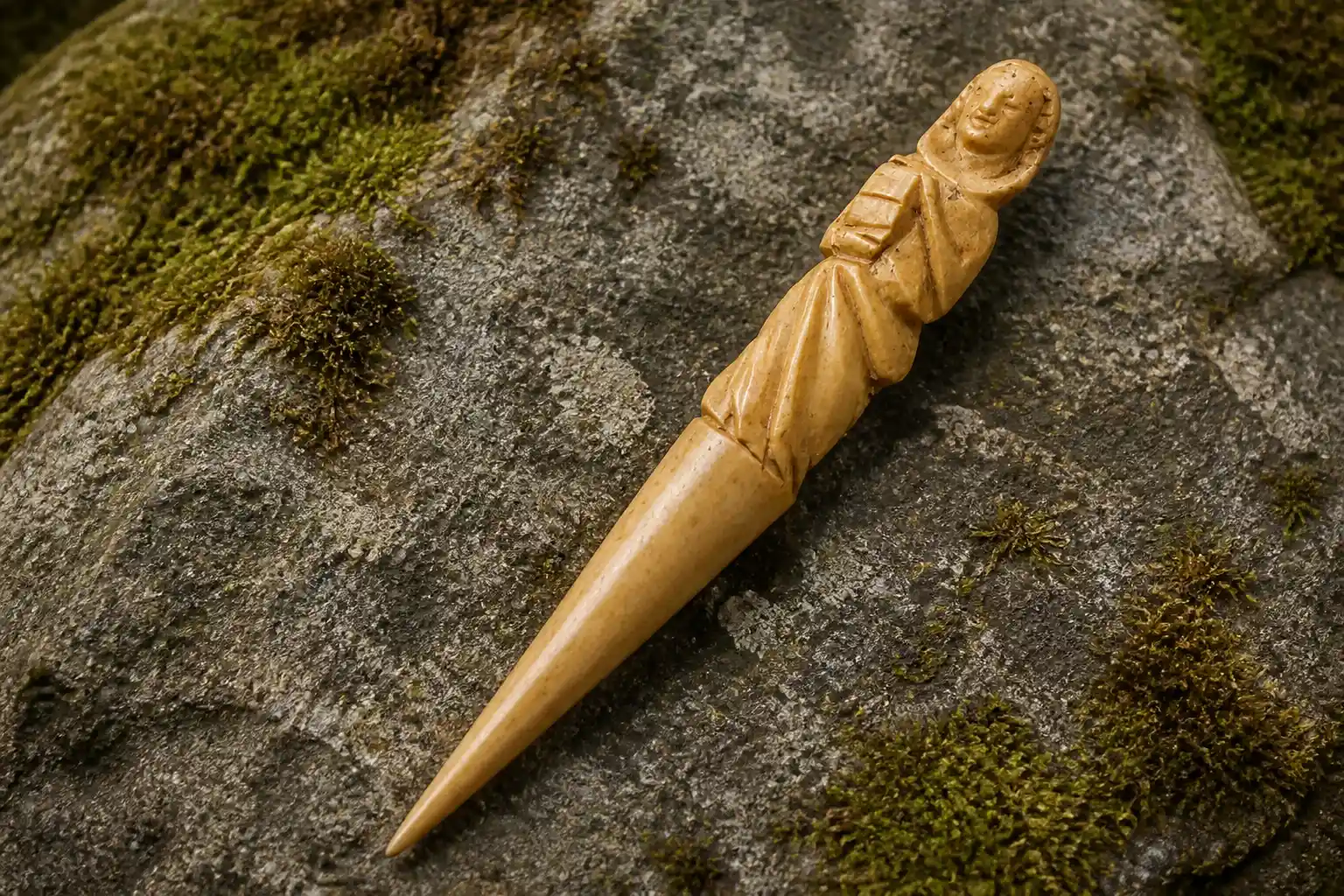
Local Antler, Continental Style
Gravoirs usually arrived as luxury ivory imports. The Eilean Donan example turns that pattern. Craftspeople shaped a European fashion object from a resource that walked the surrounding hills.
“What’s fascinating about the Eilean Donan gravoir is that it shows this connection to continental high fashion, but also rendered in a local material,” Blackwell said. The choice underlines how elite residents of this Gaelic stronghold knew the latest Parisian looks and could commission them at home.
Comparable ivory pieces survive in major collections. One North Italian late-14th-century ivory gravoir with crowned lion at the V&A shows the same functional form, often sold in leather cases with combs and mirrors from Paris workshops around 1300-1325.
The parallel is clear in outline and purpose. The difference lies in the raw material and the workshop that shaped it. Antler replaced ivory. A Highland hand replaced a Parisian one. The finished tool still did the same job in the same fashionable way.
| Feature | Eilean Donan gravoir | Typical continental piece |
|---|---|---|
| Material | Local red deer antler | Imported ivory |
| Form | Slender pointed hair tool | Same functional form |
| Likely set | Mirror and comb | Leather case with comb and mirror |
| Date window | 13th-14th centuries | Around 1300-1325 for Paris examples |
That table captures the pattern Blackwell described. Fashion travelled. The material stayed local.
Eighty Boxes of Everyday Castle Life
The gravoir is only the headline object. Excavations by FAS Heritage, commissioned by the Conchra Charitable Trust, recovered material linked to feasting, hunting, music, games, metalworking and seafaring. Brooches and dress pins speak to personal display. Animal bones and ceramic crucibles point to diet and craft.
| Category | Examples | Insight |
|---|---|---|
| Personal adornment | Brooches, dress pins, gravoir | Continental fashion adapted locally |
| Metalworking | Crucibles with gold/silver traces, smithing debris | On-site jewellery and weapons production |
| Leisure | Bone gaming pieces, iron jaw harp, buzz bones | Music, games and children’s toys |
| Food and seafaring | Animal bones, fishing weights, hooks | Farm, hunt and maritime supply |
Radiocarbon dates from the outer ward and middens place the main occupation in the 13th and 14th centuries, with later activity into the 15th-17th. The castle stood at the meeting of three sea lochs and served as a powerful centre of Highland Gaelic lordship under the earls of Ross.
Each category in the haul pulls a different strand of the same household. Adornment shows how people presented themselves. Metalworking shows what they made. Leisure shows how they passed time. Food and seafaring show how they stayed supplied at a site defined by water.
Taken together, the boxes do not describe a single elite room. They describe a working community stacked inside one set of walls.
Smiths Worked Gold Beside the Armoury
More than 60 vitrified crucible fragments came from a late-medieval midden. Traces of copper alloy, silver and gold inside them show jewellery and personal accessories were cast on site. The collection ranks among the most important assemblages of medieval metalworking material in the United Kingdom.
Later phases reveal an armoury floor packed with hammerscale, large smithing cakes and a near-complete rotary grindstone. Chainmail fragments and armour-piercing points sit alongside everyday buckles. Craftspeople produced both high-status ornaments and military kit inside the same walls.
- Small ceramic crucibles for melting precious metals
- In-situ hammerscale mapping an anvil position
- Large rotary grindstone and smithing hearth bottoms
- Chainmail links and crossbow-bolt tips
The picture is of a busy working environment running beside political and domestic life, not a purely residential fortress.
Gold residue and armour debris in the same complex matter because they collapse a tidy split between luxury and war. One workshop tradition could serve display and defence without leaving the island. The hammerscale that mapped an anvil position makes the point concrete. Someone stood there and struck metal while other people nearby ate, played, or dressed.
Jaw Harps, Gaming Pieces and Buzzing Bones
Leisure finds cut across class lines. Decorated bone gaming pieces and recycled pottery shards served as counters. An iron jaw harp, held against the teeth and plucked, supplied music. Animal bones drilled with holes and threaded on leather thongs were twisted tight then released to create a buzzing hum. These “buzz bones” may have been children’s toys or hunting lures.
This remarkable gravoir shows us how elite inhabitants of Eilean Donan were engaging with fashions on the continent. However the assemblage reveals a much broader picture of life in the 13th and 14th centuries. It allows us to imagine how the full social spectrum of people inside the castle walls spent their days, whether styling their hair, toiling in a smithy or making simple toys for children to play with. It’s a privileged glimpse into life in medieval Scotland that we don’t often get.
Dr Alice Blackwell made the point when the collection was announced. Online shares of the story often linger on the glamorous rarity of the hair tool. The deeper reaction is quieter: the site was never just a lord’s stage. Children, servants and smiths left equal traces.
A jaw harp and a buzz bone do different social work from a carved gravoir, yet they share the same soil. That shared context is what turns a single rare find into a household record.
From Gaelic Stronghold to Film Icon
iconic image of Scotland recognised worldwide, Eilean Donan first rose as a 13th-century fortification guarding the western approaches. It thrived as a Gaelic power centre through the 15th century before decline set in.
- 13th-15th centuries: Height of Gaelic lordship and maritime influence
- By 1650: Poorly maintained
- 1714: Recorded roofless and derelict
- 1719: Jacobite supply base; bombarded by British warships, then blown up
- Early 20th century: Major reconstruction creates the castle visitors see today
Miranda van Lynden, Head Trustee of the Conchra Charitable Trust, said the Trust commissioned the digs precisely because so little was known about the medieval heyday. The rebuilt walls had become a film location for Highlander and The World Is Not Enough, yet the people who once lived there stayed almost invisible.
FAS Heritage excavations since 2007 under Cecily Spall have now defined lost towers, curtain walls and timber buildings, turning the tourist landmark back into an archaeological site with depth.
The timeline above explains why the medieval layers needed recovery. Centuries of decay, destruction and later rebuilding had buried the ordinary routines the Trust wanted to understand. Film fame came first. The household record followed only after systematic digging.
How the Finds Map a Working Household
The gravoir draws the eye, yet the wider collection works like a floor plan of daily roles. Personal adornment, metalworking debris, leisure objects and food remains do not float free of one another. They mark overlapping spaces inside one Gaelic centre.
- Elite display through locally made continental forms
- On-site casting of gold, silver and copper alloy
- Armoury activity beside ordinary buckles and tools
- Music, games and possible children’s toys in the same phases
- Farm, hunt and maritime supply feeding the walls
That list follows the categories already present in the excavated material. It shows range rather than rank alone. A dressing set and a buzz bone belong to different hands, but both hands worked inside the same occupation window of the 13th and 14th centuries.
The castle’s position at the meeting of three sea lochs made that mixed household possible. Maritime routes brought ideas and goods. Local hills supplied antler and game. Workshops on site closed the loop by turning raw material into finished objects for war and display alike.
What the Collection Opens Next
The 80 boxes now sit at the National Museums Collection Centre in Granton, Edinburgh, open for further study. Researchers can track not only elite display but the routines of metalworkers, servants and children. The gravoir remains the standout single object, yet its real power is the company it keeps.
The find does not rewrite the castle’s military or political history. It simply fills in the ordinary hours that history usually skips: a lady parting her hair in the French manner with a tool made from a Highland stag, a smith pouring gold, a child spinning a buzz bone until it hummed.
Further work on the boxes can test how those roles shared space and time. Crucibles, gaming pieces, fishing gear and dress fittings already sketch the outline. Closer study can sharpen the links between them without needing a new headline object.
In that sense the acquisition is a beginning as much as a conclusion. The nation now holds the full assemblage, not only the rare antler tool that first caught public attention.
Frequently Asked Questions
What is a medieval gravoir?
A gravoir is a slender pointed hair-parting tool, also called a broche or discernibulum in period documents, used to create neat parts and elaborate styles; wealthy owners often kept them in leather dressing cases with matching combs and mirrors.
How was the Eilean Donan gravoir used?
Its pointed tip parted hair with precision while the carved handle provided grip; the style originated in 13th-century France and spread north, so the owner would have followed continental fashion trends while using a locally made implement.
Why is the antler material unusual?
Most known gravoirs were carved from expensive imported ivory; using red deer antler from the surrounding Highlands shows local craftspeople could reproduce high-status European forms with readily available materials.
How many other gravoirs exist in the UK?
Only two others are known, both recovered in London; the Eilean Donan example is therefore the sole Scottish find and one of the rarest personal grooming objects from medieval Britain.
What else did the excavations recover?
Beyond the gravoir the digs produced crucibles with precious-metal residues, bone gaming pieces, an iron jaw harp, buzz-bone toys, dress fittings, fishing gear and extensive evidence of iron smithing including an armoury floor.
 GTA Online Summer Heist Event Doubles Classic Finales Cash
  Samsung Galaxy F70 Pro Tease Locks Flipkart While M47 Holds Amazon
  Meta AI Glasses Turn Delhi Protests Into Walking Cameras
  India’s Net Neutrality Review Follows Airtel Slicing Gap
  Galaxy Z Fold 8 Preorders Race Past S26 Benchmarks
  Maruti Hansalpur Plant D Lifts Capacity Toward Four Million