
 Ishan Crawford
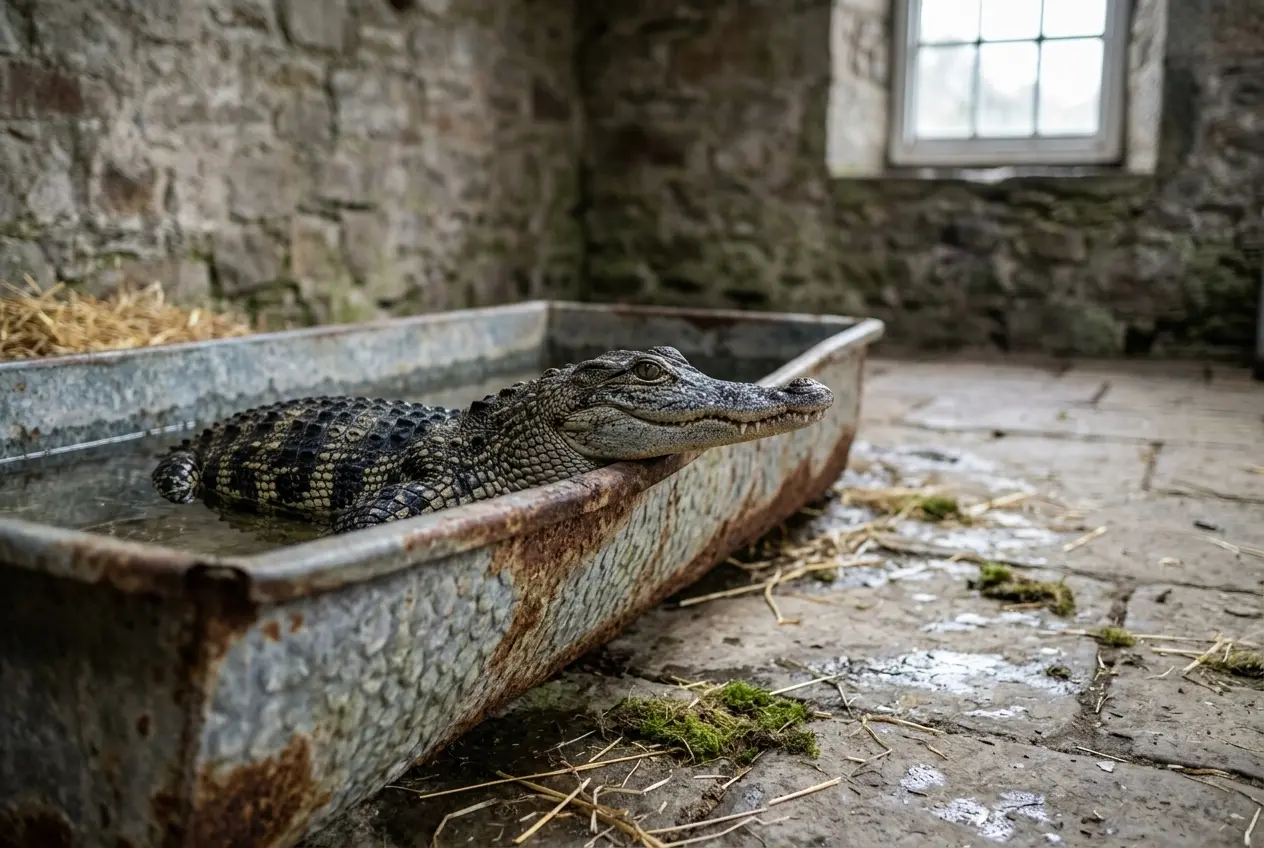
 A Nile crocodile lives, legally, in a private home in Angus. So do gaboon vipers, Gila monsters and an eastern diamondback rattlesnake, part of 22 licensed dangerous animals in that one Scottish council area alone. Wildlife charity Born Free says Britain now has more than 2,200 animals classed as “dangerous” living in private hands, and the research lands almost to the day on the 50th anniversary of the law that was supposed to make that rare.
Born Free wants ministers to overhaul it. But the ministers it names sit at Westminster, promising change for England and Wales. The law in Scotland, where the charity says the most licensed wild cat hybrids in Britain now live, runs on a separate devolved track that nobody in this campaign is asking to touch.
Scotland’s Ledger of Licensed Danger
The regional breakdown is specific. Angus holds crocodiles, alligators, Gila monsters, gaboon vipers, eastern diamondback rattlesnakes and a rhino viper among its 22 licences. Moray has at least 13 wild cats, including Savannah cats and servals. Perth and Kinross licenses 30 mouflon sheep, four Przewalski’s horses and three bison. Dumfries and Galloway has 40 wild boar, six camels and a lynx. Aberdeenshire keeps nine ostriches, Aberdeen city has one venomous reptile, East Ayrshire has five wild boar, and Fife has a single licensed Savannah cat.
| Region | Licensed Total | Notable Species |
|---|---|---|
| Angus | 22 | Nile crocodile, alligators, Gila monsters, gaboon and rhino vipers, eastern diamondback rattlesnakes |
| Perth and Kinross | 37 | 30 mouflon sheep, 4 Przewalski’s horses, 3 bison |
| Dumfries and Galloway | 47 | 40 wild boar, 6 camels, 1 lynx |
| Moray | 13+ | Savannah cats and servals |
| Aberdeenshire | 9 | Ostriches |
| East Ayrshire | 5 | Wild boar |
| Aberdeen City | 1 | Unnamed venomous reptile |
| Fife | 1 | Savannah cat |
Zoom out to Britain as a whole and the categories that worry Born Free most are the ones with teeth or venom glands.
- 500+ venomous snakes kept privately across Britain, a category that includes pit vipers
- Nearly 300 primates held in private ownership
- 79 crocodiles, alligators and caimans living in homes and private premises
- 166 wild cats, including lions, pumas and tigers
Dame Joanna Lumley, the actress who serves as Born Free’s founder patron, said the scale of it should embarrass the country that licenses it.
Wild animals should never ever be kept as pets, no matter how much we feel we could give them a wonderful home. It is shocking that so many are still being legally kept in private hands, propping up a cruel and ghastly trade.
Her line about private hands is the one that matters for Scotland specifically, because the hands holding these licences answer to two different governments depending which side of the border they sit on.
The Law Scotland Runs on Its Own
The Dangerous Wild Animals Act 1976 covers England, Wales and Scotland alike. But responsibility for the Act has been devolved to Scotland since devolution, meaning Scottish ministers, not Defra, own the policy. Scotland has run its own amended schedule of covered species since 2008, when a Scottish order substituted a new list of controlled animals for the one used south of the border.
That matters because of who answered STV’s questions on this story. A Defra spokesperson, representing the UK government department that covers England, said anyone wanting to keep a licensed animal “must be carefully vetted” and that a licence sets out “strict conditions” for how the animal is kept. True enough, but Defra does not write Scotland’s rules and cannot promise to change them.
Chris Lewis, Born Free’s captivity research and policy manager, put the failure in blunter terms. “These animals are still wild, still dangerous, yet still legal to keep,” he said, adding that “the Government must urgently review and reform the laws governing the trade in, and keeping of, wild animals as pets.” The government he is addressing is the one in London. Holyrood is not named in that ask anywhere in Born Free’s campaign material, even though its own research shows Scotland leads Britain on the exact trend, hybrid wild cats, that worries the charity most.
Same Craze, Half a Century Apart
The 1976 Act did not appear from nowhere. It was written to stop a fashion. Wikipedia’s record of the statute notes it was enacted after vets were required to inspect premises before any licence could be granted, a direct response to a boom in the late 1960s and early 1970s for owning dangerous exotic species and hybrids between wild and domestic animals, wolfdogs and Bengal cats among them. Parliament decided the average citizen should not be able to acquire something that dangerous without a licence and a vet’s sign-off.
Fifty years later, Born Free describes almost the same craze wearing new branding. Small wild cats and their hybrids, Savannah cats crossed from domestic cats and servals, have become fashionable partly through social media, and the charity’s research found they are among the most frequently licensed species in Britain, with Scotland home to more of these hybrids than anywhere else in the country. The animal changed. The impulse to own something wild as a status object did not.
Why Do Some Wild Cat Hybrids Need No Licence at All?
Later-generation wild cat hybrids can be bred far enough from their wild ancestor that they fall outside the Act’s schedule entirely, even while keeping serval-like size, strength and temperament. A cat close to its wild parent needs a licence, a vet inspection and a local authority’s approval. A few generations further down the same bloodline, the same broad physical traits can exist in an animal nobody has to register anywhere.
That gap is precisely what turns a licensing system into an incentive. Breeders and buyers who want the look and status of a wild cat without the paperwork have a simple workaround: buy or breed a generation or two past the line. Born Free’s licensed totals, big as they are, sit on top of an unknown and unlicensed population the charity says is likely larger still, since the Act only counts what local authorities have actually been asked to license.
A Decade of Scotland’s Own Reviews
Scotland has actually spent a decade examining this problem through its own institutions, on a track separate from Born Free’s Westminster campaign, and largely unresolved.
- 2015: Then-environment secretary Richard Lochhead commits the Scottish Government to reviewing the exotic pet trade after talks with charity OneKind, following incidents including a monitor lizard found in an Edinburgh supermarket toilet.
- 2020: Born Free’s own tally, cited in the Scottish Government’s later working papers, counts 255 dangerous wild animals licensed in Scotland alone, including a king cobra, a mamba and 54 cats such as Savannah cats and caracals.
- 2021: New Scottish licensing rules for animal sellers and breeders take effect in September, run alongside the older Dangerous Wild Animals Act rather than replacing it.
- 2022: The Scottish Animal Welfare Commission, the advisory body Scottish ministers tasked with the review, finishes examining the exotic pet trade and recommends a “positive list” system plus a ban on importing wild-caught animals for the pet trade.
- 2024: Researchers publish the first formal academic evaluation of the Dangerous Wild Animals Act in more than 20 years, flagging that the law never actually defines what counts as “dangerous.”
- 2026: Born Free’s new count finds Scotland still holds Britain’s largest licensed wild cat hybrid population, on the Act’s 50th anniversary.
A positive list would flip the current system. Right now Britain works from a negative list, meaning an animal is unregulated unless specifically named in the schedule, which is how later-generation hybrids slip through. A positive list would instead ban everything except species specifically approved, closing that gap by default rather than by amendment. Scotland’s own advisory commission recommended exactly that years ago. It has not become law.
Bison, Elk and a Different Kind of Wild
Not every animal on the Act’s schedule is a private status pet. Some of the licences Born Free counted cover bison in large countryside enclosures and other conservation grazing projects, animals doing ecological work rather than living in a spare room. The Wildlife Trusts have raised a separate concern about exactly this group, arguing that species like bison and elk used to restore habitats are currently caught by both the Dangerous Wild Animals Act and farming regulation at once, rules built for neither purpose.
They want a new “kept wild” status carved out for conservation animals, one that would meet welfare standards while letting bison and elk roam larger landscapes and behave more naturally, rather than being licensed and inspected as if they were a private collector’s tiger. It is a narrower ask than Born Free’s, and it does not touch the private ownership question at all. But it shows the same 50-year-old statute is now being pulled at from two different directions, by people who agree it needs to change and disagree about which parts.
None of that Westminster-facing reform conversation currently commits Scotland to anything. Whatever happens to England and Wales’s schedule next, Scotland’s own list of controlled species will keep needing a separate Scottish order to change it, the same mechanism used in 2008, and so far no minister at Holyrood has put a date on using it again.
Frequently Asked Questions
Do You Need a Licence to Keep a Venomous Snake in Scotland?
Yes. Under the Dangerous Wild Animals Act, a local authority cannot grant a licence until a vet has inspected the premises and reported back on whether the animal can be safely and suitably housed there, a requirement that applies to venomous snakes on Scotland’s schedule just as it does in England and Wales.
What Happens if You Keep a Dangerous Wild Animal Without a Licence?
It is a criminal offence under the Act to keep any species named on the schedule without a licence from the local authority, regardless of how the animal was acquired or how long it has been kept.
Why Are Savannah Cats Legal to Own Without a Licence?
Many are not exempt, early-generation Savannah cats bred close to their serval ancestor still require a DWAA licence, but breeders can produce later-generation hybrids far enough removed from the wild parent that they fall outside the schedule entirely while keeping much of the size and temperament that made the breed popular.
Does the Dangerous Wild Animals Act Apply in Northern Ireland?
No. The Act’s territorial extent covers England, Wales and Scotland only, so Northern Ireland sits outside this particular piece of legislation altogether.
What Is the Difference Between a Positive List and the Current Rules?
Britain’s current system is a negative list, animals are unregulated by default unless specifically named as dangerous. A positive list, the approach Scotland’s own animal welfare advisors have recommended, would reverse that by banning any species as a pet unless it has been specifically approved, closing loopholes automatically rather than one amendment at a time.
 One UI 9’s Privacy Display Fix Reaches Just One Galaxy Phone
  Samsung Drops Its Own Exynos Chip for the Galaxy Watch9 and Ultra 2
  Marathon’s Vault Breaker Arrives as Bungie’s Bigger Bet Keeps Faltering
  Sony’s PlayStation Disc Cutoff Erases the Last Proof of Ownership
  Tesla’s Summer Update Hands Grok the Keys, and Musk’s Empire More Reach
  Apple’s $634 Million Masimo Payment Is Final After Appeal Denial