
 Ishan Crawford
 Old Petty, the new Tom Doak-designed links course at Cabot Highlands, opened May 15 beside a 400-year-old castle on Scotland’s Moray Firth. It’s the country’s newest 18-hole course. It’s also the seventh stop in a golf empire that now stretches from a former coal mine in Nova Scotia to the Arctic Circle in Norway.
Cabot, the Canadian company that owns Cabot Highlands, opened its first course on an abandoned coal mine in Cape Breton in 2012. Fourteen years and six more countries later, Old Petty is its newest project, built on land the resort’s original architect wanted to develop before he died in 2019.
Old Petty Joins Castle Stuart on the Moray Firth
Old Petty is Cabot Highlands’ second course, joining Castle Stuart on a stretch of coastline just outside Inverness. It’s a walking-only links layout designed by Tom Doak, with Clyde Johnson as lead associate, and it opened to the public after a preview run in August and September 2025 that drew strong reviews from golfers and course critics.
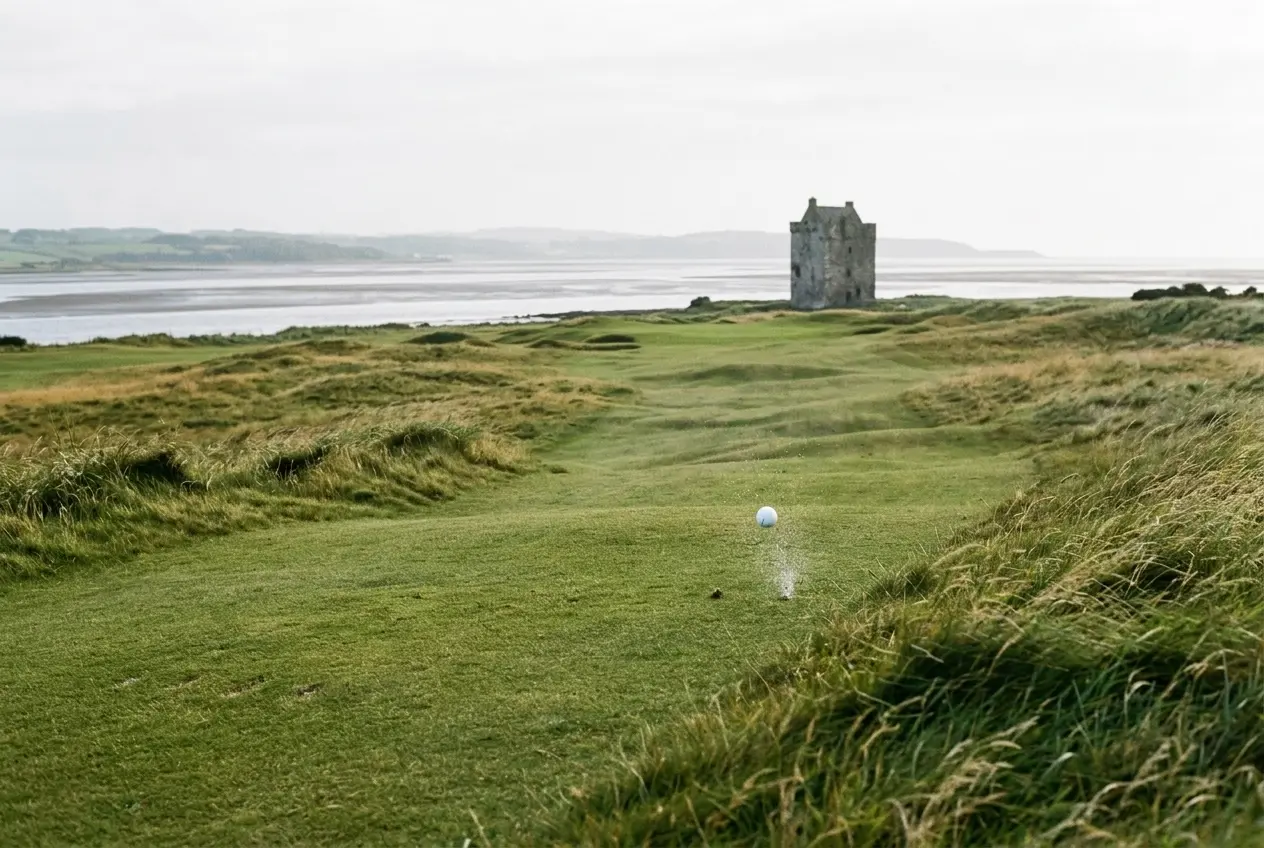
The course takes its name from Old Petty Church, a stone chapel built in 1839. Doak’s routing sends players past the church on the second hole and within view of Castle Stuart’s 400-year-old tower house, completed in 1625, on the downhill par-3 third. From 13 of Old Petty’s 18 holes, that same tower stays visible across the water.
The first and 18th fairways cross paths near the clubhouse, a feature rare in modern golf that Cabot says balances playability with strategic intrigue. Even before its official debut, Old Petty had already cracked Golf World’s Scotland Top 100 list at number 34, with the magazine suggesting it could climb into the top 20 as the turf matures.
The Global Playbook Behind Old Petty
Cabot Highlands is one node in a much larger network. The company’s collection of golf destinations now runs from Cabot Cape Breton in Nova Scotia, its flagship, to Cabot Saint Lucia in the Caribbean, Cabot Citrus Farms in Florida, Cabot Bordeaux in France, Lofoten Links in Norway and Cabot Revelstoke, a mountain resort under construction in British Columbia. By the company’s own description, that adds up to seven destinations across five countries.
| Destination | Location | Signature Golf | Status |
|---|---|---|---|
| Cabot Cape Breton | Nova Scotia, Canada | Cabot Links and Cabot Cliffs | Flagship, opened 2012 |
| Cabot Highlands | Inverness, Scotland | Castle Stuart and Old Petty | Old Petty opened May 15, 2026 |
| Cabot Saint Lucia | Point Hardy, Saint Lucia | Point Hardy Golf Club | Open, designed by Coore and Crenshaw |
| Cabot Citrus Farms | Brooksville, Florida | Karoo and Roost | Named Golf Inc.’s 2025 Development of the Year |
| Cabot Revelstoke | British Columbia, Canada | Rod Whitman design | Preview play set for late 2026 |
| Cabot Bordeaux | Medoc, France | Under development | No opening date announced |
| Lofoten Links | Norway | Jeremy Turner design | Part of the collection |
Cabot Citrus Farms, the company’s first US property, was named 2025 Development of the Year by Golf Inc., a golf industry trade publication. Cabot Revelstoke, its first mountain project, is due to begin preview play later this year, with a 155-room lodge following in 2027. The company also says it’s the first multi-property golf brand to enroll every course into Audubon International’s Platinum Signature Sanctuary certification program, a sustainability designation covering the whole collection.
Two Towns Named Inverness
Cabot’s founder, Ben Cowan-Dewar, built the company’s first course with backing from U.S. golf developer Mike Keiser. Cabot Links opened in 2012 on an abandoned coal mine in Inverness, a small community on Cape Breton Island in Nova Scotia.
Fourteen years later, Cabot’s most historic project sits in a different Inverness, the Highland city nearest to Cabot Highlands. The coincidence of geography is entirely its own: the company’s empire began in one Inverness and has now reached its most storied entry in another.
Cabot bought Castle Stuart in 2022, folding it into a portfolio that already included Cape Breton and properties then under construction in Saint Lucia and British Columbia. “Not only is this significant golf news, it is also a major boost for the regional economy of the Highlands,” Stuart McColm, Castle Stuart’s general manager, said when the deal closed.
Finishing What Parsinen Started
Mark Parsinen, the American developer who created Castle Stuart with architect Gil Hanse, always wanted a second course on the property. He never got the chance. Parsinen suffered a stroke at his California home and died in hospital on June 3, 2019, at age 70.
Castle Stuart opened in 2009 and landed a Scottish Open date within 18 months. Colleagues said Parsinen’s ambitions for the site went further. “He was immensely proud of what he achieved here, but his vision for the resort was much bigger,” Grant Sword, a Castle Stuart managing partner, said after Parsinen’s death.
When Cabot acquired the resort three years later, it inherited both a world top 100 course and an unfinished ambition. Doak, not Gil Hanse, got the call to finish it.
How Doak Reads the Ground
Doak said the job wasn’t simple. “This was kind of a tough assignment, because there’s a really good golf course already here that used up a lot of the most spectacular views in parts of the property,” he told Forbes after playing his first round on the finished course. He said he never treated it as a rivalry: whichever course people end up preferring, he said, the goal was building something worth playing.
The most important thing you can have in golf is a difference between where the ball lands and where it winds up. Here, it’s because of the firmness of the ground and the wind. And you don’t get that in every place that you work. But when you have it, it’s much more interesting.
Doak said that after his first look at the finished layout. His team discussed building Old Petty without bunkers entirely, he said, before deciding that approach suits tighter, more contained sites. Old Petty’s broad, wind exposed ground called for something else: contour and turf firmness doing the work sand usually does.
The par-4 fifth hole passes a small stone bothy, a traditional Scottish cottage now used as a halfway house for snacks and drinks. From there Doak turns the routing inland for the rest of the front nine before the course swings back to the water, hugging the Moray Firth from the 13th through the 16th on its way home. Caddies are available for hire, and a limited number of carts can be reserved for players holding a medical certificate, since the course otherwise requires walking.
The Highlands Start Cashing In
Golf tourism generated an estimated £60 million (about $81 million) for the Highlands economy in 2025, according to Golf Highland, a co-operative representing 34 clubs across the region. Green fee income for its member courses topped £12 million last year, more than double the figure recorded when the group first surveyed the market in 2018, and visiting golfer numbers climbed 16% to more than 120,000. The co-operative names Cabot Highlands alongside Royal Dornoch and Nairn as the region’s marquee draws.
Cabot Highlands is also selling real estate alongside the golf. A first round of on-site residences is now fully spoken for, the company says, with a new release starting at £2.25 million. That expansion mirrors Cabot Highlands’ own emergence as one of Scotland’s premier golf destinations, a status that took shape well before Old Petty’s turf had fully rooted.
For scale, St Andrews alone generates more than £300 million a year for the Scottish economy, according to VisitScotland’s golf tourism research. The Highlands total is smaller, but growing faster off a lower base, and Old Petty gives the region a second world-class course to sell alongside Royal Dornoch.
Golfers who fly into Inverness, the closest airport to Cabot Highlands, don’t have to stop at golf. Within a short drive:
- Loch Ness – the loch and its monster legend pull visitors regardless of golf plans
- Urquhart Castle – a ruined medieval fortress on the loch’s western shore
- Flow Country – a UNESCO World Heritage Site of peatland bog in the far north
- Highland distilleries – part of a dense cluster of Scotch whisky producers within driving range
Cabot’s next opening is already on the calendar. Revelstoke begins preview play this year, ahead of a mountain lodge due in 2027, the next piece of a collection that started with one course on a coal mine fourteen years ago.
Frequently Asked Questions
How much does it cost to play Old Petty?
Old Petty’s green fee stood at £385 for 18 holes in its first full season, matching the rate at Castle Stuart next door and landing close to Royal Dornoch’s £360 and Nairn’s £350, according to green fee tracking across Scotland’s top courses in 2026.
When does Old Petty’s golf season run?
Old Petty operates from its May 15 opening through November 14 each year, per Cabot Highlands’ own booking terms, closing over winter like most exposed links courses in the Highlands.
Who else worked on Old Petty’s design besides Tom Doak?
Clyde Johnson served as lead associate architect on the project, working alongside Doak throughout the design and construction of the course, according to Cabot’s official opening announcement.
What would a multi-course Highlands golf trip cost?
A five-round itinerary pairing Royal Dornoch, Cabot Highlands, Nairn, Brora and Boat of Garten runs to roughly £1,390 in green fees alone, or about £278 a round, based on 2026 pricing surveys of Scotland’s courses.
Is Cabot building golf courses beyond Scotland right now?
Yes. Cabot Revelstoke in British Columbia is scheduled for preview play in late 2026, and Cabot Bordeaux in France remains under development, both part of a collection that has grown to seven destinations since the company’s 2012 debut.
 One UI 9’s Privacy Display Fix Reaches Just One Galaxy Phone
  Samsung Drops Its Own Exynos Chip for the Galaxy Watch9 and Ultra 2
  Marathon’s Vault Breaker Arrives as Bungie’s Bigger Bet Keeps Faltering
  Sony’s PlayStation Disc Cutoff Erases the Last Proof of Ownership
  Tesla’s Summer Update Hands Grok the Keys, and Musk’s Empire More Reach
  Apple’s $634 Million Masimo Payment Is Final After Appeal Denial