
 Ishan Crawford
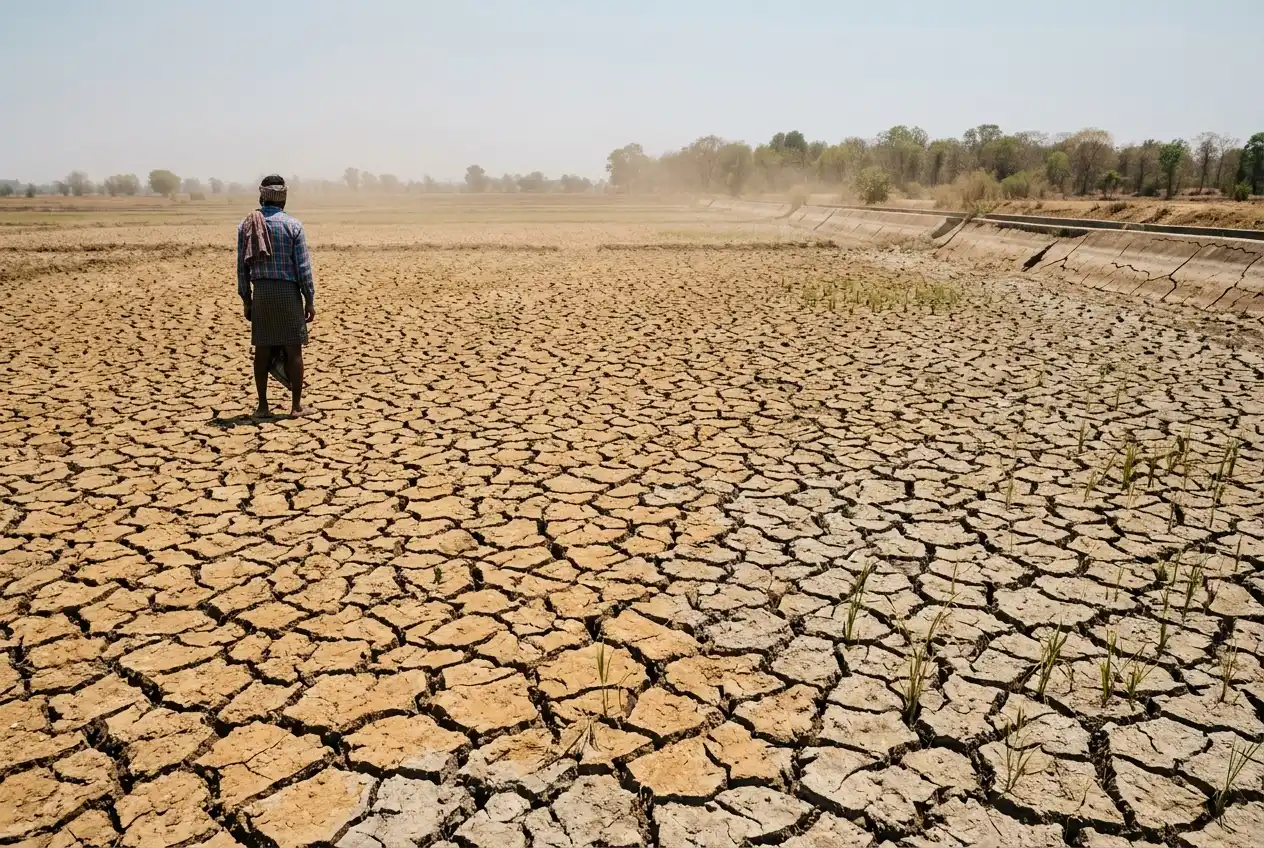
 India’s weather office now expects the 2026 monsoon to arrive at 90 percent of normal, and economists reading that deficient monsoon forecast see retail inflation climbing back above 5 percent in FY27 from 3.48 percent today. Thinner rains mean smaller harvests, pricier food, and tighter rural budgets. What sits in the country’s government warehouses and reservoirs is the reason the food-price shock has a ceiling.
Most of the worry lands on a single line in the India Meteorological Department’s May 29 forecast. The bigger question for prices is how evenly the rain falls across June to September, and whether a building El Niño tips a weak season into a dry one.
Why a 90% Monsoon Has Economists Watching Food Prices
The India Meteorological Department (IMD, the national weather service) cut its 2026 monsoon forecast to 90 percent of the long-period average (LPA, the 1971-2020 rainfall benchmark) on May 29, down from the 92 percent it gave on April 13. The agency now puts the combined probability of a below-normal-to-deficient season at 84 percent, up from 66 percent in its first estimate, with a 60 percent chance the rains land in outright deficient territory.
It also flags a high likelihood of El Niño, the Pacific warming pattern that weakens the Indian monsoon, and above-normal heatwave days through June across Uttar Pradesh, Punjab, Haryana, Bihar and several other states. Delayed, drier rain on top of extreme heat is a poor backdrop for early sowing.
Retail prices, for now, are tame. The Consumer Price Index rose 3.48 percent in April, per the April Consumer Price Index release from the Ministry of Statistics, the fastest pace in a year but still soft, while food inflation climbed to 4.2 percent from 3.87 percent a month earlier. Some of that softness leaned on collapsing vegetable prices, with potato down about 24 percent and onion down roughly 18 percent year on year, a low base that will not repeat if heat and thin rain damage the next crop.
Economists expect the food line to push higher. Debopam Chaudhuri, chief economist at Piramal Group, pegs current food inflation near 5.5 percent and headline inflation around 5 percent, with room to revise up depending on the season. Economists at ICICI Bank also see headline inflation above 5 percent, pointing to meat, fish, fruits, edible oils and ready-made foods, and to perishables spiking as the heat bites.
The Cushion Sitting in India’s Granaries
The inflation calls tend to underplay the size of the grain stockpile. India faces a weak monsoon while sitting on near-record cereal stocks and fuller-than-usual reservoirs.
The Department of Food and Public Distribution reports wheat stocks at 513 lakh tonnes (LMT, where one lakh tonne is 100,000 tonnes) against a buffer norm of 275 LMT due on July 1, and rice at 397 LMT versus a 135 LMT norm. Combined rice and wheat holdings with the Food Corporation of India and state agencies stood above 817 LMT at end-April, multiples of what the rulebook requires. These are peak-season stocks, topped up by this year’s wheat procurement, and they sit well above where they stood before the 2015 deficit.
| Grain | Stock (LMT) | Buffer norm (LMT) |
|---|---|---|
| Wheat | 513 | 275 |
| Rice | 397 | 135 |
Reservoirs back up the picture. Live storage across the major reservoirs was 31 percent of capacity on May 29, above the long-period average of 26 percent for the date and close to 124 percent of the decadal mean, the cushion left by two good monsoons running. The Finance Ministry’s monthly economic review for May flagged a deficient monsoon as a food-price risk stacked on energy costs, while noting comfortable buffers temper it. Those stocks are a lever: the government can release grain to cap cereal prices if the kharif (the monsoon-sown summer crop) season disappoints.
Which Crops Carry the Price Risk
Not every crop is equally exposed, and that is what bounds the damage. The split runs along irrigation lines.
The most vulnerable crops are rain-fed and grown in the monsoon core zone, the central, western and eastern belt that produces about 40 percent of national output and is set for below-normal rain:
- Pulses, where India already leans on imports and where shortfalls pass quickly to the consumer plate
- Coarse cereals and millets, sown largely without irrigation
- Oilseeds, which feed the import-heavy edible-oil basket that ICICI Bank flagged
- Spices, another rain-dependent category prone to sharp price moves
The staples that anchor the price index are better protected. Paddy is concentrated in the irrigated northwest (about 27 percent of output) and the east and northeast (23 percent), with central and southern India splitting much of the rest. Wheat is even more sheltered: the northwest grows 68 percent and central India 25 percent, both on heavy irrigation. Delayed or thin rain bites less where canals and tubewells carry the load. IMD officials expect early forecasts to let farmers swap water-hungry paddy for less thirsty millets, maize and pulses in rain-short districts, the same response that limited losses a decade ago. The danger turns real only if soil moisture and reservoir levels run down before the rabi (winter) sowing that follows the monsoon.
Distribution Beats the Headline Shortfall
Headlines fixate on the seasonal total. Harvests turn on how evenly the rain spreads across June to September. Chaudhuri put a figure on how little the shortfall alone tends to move prices, as long as the kharif crop is not wiped out:
Taking cues from past episodes of deficient monsoons, this factor alone may not move the needle on food inflation by more than 25 bps. If, however, the monsoon shortfall is accompanied by drought conditions across major kharif-growing regions, as can occur during a severe El Niño event, headline food inflation could rise by as much as 50 bps, while rural consumers may face significantly higher price pressures than their urban counterparts.
Chaudhuri was speaking to Moneycontrol, the financial news outlet that gathered the forecasts. That 25 to 50 basis points band (a basis point is one-hundredth of a percentage point) is the distance between a weak season and a drought.
The Last Deficient Year
The reference point is the season a decade ago, when rainfall came in around 86 percent of LPA, deficient by any measure, yet crop losses stayed contained. D S Pai, head of the Regional Meteorological Centre in Chennai, told Moneycontrol that output that year was slightly below normal rather than collapsed, because early forecasts let farmers shift to short-duration and alternate crops. He added that 2026 starts from a stronger base, with reservoirs higher than they were going into the 2014-15 stress, except in parts of the south. Academic studies of that year’s monsoon trace the deficit to a strong El Niño and a disrupted circulation pattern.
How Evenly the Rain Falls
Spread is the swing factor. Former Agriculture Secretary Siraj Hussain told Moneycontrol that two consecutive droughts in 2014-15 and 2015-16 still cost only about 5 percent of production, because what matters is whether rain arrives every week. Pai framed the same uncertainty in the forecast’s own range: a supportive Indian Ocean Dipole could lift the season toward 94 percent of LPA, while worsening conditions could drag it down near 86 percent, the reason IMD carries a plus-or-minus 4 percent margin on its number.
What Weak Rains Do to Rural Wallets
The monsoon reaches the economy well beyond the grocery bill. A good season lifts rural income and spending. When the rain fails, both shrink, and rural households carry the thinner cushion. April already showed the split, with rural inflation at 3.74 percent against 3.16 percent in towns and cities.
That is why the rain sits inside the central bank’s arithmetic. The Reserve Bank of India has pinned FY27 growth at 6.9 percent while naming below-normal rainfall and El Niño as the risk it cannot steer, with food making up 46.2 percent of the CPI basket and inflation projected to peak near 5.2 percent in the October-to-December quarter, just as post-monsoon shortages reach the market. Those projections rested on the earlier 92 percent rainfall call; the May 29 cut to 90 percent moves the risk the wrong way.
Energy adds to the load. Brent crude averaged above $108 a barrel in May after topping $120 in April, and the Finance Ministry has warned that the gap between retail and wholesale inflation shows cost pressure building. Heatwaves pile on, lifting power demand and spoiling perishables before they reach the mandi (the wholesale farm market). Rural demand has been a swing factor for everything from staples to two-wheelers, and a poor monsoon would test it just as urban spending cools.
The Monetary Policy Committee meets this week. Its FY27 inflation path averages 4.6 percent on the central bank’s own numbers, yet runs above 5 percent for three straight quarters, leaving little room for the rate cuts a softer economy might otherwise invite.
The Calendar Now Running
For now, the buffers hold. Grain stocks at multiples of their norms give the government room to release supply and cap cereal prices if the season disappoints, and reservoirs are fuller than they were heading into the last drought.
The piece nobody controls is how the rain spreads from June to September. The monsoon’s progress over the core zone through July, and whether El Niño firms up, will settle the food-inflation question that the 90 percent forecast only opened.
 ASUS ROG Turns 20 With Edition 20 Lineup at Computex
  Google’s $80 Billion AI Raise Tests the Capex Bill
  CCI Probe Puts Mrs India Inc Pageant Contracts Under Fire
  Suzuki XL7 Facelift Spy Shots Put India’s XL6 on Alert
  Meze ARTA Headphones Put a $6,000 Bet on Repairable Hi-Fi
  Cyberpunk and Blue Prince Give Apple Design Awards a Mac Edge