
 Ishan Crawford
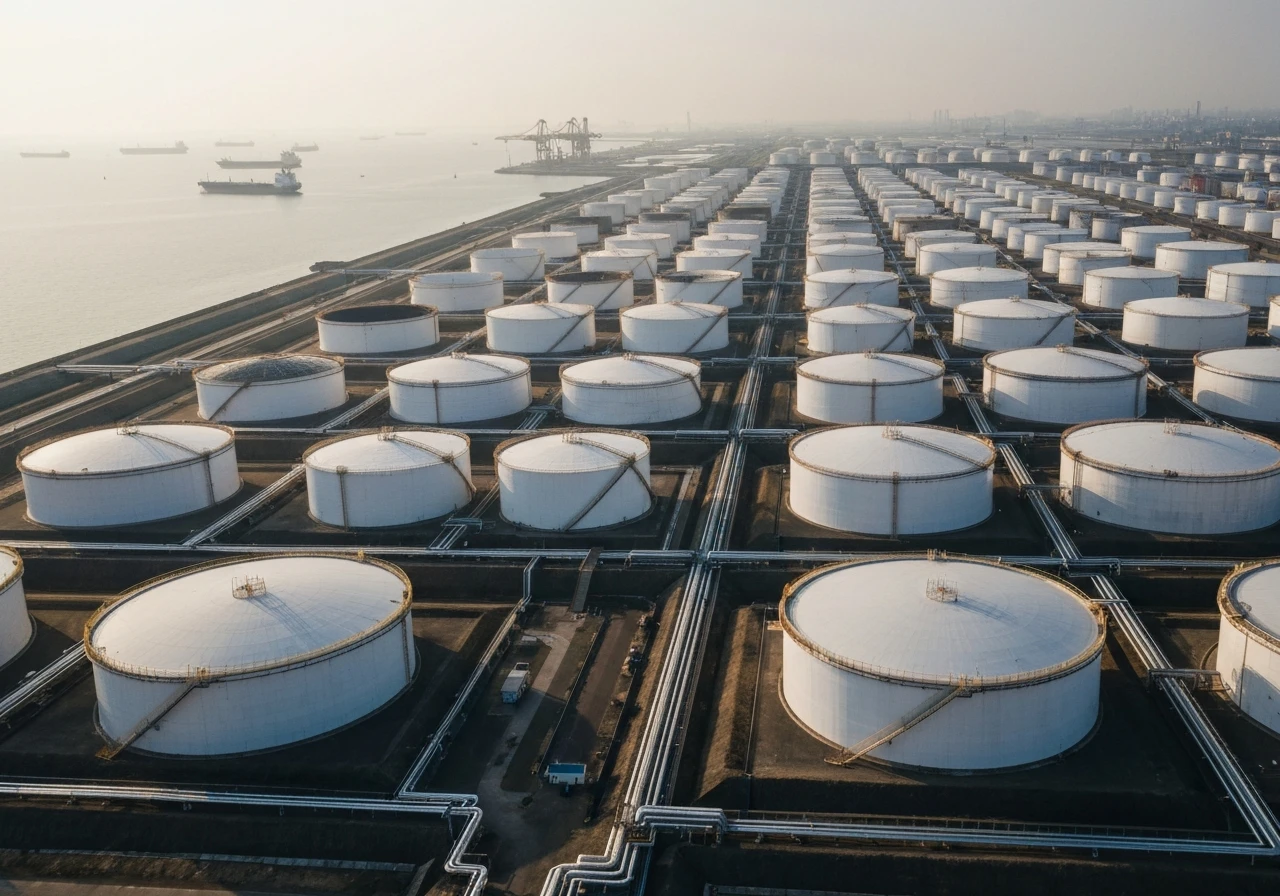
 While the Iran war has erased about a billion barrels of crude from global supply and pushed the rest of the world to drain storage tanks at nearly 1.7 million barrels a day, China is leaning on a cushion it spent the past year quietly assembling: more than 1.2 billion barrels of stockpiled crude. That buffer leaves Beijing the one major economy that can ride out the worst oil supply disruption on record without scrambling for cargoes at panic prices.
The headline numbers belong to the chokepoint. The quieter advantage was bought in the calm before it, when China was buying discounted barrels nobody else wanted and parking them underground.
China Walked Into the War on a Year of Buying
The strikes that began on February 28 found China holding the deepest oil cushion in the world. That was not luck. Through 2025, Chinese buyers added crude to inventories at an average pace of roughly 1.1 million barrels per day, soaking up sanctioned and discounted cargoes from Iran, Russia and Venezuela that Western refiners would not touch.
Buying at a Discount Nobody Else Wanted
Sanctioned oil came to account for around a fifth of China’s total imports, and Beijing paid below market rates for much of it. The result was a slow, deliberate build that drew little notice while Brent traded quietly and analysts spent late 2025 forecasting a year of oversupply.
By December 2025, China’s government-held reserves averaged about 360 million barrels, and commercial inventories had grown to roughly 1 billion barrels, according to the 2025 strategic oil inventory rankings from the U.S. Energy Information Administration. Add the two and China sat on close to 1.4 billion barrels of crude before the first missile flew.
Three Times the U.S. Cushion
The contrast with everyone else is stark. The U.S. Strategic Petroleum Reserve (SPR, the government emergency stockpile) held 413 million barrels in December, still well below where it stood before drawdowns earlier in the decade. Japan’s government reserves came to 263 million. Set side by side, China entered the conflict with more than three times the strategic crude cushion of the United States.
| Country | Government-held crude (Dec 2025) | Commercial crude | 2025 build pace |
|---|---|---|---|
| China | ~360 million bbl | ~1.0 billion bbl | +1.1 million bpd |
| United States | 413 million bbl (SPR) | >400 million bbl | roughly flat |
| Japan | 263 million bbl | ~220 million bbl | roughly flat |
The Rest of the World Is Draining Its Tanks
Outside China, the buffers are going the other way. With cargoes trapped behind a closed strait and refiners unwilling to wait, onshore inventories are falling at a quickening pace nearly everywhere, including the United States. Kpler, the cargo-tracking firm, pegged the global drawdown at just over 1.5 million barrels per day in early May. By late in the month it had jumped to nearly 1.7 million barrels a day.
That is the signal traders watch most closely. A drawdown that accelerates while production stays crippled means the market is eating into the stocks that have kept prices from running past $150. Strip out China’s hoard and the rest of the world’s tanks are emptying faster than any single producer can refill them.
Here is the supply hole in four figures:
- 1 billion barrels of crude and condensate erased from global supply by the end of May, per Kpler, which logged 961 million lost as of May 22.
- 10 million barrels per day wiped off daily global production after Gulf producers curtailed output as their own storage filled.
- 97 million barrels per day, where global supply landed in March after a 10.1 million bpd fall, the steepest on record.
- 1.7 million barrels per day, the accelerating rate at which the world outside China drained onshore stocks late in May.
How the Strait of Hormuz Went Dark
All of it traces back to a single waterway. The Strait of Hormuz normally carries about 20% of the world’s oil and liquefied natural gas, and in the weeks after the strikes traffic through it collapsed by roughly 90%. The International Energy Agency (IEA, the rich-world energy watchdog) put daily flows at 3.8 million barrels in early April, down from 20 million in February, and called the result the largest supply disruption in the history of the global oil market.
The market had braced for a jolt the day the strikes landed, when crude first spiked on the news and then settled, mirroring the early market reaction to the US strikes on Iran. What followed was not a single spike but a grinding, weeks-long squeeze as Gulf cargoes simply stopped moving.
Shipping itself has changed shape. Saudi Arabia, the top crude exporter, is now routing barrels out of its Red Sea port at Yanbu to skip Hormuz entirely, while the United Arab Emirates is leaning harder on its pipeline to Fujairah outside the strait. The vessels still willing to cross increasingly do so with their transponders switched off, a tactic once reserved for sanctioned Iranian ships. The Congressional Research Service has long flagged Hormuz as the single most exposed link in global energy trade, a vulnerability laid out in the Congressional analysis of Hormuz oil and gas flows.
AIS-off movements through Hormuz are no longer only a sanctions-evasion signal. They have become a wider commercial response to conflict risk, operational uncertainty, and the need to keep Gulf cargo moving through one of the world’s most important energy chokepoints.
That was Claire Jungman, Director of Maritime Risk and Intelligence at the cargo-analytics firm Vortexa, describing how Automatic Identification System (AIS, the transponder signal that tracks ships) blackouts have spread to ordinary commercial cargo. The practical effect, she noted, is that the market can no longer see in real time where oil, fuel and gas are actually going.
Qatar’s LNG Gap Could Stay Open Five Years
The gas side may prove harder to fix than the oil. Qatar halted LNG production as early as March 2 after Iranian missiles struck the Ras Laffan complex, the world’s single largest liquefaction site, and volumes from Qatar and the UAE were trapped behind the same closed strait. Doha later warned that its export capacity might not return to pre-war levels for as long as five years because of the damage.
That timeline matters because gas, unlike crude, cannot be stockpiled the way China stockpiled oil. A multi-year shortfall from the Gulf’s biggest exporter reshapes contracts and prices well beyond the war itself, and it leaves Asian buyers who depend on Qatari cargoes exposed long after any ceasefire.
Asia Feels the Shortage First
Real shortages are showing up first in Asia, the region most dependent on barrels that move through Hormuz. China’s buffer keeps its own refiners fed, but its neighbors have no comparable cushion and are competing for whatever cargoes still reach the market.
The strain is already visible across the region’s importers:
- Japan saw crude imports fall 66% in April as Gulf cargoes failed to arrive, hitting refiners that hold far less government stock than China.
- South Korea watched its benchmark KOSPI index drop 12% and trigger a circuit breaker in the war’s first days, a direct read on import dependence.
- India and other South and Southeast Asian buyers face the squeeze on price rather than volume, with regional refiners bidding up scarce non-Gulf grades.
Kpler analyst Naveen Das cautioned that even a seasonal pickup may not help much. “Seasonally-higher demand is coming, which could incrementally boost regional supply to meet demand,” he wrote, “though the economic realities in the region may force some organic demand destruction as well.” In plain terms, some buyers will be priced out before supply catches up.
How Long Beijing’s Cushion Lasts
A cushion is not immunity. At a drawdown rate similar to the rest of the world’s, even a stockpile north of a billion barrels is measured in months, not years, and Beijing has no interest in burning through reserves it spent a year building. The advantage is leverage and time: China can keep its refiners running, avoid the worst of the bidding war, and wait out price spikes that force rivals to chase cargoes.
It also reshapes the diplomacy. A country that does not need to buy at the top of the market negotiates from a stronger seat, whether the talks are over the strait, over Iranian crude, or over the eventual peace. Markets have already shown how fast sentiment turns on any sign of de-escalation, as seen when crude slid on renewed talks over the Strait of Hormuz. The deeper question is who can afford to wait, and on that measure Beijing bought itself room nobody else has. The IEA’s own running tally of the disruption sits inside the agency’s April oil market assessment.
So the war has split the world into those drawing down and the one that spent last year building up. If the strait reopens this summer and flows recover, China’s hoard becomes a quiet windfall it never has to touch. If Hormuz stays dark into autumn and global tanks keep emptying at 1.7 million barrels a day, even Beijing’s cushion starts counting down, and the buffer that looks like insulation today turns into a clock.
 ONGC licence frees Venezuela cash and operatorship talks
  Anthropic Hits $65 Billion Run Rate and Flips the AI Cash Test
  Supreme Court grounds the fare free-for-all with three-week clock
  Gold Nears $4400 as Soft Data Meets Oil Inflation Risk
  Nifty Slips as Zaggle Circuits and Dhoot Debuts Big
  Diesel Crack Tops $100 as Iran Rhetoric Lifts Crude