
 Ishan Crawford
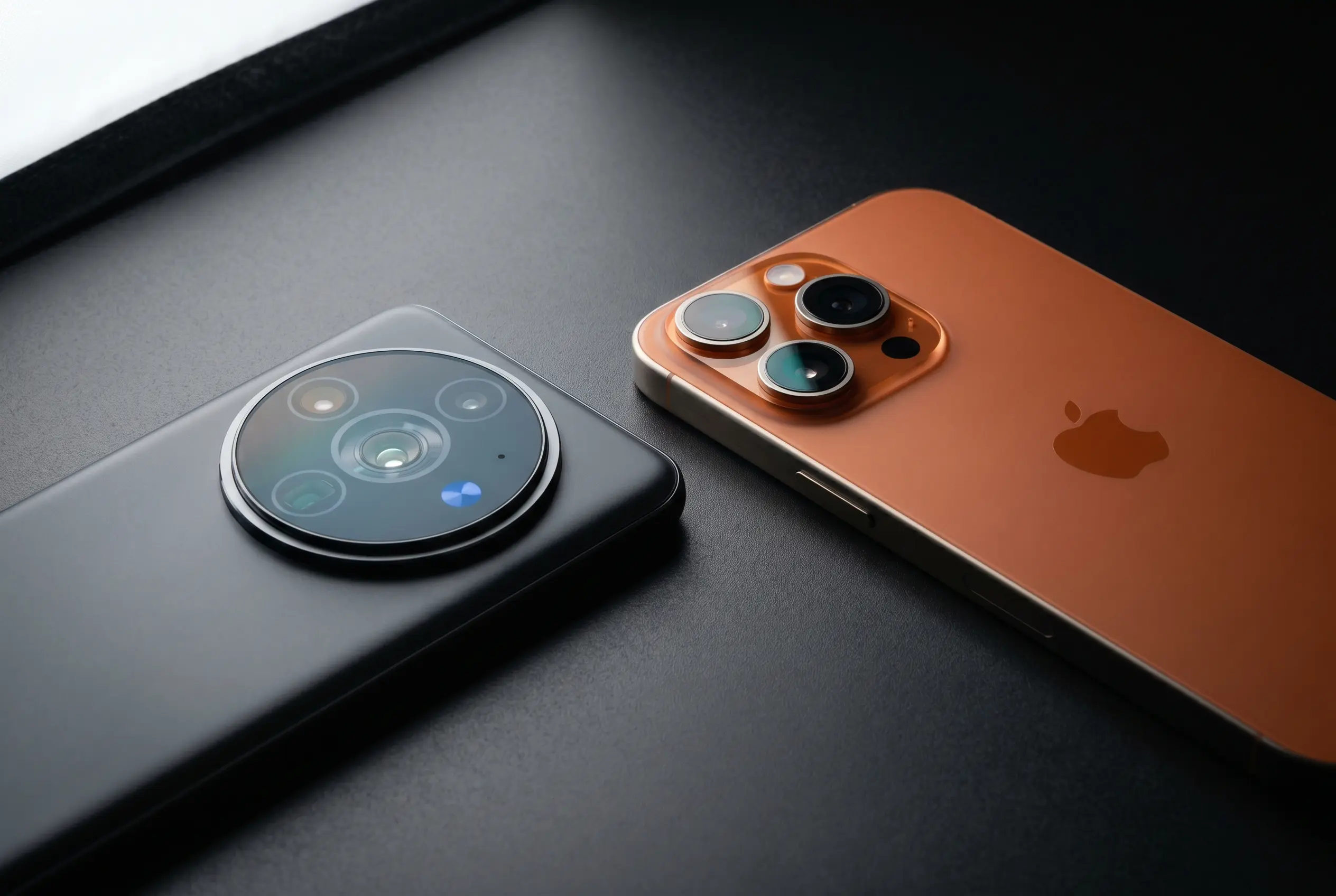
 Two 200-megapixel Sony and Samsung sensors. A 1/1.12-inch main, a 1/1.4-inch periscope at 85mm, Zeiss T* coating across the stack, and a screw-on 400mm telephoto extender in the box for buyers who want one. That is what Vivo loaded into the X300 Ultra, the China-launched flagship that started selling globally in April and now sits opposite the iPhone 17 Pro in every camera comparison published this spring.
On paper, the hardware fight is not close. The X300 Ultra’s main sensor is roughly 30% physically larger than the iPhone’s, its ultrawide sensor is close to three times the area, and its telephoto sensor is larger again. What Apple still owns is the boring stuff that decides which phone a normal buyer keeps for four years: color science consistency, video pipeline, accessory standards, and the software support timeline. The hardware lead has flipped. The reasons to buy an iPhone 17 Pro have not.
Spec Sheet at a Glance
The two phones approach the camera problem from opposite directions. Apple sticks with a 24mm main lens and a tetraprism telephoto that folds optics inside a thin body. Vivo ships a 35mm main, a periscope telephoto with optional bolt-on extenders, and a body that is heavier and thicker because of it.
| Spec | Vivo X300 Ultra | iPhone 17 Pro |
|---|---|---|
| Main sensor | 200MP Sony LYT-901, 1/1.12″, f/1.9, 35mm | 48MP Fusion, 1/1.28″, f/1.78, 24mm |
| Ultrawide | 50MP Sony LYT-818, 1/1.28″, f/2.0, 14mm | 48MP Fusion, 1/2.55″, f/2.2, 13mm |
| Telephoto | 200MP Samsung HP0, 1/1.4″, f/2.7, 85mm (3.7x) | 48MP Fusion, 1/2.55″, f/2.8, 100mm (4x) |
| Front | 50MP, f/2.5, 4K | 18MP Center Stage, f/1.9, 4K Dolby Vision |
| Optical reach | Up to 400mm with Gen 2 Ultra extender | 200mm (8x optical-quality) |
| Weight | 232g | 199g |
| Launch price | €1,999 (1TB/16GB) | $1,099 starting |
The structural difference is the periscope module. Vivo built the X300 Ultra around a separable lens mount on the case, which is why the 400mm extender plugs in like a DSLR lens. Apple’s tetraprism is sealed inside a thin chassis, which is why the 17 Pro stops at 200mm equivalent and weighs 33 grams less.
The 35mm Main Camera Choice
Vivo’s most defensible spec decision is the focal length on the main sensor. 35mm is the focal length most working photographers default to for street and people work because it sees roughly what the human eye frames. Apple’s 24mm sees wider, fits more in, and is the safer default for tourists and landscape shooters.
That choice cascades through every comparison shot. When a reviewer photographs a friend at conversational distance, the iPhone 17 Pro includes the parked car, the lamppost, and a slice of the next building. The X300 Ultra frames just the person and the immediate background. Both are technically correct exposures. Only one looks like a portrait.
Apple has a workaround. The 17 Pro exposes a 1.5x crop button that maps to roughly 36mm and uses the Fusion sensor’s high pixel count to deliver a clean 12MP file at that framing. It works, but it is a crop of a wider sensor rather than a native 35mm capture. Vivo’s frame is uncropped at native resolution off a much larger sensor.
The sensor size gap matters more after dark than in daylight. The LYT-901 is roughly 30% larger in surface area than the iPhone’s main sensor, which translates into measurably lower noise in low-light scenes, cleaner shadows in high-contrast frames, and shallower depth of field at the same aperture. In bright daylight both phones produce excellent files; in a bar or a dim restaurant the difference is visible at thumbnail size.
Ultrawide Sensors Tell Different Stories
The ultrawide is where the spec gap stops being subtle. Vivo’s 50MP LYT-818 is a 1/1.28-inch sensor with f/2.0 optics. Apple’s 48MP Fusion ultrawide is a 1/2.55-inch sensor with f/2.2. That is roughly a 2.7x difference in sensor area.
In practical shooting, the iPhone’s ultrawide is good in daylight and breaks down after sunset. The X300 Ultra’s ultrawide is closer to a usable second main camera. PhoneArena’s side-by-side comparison shows a crop of the Vivo ultrawide at 28mm matching the iPhone’s native 24mm main file for detail and noise, which is the kind of result that should not be possible if the ultrawide were a marketing camera.
The macro behavior follows the same pattern. The X300 Ultra focuses to roughly 1.5cm using the ultrawide module, with autofocus and OIS. The iPhone 17 Pro’s macro mode uses the same ultrawide and produces sharp files in good light, but the smaller sensor limits how much background separation you get on small subjects.
Where Apple keeps pace is field of view consistency. The 13mm ultrawide is engineered to match the main sensor’s color and tone curve so a swipe between lenses does not produce a visible white-balance jump. Vivo’s color tuning between modules is closer than it used to be on earlier X-series flagships, but the iPhone is still a touch more seamless on that specific transition.
Telephoto Is a Hardware Mismatch
The most lopsided part of the spec sheet is the telephoto. Apple’s 17 Pro ships a 48MP, 1/2.55-inch tetraprism sensor at 100mm equivalent with a 4x optical zoom. The X300 Ultra ships a 200MP Samsung ISOCELL HP0 sensor at 85mm equivalent with a 3.7x optical zoom, then layers two optional add-on lenses that push optical reach to 200mm and 400mm.
Native Reach and Sensor Area
The Samsung HP0 is roughly 3x the surface area of the iPhone telephoto sensor. That extra silicon translates into the cleanest zoom files of any current flagship phone in independent reviews, including detail visible at 10x that Apple’s 17 Pro renders as a smeared computational reconstruction. PetaPixel’s hands-on review calls the 200MP telephoto the standout module on a phone in which every module is strong.
Apple’s Tetraprism Counter
Apple’s counter is the second-generation tetraprism and a 56% larger telephoto sensor than the iPhone 16 Pro. The headline number is 8x optical-quality zoom, achieved by cropping into the 48MP sensor at 200mm equivalent. That output is genuinely usable, and it is a meaningful upgrade over the iPhone 16 Pro’s 5x ceiling. It is also a software crop, not a native optical capture, which is why detail at 8x looks computational next to the X300 Ultra’s native 85mm file.
The Bolt-On 400mm Lens
The Gen 2 Ultra extender pushes the X300 Ultra’s reach to 400mm equivalent with 15 high-transmittance glass elements and gimbal-grade OIS. That is a niche accessory most buyers will never carry. It is also an option Apple does not offer at any price.
Selfies, Video, and Daily Shooting
The selfie cameras are a flat trade. Vivo’s 50MP front sensor produces denser files with more crop room. Apple’s 18MP Center Stage camera includes a time-of-flight autofocus system and Dolby Vision capture at 4K 60fps, which matters for anyone who shoots front-facing video for social platforms.
Video is the category where Apple still wins by a measurable margin. The 17 Pro shoots ProRes at 4K 120fps with external recording, Dolby Vision HDR end to end, and Cinematic Mode with rack focus pulls. Vivo shoots 8K at 30fps and 4K at 60fps on every module, with strong stabilization, but the broader app ecosystem for color grading and finishing on iOS remains a competitive moat.
The X300 Ultra is one of the most coherent camera-first flagships to arrive in years, though buyers looking for the lightest or simplest ultra-premium smartphone may find the weight and accessory ecosystem more demanding.
That summary from an Android Central long-form review captures the trade. The X300 Ultra is heavier, thicker, and built around an accessory mount most buyers will not touch. The iPhone 17 Pro is lighter, simpler, and built around defaults that work in any hand.
Where Apple Still Holds the Edge
The hardware lead has flipped to Vivo. The reasons most buyers will still choose an iPhone are everything that surrounds the sensor.
Software support is the first one. Apple commits to roughly six years of iOS updates on the 17 Pro. Vivo’s OriginOS update window is closer to four. For a phone bought at €1,999 or $1,099, that gap is real money.
The second is color science consistency. Apple’s pipeline produces a recognizable look across every module and every lighting condition. Vivo’s images are more dynamic and often more flattering, but they vary more between scenes. Photographers who edit their own files prefer the Vivo. People who hand the phone to a stranger to take a group shot prefer the iPhone.
The third is accessory and app ecosystem. ProRAW, ProRes, Final Cut on iPad, the LiDAR-assisted depth pipeline, the way third-party photo apps optimize for iPhone first: none of that has a one-to-one equivalent on Android, let alone on Vivo. For a content creator who already lives in that stack, the camera file is only part of the workflow.
And the X300 Ultra has not launched in the United States and is not expected to. Buyers there choose between the 17 Pro and what is left of the Pixel and Galaxy lineups, which is part of why Apple’s incumbent advantage in the U.S. market keeps compounding. If you want to know what Apple plans to ship against the next round of Chinese flagships, the iPhone 18 Pro Max preview and the leaked iPhone 18 Pro launch pricing both point at a vapor-chamber redesign and an A20 chip rather than a sensor rebuild. The camera fight on the iPhone side is computational, not optical.
If you photograph buildings, food, holidays, kids, and the occasional concert, the iPhone 17 Pro will produce a more consistent stream of files you do not need to edit. If you photograph anything where sensor size is decisive (low light, deep zoom, controlled portraits), the X300 Ultra produces a measurably better file off the camera, accepts a 400mm lens that no iPhone accepts, and asks you to carry 33 more grams to get it.
Frequently Asked Questions
Is the Vivo X300 Ultra sold in the United States?
No. The X300 Ultra launched in China on March 30 and rolled out across Europe and parts of Asia in April. Vivo has not announced a U.S. release and U.S. carrier certification is unlikely given the company’s current import status. Buyers in the U.S. would need to import an unlocked unit and accept limited 5G band support.
How much does the Vivo X300 Ultra cost compared to the iPhone 17 Pro?
The X300 Ultra starts at roughly €1,999 for the 1TB/16GB configuration in Europe and ₹159,999 for the 512GB/16GB variant in India. The iPhone 17 Pro starts at $1,099 in the U.S. for 256GB. On a like-for-like storage basis the Vivo is more expensive, but it ships with a higher RAM ceiling and a larger battery.
Does the iPhone 17 Pro support a 35mm focal length natively?
Not natively. The 17 Pro’s main sensor is 24mm with a 1.5x crop preset that maps to roughly 36mm using the Fusion sensor’s pixel count. The output is clean at 12MP but is a crop rather than a true optical 35mm capture like the Vivo’s main lens.
What is the maximum optical zoom on each phone?
The iPhone 17 Pro offers 4x native optical zoom with 8x optical-quality zoom via sensor crop, capped at 200mm equivalent. The Vivo X300 Ultra offers 3.7x native optical zoom at 85mm, extendable to 200mm and 400mm equivalent through screw-on Zeiss telephoto extenders sold separately.
Which phone is better for low-light photography?
The Vivo X300 Ultra has measurably larger sensors on all three rear cameras, which translates into less noise and cleaner shadows in low light, especially on the ultrawide and telephoto modules. The iPhone 17 Pro produces a more consistent file across modules but with more aggressive noise reduction.
How long will each phone receive software updates?
Apple typically supports iPhone Pro models with six years of major iOS updates. Vivo currently commits to four years of OriginOS major updates and five years of security patches for the X300 Ultra. For long-term ownership the iPhone has a clear advantage.
Is the Vivo X300 Ultra worth the weight penalty?
The X300 Ultra weighs 232 grams compared to the iPhone 17 Pro’s 199 grams, a 33-gram gap most users notice within a day of carrying. For buyers who prioritize camera output, the weight is acceptable. For buyers who use their phone primarily for messaging, video, and reading, the lighter iPhone is the better daily driver.
 One UI 9’s Privacy Display Fix Reaches Just One Galaxy Phone
  Samsung Drops Its Own Exynos Chip for the Galaxy Watch9 and Ultra 2
  Marathon’s Vault Breaker Arrives as Bungie’s Bigger Bet Keeps Faltering
  Sony’s PlayStation Disc Cutoff Erases the Last Proof of Ownership
  Tesla’s Summer Update Hands Grok the Keys, and Musk’s Empire More Reach
  Apple’s $634 Million Masimo Payment Is Final After Appeal Denial