
 Ishan Crawford
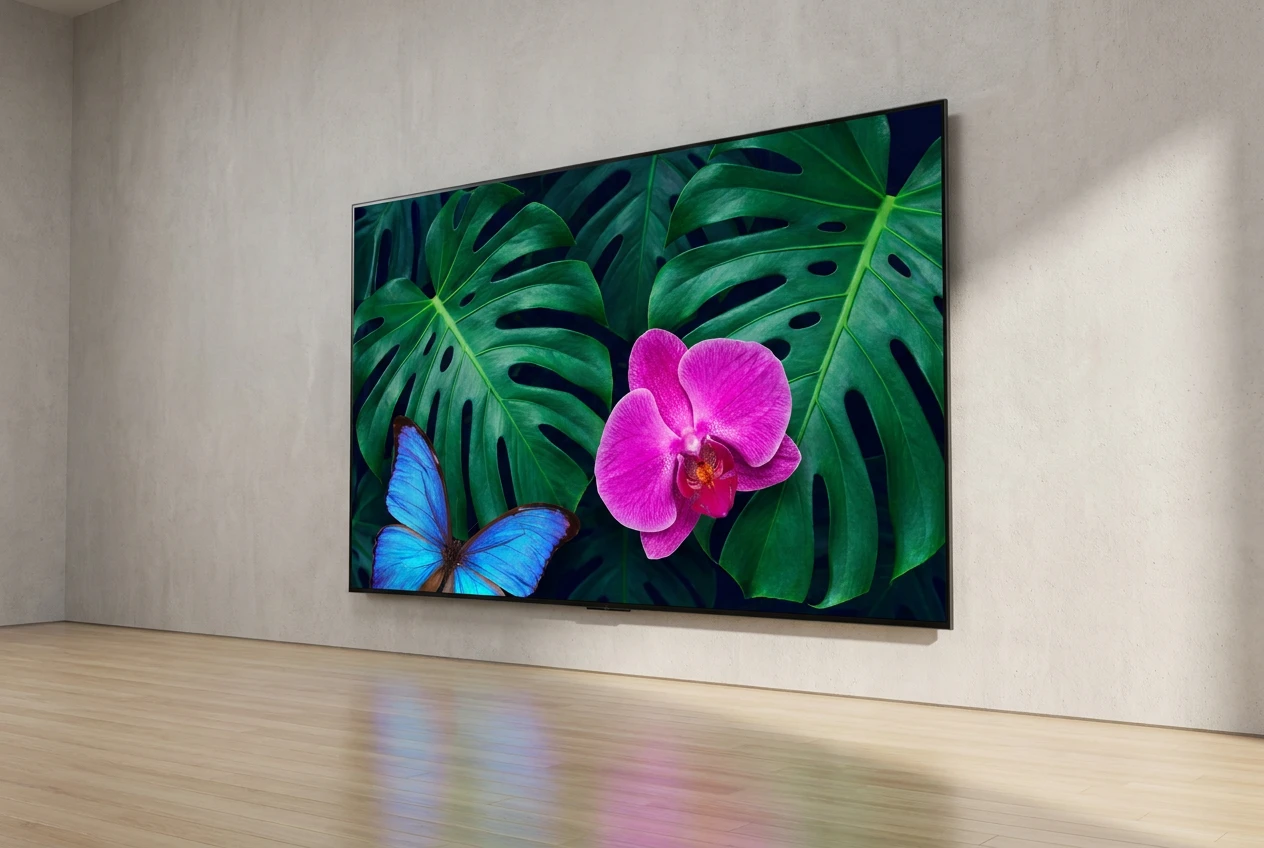
 Samsung Electronics put a 130-inch television in front of CES judges in January, and they handed it the show’s Best of Innovation prize. The R95H, the flagship of the South Korean firm’s freshly named Micro RGB lineup, swaps the blue-LED-and-quantum-dot stack found in QLED panels for individually addressable red, green, and blue light sources measured in tens of microns, and clears 100% of the BT.2020 colour gamut, a target that has until now lived only inside professional grading suites.
The engineering milestone is real, and TIME has since added the technology to its Best Inventions of 2025 list. The harder question, posed by every reviewer who has stood in front of the panel and by every shopper about to weigh a $3,199.99 sticker on the 65-inch R95H against an LG G5 OLED, is whether the colour ceiling Samsung just raised is one most living-room content can reach.
Tiny RGB LEDs Replace the Quantum-Dot Stack
The category exists because Samsung re-engineered the backlight, not the front panel. A conventional QLED (quantum-dot light emitting diode) uses a sheet of blue LEDs whose output passes through a quantum-dot film that shifts a portion of that blue light into red and green. The colours mix in the stack and reach the LCD layer as broadband white. It works well, and it has anchored Samsung’s premium LCD strategy since 2017.
Micro RGB takes a harder route. Instead of blue plus a colour-shifting film, the backlight uses discrete red, green, and blue LEDs, each tens of micrometres across, controlled in their own dimming zones. The LCD layer then modulates that pre-coloured light into the final image. Samsung calls the proprietary concept Micro RGB, and the team behind it includes Insang Hwang of the Visual Display Business Division’s Product Planning Group, who led the consumer-facing pitch for the launch.
The architectural payoff is in the colour primaries. Because each LED emits a narrow band of red, green, or blue, the resulting gamut is wider than what a quantum-dot diffuser can pass cleanly. TIME’s listing credits the same architecture with cutting power draw by about 20% versus the equivalent blue-LED-plus-quantum-dot setup, because no light is being wavelength-converted by a phosphor and then partially absorbed on its way through.
That is the technical story. The marketing story, which Hwang’s team has been pushing since January, is that this is the first new TV backlight category in roughly eight years.
Hitting the Ultimate Colour Gamut on a Living-Room TV
BT.2020 is the International Telecommunication Union’s (ITU, the United Nations body that sets global broadcast standards) colour space for ultra-high-definition video. It covers about 76% of all colours visible to the human eye, a sharp jump from the BT.709 space used in standard HD and most current 4K content, which clears roughly 36%.
Until this year, BT.2020 was a target chased on lab benches and ticked off only by reference monitors used in colour-grading studios. No mass-market television hit it. The R95H carries the world’s first Micro RGB Precision Color certification from the VDE testing institute in Germany, which validates the 100% BT.2020 claim under a defined measurement protocol. Hwang has been candid that the team had to build that protocol because no consumer benchmark for the gamut existed.
Although the Micro RGB TV started with the goal of delivering richer colour reproduction, there was no clearly defined industry standard at the time. We felt a strong sense of responsibility, believing that the conditions we set could become the new standard for the market.
That quote belongs to Hwang, speaking with Samsung Newsroom about the development timeline. The honesty matters: a colour gamut figure on a spec sheet is only useful if the testing method is consistent across brands, and the VDE protocol is what the rest of the industry will now have to either accept or contest.
The competitive read is unflattering for older spec sheets. LG’s W-OLED panels, which have led the premium dark-room TV category since 2017, hit roughly 70 to 75% of BT.2020 in independent measurement. Mini-LED LCDs from Sony and Hisense have crept into the high 80s. Samsung’s claim, validated by an outside laboratory, is a step-change rather than an increment.
The 2026 Lineup, From 55 Inches Up to a 130-Inch Wall
Samsung is selling Micro RGB as two model series at launch. The R85H is the entry rung, opening at $1,599.99 for a 55-inch panel. The R95H sits above it and starts at $3,199.99 for a 65-inch, climbing through several intermediate sizes to the 130-inch flagship that won the CES prize. The 130-inch model is the largest LCD-architecture TV Samsung has ever shipped to retail.
The 2026 premium TV market now has three Micro RGB pitches running in parallel, each with a different bet on size, refresh rate, and software ecosystem.
| Brand | Flagship line | Screen-size range | Headline spec | HDR layer |
|---|---|---|---|---|
| Samsung | Micro RGB R95H / R85H | 55 in. to 130 in. | 100% BT.2020, VDE certified | HDR10+ ADVANCED |
| LG | Micro RGB Evo MRGB95B | 75 in. to 100 in. | 165Hz refresh rate | Dolby Vision |
| Hisense | RGB Mini LED ULED X | 75 in. to 116 in. | Peak brightness above 10,000 nits | Dolby Vision IQ |
The size spread is the most concrete differentiator. Samsung is the only one of the three willing to go below 75 inches at the launch tier and the only one with a 130-inch SKU, which sits at a price point Samsung has not publicly disclosed but which Best Buy listings during CES week pegged in the low six figures.
The 130-inch chassis also carries a 160W 10.4.2-channel speaker array, more than most premium soundbars carry on their own, and a proprietary pocket-and-bracket wall mount that lets the panel sit flush. Samsung publishes that flush-mount kit only for the 85-inch, 75-inch, and 65-inch R95H variants. Anyone wall-hanging the 130-inch is doing it through a custom integrator.
AI Does the Translation Between Panel and Programming
The colour gamut problem nobody wants to talk about: almost nothing you watch is mastered in BT.2020. Most streaming HDR is graded in DCI-P3, which covers about 54% of the visible spectrum. Most live TV and most sports broadcasts are still BT.709. A panel that can show 100% BT.2020 is, for the bulk of typical viewing, doing extrapolation rather than reproduction.
That gap is what Samsung’s AI Engine Pro and Micro RGB Color Booster Pro are built to bridge. Both run on a dedicated neural processing unit (NPU, the silicon block that handles machine-learning inference inside the TV’s main system-on-chip) and re-map source colour data toward the wider gamut in real time. The 2026 lineup adds three software layers that exist specifically to give the panel something to do.
- AI Soccer Mode Pro detects football coverage on the input and lifts grass greens, jersey reds and blues, and skin tones inside the broadcast’s colour envelope, a feature Samsung is pushing ahead of the European league restart in late summer.
- Supersize Picture Enhancer targets the 98-inch and 130-inch SKUs, where viewing distance and pixel pitch collide; it sharpens edges and reduces upscaling artefacts on sub-4K source material.
- Glare Free, validated against the Unified Glare Rating standard by Underwriters Laboratories, applies a matte optical coating tuned so the panel reads as black rather than mirror-grey under direct lighting.
- Vision AI Companion ties the set to Microsoft Copilot and Perplexity for conversational search and proactive recommendations, the first time Samsung has shipped third-party generative models pre-installed on a TV.
The pattern across all four is the same: the hardware is finished, the content pipeline is not, so the software has to close the distance. Whether the AI uplift is convincing or oversaturated will be the central question in every long-form review filed this summer.
Where OLED Still Owns the Argument
Micro RGB sells colour. OLED sells contrast. The two arguments do not directly collide, which is why both technologies are likely to coexist at the high end for the rest of the decade.
The numbers an OLED buyer cares about have not moved:
- Perfect per-pixel black remains exclusive to self-emissive panels. Micro RGB’s dimming zones, even at the micrometre scale, still produce a measurable halo around bright objects on dark backgrounds, an artefact reviewers call blooming.
- 165Hz native refresh ships on LG’s MRGB95B and on every premium 2026 OLED. The R95H tops out at 144Hz, a meaningful gap for PC gamers and a marginal one for everyone else.
- Dolby Vision support is absent on every Samsung television, Micro RGB included. Samsung’s HDR10+ ADVANCED format is competitive on paper, but the streaming catalogue mastered in Dolby Vision is roughly five times larger.
- Burn-in risk, the historical knock against OLED, has been largely engineered out of 2026 panels through pixel-shifting and luminance throttling, removing one of the last arguments Samsung’s marketing used to lean on.
The honest framing is that a Micro RGB R95H is the TV to buy if the room has windows, the viewer watches a lot of sport and colour-graded HDR, and the screen is going on a wall larger than 75 inches. An OLED is still the TV to buy if the room is dark, the viewing distance is short, and movie nights matter more than match days.
The Content Gap Marketing Cannot Close
The wider problem is that almost no consumer-grade content is mastered in BT.2020. Netflix, Disney+, and Amazon Prime Video all deliver HDR in P3-D65 inside a BT.2020 container, which means the colour data is signalled in the wider space but the actual graded values sit inside the smaller P3 volume. Apple TV+ is the most aggressive on colour but still does not reach the full BT.2020 envelope.
YouTube serves some BT.2020 user-generated content. A small slice of demonstration material on the ITU’s BT.2020 reference page reaches it. Live broadcast does not. Console gaming does not, with the partial exception of the PlayStation 5 Pro’s HDR pipeline, which still tops out near the P3 boundary.
The R95H is therefore a panel built for the next decade of content, not this one. That is not a criticism of Samsung’s engineering, and Hwang has been explicit that the gamut figure was set with the expectation that broadcast and streaming would catch up rather than the reverse. It is, however, an honest read of what a buyer is paying for in the first year of ownership.
Samsung’s bet is that the ceiling matters even when the floor is what gets watched. Five years from now the calculation may be obvious. For the 2026 buying season, it is the bet on the showroom floor.
 Leeds Botox Botulism Cases Reopen Britain’s Cosmetic Jab Gap
  Pragg Beats Carlsen at Norway Chess as Firouzja Holds Three-Point Lead
  Vivo X300 Ultra vs iPhone 17 Pro: The Camera Hardware Gap Is Real
  McCullum Bets Refined Bazball Can Survive a Home Summer Reckoning
  India 0, Jamaica 2: 24-Year English Wait Ends in a Familiar Loss
  India NCD Deaths Hit 60% as Heart Disease Drives One in Three