
 Ishan Crawford
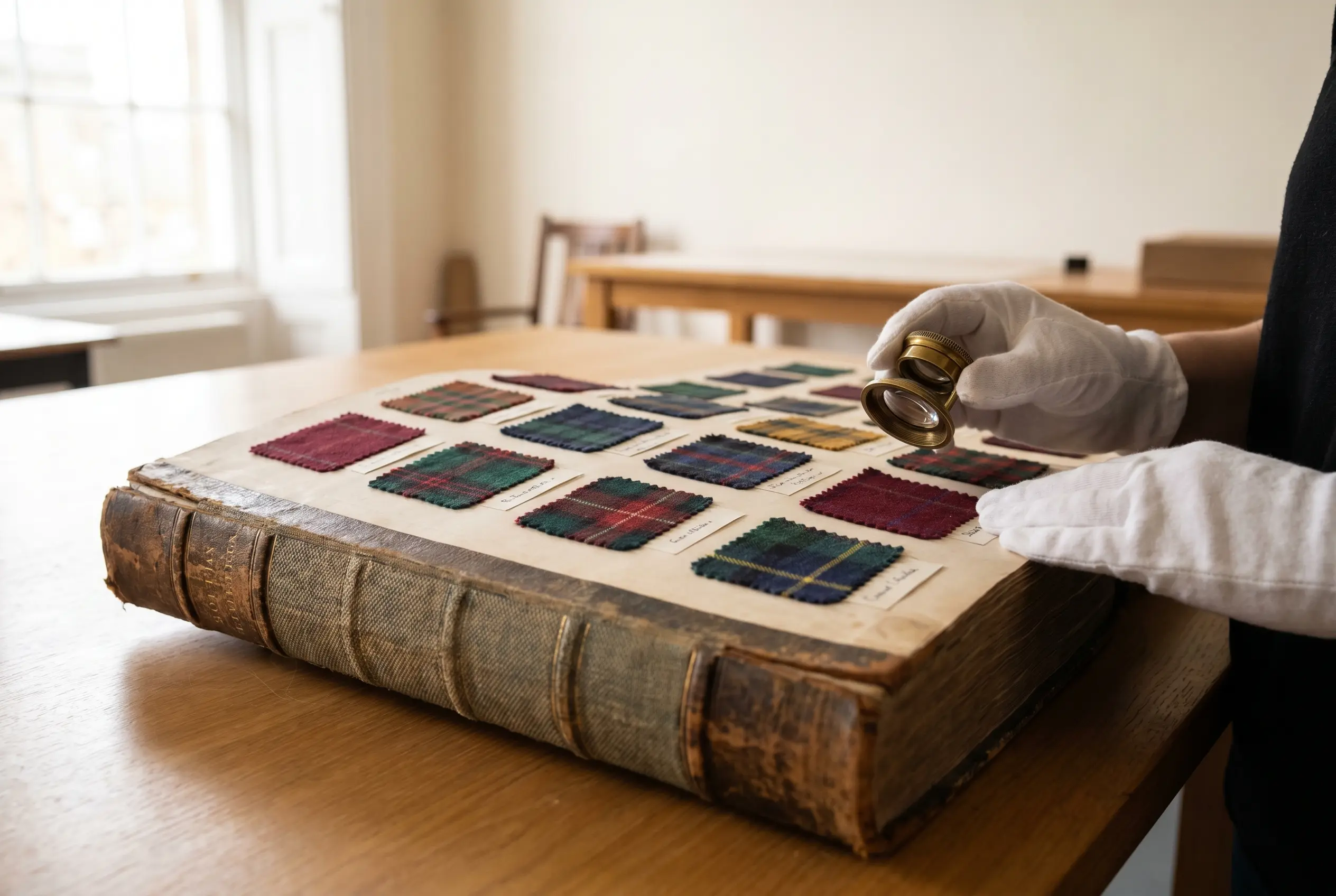
 Stuart Paton has handed almost 800 historic tartan samples to National Museums Scotland, an archive his family kept for more than two centuries before signing it over. The textiles, woven by the Tillicoultry firm that James and David Paton founded in 1824, will be catalogued at the museum’s collection centre in Edinburgh and opened to researchers.
Inside the bound sample books sit cloth woven for Queen Victoria’s household, fabric cut for Scottish regiments, fashion textiles laced with silk, and clan patterns that have never appeared on the official Scottish Register of Tartans.
What Stuart Paton Handed Over
The donation covers the firm’s entire production history, from foundation in the 1820s through to closure in the 1960s. Each sample was originally a working tool, kept by weavers and pattern-makers on the mill floor to verify clan identification, dye colour, and the geometric setts that distinguish one tartan from another.
The archive arrives at the museum in the same bound condition the mill used. Sample books, swatch cards, and trade memoranda moved together from the family home, untouched as a working record. The collection has been kept in private storage since the company’s last weaving runs more than half a century ago.
The contents break across four broad categories:
- Royal and ceremonial textiles produced for Queen Victoria’s household and the royal residence at Balmoral
- Military issue cloth supplied to Scottish regiments across the 19th and 20th centuries
- Women’s fashion fabrics, some woven through with silk, that won the firm international awards
- Clan tartans, a number of which are absent from the modern official Scottish Register of Tartans
Each category represents a distinct strand of commercial weaving, and researchers have rarely seen them side by side in a single mill’s bound records.
From an 1824 Workshop to Five Generations
James and David Paton set up business in Tillicoultry in 1824, with seventeen sets of carding and spinning machinery and around 250 power and hand looms between them. The brothers were among the earliest large employers in the Hillfoots district, the strip of mill villages along the southern edge of the Ochil Hills that powered Scotland’s wool industry for most of the 19th century.
The company exhibited goods at the Great Exhibition in London in 1851, the moment that effectively opened export markets across Europe and North America for Scottish textile producers. Through the second half of the century the firm’s name moved with the wider Highland revival, supplying fabric to tailors who served the new middle-class market for tartan dress.
At its peak the company ran four factory sites near Tillicoultry and employed around 500 people. Awards followed at international expositions, particularly for fashion-grade cloth woven through with real silk.
The family kept ownership for five generations, producing tweeds and tartans through both world wars before the firm wound down in the 1960s. The original mill on Lower Mill Street in Tillicoultry has since been converted into housing, leaving the sample books as the largest single trace of a business that once anchored the town’s economy.
Queen Victoria, Balmoral, and the Tartan Boom
The commercial market for Scottish tartans is, in industrial terms, surprisingly young. The cloth had been broadly suppressed after the 1745 Jacobite rising and only came back into fashion through a deliberate piece of stagecraft: Sir Walter Scott’s organisation of King George IV’s three-week visit to Edinburgh in August 1822.
Scott persuaded chiefs to bring their men in full Highland dress, and Lowland gentlemen scrambled to claim ancestry that would justify a new kilt. Within a generation, the look had been adopted by Queen Victoria, who decorated Balmoral in her own setts and sat for portraits in tartan shawls. Middle-class demand followed the throne, and tartan advertisements began appearing in London and continental European fashion press by the 1840s.
That demand had to be met somewhere. Highland weavers had neither the looms nor the scale to feed a market that suddenly stretched from London to Vienna, so industrial mills in the central belt, Paton’s among them, took the volume work. A separate commemorative Team Scotland tartan reveal for the Glasgow 2026 Commonwealth Games shows how durable the same commercial logic remains today: the design is woven not in the Highlands, but in mill towns that have specialised in the cloth for two centuries.
The Mill Town Behind the Highland Myth
Tillicoultry sits in the Hillfoots, north of Edinburgh, in a narrow valley shaped by fast water that powered woollen mills from the late 18th century onwards. By the 1850s the town’s population had passed 4,000 residents, with a clear majority working in textiles. Paton was the largest of several family firms, alongside Archibald, Walker, and the Devon Valley group.
The town’s economic story is one most general histories of tartan skip past. Highland chiefs and royal pageants gave the cloth its iconography, while the actual weaving happened in central-belt mill towns that produced the volume the new market required, almost entirely out of view of the romance.
The Paton archive captures both sides at the loom level. Order books that survive in the sample collection list fabric runs by clan, by regiment, and by warehouse buyer, with quantity, price, and dye-batch references tied to specific weaver’s notes. Working detail of that depth has been hard for researchers to assemble before, because most surviving Scottish mill records hold either books or cloth, rarely both bound together.
It also captures the human scale of a vanished industry. Five hundred people in a small town meant most local families were tied to the mill across multiple generations, a social fabric that disappeared with the firm in the 1960s.
Why Curators Say This Could Rewrite Tartan
Dr Mhairi Maxwell, curator of modern and contemporary history at National Museums Scotland, has called the archive a primary source that could change what the trade thinks it knows about who designed which tartan and when.
We are really hoping that this will rewrite the history of tartan production as we currently understand it.
Maxwell, who co-curated the V&A Dundee tartan exhibition that ran from April 2023 to January 2024, joined the museum’s department in 2023 and now leads its contemporary collecting work. Her case for the archive rests on the unrecorded clan patterns and the granular sett detail in the bound books, evidence that some named tartans the Register currently lists as modern may in fact trace to industrial designers in mill towns rather than to clan heritage.
The museum already holds one of the largest tartan collections in the world, spanning more than three centuries of production. The Paton donation gives that collection a single, internally consistent industrial-scale dataset.
| Tartan archive | Held by | Period covered | Approx. holdings |
|---|---|---|---|
| J&D Paton archive | National Museums Scotland | 1820s to 1960s | ~800 samples |
| Scottish Register of Tartans | National Records of Scotland | 1500s to today | 11,000+ registered designs |
| V&A Dundee tartan exhibition | V&A Dundee | 16th century to today | 300+ objects shown |
Cataloguing Begins at the Collection Centre
The samples have already moved to the National Museums Collection Centre at Granton in Edinburgh, where cataloguing will begin this summer. Items will be photographed, weave-analysed, and matched against the Register of Tartans before public research access opens. The work sits alongside other recent heritage recoveries in the country, including the recent return of more than 3,000 stolen Scottish documents to their original institutions.
The museum has also issued a public appeal. Descendants of anyone who worked at any of the Paton sites are being asked to make contact at info@nms.ac.uk. Family records, photographs, and oral history from former employees are seen as essential to filling out the archive’s commercial and social context.
Stuart Paton, the former director of the firm, said he made the donation in memory of his godfather, Captain Paton, who chaired the company for decades.
The bound books sat on Paton shelves for two centuries; they will sit in Granton stacks for the next.
 Leeds Botox Botulism Cases Reopen Britain’s Cosmetic Jab Gap
  Pragg Beats Carlsen at Norway Chess as Firouzja Holds Three-Point Lead
  Vivo X300 Ultra vs iPhone 17 Pro: The Camera Hardware Gap Is Real
  McCullum Bets Refined Bazball Can Survive a Home Summer Reckoning
  India 0, Jamaica 2: 24-Year English Wait Ends in a Familiar Loss
  India NCD Deaths Hit 60% as Heart Disease Drives One in Three