
 Ishan Crawford
 Scotland Health Care System in Laurinburg, North Carolina, has been named one of three finalists for the 2026 American Hospital Association Rural Hospital Excellence in Innovation Award. The recognition, announced February 5 and formalised at the AHA’s annual rural conference in San Antonio, places a home-based care program built for a county where roughly one in four residents lives below the poverty line onto a national shortlist alongside hospitals in Vermont, Indiana and West Virginia.
The headline figure is the drop in obstetric no-show rates from a range of 20 to 25 percent down to 17 percent, with significant declines in inadequate prenatal care over the same period. Behind the number sits a delivery model, two teams visiting patients in their homes, that mirrors what every other hospital on the 2026 shortlist is doing in some form.
A Laurinburg Hospital Joins the National Shortlist
The American Hospital Association named Scotland Health Care System one of three finalists for its 2026 Rural Hospital Excellence in Innovation Award on February 5, recognition for a home-based care program serving Laurinburg and the surrounding county. WVU Medicine Potomac Valley Hospital in Keyser, West Virginia, took the top prize for a virtual intensive care unit (ICU, the unit hospitals use for their sickest inpatients) rebuild. The other finalists were Brattleboro Memorial Hospital in Vermont and Reid Health in Richmond, Indiana.
The full slate was presented at the 39th annual AHA Rural Health Care Leadership Conference in San Antonio, held February 8 to 11. Microsoft sponsored the award, part of a broader push by the company to fund cybersecurity assessments and innovation grants across the country’s rural hospital footprint.
For Scotland Health, the citation lands in a county where the structural pressures on hospitals are loud. Laurinburg sits roughly 45 minutes southwest of Fayetteville and counts about 15,000 residents, with Scotland County reporting a poverty rate near 25.8 percent according to Census data.
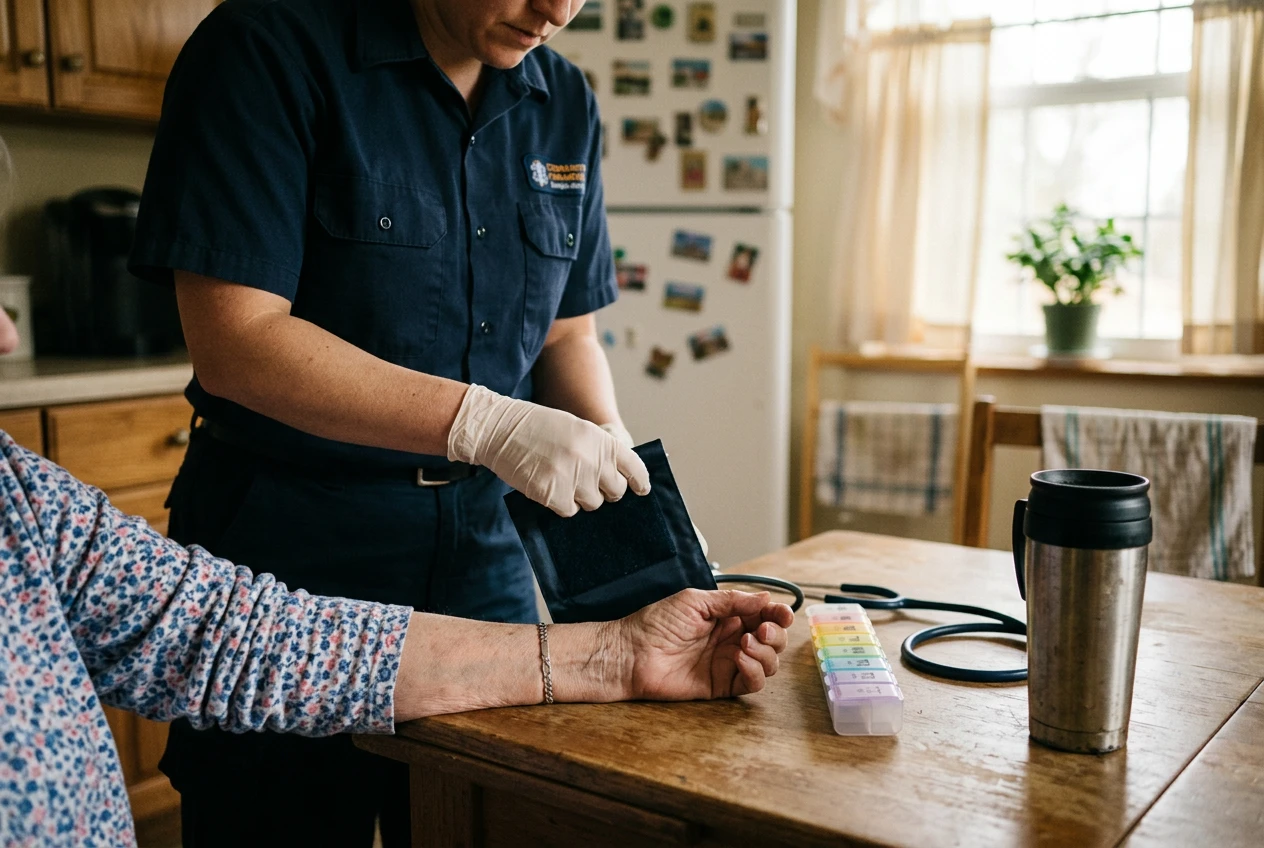
The program the award recognised, Scotland Health at Home, started with a narrow brief: connect patients to treatment regardless of where they were physically located. That brief grew into two operating arms. One is a community health worker (CHW, lay health staff who bridge clinical and social services) team that walks into patients’ homes for medication reviews and primary care navigation. The other is a community paramedic team that handles wellness checks, post-discharge follow-up and the technical scaffolding for telehealth visits in homes where patients are not comfortable with the screens.
How Scotland Health at Home Works in Two Arms
Community health workers function as the connective tissue between patient and physician. They reconcile medications, confirm follow-up appointments, route patients to primary care instead of the emergency department for non-urgent issues, and screen for the non-medical conditions that quietly drive readmissions. Transportation gaps, food insecurity and unstable housing all surface during these visits.
“They assist with medication management, make sure patients are connected with primary care physicians and help patients access the right level of care instead of relying on the emergency department for non-emergency needs,” said Misty McMillan, executive director at the Scotland Memorial Foundation. “Overall, it’s better for patients, the hospital and the community we serve.”
The community paramedic arm overlaps but specialises. A paramedic can drive 30 minutes to a patient who cannot make that trip themselves, take vitals at the kitchen table, and patch in a physician by video so the encounter still counts as a clinical visit. That structure matters in a county where reliable transport is the gating factor on whether a follow-up appointment happens.
“For many patients, getting to the hospital can mean a 30-minute drive, which is difficult without reliable transportation,” McMillan told the AHA. “Community paramedics can visit patients at home, provide wellness checks, educate on medications, and help them connect back to their doctor.”
A second function of the paramedic visit is technical support. Many of the patients enrolled in the at-home program are older, on multiple medications, and managing more than one chronic condition. They are also, in many cases, the demographic least likely to navigate a video-call telehealth interface on their own. The paramedic doubles as the on-site technology helper, getting the call connected, holding the camera at the right angle and reading the vitals into the chart. Screening for social drivers of health is folded into both touchpoints, with Jamie Cicali, the system’s executive director of population health, telling the AHA that the system runs the screen on nearly all patients.
Where the Numbers Landed
The maternal health side of the program is where the data is the cleanest. Obstetric appointment no-show rates dropped from a range of 20 to 25 percent down to 17 percent, according to figures Scotland Health shared with the AHA. Rates of inadequate prenatal care, a metric tied directly to low birth weight and later infant mortality, also declined over the same window.
On chronic care, the AHA citation focuses on the top decile of high-risk patients in the system’s roster. Emergency department use by that cohort fell sharply, the result of catching small problems in the home before they escalate into ambulance calls. The system also reports reduced hospital readmissions, the metric Medicare uses as a financial penalty trigger under the Hospital Readmissions Reduction Program. The screening for social drivers of health is where the program quietly buys its own runway, since identifying a transportation barrier before a missed dialysis appointment is cheaper than treating the consequences of three missed appointments.
What ties the obstetric numbers and the chronic care numbers together is the same delivery mechanism. A community health worker or a community paramedic showing up at the front door turns out to be the high-leverage intervention. The cost of one home visit sits well below the cost of one ambulance ride, and the cost of three home visits sits well below the cost of one inpatient bed-night.
The County the Program Is Built For
Scotland County’s demographic profile explains why the at-home model exists at all. Roughly 25.8 percent of residents live below the federal poverty line, more than double the national rate. In 2020, the share of residents under 200 percent of the federal poverty level reached 52 percent according to county data. A 2025 estimate placed child poverty at almost 43 percent.
Population density is the other variable. Laurinburg is the county seat and the largest population centre, with the hospital pulling patients from surrounding rural townships where a one-way trip to the emergency department can run 30 to 45 minutes.
The state’s maternal and child health data dashboard for North Carolina documents the cumulative impact across rural counties, where outcomes track tightly with income, transportation access and the presence or absence of an in-county obstetric service. The structural problem the program addresses is not limited to one corner of the state. The North Carolina State Center for Health Statistics’ 2025 County Health Data Book shows similar pressure across most of the state’s rural footprint.
What is less common is the response: a hospital system actively pushing labour and clinical capacity outside its own walls, rather than waiting for patients to find their way in. That inversion is the central reason the AHA pulled the program onto a national shortlist. Plenty of hospitals run community health worker programs. Fewer run two parallel teams with a shared screening backbone tied to a single electronic record.
What the 2026 Shortlist Has in Common
The four hospitals on the 2026 shortlist look different on paper but rhyme on substrate.
Each is rural. Each operates in a state with documented gaps in specialist access. Each used the program submitted for the award to push care delivery either outside the hospital walls or into a virtual layer accessible from the home.
| Hospital | State | Award Result | Program Submitted |
|---|---|---|---|
| WVU Medicine Potomac Valley Hospital | West Virginia | Winner | Virtual ICU staffed by remote intensivists, reopened a previously closed unit |
| Brattleboro Memorial Hospital | Vermont | Finalist | Mobile Integrated Health Initiative pairing EMS staff with care teams for in-home work |
| Reid Health | Indiana | Finalist | Real-time documentation tech plus virtual nursing, with 10 to 12 minutes saved per clinical note |
| Scotland Health Care System | North Carolina | Finalist | Scotland Health at Home, community health workers plus community paramedics |
The pattern across the four is a shift in where the care happens. The West Virginia winner moves the intensivist into a screen. The Vermont and North Carolina finalists move clinicians into the patient’s living room. The Indiana finalist moves nursing capacity into a virtual layer that frees the bedside team.
Each is a workaround for the same shortage: not enough specialists, not enough geographic reach, not enough time per encounter under fee-for-service economics. The AHA’s official 2026 award announcement and finalist list frames the through line as care redesign, collaboration and technology-driven delivery.
Read the four submissions back to back and the through line is sharper than that. It is the conversion of the building from a destination into a hub that pushes capacity out.
The Evidence Base Beyond One Hospital
Community paramedicine has been studied for the better part of a decade, with the bulk of the published evidence coming from rural pilot programs. A 2025 review by the Flex Monitoring Team’s evidence summary on rural community paramedicine pulled results from multiple state programs and found consistent reductions in emergency department visits and hospital readmissions across patient cohorts.
A handful of the headline findings from that body of research:
- A rural Oregon randomised trial reported a 14 percent drop in urgent emergency department visits and a 40 percent drop in visits classified as avoidable.
- A rural Maryland mobile integrated health program reported average per-patient savings of $14,566 over the study period.
- A 2020 community paramedicine study of frequent emergency department users reported close to 60 percent fewer visits among enrolled patients.
- A cardiopulmonary cohort study published in 2023 found a paramedic-led intervention saved 218 bed-days and roughly $410,000 in healthcare costs.
The Rural Health Information Hub’s community paramedicine topic overview catalogues similar findings and notes that the standard intervention template is one or two home visits per week for 30 days post-discharge. The Laurinburg program runs longer for its highest-risk patients but uses the same scaffolding.
A parallel pressure is visible in regional health systems abroad. In Scotland, the United Kingdom variety, NHS Lanarkshire is preparing to open the country’s first fully digital and net-zero hospital at Monklands, a project built on a similar premise of pushing clinical decision support outside traditional in-person workflows. The technology stacks differ. The pressure forcing the change does not.
Why Recognition Changes the Funding Conversation
The most immediate consequence of a national finalist citation, especially for a hospital operating in a high-poverty county, is the conversation with donors and the board.
Early on, these programs received a great deal of careful evaluation when funding was requested because people wanted to avoid duplicating services. Now when we talk about this national award and the impact on patients, we remind donors and board members that they helped make it possible. That recognition reinforces the value of investing in these programs.
That was McMillan, speaking to the AHA. The point is straightforward. Health systems that ask boards to underwrite a program that does not generate fee-for-service revenue have to lean on outcomes data and external validation in roughly equal measure. The first is hard to produce in the first 18 months. The second moves quickly when an award lands.
Cicali made the parallel internal case. Recognition from a national body tells the staff doing the home visits, the screening calls and the medication reconciliation that the work registers outside the building. Retention in lay health and paramedic roles is one of the quiet pressures on every rural system attempting this model. The 2027 award cycle is already open, with the AHA’s main award page for rural hospital excellence in innovation listing a submission deadline of June 23, 2026 for the next round, and the presentation set for the 40th annual conference in Orlando from January 31 to February 3. The shortlist the Laurinburg system joined this year is likely to grow, and the model it is built on is no longer a regional experiment.
 Leeds Botox Botulism Cases Reopen Britain’s Cosmetic Jab Gap
  Pragg Beats Carlsen at Norway Chess as Firouzja Holds Three-Point Lead
  Vivo X300 Ultra vs iPhone 17 Pro: The Camera Hardware Gap Is Real
  McCullum Bets Refined Bazball Can Survive a Home Summer Reckoning
  India 0, Jamaica 2: 24-Year English Wait Ends in a Familiar Loss
  India NCD Deaths Hit 60% as Heart Disease Drives One in Three