
 Ishan Crawford
 Rs 10.9 lakh crore. That is the size of the crude oil bill India is on track to pay this fiscal year, with the rupee already past 96 against the dollar and Brent still elevated by the Iran war. Rather than absorb another fuel-price hike, the government is moving to replace the barrel itself, fast.
Two parallel policy pushes landed in New Delhi this week. The Ministry of Petroleum and Natural Gas wants 5,000 dispensing stations for E100 (a fuel that is almost entirely ethanol) running within two years, with 150 of them open in the next month. Separately, Bloomberg reported the Prime Minister’s Office is sizing an incentive package above $1 billion to push private bus and truck operators into electric fleets. Both moves target the country’s hardest fossil-fuel consumers, the segments that previous subsidies barely touched.
The Rupee Bill Behind the Iran Shock
India imports close to 90 percent of the crude oil it burns, and nearly half of that flow originates in the Gulf. A regional flare-up like the U.S. and Israel’s strikes on Iran therefore translates into stress on Indian household budgets within days, not quarters. When Tehran briefly choked the Strait of Hormuz earlier this year, roughly 20 percent of global oil traffic was disrupted overnight, a shock the New Lines Institute analysis of the energy shock traced through Indian and Chinese import lines in real time.
The Reserve Bank of India and the finance ministry have been watching three numbers move in the wrong direction at once. Imported inflation is feeding into core CPI. The current account deficit is widening as the dollar value of crude rises. The rupee, which sat around 88 to the dollar a year ago, has slipped past 96, adding another layer of cost on top of the same physical barrel.
- Rs 10.9 lakh crore projected FY26 crude oil import outlay
- ~90 percent of India’s crude requirement sourced from abroad
- ~50 percent of imported crude originating in the Gulf
- 96+ rupees to the dollar, down from 88 twelve months ago
That trifecta has done what years of climate diplomacy could not. Energy transition has shifted from a slow environmental goal into a balance-of-payments emergency the Modi government can no longer file under “medium-term priorities.”
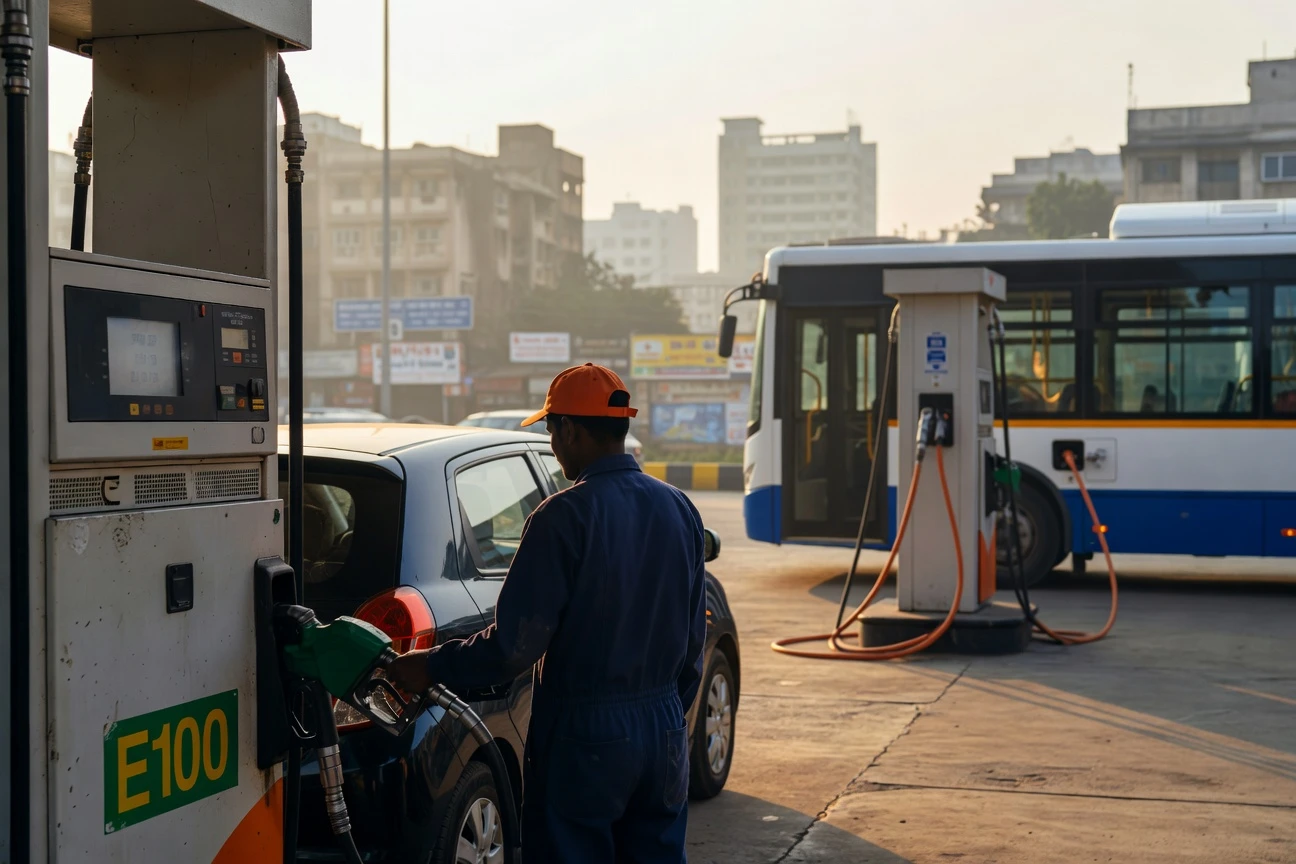
From Blending Target to E100 Pumps
India only crossed 20 percent ethanol blending (E20, a fuel mix containing one-fifth ethanol) on April 1 this year, five years ahead of the original 2030 deadline. The next leap, to fuel that is almost entirely ethanol, would have looked aspirational six months ago. After the Iran shock, it has become operational planning.
According to government sources cited in The Economic Times, the petroleum ministry has mapped a three-phase rollout designed to build refueling density in metros first before pushing into the rest of the country.
- Within one month, 150 E100 outlets opening across Delhi, Mumbai, Pune and Nagpur.
- Over the next six to twelve months, the network expanding deeper into Delhi-NCR and Maharashtra, and entering Bengaluru, Chennai, Kolkata and Hyderabad, with a cumulative target of 500 outlets.
- By the end of the 24-month window, 5,000 retail outlets operational nationally, anchored by the national ethanol policy framework.
The choice to cluster early outlets in metros is deliberate. A previous Indian Oil Corporation pilot across roughly 400 outlets in smaller towns saw negligible offtake, because the flex-fuel vehicle base was simply too thin. This time, refueling density goes where the high-end private-car market already lives, and where automakers can credibly launch into a visible network.
The Chicken and Egg Holding Back Showrooms
A reasonable consumer in Pune does not buy a flex-fuel car if she cannot find E100 at her usual pump. A reasonable oil marketing company does not allocate a pump to E100 if there are not enough flex-fuel cars to justify the throughput. That stand-off has been the bottleneck for three years.
Most major automakers have shown prototypes but held back on commercial launches. Toyota is the outlier, having put the Innova Hycross FFV on sale as the country’s first commercially available flex-fuel vehicle capable of running on any blend up to E100.
| Automaker | Current Flex-Fuel Position | Mass-Market Launch Timing |
|---|---|---|
| Toyota Kirloskar | Innova Hycross FFV on sale, runs up to E100 | Already in showrooms |
| Maruti Suzuki | Wagon R flex-fuel prototype, E20 to E85 capable | Targeting March launch window |
| Tata Motors | Flex prototype on test, E100 capable | End-of-year launch in plan |
| Hyundai | Creta flex prototype shown at Bharat Mobility Expo | No firm launch date |
| Mahindra, Hero MotoCorp, TVS | SUV and two-wheeler prototypes ready | Awaiting infra and pricing clarity |
A senior Indian Oil Corporation (IOC, India’s largest fuel retailer) official told The Economic Times that the earlier E100 pilot stalled “because of the limited vehicle base and lower fuel efficiency of E100 compared to regular petrol.” The number that summarises the gap: E100 currently accounts for under 0.5 percent of retail fuel sales. To move that share into double digits, manufacturers and oil marketers have to commit in the same quarter, which is the bet the petroleum ministry is now placing.
The 30 Percent Price Cut SIAM Wants
Ethanol carries less energy per litre than petrol, which means a flex-fuel car running on E100 returns roughly 25 to 30 percent fewer kilometres per litre than the same car on regular petrol. In a country where the marginal commuter watches the fuel gauge as closely as the meter, that gap kills demand unless the pump price compensates.
The Society of Indian Automobile Manufacturers (SIAM, the industry’s main lobby) has formally recommended that E100 be priced at least 30 percent lower than standard petrol. That number is calibrated to the mileage hit, leaving the consumer roughly even on rupees per kilometre, with the lower emissions and the domestic supply chain thrown in as upside.
Tax policy is the other lever. The Indian Sugar and Bioenergy Manufacturing Association has been lobbying for a cut in the goods and services tax (GST, India’s federal indirect tax) on ethanol-blended fuels to make the pricing math durable past any single budget.
India imports up to 90 percent of its crude oil. Ethanol is entirely homegrown and supports up to 80 million local stakeholders.
That is Deepak Ballani, director general of the Indian Sugar and Bioenergy Manufacturing Association, speaking on the policy rationale for the GST recalibration. His pitch frames the swap as a rural redistribution, with capital that would otherwise have gone to Saudi Aramco or ADNOC flowing instead to sugarcane growers in Uttar Pradesh and Maharashtra.
A Billion-Dollar Push for Private Fleets
Cars are the lighter half of the diesel problem. Freight and inter-city buses burn the most diesel in absolute terms, and they have been the slowest to electrify because the operators are private, capital-poor and credit-constrained. That is the gap the cabinet is now trying to close.
A Bloomberg report dated May 20 says the government is considering an incentive programme exceeding $1 billion, spread over a decade, to push private bus and truck operators into electric fleets. The Prime Minister’s Office and industry stakeholders are scheduled to refine the package this month before any cabinet sign-off.
Two design features matter. First, an interest subvention worth up to Rs 1.5 million per vehicle over its lifetime, meant to offset the higher upfront cost of an electric truck or bus against a comparable diesel unit. Second, a partial credit guarantee mechanism, intended to nudge commercial banks (which have been wary of lending to small fleet operators) into extending term loans on commercial-vehicle electrics.
Early sizing in the draft policy covers 10,000 buses in the first tranche, with a stated ambition to scale to 50,000 vehicles. Out of more than 2 million buses currently on Indian roads, the state directly controls only about 5 percent through state transport undertakings. The other 95 percent of buses, plus virtually all heavy trucks, are privately operated. That asymmetry explains why every earlier subsidy round, aimed at state-run fleets, barely moved the diesel needle.
Why India Has Fallen Behind the Global Pack
The starting point is uncomfortable. Electric buses account for around 7 percent of the country’s bus parc as of March, with roughly 16,300 e-buses on the road, according to industry tracking summarised by India’s April EV sales tracker. Heavy electric trucks barely register. China already operates hundreds of thousands of electric buses and trucks, and both the United States and the European Union are running aggressive urban-logistics electrification timelines.
The lag has had visible health costs. Vehicular emissions account for up to 40 percent of fine particulate matter (PM2.5, the smallest airborne pollutant tracked) in cities like New Delhi during peak months. The hidden bill, paid in healthcare claims and lost workdays, never shows up in any oil import line, which is part of why the political urgency has historically lagged the environmental urgency.
Industry asks now sitting in the consultation papers include:
- Dedicated charging parks along inter-city freight corridors
- Toll waivers for electric heavy commercial vehicles
- Tax breaks on battery-leasing structures
- Concessional electricity tariffs for fleet depots
Forecasts from KPMG and similar consultancies see e-bus penetration climbing from 7 percent to 35 or 40 percent of annual bus sales by fiscal year 2035, with public-transport EV penetration topping 85 percent over the same window. Those numbers were modeled before the Iran war. If the billion-dollar package clears the cabinet in something close to its current shape, and if the metro E100 corridor opens 150 outlets on schedule next month, the FY35 curve compresses meaningfully. If either misses, India closes the decade with the same crude bill it walked in with, just paid in a weaker rupee.
 One UI 9’s Privacy Display Fix Reaches Just One Galaxy Phone
  Samsung Drops Its Own Exynos Chip for the Galaxy Watch9 and Ultra 2
  Marathon’s Vault Breaker Arrives as Bungie’s Bigger Bet Keeps Faltering
  Sony’s PlayStation Disc Cutoff Erases the Last Proof of Ownership
  Tesla’s Summer Update Hands Grok the Keys, and Musk’s Empire More Reach
  Apple’s $634 Million Masimo Payment Is Final After Appeal Denial