
 Ishan Crawford
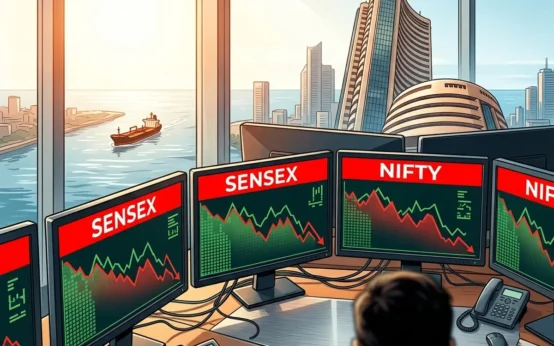
 India’s benchmark equity indices opened lower on Wednesday, May 20, with the NIFTY50 down 160.75 points, or 0.68%, to 23,457.25 and the BSE SENSEX down 394.36 points, or 0.52%, to 74,806.49 at the 9:15 am bell. The rupee opened at a record 96.89 to the US dollar, marking the ninth straight session of new lows, while foreign investors have pulled more than $22 billion from Indian assets since the Iran war began in late February. Brent crude was trading near $109 a barrel, and the Reserve Bank of India sold dollars in early hours to slow the rupee’s slide.
Three Pressures Stacked at the Open
The open looked uniform on the screens. Forty-two of the 50 NIFTY50 stocks were in the red. Asian markets reinforced the move, with the Nikkei 225 down 1.3%, Hang Seng off 0.86%, Shanghai down 0.57%, and the Asia Dow lower by 1.04% to 6,311.
What separated this fall from a routine global-cue morning was the currency print and the cumulative outflow behind it.
The numbers behind the open:
- NIFTY50 down 160.75 points to 23,457.25 at 9:15 am
- SENSEX down 394.36 points to 74,806.49 at the opening bell
- Rupee at 96.89 to USD, ninth straight all-time low
- Foreign investors sold ₹2,457.49 crore on Tuesday alone, per NSE data
- Domestic investors absorbed with ₹3,801.68 crore in buying
- Brent crude near $109 a barrel, up roughly 50% since late February
GIFT Nifty futures had foreshadowed the cash open, trading 0.44% lower at 23,410.50 before the bell. By the time Mumbai opened, the rupee was already through Tuesday’s 96.6150 record. None of the three pressures, foreign exchange, oil, or capital outflows, originated overnight. The pile has been building since the morning of February 28.

The Rupee Is Now the Lead Indicator
The rupee weakened to 96.89 against the dollar around 9:03 am, beating Tuesday’s 96.6150 mark. Five paise on top of a nine-session run sounds incremental. The cumulative number is heavier: the currency has fallen roughly 6% since the Iran war began in late February, when it traded near 87 to the dollar.
That 6% slide is the steepest sustained rupee depreciation in at least a decade, making the rupee Asia’s worst-performing currency for the year so far. The Reserve Bank of India intervened early Wednesday, selling small dollar parcels in the onshore market to slow the descent. The RBI’s published mandate is to limit volatility rather than defend a level, and the central bank has stayed inside that framing through the slide.
The cost of that defense is visible in the reserves data. India’s foreign exchange reserves fell $7.79 billion to $690.69 billion in the week ending May 1, having peaked at $728.49 billion in late February. The $37 billion drawdown tracks the start of the war almost to the day. You can see the rupee’s spot-rate trajectory since February compressing into a near-vertical line in May.
Three feedback loops are now running together:
- Higher oil prices widen India’s current-account deficit, requiring more dollars for imports
- A weaker rupee inflates every dollar-denominated import line, including the oil bill itself
- Foreign investors, watching both, pull more capital out, requiring more RBI dollar sales
Each loop reinforces the others. Until one of the three inputs reverses, whether oil falling, foreign flows returning, or dollar strength easing, the slide has no obvious mechanical floor.
Oil at $109 Is Doing the Heavy Lifting
Brent crude was trading near $109 a barrel on Wednesday morning, having briefly touched $126.41 in late April, the highest in four years. Compared with the late-February level near $72, the current price represents roughly a 50% rise. Brent’s price history through the Iran war shows the move came in two distinct legs, the initial February-March spike and the April escalation.
The Import Bill Math
Every $10 increase in Brent adds approximately $14 billion to $15 billion to India’s annual import bill, given that the country imports about 85% of its crude requirement. Run the arithmetic out: a $37 increase since late February implies roughly $52 billion to $55 billion in incremental annual import cost, assuming volumes hold and the rupee held steady. The rupee has not held steady. With the currency 6% weaker, every dollar of oil now costs an extra 5.81 rupees compared with February. That second-order pressure feeds wholesale prices through diesel, petrol, fertilizer, paint, and freight.
Why Steel and Auto Names Lead the Drop
The losers’ table on Wednesday mapped cleanly onto the cost story. Tata Steel was down 2.7%, BEL (Bharat Electronics, the state-owned defence electronics maker) down 2.2%, JSW Steel down 1.6%, Mahindra & Mahindra off 1.3%, Grasim Industries down 1.3%, and Maruti Suzuki India off 1.3%. Metals carry direct energy intensity. Auto carries indirect input cost plus a demand drag from higher pump prices. Capital-goods names like BEL get hit on a different vector, namely order-book repricing risk if defence procurement gets recalendared into a fiscal tightening scenario.
Where Brent Goes Next
Analysts have flagged $120 as a plausible upside if the Strait of Hormuz situation worsens. Iran declared the strait closed on March 4 and reopened it to traffic on April 17, but the US blockade of Iranian ports remains in place. Roughly 1,600 ships are still stuck pending a deal. A renewed closure would print differently on the rupee than the first one did, because the RBI’s reserves cushion is $37 billion thinner.
Sector Split: Metals Sink, Pharma and IT Climb
Out of the 50 stocks in the NIFTY50, only 8 were trading in the green by the early bell. The split tracks the two macro stories. Anything import-cost or capex-sensitive sold. Anything dollar-revenue or defensive bought.
| Top NIFTY50 Gainers | Move | Top NIFTY50 Losers | Move |
|---|---|---|---|
| Hindalco | +3.3% | Tata Steel | -2.7% |
| Cipla | +0.8% | BEL | -2.2% |
| Infosys | +0.3% | JSW Steel | -1.6% |
| Sun Pharma | +0.2% | Mahindra & Mahindra | -1.3% |
| TCS | +0.2% | Grasim Industries | -1.3% |
| Reliance Industries | +0.2% | Maruti Suzuki India | -1.3% |
The eight gainers cluster around two themes. Dollar-revenue exporters such as Infosys, TCS, Wipro, and Tech Mahindra catch a tailwind from the same rupee weakness that hurts importers. Defensive earnings names like Cipla and Sun Pharma carry pricing power in the home market. Reliance Industries’ positive print sat slightly off-thesis, helped by refining margin expansion as Brent-light spreads widened.
Hindalco’s 3.3% gain came on a separate story. Its US subsidiary Novelis Inc reported March-quarter results showing an $84 million loss tied to fire damage at its Oswego, New York plant, while consolidated sales rose to $4,787 million from $4,587 million year on year. The reaction was a relief print on the loss being smaller than feared, not a thesis upgrade.
In the broader market, GE Vernova led mid-caps with a 4.2% gain, followed by Mankind Pharma at 2.6% and Coforge at 2%. On the Nifty Smallcap 100, BLS International was up 7.9% and Godawari Power up 4.4%. The smallcap leaders shared no single theme, which reads as bottom-fishing rather than rotation.
The lagging cohorts told a sharper story. PI Industries fell 7.8% on the Midcap 100, with Bharat Dynamics, Adani Total Gas, Godfrey Phillips, and Coromandel International each down about 2%. On smallcaps, Cholamandalam Financial Holdings was off 3.3%, Hindustan Copper down 2.8%, Karur Vysya Bank down 2.3%, IDBI Bank down 2.2%, and Devyani International down 2.1%. When private-bank and PSU-bank names move together on a foreign-flow day, the signal is institutional reallocation, not single-stock news.
FIIs Have Sold $22 Billion; DIIs Have Absorbed Most of It
Foreign portfolio investors sold ₹2,457.49 crore worth of Indian assets in Tuesday’s session, per NSE’s official FII and DII trading activity report. Domestic institutional investors bought ₹3,801.68 crore, more than absorbing the outflow on a single-day basis. That ratio has held for most of 2026.
The cumulative numbers tell a starker version:
- $22 billion+ pulled out by foreign investors since late February
- ₹1.98 lakh crore in foreign portfolio selling between January 1 and April 30
- ₹1.7 lakh crore in domestic institutional buying over the same window
Roughly 90% of foreign selling has been absorbed by domestic flows year to date, according to NSDL’s foreign portfolio investment calendar-year data. The balance is why NIFTY50 at 23,457 is only roughly 3-4% off recent highs despite a 6% rupee depreciation and the largest sustained foreign outflow in years. The domestic bid is real.
The fragility sits one layer down. Systematic investment plan flows depend on the same retail investor base whose discretionary income is now compressed by higher pump prices and inflation pass-through from the weaker rupee. If month-over-month SIP additions slow even modestly through the June or July prints, the absorption ratio gets thinner exactly when foreign selling could accelerate again on any military escalation.
Tuesday’s session was the cleanest illustration. Foreign institutional investors sold ₹2,457.49 crore. Domestic institutional investors bought ₹3,801.68 crore. The net was positive. The price still fell, because price-makers set prints at the margin and foreign selling clears at the offer rather than the bid. That dynamic explains why a session can show net DII positive and still close red.
The Iran Calendar Holds the Next Move
The next direction depends almost entirely on inputs the market does not control.
A breakdown in US-Iran talks producing an actual military strike would push Brent toward $120 immediately and the rupee toward 100 inside a session. The Trump administration has held the option open since late April and is, per multiple statements out of the White House this month, prepared for a large-scale action if Gulf countries fail to negotiate a peace framework.
The inverse path is also live. A surprise framework announcement, or even a credible signal of one, removes the war premium from oil at speed. Brent could give back $15 to $20 a barrel in days. Foreign investors who shorted India primarily on the dollar trade rather than on company fundamentals would unwind in size.
The RBI’s intervention capacity is the third variable. Reserves at $690.69 billion still rank India among the top five holders globally, but the $37 billion already spent on this defense leg means the central bank has less room for an extended battle. The RBI’s signaling, that intervention is to manage volatility rather than to peg a level, is the policy floor, and markets will test it again if the rupee approaches 98. The central bank’s framework is set out on the RBI’s published foreign exchange operations FAQ.
Domestic earnings season finishes through the next two weeks. None of those prints will move the index more than a single Brent spike or a White House readout. The macro is the story.
If talks produce a deal before the end of May, the SENSEX trades back through 76,000 by mid-June. If they break and a strike follows, the next leg lower is sharper than this morning’s, and the conversation moves to whether the RBI lets the rupee print past 100 to preserve reserves.
Disclaimer: This article is for informational purposes only and does not constitute investment advice. Equity markets carry risk, and individual stocks can move sharply on news outside the scenarios discussed here. Readers should consult a SEBI-registered investment adviser before making any portfolio decisions. All figures and prices cited are accurate as of publication on May 20, 2026.
 SEBI CAS Forces Options Traders to Recalibrate Closing Risk
  Sensex Drops 400 Points as Oil Spike Tests Market Resilience
  Ardee Industries IPO Rides Lead Recycling Boom at Discount
  Gold Nears 4300 but Iran Risks Cap Gains Ahead of NFP
  Scotland Construction Stalls as Skills and Tariffs Blunt Infra Gains
  Lok Sabha Bill Opens UPI Charges Path for Banks Over Merchants