
 Ishan Crawford
 Eight days after the Netherlands formally returned 24 Chola-era copper plates to India at a ceremony in The Hague, the Archaeological Survey of India has begun building the dossier for its next request: seven Sanskrit charters held since 1947 at the Edinburgh University Library in Scotland. The plates, dating from 444 CE to 1508 CE, span four South Indian dynasties and a Gujarat kingdom, and they record village grants that historians use to map the political geography of the Pallava, Chalukya, Gurjara and Vijayanagara worlds.
The Edinburgh request is the first big test of whether the Leiden script travels. The Dutch return rested on a formal advisory body, the Colonial Collections Committee, which ruled the plates an involuntary loss of possession. The United Kingdom has no equivalent national mechanism, and a Scottish university will have to decide on its own legal footing whether nineteenth-century fieldwork by a Madras civil servant counts as a clean acquisition.
The Seven Plates Edinburgh Holds
The collection sits inside the Sir Walter Elliot Archive (catalogue reference Coll-1860/CP) and runs to one linear metre across six storage boxes, according to the Edinburgh University Archive and Manuscript Collections finding aid. Six charters were lifted from sites in present-day Andhra Pradesh, with the seventh from Gujarat. K Munirathnam Reddy, Director (Epigraphy) at the Archaeological Survey of India (ASI, the country’s central archaeology agency), confirmed the geographic breakdown to reporters in Visakhapatnam last week: three from Guntur, two from Anantapur, one from Kurnool, and one from the Gurjara kingdom of the seventh century.
Five plates carry dates that pin them to specific rulers’ regnal years. Two are early Pallava grants issued from Dasanapura. One is the Gurjara-era charter of Dadda II Prashantaraga, a king better known from coin hoards than from intact land records. The two Vijayanagara plates are the latest, and the most administratively dense.
| Charter | Year (CE) | Dynasty / Issuer | Origin |
|---|---|---|---|
| Mangalur | 444 | Pallava Maharaja Simhavarman II | Andhra Pradesh |
| Uruvapalli | 447 | Pallava Maharaja Simhavarman II | Andhra Pradesh |
| Dadda II Prashantaraga | 638 | Gurjara kingdom | Gujarat |
| Vijayaditya Satyashraya | 700 | Western Chalukya | Andhra Pradesh |
| Vijayaditya III | 9th century | Eastern Chalukya | Andhra Pradesh |
| Narasimha Raya II | 1504 | Vijayanagara | Andhra Pradesh |
| Sriranga II | 1508 | Vijayanagara | Andhra Pradesh |
Edinburgh’s own catalogue describes the Mangalur grant as seven copper plates in southern Brahmi script, bound by a ring with an eroded seal, conveying a village to Brahmins in the eighth year of the king’s reign. That detail matters for the ASI’s case: every charter in the set documents a specific land transfer that historians can cross-reference to villages still on the map.
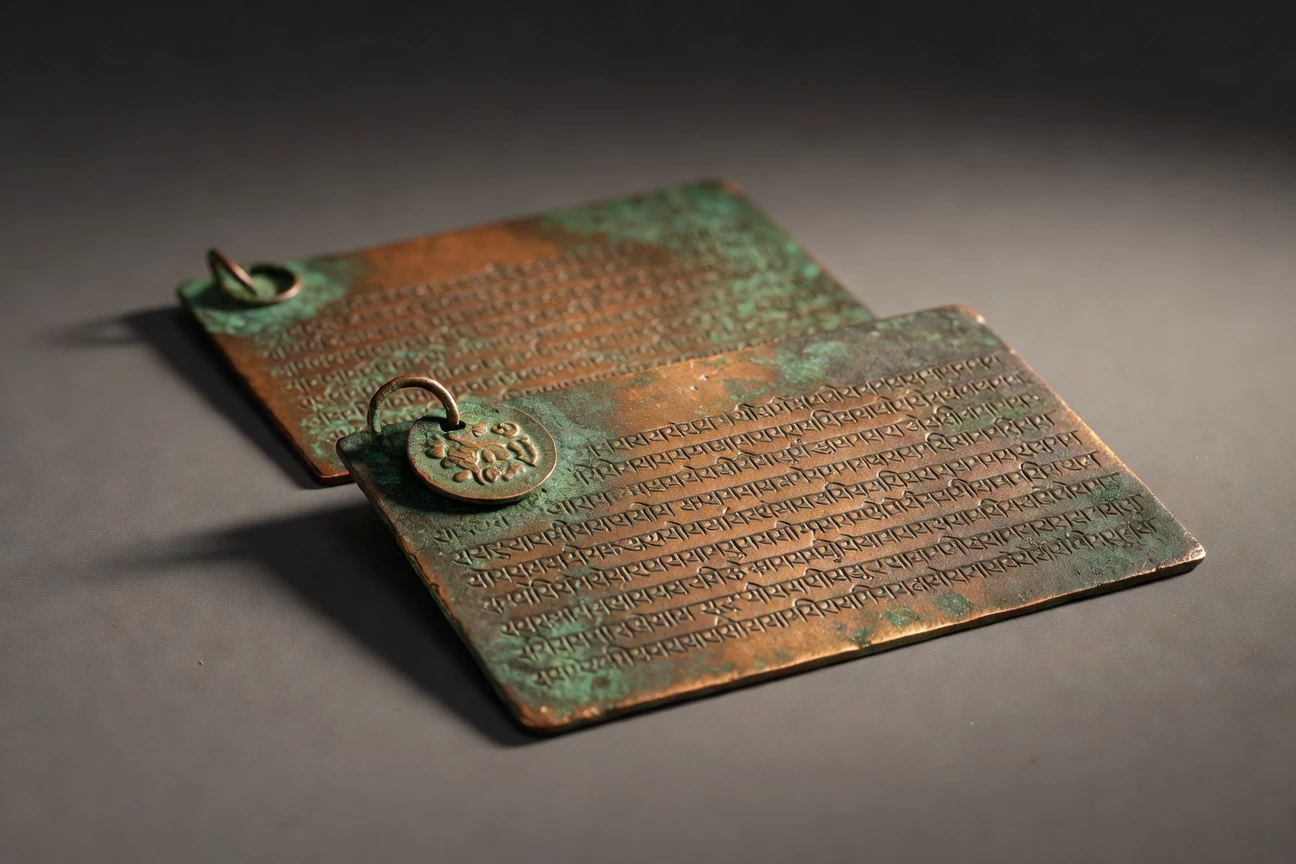
From Guntur Soil to Eggeling’s Study
The provenance trail is unusually clean for a colonial-era collection, which cuts both ways. Sir Walter Elliot (1803-1887), a civil servant in the Madras Presidency, excavated most of the plates between 1825 and 1835 while serving across districts that now form coastal Andhra Pradesh. He was an amateur Sanskritist and numismatist who corresponded with European Indologists for decades, and he kept detailed field notes that are themselves part of the Edinburgh holding.
The Eggeling Bequest
Elliot’s plates passed to Hans Julius Eggeling (1842-1918), Professor of Sanskrit at Edinburgh from 1875 to 1914 and one of the era’s leading translators of Vedic literature. Eggeling kept the charters in his personal collection until his death. His son, Major Hans F Eggeling, donated the full set to the university library in 1947, the year India became independent. There is no record of either Elliot or Eggeling claiming the plates as government property or registering them under colonial-era antiquities rules.
Why the Paper Trail Cuts Both Ways
For Edinburgh, that documented private chain of custody is a defence. The plates were not seized in war, not bought from a dealer, not removed under duress that the library can verify. For the ASI, the same paper trail is the case for return: a single colonial administrator collecting state-issued royal charters and shipping them home is exactly the pattern that newer cultural-property norms read as extraction. The library’s own description acknowledges that thousands of such charters survive in India but very few sit in overseas institutions.
The Leiden Template, Eight Days Old
On May 16, 2026, at a ceremony in The Hague attended by Prime Minister Narendra Modi and his Dutch counterpart Rob Jetten, Leiden University formally announced the return of two sets of Chola plates that had sat in its Asian Library since the late seventeenth century. The first set, catalogued Or.1687, comprises 21 copper plates sealed with the royal mark of Rajendra Chola I. The second, Or.1688, holds three smaller plates issued by Kulottunga Chola I. Combined weight: about 30 kilograms.
This is a joyous moment for every Indian. These plates are not just metal; they are the living memory of our maritime past and our Tamil heritage.
That was Modi, speaking at the handover, as quoted by news agencies travelling with the prime minister. The plates record agreements about the revenue rights of a Buddhist shrine and several monasteries at Nagapattinam, on the Coromandel coast.
The return process inside Leiden was not quick. India lodged its formal request in summer 2023. The Leiden University statement on the Chola transfer notes that the institution commissioned an independent provenance investigation, then referred the file to the Dutch national Colonial Collections Committee. The committee concluded in late 2025 that the plates were most likely excavated during the construction of Fort Vijf Sinnen by the Dutch East India Company between 1687 and 1700, that no consent was ever sought from local rights-holders, and that the case met the bar for unconditional return.
What Edinburgh Cannot Copy
The structural problem for the ASI’s Scotland request is that the United Kingdom has no Colonial Collections Committee. There is no Cabinet-Office advisory body, no published criteria for when colonial-era acquisitions count as involuntary loss, no national framework that a university can lean on when it makes a judgement call.
The Legal Vacuum
The British Museum is bound by the British Museum Act 1963, which forbids most deaccessions outright. Edinburgh University Library is not subject to that statute, which gives it more freedom than the national museums in London. But the absence of a national framework means the library’s lawyers will have to write the policy as they apply it.
What the ASI Is Building
Munirathnam Reddy told reporters the agency is compiling a dossier with the measurements of each plate, the donation chain from Elliot to Eggeling to the 1947 transfer, and the modern provenance case for return. That file will go through the Indian High Commission in London to Edinburgh’s library administration. The same official said the ASI is preparing a broader inventory of copper plates and inscribed slabs taken out of India during the colonial period, which suggests the Scotland request is the opening move in a longer campaign across UK universities and county collections.
The Scottish Variable
Scotland’s devolved cultural-policy landscape adds another layer. The Scottish Government has been more openly receptive to repatriation claims than Westminster, having returned a totem pole to the Nisga’a Nation in 2023 and a set of Benin bronzes via Aberdeen University in 2021. Edinburgh, as a Scottish institution rather than a UK national one, has its own room to act. Whether the library’s trustees see the Elliot charters in the same frame as a Nigerian royal bronze is the question that decides the timeline.
The Decade’s Return Arc, By Numbers
The Edinburgh request lands inside a sharp acceleration of repatriations to India. The Centre’s own tally, reported by multiple Indian outlets after the Leiden handover, puts the post-2014 total at 668 antiquities returned, against just 13 in the 67 years between independence and 2014.
- 668 antiquities returned to India since 2014, per Ministry of Culture figures
- 578 of those came from the United States, including Chola bronzes seized by US Homeland Security investigations
- 13 antiquities returned in the 67 years from 1947 to mid-2014, the entire pre-Modi era
- About a dozen of the post-2014 returns are physically back at their place of origin; most sit in ASI storage or central museums
The last bullet is the one that should land hardest. A successful Edinburgh request that places the seven plates in a Delhi storeroom is not the same outcome as one that puts them in a museum case in Guntur or Anantapur. The ASI has not yet said which it will pursue.
Where the Plates Would Land
For now, custody talk is premature. The dossier is being drafted, the High Commission has not yet sent it, and Edinburgh has not been formally approached. But Munirathnam Reddy’s public framing has been that successful returns would be displayed in the archaeological museums closest to the original find-sites, a stance the agency took in the Chola case too.
That is harder than it sounds. The State Archaeology Department in Andhra Pradesh runs a network of smaller site museums, but few have the conservation infrastructure for fifth-century copper plates with active corrosion risk. The plates would likely transit through the ASI’s central conservation lab in Dehradun before any regional placement. Tamil Nadu’s experience with the Leiden plates is instructive: state leaders have already begun asking that the Chola charters be exhibited in the Chola heartland rather than housed in a national institution, and that argument has not been resolved.
The Gujarat plate, the Dadda II Prashantaraga grant, is the orphan in the set. It would not fit the Andhra-display narrative, and Gujarat’s museum infrastructure for early-medieval epigraphy is concentrated in Vadodara and Ahmedabad. Whether the state government claims it actively, or whether it goes to ASI custody by default, is a smaller question inside the bigger one.
If Edinburgh accepts the case on the documentation alone, the seven plates could move within 18 months, faster than Leiden’s 33-month timeline because there is no committee referral built into the UK process. If the library insists on commissioning its own provenance review, modelled on the Dutch precedent, the file slips toward late 2027. Either outcome counts as movement; the harder test is whether plates 444 CE old end up where they were dug, or in a vault 1,500 kilometres away.
 One UI 9’s Privacy Display Fix Reaches Just One Galaxy Phone
  Samsung Drops Its Own Exynos Chip for the Galaxy Watch9 and Ultra 2
  Marathon’s Vault Breaker Arrives as Bungie’s Bigger Bet Keeps Faltering
  Sony’s PlayStation Disc Cutoff Erases the Last Proof of Ownership
  Tesla’s Summer Update Hands Grok the Keys, and Musk’s Empire More Reach
  Apple’s $634 Million Masimo Payment Is Final After Appeal Denial