
 Ishan Crawford
 Norwegian ocean-forecasting startup Oceanbox’s high-resolution coastal model went live for Scottish waters on May 20, the first commercial deployment outside the company’s home market in Tromsø. The launch covers three-to-five-day forecasts of currents, temperature, salinity and particle transport, tuned to the sea lochs and fjordic inlets where Scotland farms most of its salmon.
The timing is not coincidental. Scottish salmon mortality hit a 35-year high in 2025, sea-lice limit breaches averaged more than three per day, and the country’s environmental regulator now leans on hydrodynamic computation to set site licences. Oceanbox is walking into a market where the demand for better water-column modelling has rarely been more acute, and where the data those models produce can carry direct regulatory weight.
The Atlantis System Arrives in Scottish Waters
Oceanbox’s product is built around a modelling engine the company calls Atlantis. It resolves coastal currents at grids as fine as 15 metres and renders the water column in 35 vertical depth layers, then runs particle-tracking on top of that physics to predict where sea lice larvae, delousing chemicals, sediment plumes and fish-farm effluent will travel over the next several days.
The Scotland model is a fresh build, not a port. Coastal bathymetry, tide regimes and freshwater inflow patterns around the Hebrides, the Sound of Mull, and the lochs of the west coast differ enough from Norwegian fjords that the underlying mesh and forcing data had to be reconstructed from scratch. Oceanbox staff visited Scottish Sea Farms’ Scallastle site on the Sound of Mull last month to ground-truth assumptions ahead of the public launch.
Chief executive and co-founder Svenn Hanssen has framed the move as the first move in a wider international push. The company stated in December that Norway’s domestic market, large as it is, would not by itself absorb the capacity Oceanbox is building. Scotland is the proving ground.
Mortality at a 35-Year High Sets the Demand Floor
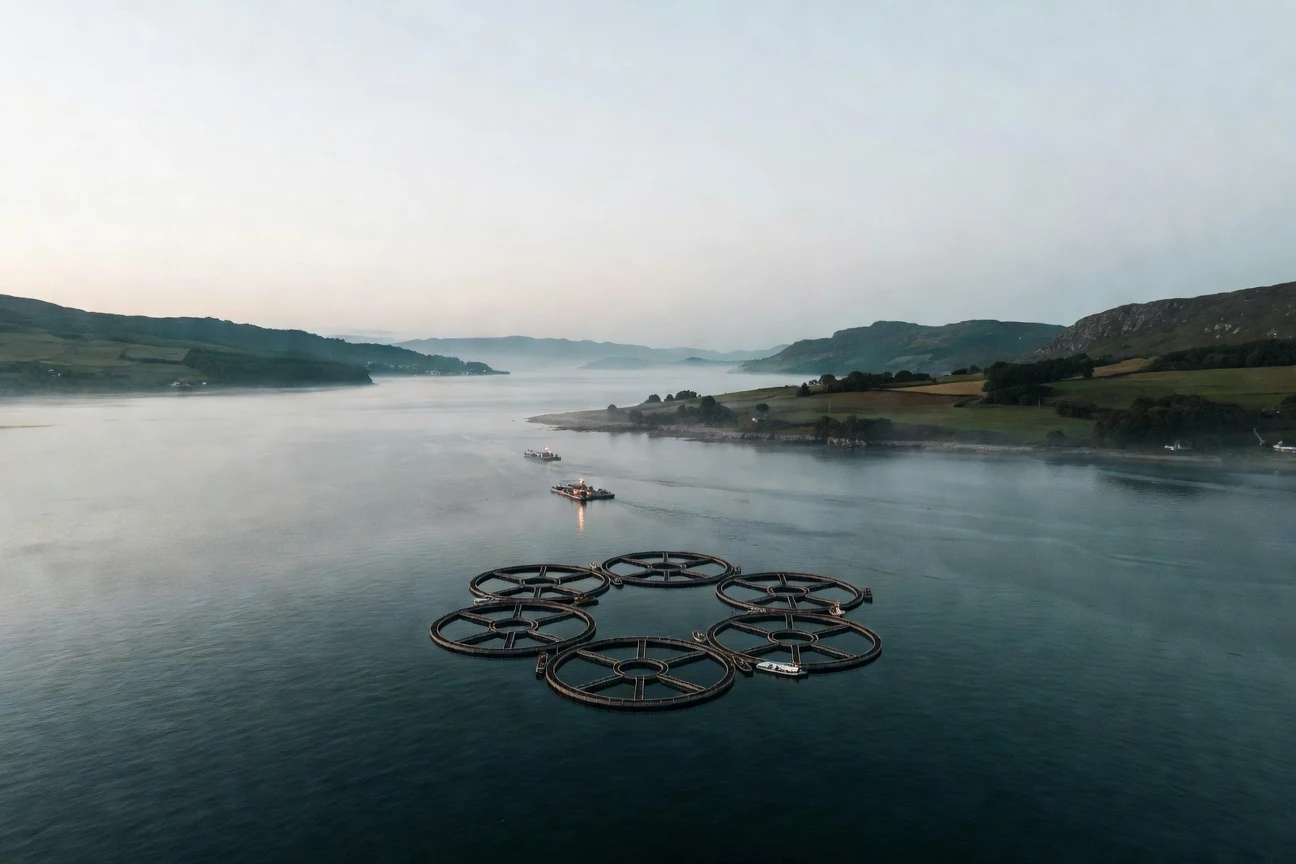
The Scottish industry that Oceanbox is selling into is in operational distress. The 2025 calendar year produced about 1.5 million more salmon deaths on Scottish farms than 2024, according to figures compiled from Fish Health Inspectorate site returns. Individual sites posted mortality numbers that would have triggered emergency reviews in earlier decades.
The pattern is broader than any one operator and explains why a forecasting tool has commercial pull rather than being a nice-to-have data feed.
- 40.6% mortality at the Bay of Holland site in January 2025.
- 40.2% mortality at Meall Mhor in June 2025.
- 33.7% mortality at Muck in July 2025.
- 1,200 recorded sea-lice limit breaches across Scottish farms in 2025, more than three per day.
- 48 tonnes of formaldehyde discharged into Scottish lochs in 2025, with environmental non-compliances up 243% year on year.
Operators caught between treatment limits and rising lice loads have begun lobbying for tools that can flag transport corridors between cages before an outbreak crosses sites. A model that simulates how a lice plume from one farm reaches a neighbour 48 hours later is, in this market, a compliance asset and an insurance argument, not just a science demonstrator.
The Mechanics of a Three-to-Five-Day Forecast
Atlantis runs daily on a finite-volume ocean model, a class of solver well suited to the irregular coastlines and steep bathymetric gradients that define Scotland’s salmon-farming geography. Each run pulls atmospheric forcing data, tidal harmonics, and freshwater river-discharge estimates, then solves the equations of motion across a 3D mesh that can hold millions of triangular cells, each carrying current, temperature, salinity and particle parameters.
The customer-facing layer is a browser-based simulation tool. Salmon farmers, environmental consultants and regulators can run scenarios on demand without installing software, and validate model output against any in-water sensor data they already collect.
What the Model Computes
Daily outputs cover the variables that drive both operational decisions and regulatory submissions:
- Currents and water exchange at cage depth, used for siting and cage rotation.
- Temperature and salinity profiles, used for stocking and treatment planning.
- Sea-lice larval dispersion between sites, used for biosecurity coordination.
- Delousing-agent and bath-treatment plume tracking, used for chemical-use compliance.
- Sediment and benthic-deposition modelling, used for seabed-impact reporting.
Forecast Window and Validation
The horizon is short by atmospheric-modelling standards but well calibrated to fish-farm operations: three to five days is the window in which most treatment, harvest and feeding decisions are made. Oceanbox offers a 24-hour turnaround validation service: a farm sends in its sensor record, and the company benchmarks the model’s hindcast against the actual measurements before any commercial commitment.
Why SEPA’s Framework Made Scotland the Logical Next Market
Scotland is the rare market where regulation pulls modelling demand upward. The Scottish Environment Protection Agency has built its aquaculture regulatory framework on hydrodynamic computation, using small-scale local models to assess how waste, chemicals and pathogens disperse from individual and clustered farms.
The agency’s approach includes virtual fish tracking, where computer-simulated juvenile wild salmon are routed through model output to estimate cumulative exposure as they migrate seaward. The government’s 2024 SPILLS final project report on salmon parasite interactions in Linnhe, Lorn and Shuna built on this kind of modelling architecture, and recommended its continued use in licence decisions.
For a salmon farmer in Scotland, the upshot is that hydrodynamic data is not optional. Site applications, expansion permits and licence renewals routinely require modelled outputs of dispersion, deposition and connectivity, calibrated and defensible to the regulator. The CLAWS toolkit (Chemicals, Lice and Waste from Salmon Farms) was developed precisely to meet that brief on the public-science side. Oceanbox enters as a commercial alternative pitched at operators who want higher resolution, faster turnaround and an interactive workflow.
The Norway Template: Lerøy, Eide, and the Push to Scale
Oceanbox arrives in Scotland with a usable Norwegian reference deck. The company’s anchor customer in its home market has been Lerøy Seafood Group, the world’s second-largest Atlantic salmon producer, which has used the Atlantis platform to model conditions at its Norwegian sites. Classification society DNV has profiled the system as an example of how ocean-physics data is being threaded directly into fish-farm operating decisions.
Atle adds competence, experience, and professionalism at a time when Oceanbox is entering a growth phase. His energy and enthusiasm fit perfectly with the rest of the team.
That assessment came from Hanssen in December, on the appointment of Atle Eide as chair of the Oceanbox board. Eide is a former chief executive of Marine Harvest (now Mowi) and a former chair of SalMar, two of the largest names in global salmon production. Bringing him in at the start of the international push signals that Oceanbox wants the Scotland launch to read to potential customers as an industry-grade move, not a research-lab outing.
Norway versus Scotland: How the Two Markets Compare
The structural differences between Oceanbox’s home market and the one it just entered shape what a successful Scotland rollout would actually look like.
| Indicator | Norway | Scotland |
|---|---|---|
| Approximate annual salmon production | ~1.5 million tonnes | ~190,000 tonnes |
| Lead environmental regulator | Mattilsynet and Fiskeridirektoratet | SEPA and Marine Directorate |
| Hydrodynamic modelling in licensing | Site-specific permits use dispersion data | Framework explicitly built on hydrodynamic computation |
| 2025 mortality profile | Elevated but trending lower | Highest in 35 years |
| Oceanbox status as of May 2026 | Operational, Lerøy anchor | Day-one launch |
The smaller Scottish industry produces roughly one-eighth of Norway’s salmon output, but its regulatory intensity per tonne is higher and its public-license-to-operate pressure is more acute. That changes the sales pitch. In Norway, Oceanbox argues yield and biosecurity. In Scotland, it has to argue yield, biosecurity, and regulatory survival.
What Could Slow the Rollout
Two constraints are worth flagging. The first is technical: even a 15-metre grid model needs calibration data from in-water sensors to perform reliably at any specific site, and Scottish farms vary widely in how much of that data they collect or are willing to share. A model is only as good as its boundary conditions, and Oceanbox will spend the first months of its Scottish operation feeding the system enough local observation to make its forecasts trustworthy to skeptical farm managers.
The second is reputational. Scottish Sea Farms and other operators are under sustained pressure from wild-salmon advocacy groups who argue that more sophisticated modelling can be used to justify the continued operation of sites that should be closed on welfare grounds. Oceanbox sells to the industry side of that debate; how its outputs are used in SEPA licence hearings will shape whether the company is seen as a neutral scientific provider or as a tool of incumbent operators.
If the Scotland deployment lands a marquee operator on a multi-site contract by year-end, the case for opening offices in Chile, the Faroes, or eastern Canada writes itself. If the first commercial customers stay in pilot mode through 2026, the international growth strategy stays a slide deck.
 WhatsApp Tests ‘After Reading’ Messages Without Screenshot Blocking
  Meta and LinkedIn Layoffs Hit on Same Day as Survivor Anxiety Spreads
  Nifty Pharma Hits 52-Week High as Mankind, Zydus Print Beats
  iPhone 18 Pro Max Preview: 2nm Chip, Iris Camera, India Price
  Wear OS 7 Lands With Gemini, Wear Widgets, and a 10% Battery Bump
  India Weighs $1 Billion EV Aid Plan, JBM Auto and Olectra in Focus