
 Zane Lee
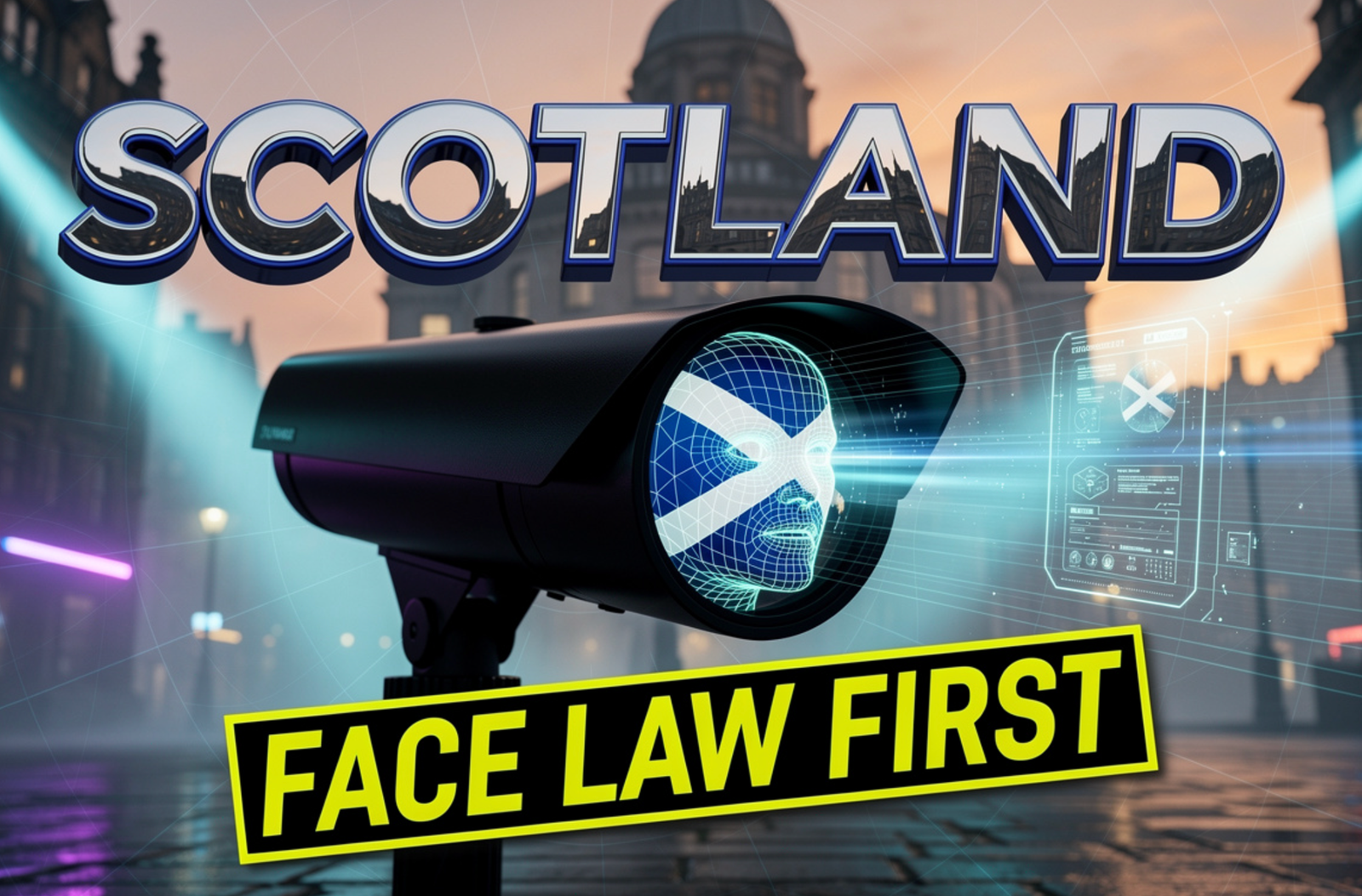
 Scotland could become the first country on the planet to pass a dedicated law for live facial recognition by police, as the rest of the UK races ahead with the controversial tech. The Scottish privacy commissioner is now pushing hard for an Act of Parliament. Critics warn that without it, public trust will collapse before the cameras even switch on.
Why Scotland Wants Its Own Facial Recognition Law
Dr. Brian Plastow, the Scottish Biometrics Commissioner, has written to Audrey Nicoll MSP urging Holyrood to act. He says primary legislation would offer the “gold standard” for live facial recognition, known as LFR.
No country has passed such a law yet. That gap is exactly what Plastow wants Scotland to fill.
His message is blunt. He believes the technology is “nowhere near as effective as the police claim it is” and warns that the current “patchwork” of rules cannot protect the public.
Plastow has also told the Criminal Justice Committee that without a proper law, any rollout by Police Scotland would face a wave of legal challenges, complaints, and human rights pushback.
How the Rest of the UK Is Racing Ahead
While Scotland debates, England and Wales are already deep into deployment. Thirteen forces are now using live facial recognition, according to a recent Scotsman report.
The London Metropolitan Police alone scanned more than 1.7 million faces in the first four months of 2026. That is an 87 percent jump compared with the same window in 2025.
In February 2026, the Home Office launched a pilot of LFR at busy railway stations, starting with London Bridge. The government has signalled it wants all 43 forces in England and Wales to use the tech more widely.
| UK Force or Body | Status of Facial Recognition Use |
|---|---|
| Metropolitan Police | Active LFR, planning OIFR trial |
| South Wales Police | LFR and OIFR active |
| Gwent Police | OIFR active |
| Merseyside Police | LFR active, OIFR pilot on 125 officer phones |
| Police Scotland | Not deployed, business case due 2027 |
On April 21, 2026, the UK High Court ruled that the Met’s live facial recognition use is lawful and compatible with human rights. The claimants, including Big Brother Watch director Silkie Carlo, plan to appeal.
Mobile Facial Recognition Adds a New Worry
The bigger shock for many privacy groups is the rise of operator-initiated facial recognition, or OIFR. This puts the power of biometric matching directly into an officer’s smartphone.
An officer can snap a photo of a person on the street and run it against police databases within seconds. South Wales and Gwent forces already use it through an app called iPatrol.
Merseyside Police has rolled it out to 125 officers in a pilot area. The Met is preparing its own trial.
“LFR isn’t a plug and play upgrade, and crossbreeding biometrics with old school surveillance technology is ill advised.” Fraser Sampson, former UK Biometrics and Surveillance Camera Commissioner
A Liberty Investigates report calls OIFR a “significant expansion” of police power. The Home Office, however, insists there are no plans for a national rollout, saying decisions sit with individual forces.
Civil rights groups are not convinced. Liberty has documented cases where LFR was used to scan children as young as 12. Studies still show higher error rates for Black and Asian faces.
What Police Scotland Has Said So Far
Police Scotland has not adopted live facial recognition. A detailed business case is not expected until 2027, and a public consultation would follow that.
Alasdair Hay, chair of the Scottish Police Authority’s policing performance committee, says the force would have to produce a “bespoke code of practice” before any deployment. It would also need to comply with the biometrics commissioner’s own code.
There is no money set aside for LFR in the 2026/27 provisional budget. That gives lawmakers breathing room that no other UK nation has.
- No final decision taken by Police Scotland on LFR
- Business case expected in 2027
- Public consultation to follow the business case
- Bespoke code of practice required before any use
- No 2026/27 budget allocation for the technology
The Bigger Fight Over Privacy and Power
The debate is no longer just technical. It is about how much surveillance a free society is willing to accept in public spaces.
Amnesty International UK and other rights groups have condemned Police Scotland’s continued exploration of LFR. They argue the tech “should have no place” in Scottish policing.
Plastow himself has framed the moment in striking terms, almost pleading with politicians to give him a clear legal framework before the cameras roll. His position is simple: build the law first, then decide on the tech.
Fraser Sampson goes further. He wants a full Biometric Surveillance Act covering the whole UK, not just Scotland. Without it, he warns, every force will write its own rules and the public will pay the price.
For ordinary Scots, the question is personal. Walking past a camera at Glasgow Central or Edinburgh Waverley could one day mean your face is checked against a watchlist within milliseconds. That is the future being negotiated right now in committee rooms in Holyrood.
Scotland stands at a rare crossroads where a small nation could write the rulebook the entire democratic world ends up borrowing. If MSPs move quickly, history may remember Edinburgh as the city that drew the first real line between safety and surveillance. If they hesitate, the cameras may arrive long before the law does, and that is a thought that should make every citizen pause. What do you think, should Scotland push ahead with a world first law, or wait and see how England and Wales handle the fallout? Share your thoughts in the comments below.
 Windows 11 KB5095093 Lands With Point-in-Time Restore and 35-Day Pause
  Meta Cuts Smart Glasses to $299 to Outflank Snap and Apple
  Messi Leads the 2026 World Cup Golden Boot Race After Two Matches
  Australia March On as Athapaththu Ton Lights Up T20 World Cup
  Galaxy Z Fold 8 Leak Reveals Colors, Storage, and a New Ultra Variant
  Ronaldo’s Six-World-Cup Record Leads a Matchday Full of Milestones