
 Chris Muir
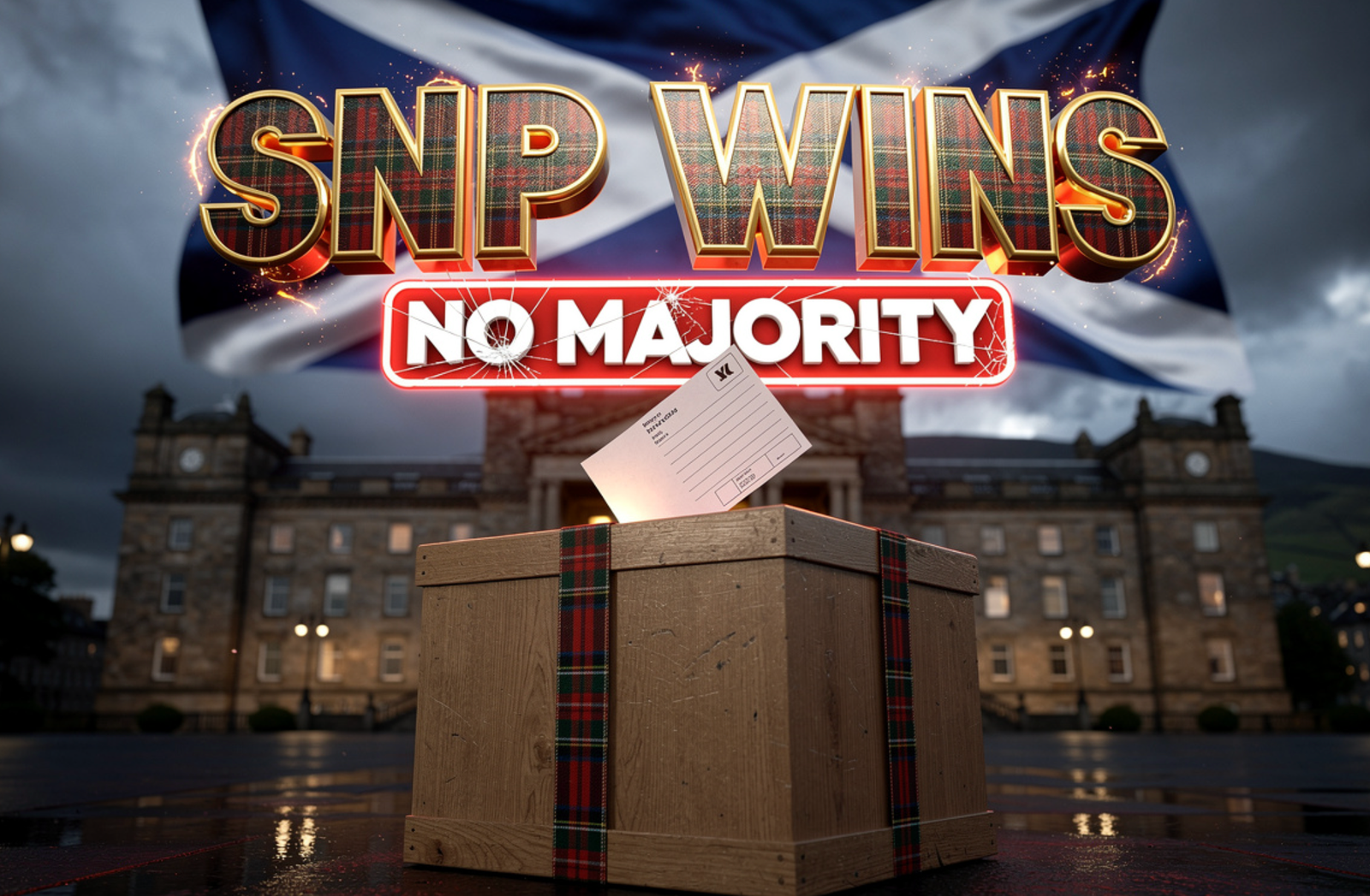
 The SNP has stormed back as the largest party in Holyrood after the 2026 Scottish Parliament election, but John Swinney’s celebrations come with a sting. With 58 seats secured, the party sits seven short of a majority, while Reform UK has crashed the gates with a stunning 17-seat debut and the Scottish Greens have made history by winning their first ever constituency contests.
SNP Holds the Top Spot in a Shaken-Up Holyrood
Scotland woke up on Friday to a parliament reshaped by anger, ambition and a few headline shocks. The SNP took 58 of the 129 seats, down six from the notional 2021 result on the new boundaries.
First Minister John Swinney told supporters his party had won the election “hands down” and confirmed the SNP will now try to form the next Scottish government.
The arithmetic, however, is brutal. Without a majority, Swinney must once again rely on deals with smaller parties to pass laws, set budgets and steer the country through a tense fifth term in office.
Reform UK and the Greens Rewrite the Rulebook
The biggest story of the night was not the SNP. It was the rise of Reform UK and the breakthrough of the Scottish Greens.
Reform, contesting Holyrood seriously for the first time, picked up 17 MSPs and tied with Scottish Labour for second place. The party drew strong support across central belt regional lists, becoming an instant force in Scottish politics.
The Greens, meanwhile, won 15 seats and finally cracked the constituency map. Holly Bruce defeated SNP Equalities Minister Kaukab Stewart in Glasgow Southside, the seat once held by former First Minister Nicola Sturgeon for 15 years.
“A Green vote is no longer a wasted vote in Scotland.”
In Edinburgh Central, Lorna Slater pulled off another stunner, knocking SNP Culture Secretary Angus Robertson down to third place behind Labour.
Seats and Vote Share at a Glance
Here is how the new Scottish Parliament will look when MSPs are sworn in.
| Party | Seats Won | Change |
|---|---|---|
| SNP | 58 | -6 |
| Scottish Labour | 17 | -5 |
| Reform UK | 17 | +17 |
| Scottish Greens | 15 | +7 |
| Scottish Conservatives | 12 | -19 |
| Scottish Liberal Democrats | 10 | +6 |
The vote share tells a similar story of fragmentation. On the constituency ballot, the SNP led with 38.2 percent, followed by Labour on 19.2 percent and Reform UK on 15.8 percent.
The regional list was even more crowded. The SNP took 27.2 percent, Reform UK 16.6 percent, Labour 16.0 percent, the Greens 14.0 percent, the Conservatives 11.8 percent and the Liberal Democrats 9.4 percent.
Big Names Out, New Faces In
This was an election of farewells as much as fresh starts. A record 42 MSPs chose not to seek re-election, including Nicola Sturgeon and several members who had served since the parliament opened in 1999.
Among the night’s biggest casualties:
- Angus Robertson, SNP Cabinet Secretary, lost Edinburgh Central to the Greens.
- Kaukab Stewart, SNP Equalities Minister, beaten in Glasgow Southside.
- Scottish Conservatives collapsed by 19 seats, their worst Holyrood result.
- Scottish Labour slipped back five seats despite being in government in Westminster.
For Anas Sarwar’s Labour, the result is a cold shower after months of high expectations. The party had hoped to challenge the SNP for first place, but voter frustration with the UK government appears to have dragged them down.
The Liberal Democrats, led by Alex Cole-Hamilton, quietly enjoyed one of their best Scottish nights in years, picking up six extra seats.
Turnout Slumps as Voters Send a Message
Turnout fell sharply. Early figures suggest the national average sat in the low 50s, well below the 63 percent recorded in 2021.
Some constituencies dipped to around 46.7 percent, while a handful pushed past 57 percent. Election officials say cost of living pressures, voter fatigue and a crowded ballot all played a role.
Quick Take: Six parties now hold double-digit seats in Holyrood for the first time ever. Coalition talks, confidence and supply deals, and issue by issue voting will define the next five years.
What Happens Next at Holyrood
Attention now shifts to the question every Scot is asking. Who will Swinney work with to keep his minority government alive?
The SNP’s previous power sharing deal with the Greens collapsed in 2024, but the two parties share ground on climate, housing and public services. A revived working relationship looks possible, even if a formal coalition does not.
Reform UK’s arrival also changes committee maths and debate dynamics. With 17 MSPs, the party will have a loud voice on immigration, energy and the constitution from day one.
Independence remains the elephant in the chamber. The pro-independence bloc of SNP and Greens combined holds 73 seats, a working majority on that single issue, even if the SNP alone falls short.
Scotland has voted, and the message is loud. Voters wanted change, but they did not hand it to one party. They split it across six. The next government will need to listen harder, talk longer and compromise more than any before it. For families worried about bills, NHS waiting lists and the future of their towns, the work starts now, and patience is wearing thin.
What do you think of the 2026 Holyrood result? Does the SNP deserve another term, or is it time for a different direction? Share your thoughts in the comments and join the conversation on social media using #ScotElection2026.
 ONGC licence frees Venezuela cash and operatorship talks
  Anthropic Hits $65 Billion Run Rate and Flips the AI Cash Test
  Supreme Court grounds the fare free-for-all with three-week clock
  Gold Nears $4400 as Soft Data Meets Oil Inflation Risk
  Nifty Slips as Zaggle Circuits and Dhoot Debuts Big
  Diesel Crack Tops $100 as Iran Rhetoric Lifts Crude