
 Ishan Crawford
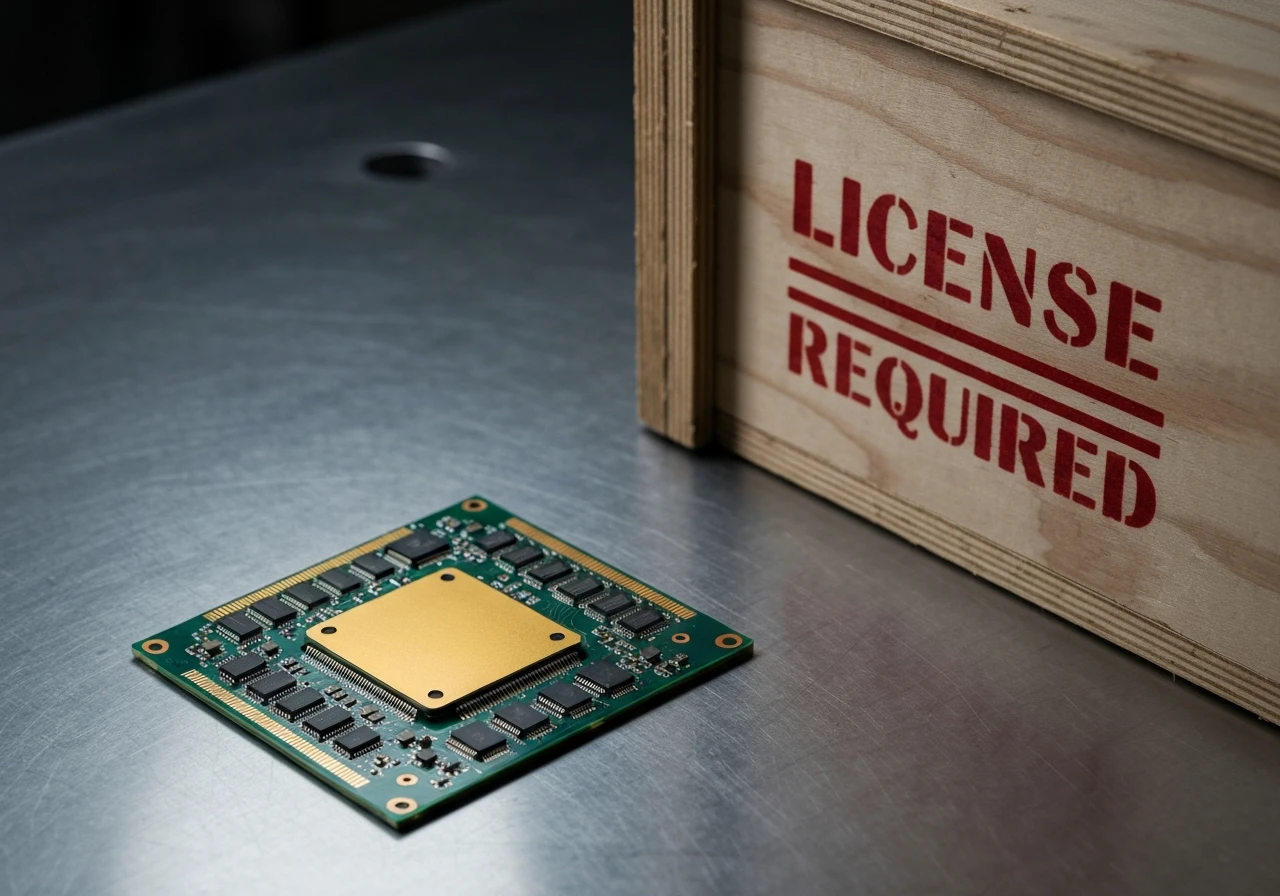
 The US Commerce Department told chipmakers on May 31 that its license rules for advanced artificial-intelligence chips travel with the buyer, not the border. Any company headquartered in China, or owned by a Chinese parent, now clearly needs a license to buy controlled processors, even when the order is placed through a subsidiary registered in Malaysia, Singapore or anywhere else outside the mainland.
That clarification shuts a gap that sat open for roughly a year. It cannot reverse the chips that already moved through it.
Commerce Reaffirms the License Wall Chinese Firms Tried To Route Around
The Bureau of Industry and Security (BIS, the Commerce Department arm that polices export controls) posted the notice on a Sunday, in answer to questions about whether it was still enforcing pre-existing rules after dropping a Biden-era framework. Its reply, in the notice itself: “The answer is yes.”
The underlying rule is not new. License requirements for the most powerful AI accelerators have been in place since 2023. What the guidance spells out is reach. The requirement attaches to any business whose headquarters or ultimate parent sits in China or Macau, and it applies worldwide, to every destination outside the United States, so a foreign address on the invoice no longer breaks the chain.
That net captures a specific tier of hardware. The processors named or swept in by the controls include:
- Nvidia’s Blackwell GPUs (graphics processing units, the chips used to train large AI models), its top current line
- Nvidia’s coming Rubin generation
- AMD’s MI350x accelerator
- Earlier high-end parts classified under the same advanced-computing export codes
You can read the language in the May 31 guidance on advanced-computing license requirements, which ties the rule to entities headquartered in, or owned by parents in, the arms-embargo country group that includes the People’s Republic of China (PRC).
How a Scrapped Framework Opened a Year-Long Window
The gap traces to May 2025. The Trump administration rescinded Biden’s Framework for Artificial Intelligence Diffusion before it took effect, calling its globe-spanning licensing regime burdensome and damaging to Washington’s diplomacy. Nvidia, among other tech firms, had attacked the framework as a threat to innovation and cross-border collaboration.
Rescinding it was the simple part. Writing replacement regulations was not. For about a year, BIS said little in public about which pre-existing requirements it was actively enforcing, and into that silence stepped a workaround. A Chinese company’s overseas subsidiary, say a unit incorporated in Malaysia, is technically located outside the mainland, so on paper it looked like a buyer the rules did not touch.
The episode fits a wider pattern of Western capitals rethinking where a Chinese parent’s ownership actually reaches, the same question that drove the UK’s move to block a Chinese-backed wind-turbine megafactory on national-security grounds. Commerce framed this week’s step the same way, publishing its own account of the rescission and the controls left standing.
The Chips That Already Shipped Cannot Be Recalled
Chris McGuire, a former State Department official who worked on technology policy under Biden, argued that the open window carried a real cost.
Chinese companies have been buying these chips, very likely at scale. And because BIS has not updated export control regulations to clearly state what it IS enforcing, all of this was legal.
That is McGuire writing on X. He welcomed the new clarity while pointing to what it quietly concedes. He added that the notice makes “Blackwell shipments to China-headquartered companies outside of China are now illegal again,” then cautioned that “we have to see how many shipments have already gone to assess how much damage was done.”
Industry estimates of the volume run high. One chip-supply-chain source quoted by reporters put the figure at hundreds of thousands of advanced chips moved during the window. The notice does not force buyers to stop using chips already acquired under the gap, which McGuire read as an admission that the shipments happened in the first place.
Nvidia, AMD and TSMC Carry the Vetting Burden
Enforcement lands on the sellers and the foundry, not the regulators alone. Nvidia, the world’s most valuable chip company, said the guidance changes nothing about how it already does business. A spokesperson said the notice “reaffirms that NVIDIA’s sales and vetting process is correct,” and that “licences are required to ship controlled products to PRC-headquartered companies.”
AMD and Intel, Nvidia’s main rivals in the GPU market, did not immediately comment. Taiwan Semiconductor Manufacturing Company (TSMC, which fabricates chips on behalf of Nvidia and others) declined to comment. For all of them, the practical task is the same: knowing the ultimate parent behind every buyer before a single accelerator ships.
That work runs through a thicket of conditions Commerce attached when it reopened limited sales earlier this year:
- 50 percent cap: shipments to China and Macau may not exceed half of a chip’s US-customer volume under the case-by-case policy
- 21,000 total processing performance ceiling for chips eligible under that review
- 6,500 GB/s total memory bandwidth limit applied alongside it
From the H200 Green Light to the Blackwell Block
The controls are not a blanket ban. They sort chips by capability, and the line keeps moving. In December, Trump cleared Nvidia to sell its H200 to approved Chinese customers, with the US government taking a 25 percent cut of those sales. The H200 is older Hopper-generation silicon, about six times as powerful as the H20 that had been the ceiling for China, yet well short of Blackwell.
Analysts split on whether that trade helps or hurts. One assessment of the H200 sales decision argued that selling China good-but-not-best hardware keeps its developers locked into Nvidia’s software while denying them the frontier, though it criticised the revenue fee as a self-inflicted tax on US firms.
Where each part now sits:
| Chip | Generation | Status for PRC-headquartered firms |
|---|---|---|
| H20 | Hopper | Previously the most advanced allowed, now superseded |
| H200 | Hopper | Case-by-case license since December, 25 percent US revenue cut |
| Blackwell | Blackwell | License required, shipments to PRC-HQ firms barred |
| Rubin | Rubin (coming) | Controlled, license required |
| MI350x | AMD CDNA | License required for PRC-headquartered buyers |
The tiering also explains why governments across Asia are racing to build their own footing. India, for one, has chosen to bet on advanced chip packaging rather than leading-edge fabrication, a hedge against exactly this kind of supply uncertainty.
Enforcement Now Rests on Audits, Not Headlines
The clarification settles the legal question. It leaves open a harder one: detection. A subsidiary’s incorporation papers in Singapore say nothing about the parent in Shenzhen unless someone checks, and Commerce leans on exporters’ know-your-customer reviews, independent testing labs and the threat of the Entity List to do that checking.
If Commerce now pairs the guidance with audits of who actually received controlled chips during the open year, the notice becomes a control with teeth. If it stays a statement without enforcement behind it, the next subsidiary is already being drafted in a lawyer’s office, and the wall Washington just rebuilt is only as tall as the parent it can trace.
 Hyderabad Gold Dip Freezes Buying as Duty Talk Hits Wedding Season
  India Pushes Japan CEPA Review After 15 Years of One-Way Gains
  HDFC Bank’s US Class Action Turns Deposit Scheme Into Securities Reckoning
  Gold Holds Above $4600 as Treasury Buybacks Fuel Debasement Bid
  Scotland’s Prevention Push Leaves Community Groups Squeezed
  Amazon Locks Three Million Nvidia GPUs Even as Trainium Grows