
 Ishan Crawford
 India buys 90 to 95 percent of the chips it uses from abroad, and the bill is climbing fast. In a roadmap released Friday, NITI Aayog, the federal government’s policy think tank, told the country to stop trying to out-build Taiwan and South Korea on the world’s most advanced chips and instead place its money where it can become impossible to replace: packaging, mature-node manufacturing and compound semiconductors. The report pegs domestic demand at more than $200 billion by 2035 and the cost of getting there at $135 billion to $180 billion.
That is the wager. Rather than spend a decade chasing a leading edge it is unlikely to reach, India would aim to own the unglamorous middle of the supply chain that every chipmaker on earth still needs. The upside is strategic leverage. The risk is that the lanes India is choosing are also the ones with the thinnest margins and the toughest incumbents.
Why NITI Aayog Wants India to Stop Chasing the Leading Edge
The core argument in the NITI Aayog semiconductor roadmap to 2035 is blunt about the futility of a head-on race. Catching the global leaders at the cutting edge, the report says, is not where India’s odds are best. Becoming the part of the supply chain nobody can route around is.
Winning the semiconductor race will not be easy if India continues to run the existing race; instead, it should shift gears and target becoming the ecosystem player that the global semiconductor industry cannot run without.
That line, from the report prepared by NITI Aayog’s Frontier Tech Hub, is the whole thesis compressed. The phrase shift gears is doing real work here. It is a concession that the most advanced logic fabs, the ones printing transistors at the smallest nodes, are out of reach for now, and a redirection toward places where India already has a foothold.
The roadmap frames the gap between soaring demand and thin domestic supply as both a danger and a window. It calls the dependence a critical strategic vulnerability and, in the same breath, a historic opportunity. The point is not modesty. It is focus. A country cannot win every layer of an industry this capital-heavy, so the report picks the layers where scale, cost and existing talent give India a fighting chance.

The $240 Billion Import Bill Behind the Pivot
The urgency is financial before it is strategic. Between FY2017 and FY2025, India spent close to $150 billion importing semiconductor products, and on current trends the annual import bill alone could hit $240 billion by 2035. For a government already wrestling with a trade deficit, that is a number with political weight.
- 90 to 95 percent of India’s semiconductor demand is met by imports today.
- $150 billion was spent on chip imports across FY2017 to FY2025.
- Domestic demand is projected to reach about $90 billion by 2030 and cross $200 billion by 2035.
- That growth runs at a compound annual growth rate (CAGR, the smoothed yearly pace) of 19 percent.
What is pulling demand up is not one sector but four moving at once. Electronics assembly keeps expanding. Data centres are being built at speed to feed cloud and artificial intelligence workloads. Cars carry far more silicon than they did a decade ago, especially electric vehicles and models with advanced driver assistance systems (ADAS, the sensor-and-software stack behind lane-keeping and automatic braking). And AI is spreading from data centres into ordinary consumer and enterprise software.
There is a security argument layered on top. The report notes that chips now sit inside defence systems, unmanned aerial vehicles and aerospace platforms, and that many of those components are still sourced abroad. With production concentrated in China and Taiwan, a single geopolitical shock or natural disaster can ripple straight into India’s military supply lines. That is the part of the import bill that does not show up in a trade ledger.
Where India Plans to Become Irreplaceable
The roadmap is specific about which lanes to drive in and which to skip. It steers spending toward mature logic and mixed-signal nodes, advanced packaging, compound semiconductors and manufacturing tied to defence and strategic infrastructure. It steers away from a vanity chase for the smallest transistors.
Packaging Over Leading-Edge Fabs
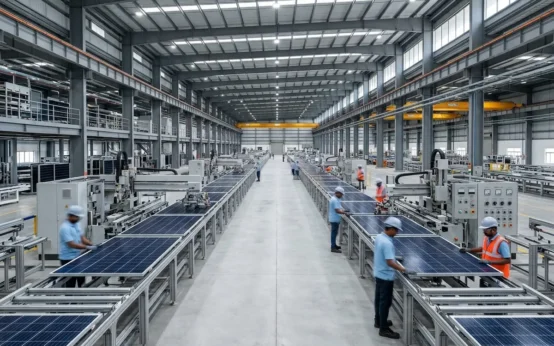
The single boldest target is to make India a top-three global destination for outsourced semiconductor assembly and test (OSAT, the back-end work of cutting, bonding and packaging finished wafers into usable chips), and for advanced packaging. As performance gains at the transistor level get harder and pricier, more of a chip’s speed now comes from how the pieces are stitched together: chiplets, and 2.5D and 3D stacking. That shift, laid out in an analysis of India’s semiconductor cluster strategy, is exactly the opening NITI Aayog wants to walk through, because packaging is labour-intensive and cost-sensitive in ways that favour India.
Compound Semiconductors and Defence Silicon
The second front is materials. The report leans on silicon carbide (SiC) and gallium nitride (GaN), compound semiconductors prized for handling high power and heat in EV drivetrains, fast chargers and radar. These are not leading-edge logic, so the brutal cost curve of the smallest nodes does not apply, yet demand is rising sharply. Pair that with mission-critical fabrication for defence and aerospace, and India gets a portfolio it can defend on cost and on sovereignty rather than on raw transistor density.
| Lane | NITI Aayog stance | Why |
|---|---|---|
| Leading-edge logic fabs | Avoid for now | Capital cost above $15 billion per fab, incumbents years ahead |
| Advanced packaging and OSAT | Target top-three globally | Cost-sensitive, labour-intensive, rising share of chip value |
| Mature and mixed-signal nodes | Build scale | Steady demand from autos, industrial and consumer goods |
| SiC and GaN compound chips | Prioritise | Power and EV demand, no leading-edge cost wall |
The Money: $135 Billion to $180 Billion and Five Pillars
None of this is cheap, and the report does not pretend otherwise. Semiconductor manufacturing is among the most capital-intensive industries anywhere. An analogue fabrication plant can run past $5 billion; an advanced-node fab can cost more than $15 billion. Across the decade, NITI Aayog estimates India needs $135 billion to $180 billion in capital spending on fabs, packaging, design and the wider ecosystem.
To keep private investors from balking, the report wants government to carry at least a third of that, roughly $45 billion to $60 billion, to de-risk the early projects. It also presses for a single-window clearance and fast-track approvals, and for steady, predictable incentives rather than start-stop schemes. The strategy is organised around five pillars:
- Pioneering: stronger design and research, with AI woven into chip engineering and a unified platform linking silicon, package and system design.
- Policy and Investment: government co-funding, single-window clearance and stable incentives.
- Production: selective bets on packaging, mature nodes, critical materials and strategic manufacturing.
- People: a National Fab Academy, a semiconductor-focused engineering curriculum and large-scale technician training.
- Partnership: deeper ties with the United States, Japan, South Korea and the European Union.
If it lands, the payoff the report sketches is a value chain worth $120 billion to $150 billion by 2035, around 10 to 13 percent of the global market, and self-sufficiency covering 35 to 50 percent of domestic chip demand. That last figure is the honest part. Even the optimistic case leaves India importing roughly half its chips a decade from now.
Twelve Plants Already Approved, From Micron to Tata
The bet is not starting from zero. As of early May, the Union Cabinet had cleared 12 semiconductor facilities across six states, with cumulative investment near ₹1.64 lakh crore (about $20 billion), according to the India Semiconductor Mission’s approved-projects record. The first of those is already running.
| Project | Location | Type | Status |
|---|---|---|---|
| Micron Technology | Sanand, Gujarat | Assembly and packaging (ATMP) | Operational, inaugurated February |
| Tata-PSMC | Dholera, Gujarat | 50,000 wafers-per-month fab | Under construction |
| Kaynes Technology | Sanand, Gujarat | OSAT | Approved |
| CG Power-Renesas | Sanand, Gujarat | OSAT | Approved |
Micron Technology, the US memory chipmaker, opened its ₹22,516 crore (about $2.7 billion) assembly, test, marking and packaging (ATMP) plant in Sanand in February, the first finished facility of this mission cycle. Tata Electronics is building a wafer fab at Dholera with partner Powerchip. The mix is telling: the marquee names cluster in packaging and mature manufacturing, exactly the lanes the new roadmap doubles down on.
The policy backdrop is shifting too. The Union Budget for 2026-27 set aside Rs 8,000 crore (about $960 million) for the semiconductor mission, its largest single-year outlay yet, alongside India Semiconductor Mission 2.0 (ISM, the government programme funding chip plants), which tilts support toward equipment, materials and design intellectual property rather than just attracting fabs.
Thin Margins, a Talent Shortfall and a China-Taiwan Wall
The case against the bet is not that the lanes are wrong. It is that they are crowded and unforgiving. Packaging looks accessible precisely because the economics are tight, and India is arriving late to a table where the seats are taken.
- Margins are thin. OSAT operating margins run in the single digits; ASE, the world’s largest packaging firm, has reported quarterly operating margins around 7 percent. Scale, not pricing power, is the only path to profit.
- The talent gap is wide. India graduates hundreds of thousands of engineers a year, but only a small fraction have fab-ready skills, and industry estimates point to a shortfall of 250,000 to 300,000 specialists by 2027. The National Fab Academy is a response, not yet a fix.
- Incumbents hold the field. Taiwan and China together control roughly three-quarters of the global OSAT market. A top-three target means taking share from entrenched players who already run at scale.
There is also a structural drag the report acknowledges only obliquely. India still lacks a deep base of local foundries, so packaging plants may have to ship wafers in and finished chips out, adding logistics cost to an already low-margin business. The 2026 global semiconductor industry outlook points to AI-driven demand as the tide lifting the whole sector, which helps any new entrant, but a rising tide does not erase a cost handicap.
So the roadmap is a genuine fork. If the packaging and compound-chip push hits scale before the talent gap and margin math bite, India ends the decade as a node the global supply chain has to route through, with half its own demand covered at home. If the money arrives slowly, the skills lag and the incumbents hold their share, the same plan delivers a respectable supplier that still writes a $200-billion-plus demand cheque mostly to foreign fabs. The report has chosen the gear. Whether the engine pulls is the question the next ten years answer.
 ONGC licence frees Venezuela cash and operatorship talks
  Anthropic Hits $65 Billion Run Rate and Flips the AI Cash Test
  Supreme Court grounds the fare free-for-all with three-week clock
  Gold Nears $4400 as Soft Data Meets Oil Inflation Risk
  Nifty Slips as Zaggle Circuits and Dhoot Debuts Big
  Diesel Crack Tops $100 as Iran Rhetoric Lifts Crude