
 Ishan Crawford
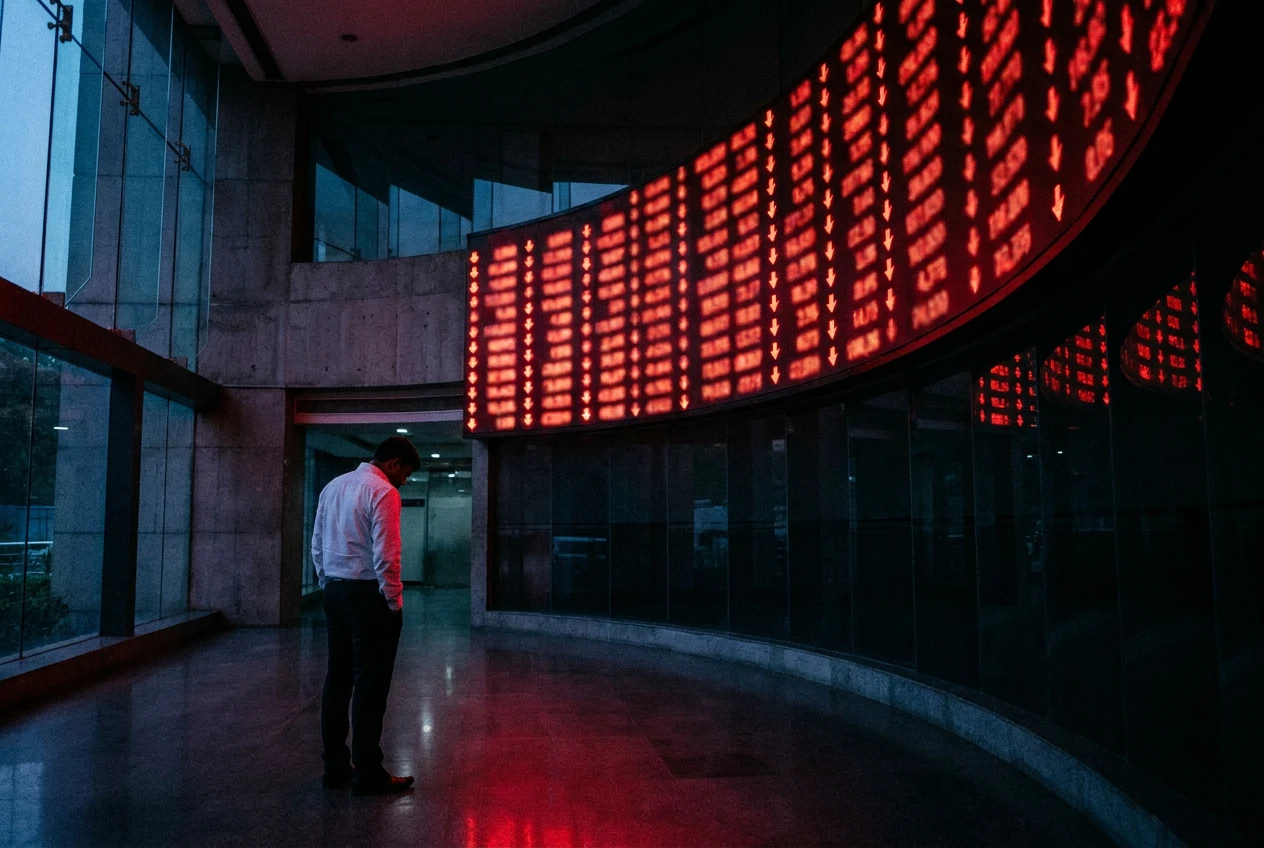
 Indian equities closed May with a thud. The BSE Sensex shed 1,092 points, or 1.44 per cent, to settle at 74,775 on Friday, while the Nifty 50 dropped 359 points, or 1.50 per cent, to 23,547, a near-300-point slide in the final half hour wiping out what had been a positive session. The trigger was not a fresh shock but a date circled weeks earlier: the May 2026 reshuffle of the MSCI Global Standard Index (the benchmark that index-tracking foreign funds mirror, run by Morgan Stanley Capital International), which pushed an estimated $800 million to $1 billion, roughly 9,000 crore rupees, out of Indian stocks at the close.
Strip out that one-off selling and the day looks calmer than the headline number suggests. Domestic institutions stepped in with their heaviest single-session buying on record to absorb the foreign exit, and the stocks shuffled in and out reflected index plumbing rather than any verdict on company earnings. The worry that should outlast Friday sits in a monsoon forecast that just got trimmed.
The Mechanical Event Behind the Headline Number
An MSCI rebalancing is housekeeping, not a referendum. Twice a year, in May and November, the index provider runs a comprehensive review of which stocks qualify for its benchmarks, screening on size, free float and trading liquidity. The changes are published about two weeks ahead, then take effect at a single closing bell. This one landed at Friday’s close.
Because trillions of dollars in passive funds track these indices, every adjustment forces mechanical buying and selling on the effective day, whether or not anything has changed at the underlying companies. India’s weight in the Standard index barely moved, easing to about 12.3 per cent from 12.4 per cent, with the constituent count steady at 165. Four names went in, four came out, and the damage was broad but shallow beyond the index heavyweights: the Midcap 100 fell 1.33 per cent and the Smallcap 100 slipped 0.85 per cent. Heavy selling in Reliance Industries, down more than 1.6 per cent, and ITC, off over 3 per cent, alongside softness in HDFC Bank and ICICI Bank, deepened the late slide.
The pressure intensified during the final hours of trade after the MSCI Global Standard Index rebalancing came into effect, triggering heightened volatility in select stocks amid expected passive fund flow adjustments.
That was Siddhartha Khemka, head of research at Motilal Oswal Financial Services, describing the close. The point analysts kept stressing is that the flows were known in advance, telegraphed on MSCI’s semi-annual index review calendar, and crammed into a few minutes of trading.
Domestic Funds Bought What Foreigners Dumped
The standout was who took the other side. Foreign portfolio investors (FPIs, overseas funds that hold listed Indian shares) were net sellers of more than 20,000 crore rupees in the cash market, the largest single-day foreign outflow on record. Domestic institutional investors (DIIs, the mutual funds, insurers and pension money managed within India) countered with net buying north of 16,000 crore rupees, their biggest one-day purchase ever logged.
That tug of war showed up in volumes. NSE cash-market turnover hit a record near 2.87 trillion rupees, eclipsing the previous high of 2.71 trillion set in June 2024 and more than doubling the prior session’s activity. You can track the running tally on the exchange’s own daily FII and DII cash-market activity report.
- 20,000 crore rupees plus in net FPI selling, a record single-day foreign outflow.
- 16,000 crore rupees plus in net DII buying, the largest one-day domestic purchase on record.
- 2.87 trillion rupees in NSE cash turnover, an all-time high.
The split matters because it tells you how much of Friday was forced and how much was conviction. When a benchmark change hands one investor’s sell order to another investor’s buy order at the same bell, the index can fall hard while ownership simply rotates from passive foreign money to active domestic money. That is closer to what happened than a stampede for the exits.
It also explains the record turnover without a record collapse: the heaviest selling ever met the heaviest buying ever, and the index gave up 1.5 per cent rather than something worse.
Four Stocks In, Four Stocks Out
The reshuffle added four mid-cap names with improving investibility scores and dropped four that no longer cleared the size or liquidity screens. None of it reflects a downgrade of the businesses themselves; the next MSCI dates are already set out in the schedule of upcoming index review announcements.
| Stock | Action | Estimated passive flow |
|---|---|---|
| Federal Bank | Added | ~$491 million inflow |
| MCX | Added | ~$373 million inflow |
| NALCO | Added | ~$308 million inflow |
| Indian Bank | Added | ~$209 million inflow |
| Rail Vikas Nigam | Removed | Passive outflow |
| Kalyan Jewellers | Removed | Passive outflow |
| Jubilant FoodWorks | Removed | Passive outflow |
| Hyundai Motor India | Removed | Passive outflow |
Federal Bank drew the largest estimated inflow of the new entrants, near $491 million, while Hyundai Motor India, listed only in late 2024, was among the deletions. Each removed stock faced concentrated selling on the day even though its earnings outlook had not changed overnight.
Monsoon Math Is the Worry the Rebalancing Masked
Once the passive noise clears, the fundamental question waiting for traders is whether it will rain enough this summer. That worry got louder on Friday for reasons that had nothing to do with index plumbing.
A Forecast Trimmed to 90 Per Cent
The India Meteorological Department (IMD, the national weather agency) cut its 2026 southwest monsoon outlook to 90 per cent of the Long Period Average (LPA, the 50-year benchmark for seasonal rainfall), down from an earlier estimate of 92 per cent, citing rising El Nino risk. You can follow the agency’s updates through the IMD’s long-range monsoon outlook.
That two-point trim sounds small, but 90 per cent sits at the edge of what forecasters class as a below-normal season. For an economy where a large slice of the workforce still depends on farm income and reservoir levels, the gap between a normal and a deficient monsoon is the difference between cooling food prices and rising ones.
Why Food Prices Spook the Street
Food is the swing factor in India’s headline inflation, so a weak monsoon feeds straight into the number the central bank watches most closely. A bad harvest can push vegetable, pulse and cereal prices higher within weeks, squeezing household budgets and complicating any case for cheaper money.
“The prospect of deficient rainfall…has heightened fears of elevated food inflation in the coming months,” said Vinod Nair, head of research at Geojit Investments, summing up why the IMD revision rattled an otherwise technical session.
The Cross-Currents Cutting the Other Way
Not everything pointed down. Several macro signals actually improved on Friday, which is part of why the headline fall flatters the gloom.
- Rupee: appreciated 69 paise to below 95.20 against the dollar, its strongest single-day gain since April 2, aided by softer crude.
- Crude oil: fell more than 1.5 per cent to below $88 a barrel, and is now down over 17 per cent across May.
- IT stocks: the lone sectoral gainer, up over 2 per cent, lifted by overnight US technology strength and the weaker rupee.
- Gold: MCX gold slipped about 950 rupees to 1,55,975 rupees per 10 grams, while COMEX gold edged higher near $4,526.
The information technology rally had a company-specific kicker. TCS, the country’s largest software exporter, stayed in focus after denying reports that it had lost a major client mandate in Canada, which steadied sentiment across the sector.
Markets had even opened firm, on reports that the United States and Iran reached a preliminary deal to extend their ceasefire by 60 days and ease shipping through the Strait of Hormuz. The Nifty briefly touched 24,002 before selling at that round number flipped the session.
RBI and the 23,700 Line Set the Range
Where the index goes next hinges on two things, one scheduled and one technical. The Reserve Bank of India’s Monetary Policy Committee (RBI MPC, the panel that sets interest rates) meets from June 3 to 5, with the repo rate widely expected to stay at 5.25 per cent.
Chart traders, meanwhile, are fixed on one level. The Nifty closed below its 50-day simple moving average (SMA, the rolling average of the last 50 closes) of 23,700, a line many treat as the boundary between recovery and further weakness.
“As long as Nifty trades below the 50-day SMA of 23,700…the weak sentiment is likely to continue,” cautioned Amol Athawale of Kotak Securities, who flagged 23,300 to 23,000 as the next support band. On a weekly basis the Nifty still ended only 0.72 per cent lower, a reminder that the drama was concentrated in a single session.
If domestic buying keeps pace once the rebalancing flows wash out and the RBI holds steady, Friday reads as a technical air pocket. If the monsoon outlook slips again and food prices start to climb, the selling that looked mechanical on Friday begins to look fundamental.
Frequently Asked Questions
What caused the Sensex to fall over 1,000 points on May 29, 2026?
The main driver was the May 2026 MSCI Global Standard Index rebalancing, which forced an estimated $800 million to $1 billion of passive foreign selling at the close. Weakness in heavyweights such as Reliance Industries and ITC, plus a downgraded monsoon forecast, added to the slide even after markets opened higher on a US-Iran ceasefire extension.
How much money left Indian stocks due to the MSCI rebalancing?
India-specific passive outflows were pegged at $800 million to $1 billion, while total passive flows from the broader May rebalance, counting both inclusions and exclusions, exceeded $1.6 billion. Net FPI selling in the cash market topped 20,000 crore rupees, a single-day record.
Which stocks were added to and removed from the MSCI Standard Index?
Federal Bank, MCX, NALCO and Indian Bank were added, while Rail Vikas Nigam, Kalyan Jewellers, Jubilant FoodWorks and Hyundai Motor India were removed. India’s overall weight in the index was little changed at about 12.3 per cent, with 165 constituents.
What is the RBI expected to do at its June 2026 meeting?
The RBI Monetary Policy Committee meets from June 3 to 5, and the repo rate is widely expected to be held at 5.25 per cent. A weaker monsoon and the food-inflation risk it carries are likely to keep the committee cautious about any future cuts.
Will the market recover after the MSCI rebalancing selloff?
Rebalancing flows are a one-day mechanical event, so the forced selling itself does not repeat. Traders are watching the Nifty’s 50-day average near 23,700; a sustained move back above it would signal recovery, while 23,300 to 23,000 is flagged as the next support if weakness persists.
Disclaimer: This article is for informational purposes only and does not constitute investment advice. Equity markets carry risk, and index figures, flow estimates and forecasts can change quickly. Consult a qualified financial adviser before making investment decisions. All figures are accurate as of publication on May 30, 2026.
 ONGC licence frees Venezuela cash and operatorship talks
  Anthropic Hits $65 Billion Run Rate and Flips the AI Cash Test
  Supreme Court grounds the fare free-for-all with three-week clock
  Gold Nears $4400 as Soft Data Meets Oil Inflation Risk
  Nifty Slips as Zaggle Circuits and Dhoot Debuts Big
  Diesel Crack Tops $100 as Iran Rhetoric Lifts Crude