
 Ishan Crawford
 Around 100 volunteers in Scotland have hand-collected more than 11 million native tree seeds in three years, smashing their original one-million target elevenfold. The haul is expected to grow nearly 7.8 million native trees for a rainforest that is disappearing faster than most people realize.
Trees for Life and Woodland Trust Scotland announced the milestone on June 29, calling it one of the largest citizen-led reforestation efforts anywhere. The seeds themselves solve only one part of a costlier problem: Scotland’s Atlantic rainforest has shrunk to about 30,000 hectares, and the wider campaign to save it is still short hundreds of millions of pounds.
Volunteers Blow Past Their Million-Seed Target Elevenfold
The Tree Seed Collection Project launched in August 2023 with a modest goal: gather one million native tree seeds over three years to help rebuild Scotland’s native woodlands. Instead, around 100 volunteers, retired teachers, doctors, office workers, students and young families among them, have gathered more than 11 million rare tree seeds by hand.
Much of the work happened far from any road. Volunteers hiked for hours into isolated ancient woodlands, working from habitat maps prepared by NatureScot and Scottish Forestry to find seed-bearing trees on steep hillsides that commercial contractors avoid because of cost and terrain. Collection hubs stretched from Lochgilphead and Oban to the Morvern peninsula, Loch Arkaig, Skye and the Western Isles. Trees for Life also paired the volunteer network with montane and niche tree species specialists to keep identification accurate in mixed woodland.
They carried bags, poles and identification guides, taking seed directly from healthy trees while leaving enough behind for natural regeneration. It is slow, physical work, and it produced eleven times what anyone expected.
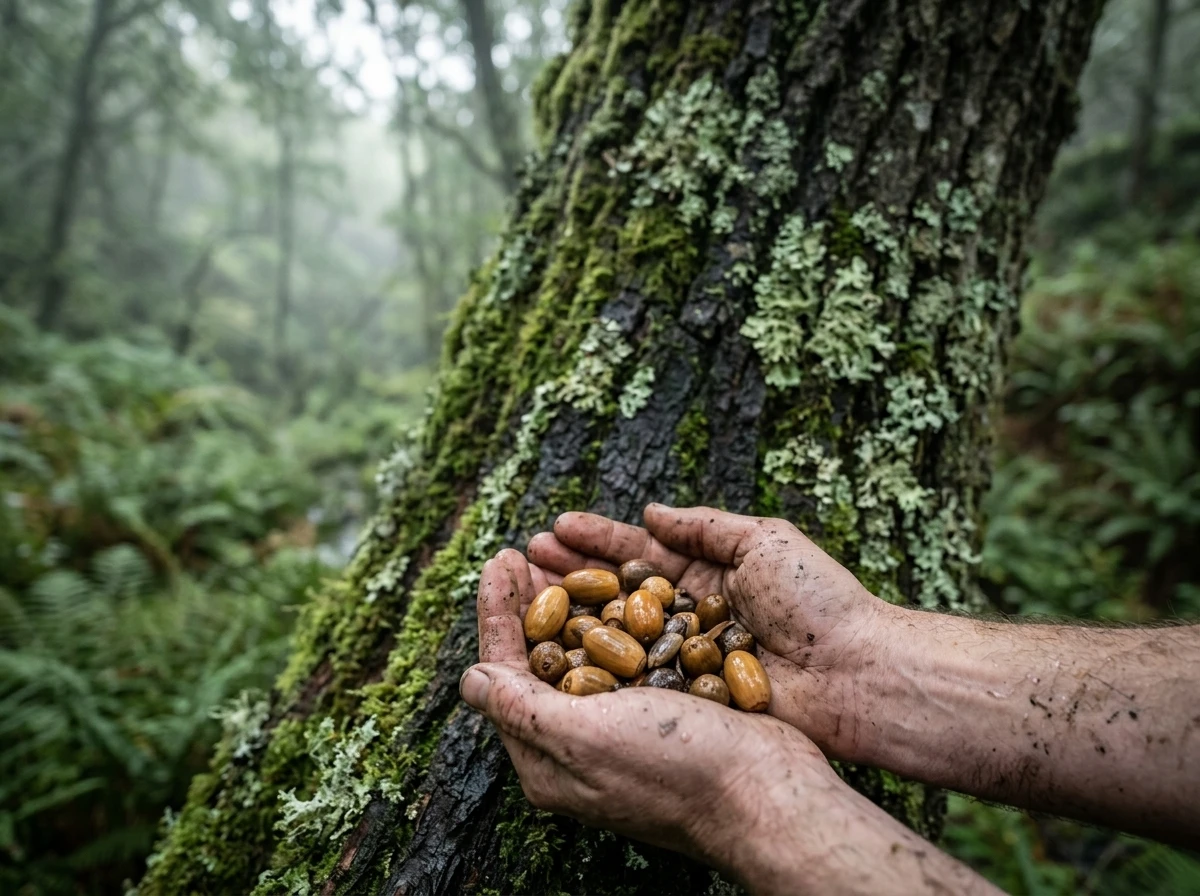
The Ice Age Genetics Packed Into Every Seed
Location is the whole point. Seeds gathered from Scotland’s west coast and its islands carry genetic traits shaped since the last Ice Age, adaptations that helped these trees survive some of the wettest, windiest conditions in Europe. Trees grown from that stock tend to survive better once replanted, which matters as diseases like ash dieback and a warming climate put more pressure on native woodland.
The project targeted ten species that are hard to find and even harder to reach: sessile oak, hazel, dwarf birch, willow, juniper, birch, wild cherry, wych elm, yew and elder. Scotland has long had a shortage of trees grown from traceable local seed, especially along the west coast, leaving restoration projects reliant on stock bred elsewhere and less suited to local conditions.
“It’s a privilege to coordinate this project,” said Roz Birch, the Tree Seed Collection Project Officer at Trees for Life. Birch has said the project addresses a severe shortage of native trees with traceable local origin, particularly from the west coast.
What Makes Scotland’s Atlantic Rainforest So Rare?
Scotland’s Atlantic rainforest, sometimes called its temperate or Ice Age rainforest, is a globally scarce habitat of moss-carpeted, lichen-draped woodland found only where Atlantic moisture and mild winters meet ancient tree cover. It survives today in scattered fragments along the west coast, which is why this restoration effort matters well beyond Scotland’s borders.
Despite its reputation for wild scenery, Scotland is one of Europe’s least-wooded countries. The numbers are stark.
| Measure | Scotland Today | Why It Matters |
|---|---|---|
| Overall tree cover | 18% of land | Europe’s average is 37% |
| Native woodland | About 4% of land | Puts Scotland among the world’s most nature-depleted countries |
| Ancient Caledonian forest | Less than 2% of historic range | Highland habitat for red squirrels, capercaillie and crossbills |
| Atlantic rainforest | About 30,000 hectares | Roughly the size of Edinburgh; over half of it in poor condition |
The largest and highest-quality fragments cluster around the sea lochs of Lochaber, Lorne and Mid Argyll, where damp bark supports rare mosses, liverworts and lichens found almost nowhere else on the planet. NatureScot estimates the habitat is small enough to fit inside Edinburgh’s boundaries yet still captures up to one million tonnes of carbon dioxide every year, on top of preventing flooding and soil erosion downstream.
From Hillside to Nursery Tray
Getting a seed from a remote hillside into the ground somewhere else takes months. The route is consistent, whatever the species:
- Volunteers hike into targeted woodland using habitat maps built by NatureScot and Scottish Forestry to locate healthy, seed-bearing trees.
- They hand-pick seed with bags, poles and identification guides, always leaving enough behind for the tree to regenerate naturally.
- Batches travel to Trees for Life’s Dundreggan Rewilding Estate in Glenmoriston, near Loch Ness, where staff inspect, clean and grade every lot.
- Seed is distributed to more than 20 nurseries enrolled in the Woodland Trust’s UK and Ireland Sourced and Grown Assurance Scheme.
- Saplings return to planting sites matched to their original collection area, so each tree grows where its genetics already fit.
“You’re literally growing the future,” Laura Corbe, a marine biologist and one of the volunteers, told the Guardian. She added that few people grasp what is at stake, even those who have lived beside the rainforest their whole lives.
The Bigger Restoration Machine These Seeds Feed
The eleven million seeds are one piece of a much larger campaign. Trees for Life and Woodland Trust Scotland are two of more than 25 organizations in the Alliance for Scotland’s Rainforest, a coalition spanning land-reform charities, landowner groups and botanical gardens. Separately, both charities back the Scottish Rewilding Alliance’s call for Scotland to become the world’s first declared Rewilding Nation, committing nature recovery across 30 percent of the country.
Government money has been catching up gradually, in stages:
- August 2023: Trees for Life and Woodland Trust Scotland launch the Tree Seed Collection Project with a target of one million seeds over three years.
- December 2024: The Scottish Government pledges further support for rainforest recovery, pushing its own investment since 2023 toward almost £10 million for rainforest restoration work.
- January 2026: NatureScot’s Rainforest Restoration Fund shares £1.76 million among ten projects working to clear invasive rhododendron and manage deer.
- June 2026: Trees for Life and Woodland Trust Scotland confirm the seed project has passed 11 million seeds and secured funding for at least a fourth year.
Julie Stoneman of the Alliance for Scotland’s Rainforest said the coalition still has ambitious targets ahead of it. “We still have a long way to go,” she said, even as new funding rounds land. A separate NatureScot review of large landscape restoration projects found they typically deliver green jobs, education programmes and nature tourism alongside the trees, though funding still arrives in smaller, shorter bursts than most projects need.
The £500 Million Problem Seeds Alone Can’t Fix
Two problems keep undoing the progress volunteers make: deer grazing that strips young growth before it can establish, and rhododendron ponticum, an invasive shrub that smothers native woodland floor across much of the west coast. Both require sustained, expensive management rather than a one-time fix.
A working group that included the Argyll and the Isles Coast and Countryside Trust, Palladium, Sylvestris Land Management and advisers at Saffery recently tested whether private money could close the gap. Public funding alone, they found, leaves an estimated £500 million shortfall for nature restoration and biodiversity work in Scotland between now and 2045, or roughly $630 million at current exchange rates, according to an analysis of the rainforest’s financing gap.
Ashley Gillan, a project developer who worked on the plan, said it needs what she called “one high integrity anchor buyer” for rainforest carbon credits, plus at least one landowner willing to go first. No landowner or anchor buyer had signed on to that role as of the group’s latest update.
A Fourth Year Begins With Millions of Trees Still to Plant
The seed project’s success bought it more time. Funders including Postcode Lottery players through Woodland Trust Scotland, Trees for Life’s Big Give Earth Raise Appeal and Wild Seed Appeal, the BrITE Foundation and the Clean Planet Foundation have committed to at least a fourth year of collecting.
That extra year matters because collecting seed is the easier half. Nearly 7.8 million saplings still need to be grown, matched to a planting site and put in the ground, a process that will play out over years, not months.
“Collecting these precious tree seeds is about hope,” Birch said. “It’s about committing to a better future for ourselves and for future generations, and for Scotland’s biodiversity.”
For now, the milestone stands at more than 11 million seeds, gathered by hand, from trees that have survived in place since the ice retreated.
Frequently Asked Questions
How Can Someone Volunteer to Collect Tree Seeds in Scotland?
Trees for Life recruits seed collectors aged 18 and over across hub areas that include Lochgilphead, Oban, the Morvern peninsula and the Western Isles. No prior expertise is required; volunteers get training in tree identification and seasonal monitoring before heading out with an experienced coordinator.
Why Can’t Commercial Contractors Just Collect These Seeds Instead?
Most of the target sites sit on steep, exposed terrain that commercial seed collectors consider too costly or too risky to reach. That is precisely why the project exists: it targets species and locations the regular seed trade skips, which is also why the genetic stock it gathers is so hard to replace elsewhere.
Is Scotland’s Atlantic Rainforest Actually Like the Amazon?
Not quite. Scotland’s rainforest is temperate and coastal, kept wet by heavy Atlantic rainfall and mild by the Gulf Stream, unlike a tropical rainforest’s heat and humidity. Conservationists only began branding these woodlands as Atlantic Oakwoods under the Scotland’s Rainforest name in recent years, a rebrand credited with building public support for restoring them.
Which Other Groups Are Working to Save Scotland’s Rainforest?
The Alliance for Scotland’s Rainforest brings together more than 25 organizations, ranging from land-reform charities to landowner representatives and botanical gardens. Trees for Life and Woodland Trust Scotland also sit inside the separate Scottish Rewilding Alliance, which wants Scotland declared the world’s first Rewilding Nation.
What Usually Slows Down Large-Scale Nature Restoration Projects in Scotland?
A review of 25 case studies from Scotland and elsewhere in Europe, carried out for NatureScot, found that limited access to long-term funding, complex land ownership and occasional local opposition were the most common barriers, alongside the ongoing cost of managing deer numbers.
 ONGC licence frees Venezuela cash and operatorship talks
  Anthropic Hits $65 Billion Run Rate and Flips the AI Cash Test
  Supreme Court grounds the fare free-for-all with three-week clock
  Gold Nears $4400 as Soft Data Meets Oil Inflation Risk
  Nifty Slips as Zaggle Circuits and Dhoot Debuts Big
  Diesel Crack Tops $100 as Iran Rhetoric Lifts Crude