
 Ishan Crawford
 A Hamilton court built to divert addicts from prison has cut local drug deaths by up to 17% in its first two years, according to a newly completed evaluation. The Alcohol and Drug Problem Solving Court (ADPSC), launched at Hamilton Sheriff Court in December 2023, is Scotland’s first to treat drug and alcohol dependency together rather than send people straight into custody.
The result lands as Scotland’s prisons run well beyond the numbers they were designed for, and as the country still records the highest drug death rate in Europe. Full-term data from the pilot’s independent evaluation show it kept dozens of people in treatment instead of cells, even as the wider system buckles.
Hamilton’s Dual Recovery Court Finishes Its Two-Year Test
South Lanarkshire Justice Social Work and North Lanarkshire Justice Social Work built the court together, each running its own team under one roof at Hamilton Sheriff Court. South Lanarkshire operates through its Recovery Orientated Justice Service (ROJS), while North Lanarkshire runs a Structured Deferred Sentence Team. Both accept only Lanarkshire residents whose offending is tied to substance use.
Funding came through the Corra Foundation’s Drugs Mission grant, and a University of the West of Scotland review tracked the pilot from December 2023 through December 2025.
By November 2025, the two teams had placed 105 people on structured deferred sentences (SDS), a court order that pauses sentencing while someone completes a recovery plan under Section 202 of the Criminal Procedure (Scotland) Act 1995. Forty four had completed their SDS, and 16 of those walked away with their charge admonished, wiped clean rather than punished. Thirty seven were still enrolled, and 24 had the order revoked.
To qualify, someone had to meet a specific set of conditions:
- Live in South or North Lanarkshire
- Be between 25 and 55 years old
- Be assessed as at risk of a custodial sentence
- Have an alcohol or drug dependency directly linked to their offending
Its own evaluator did not expect much from the experiment.
I was sceptical this new initiative would have any real lasting effect or success. I could not have been more wrong.
Dr Robert McLean, a criminal justice lecturer at the University of the West of Scotland who has spent over a decade researching the country’s drug harms and gang violence, wrote that verdict after running the pilot’s independent evaluation.
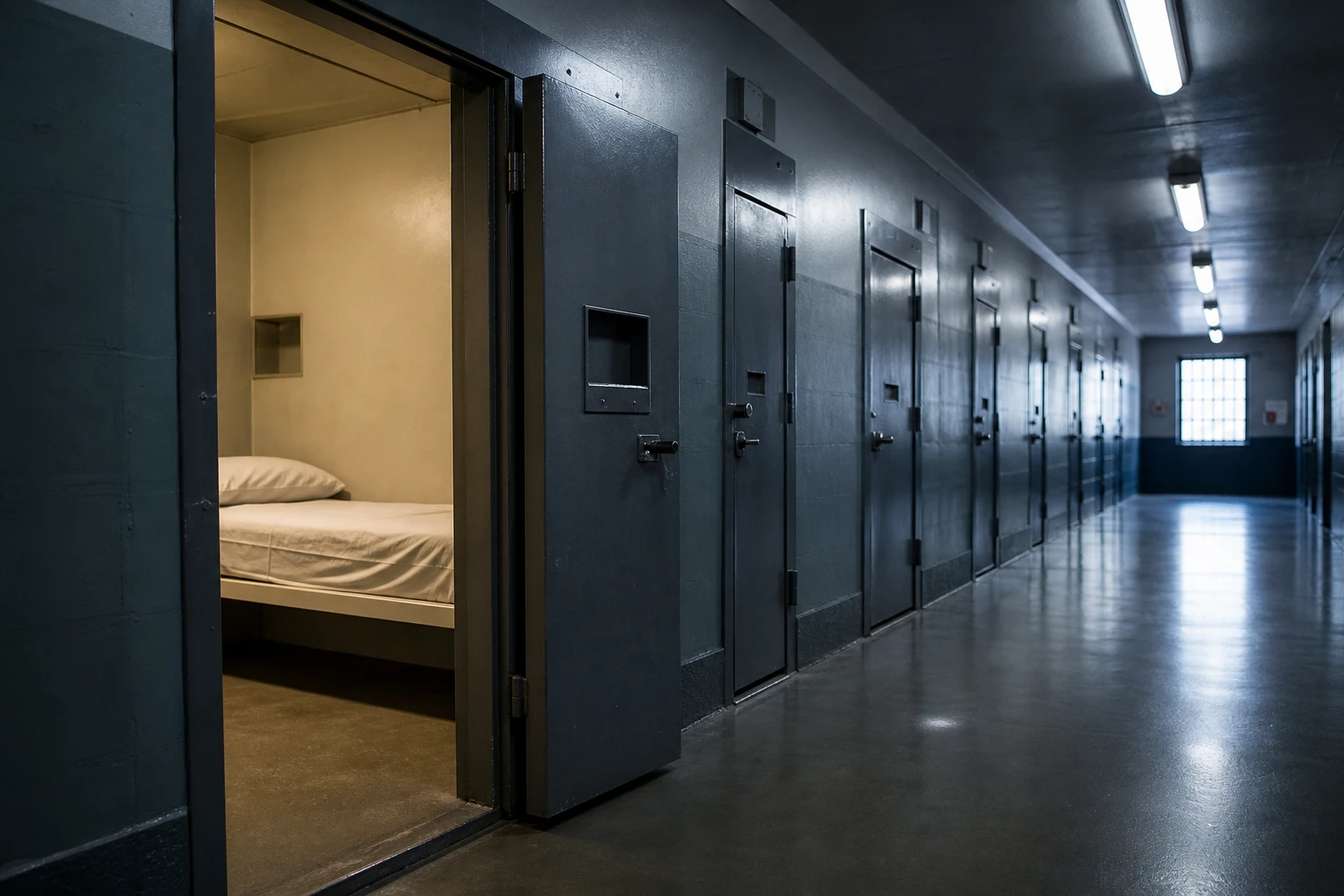
Scotland’s Prisons Blow Past Their Design Limit
The pilot’s numbers land against a backdrop of record crowding. Scotland’s prison population hit an all-time high of 8,441 people on 11 November 2025, and government modelling expects it to keep climbing.
Scotland’s prisons were designed to hold about 7,805 people, prison authorities say, and the system has run above that mark for months. As of late January 2026, eight prisons were flagged red for capacity risk and 15 more sat at or close to their ceiling, Cabinet Secretary for Justice Angela Constance told the Scottish Parliament, with the population that day standing at 8,301.
Ministers have already shifted the automatic release point for short-term prisoners from 50% of a sentence to 40%, and are now consulting on cutting it again to 30%. A second wave of emergency releases has also been running since November 2025. None of it is projected to bring the population down for long. Government modelling expects the daily average to sit between 8,200 and 8,800 by the end of July 2026, barely below where it stood in February.
How Bad Is Scotland’s Drug Death Crisis?
Scotland recorded 1,017 drug misuse deaths in 2024, a 13% drop from 2023 but still the highest rate anywhere in Europe. Opioids were involved in about four in five of those deaths, and the country has held the continent’s worst drug death rate for seven years running, according to the addiction charity Cranstoun.
The age profile has shifted too. The average age of a drug misuse death has climbed from 32 in 2000 to 45 in 2024, and men are more than twice as likely to die as women. People in Scotland’s most deprived areas are twelve times more likely to die of drug misuse than those in the least deprived, National Records of Scotland data show.
“We must all take a moment to pause and reflect on the stark reality of this report,” said Dr Tara Shivaji, a consultant at Public Health Scotland, reflecting on the 2024 figures. Deaths involving nitazenes, a class of synthetic opioids far more potent than heroin, jumped from 23 in 2023 to 76 in 2024, a 230% increase that alarmed campaigners.
| Area | Drug Deaths, 2024 | Change vs 2023 | Alcohol Deaths, 2024 |
|---|---|---|---|
| Scotland (national total) | 1,017 | Down 13% (155 fewer) | 1,185 (down 7%) |
| South Lanarkshire | 64 | Down from 71 in 2023 | 75 (5th-highest in Scotland) |
| North Lanarkshire | Among the steepest declines nationally | Down 18 deaths | 101 (2nd-highest in Scotland) |
Those local totals are exactly the numbers the Hamilton pilot was built to move.
Two Decades of Scottish Courts Betting on Treatment
Hamilton’s court did not invent the idea. Scotland’s first problem-solving court opened in Glasgow in 2001, routing people through Drug Treatment and Testing Orders under a dedicated multi-disciplinary team and regular judicial check-ins. Edinburgh followed with a dedicated Alcohol Court in 2013.
By 2010, the Criminal Justice and Licensing (Scotland) Act let every court in the country hold regular progress reviews for anyone serving a Community Payback Order, spreading problem-solving principles well beyond the specialist sites.
The international evidence backing the model is strong, but not uniform. A review of the research, run by the London-based Centre for Justice Innovation, found adult drug courts reliably cut substance misuse and reoffending, with the strongest gains among people most likely to reoffend. The same review found the opposite for young offenders, with juvenile drug courts showing minimal or even harmful effects.
Not everyone in the field draws the same conclusion from that evidence:
- The Centre for Justice Innovation and Scotland’s own justice ministry point to strong international evidence that adult drug courts cut reoffending, improve compliance and save the state money.
- Erin Collins, a law professor at the University of Richmond, has argued that problem-solving courts often resist evidence that challenges their founding assumptions, including the abstinence-only treatment model many were originally built on.
- Evaluators of youth-focused drug courts have found the opposite result to adult courts, reporting minimal or harmful effects on people under 18.
The Cases That Don’t Make It Through
Not every case ends in recovery, and the people running Hamilton’s court have stopped pretending otherwise. Sheriffs, social workers and recovery staff quickly found that success meant different things to different people coming through the door.
Success meant finishing the order clean for some, an admonished charge for others, and for a few, something quieter: drinking less, or speaking to an estranged family member for the first time in years. One participant told researchers evaluating the pilot, “For me alcohol is the solution,” a line that stuck with the evaluation team, who came to see addiction less as the core problem and more as an answer to older pain.
The evaluation flagged real strain too. Caseloads have skewed toward people with increasingly complex, entrenched addiction and offending histories, which makes plain completion rates a shakier measure of success over time. Housing shortages and gaps in mental health support came up repeatedly in interviews with staff and service users.
A year into the pilot, South Lanarkshire alone had referred 18 residents, and 80% of them were still following their support plans a year later, Community Justice Scotland reported. That combined caseload across both council areas had grown to 105 by the time the full pilot closed in December 2025.
South Lanarkshire Makes Its Recovery Court Permanent
South Lanarkshire Council has already moved to keep its half of the experiment running past the pilot. Councillors made the Recovery Orientated Justice Service a permanent service, and the wider initiative won the Integrated Care Award at the 2024 Scottish Health Awards.
“Drug and alcohol related deaths and crime are a blight on individuals, families, and communities across Scotland,” said Professor Soumen Sengupta, chief officer for health and social care at South Lanarkshire Council.
South Lanarkshire’s own Justice Social Work objectives, tracked across the pilot, show why the council is committing further:
- 100% of service users were connected to employment, housing or health and welfare support.
- 90% received medically assisted treatment or recovery plans alongside community recovery networks.
- 77% of those given an SDS disposal were sustaining or had completed their support period.
- 100% of service users’ families received advice and support of their own.
The evaluation’s own recommendations point toward growth rather than caution: widening eligibility to first-time offenders, so an admonishment can pull someone out of the justice system before addiction and crime become intertwined, and adding a dedicated mental health specialist to the team.
An independent Sentencing and Penal Policy Commission, set up in February 2025, published its own findings weeks after Hamilton’s evaluation closed its books, calling for Scotland to cut its prison population toward the European average of about 5,775, roughly a third below where it stands now. “Prison should be for serious and dangerous offenders, not for people who need help, support or simply a second chance,” said Martyn Evans, the commission’s chair.
McLean has recommended more independent evaluations rather than a declaration of victory, plus the longitudinal research Lanarkshire has yet to commission. Scotland’s problem-solving courts now carry two decades of results behind them. Hamilton’s is simply the newest one on the books.
Frequently Asked Questions
What Is Scotland’s Alcohol and Drug Problem Solving Court?
It is a specialist court that pauses sentencing so people whose offending is tied to drug or alcohol dependency can complete a supervised recovery plan instead of going straight to prison. It launched at Hamilton Sheriff Court in December 2023 and began sitting on a dedicated day every week from August 2024, run jointly by South Lanarkshire’s Recovery Orientated Justice Service and North Lanarkshire’s Structured Deferred Sentence Team.
Who Can Get a Structured Deferred Sentence in Lanarkshire?
Only Lanarkshire residents aged between 25 and 55 who are assessed as being at risk of a custodial sentence, and whose alcohol or drug dependency is directly linked to their offending, can be referred. Referrals happen only after conviction, not at first court appearance, so normal legal aid arrangements apply until that point.
How Does Scotland’s Drug Death Rate Compare with the Rest of Europe?
Scotland recorded 1,017 drug misuse deaths in 2024, the lowest total in any year since 2017, but the rate remains the highest in Europe for the seventh year running. Opioids were involved in about four in five of those deaths, with cocaine and benzodiazepines also heavily implicated.
What Happens If Someone’s Deferred Sentence Is Revoked?
A revoked order sends the case back to the sheriff for sentencing under whatever powers would have applied at the original conviction, now informed by a supervising officer’s report on how the deferral period went. It is not an automatic prison sentence, but the extra support that came with the deferral ends.
Do Problem Solving Courts Work in Other Countries?
Problem-solving courts began in the United States and have since spread to Canada, Australia, Brazil and elsewhere in Europe. Evidence reviews rate adult drug courts and family drug and alcohol courts as effective, with family courts specifically linked to fewer children being permanently removed from parents with substance use problems.
Will Scotland Expand This Model Beyond Lanarkshire?
That is one of the evaluation’s own recommendations. Its authors argue the pilot has the potential to reshape national standards for how Community Payback Orders are delivered across Scotland for people whose offending is driven by substance use, though no national rollout has been confirmed.
 ONGC licence frees Venezuela cash and operatorship talks
  Anthropic Hits $65 Billion Run Rate and Flips the AI Cash Test
  Supreme Court grounds the fare free-for-all with three-week clock
  Gold Nears $4400 as Soft Data Meets Oil Inflation Risk
  Nifty Slips as Zaggle Circuits and Dhoot Debuts Big
  Diesel Crack Tops $100 as Iran Rhetoric Lifts Crude