
 Ishan Crawford
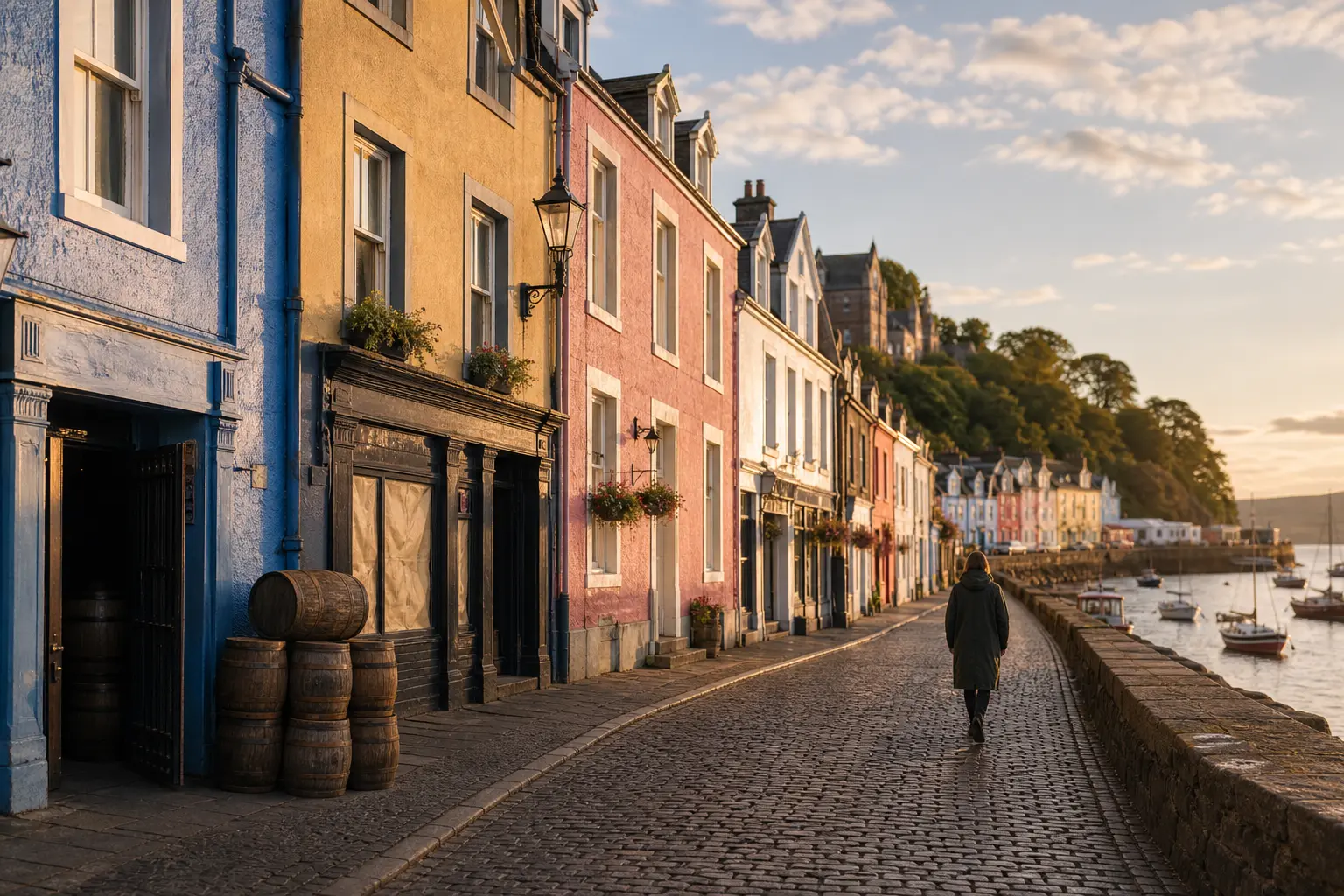
 Scotland’s biggest retail and hospitality groups warned Holyrood last December that the country is one bad Budget away from losing its high streets for good. Nobody sent that memo to Tobermory, Plockton or Kelso.
On these small-town Main Streets, whisky barrels, seafood platters and centuries-old stone are pulling in visitors even as chain retailers vanish from Scotland’s bigger cities. The gap between the two Scotlands now shows up in vacancy rates, footfall counts and, in one Highland village, a row of cottages that sits dark most nights because almost nobody actually lives there anymore.
Scotland’s High Streets Brace for a Reckoning
The warning arrived in a joint letter to MSPs ahead of the Scottish Budget on January 13. The Scottish Retail Consortium (SRC), which represents shops across Scotland, joined four other groups, UKHospitality Scotland, the Scottish Tourism Alliance, the UK Cinema Association and ukactive, in urging politicians to match a business rates discount for retail, hospitality and leisure premises already running in England.
SRC director David Lonsdale did not soften the message. “We’re one bad Budget away from losing our high streets as we know them,” he said. Together, the five sectors he represents employ 457,000 Scots.
The numbers back up the mood. Footfall in Glasgow and Edinburgh dropped more than 2% in September, with Storm Amy partly to blame, while shopping centre and retail park visits fell another 1.2%. Non-food sales grew just 1.7% over the following quarter, evidence that shoppers are being deliberate rather than staying away entirely.
Even that picture is not uniformly bleak. Property consultancy Savills found UK-wide shopping centre and high street vacancies had dropped to their lowest level since 2020, with acquisitions outpacing closures nationally. What is emerging in Scotland looks less like a blanket collapse and more like a widening split between destinations people still travel for and streets they simply drive past.
Where Tourists Spend, the Vacancies Disappear
Look at city-by-city vacancy data and that split becomes obvious. Places with strong culture, food and tourism scenes keep their shop units full. Places without them don’t.
Edinburgh’s vacancy rate sits at 9.3%, held down by a balance of culture, tourism and retail that analysts point to directly. Newport, Bradford and Blackpool, by contrast, have nearly one in five shopfronts standing empty. In York, visitors now outspend residents, making up 40% of all high street spending, and in both York and Edinburgh, one pound in every four now goes on food rather than goods.
Retail analyst Dr Amna Khan, a senior lecturer at Manchester Metropolitan University, argues that survival now depends on what a high street offers beyond shopping.
What will make them sing is the vibrancy that comes from culture and experiences you don’t get in shopping centres or retail parks.
Dr Khan made the point to STV News, adding that Scotland still has plenty of strong high streets where creativity and cultural vibrancy keep the tills ringing, even outside Edinburgh and Glasgow.
The Blueprint Behind Eleven Thriving Streets
Scotland’s tourism economy is not a footnote to this story. Visitor spend reached £10.8 billion in 2023 (about $13.7 billion), sustaining 245,000 jobs and 16,045 businesses. Tourism has overtaken business and financial services as Scotland’s single biggest source of employment.
Scotland has also been redrawing the map of what counts as a town, a reminder that these Main Streets sit inside a much larger, shifting settlement pattern rather than existing in isolation. Against that backdrop, a specific set of towns across the Highlands, islands, Borders and central belt share a rough blueprint for keeping their own streets full.
- A working anchor beyond retail, a distillery, harbour or brewery that gives the street a reason to exist even if every shop closed tomorrow.
- A distinct architectural identity, whitewashed cottages, pastel Georgian fronts or red sandstone, instead of the generic shopfronts found on most UK high streets.
- Food and drink filling the gaps, cafes, bakeries and restaurants taking over units that chain retailers used to occupy.
- A screen or heritage hook, a royal charter, a Highland Games history or a television series that keeps pulling new visitors back.
Eleven towns in particular show this pattern clearly enough to work as case studies, each selling a version of Scotland a shopping centre simply cannot stock.
Whisky Barrels and Bake-Off Bakeries
The Hebridean and Highland Coast
On the Isle of Mull, Tobermory’s Main Street curves around Tobermory Bay in a row of multicoloured buildings anchored by the 1869 Mishnish Pub. Tobermory Distillery, dating to 1798, is one of the oldest whisky producers in Scotland and sits at the western end of the same street.
Portree, on Skye, tells a similar story around its harbour. Engineer Thomas Telford designed the port and built its original pier in the 1800s, back when the town traded livestock and cargo. The wooded hilltop above the water, known as the Lump, has hosted the Isle of Skye’s Highland Games every year since 1877.
Plockton, sometimes called the Jewel of the Highlands, has a row of 19th-century whitewashed cottages on Harbour Street overlooking Loch Carron, where seals and dolphins surface within view of visitors having a dram at the Plockton Distillery.
Culross and Crieff Sell a Different Story
Further south, the pattern holds with a different set of props. Culross, on the Firth of Forth, preserves 16th and 17th-century buildings along Back Causeway, where raised cobblestones once let the upper class keep their shoes out of the filth running through the street. Culross Palace, parts of which date to the 1500s, doubled as a set for the Starz series “Outlander.”
In Crieff, Perthshire, actor Ewan McGregor, who grew up in the town, has praised the pies at Campbell’s Bakery on the same High Street where Glenturret Distillery has been distilling since 1775, older than Tobermory’s. The Crieff Highland Gathering has run every year since 1870.
Six More Towns, Six Different Anchors
A further six towns round out the picture, each built around its own specific anchor rather than a shared template.
| Town | Main Street | Signature Anchor | Defining Detail |
|---|---|---|---|
| Melrose | High Street | Trimontium Museum | Tells the region’s Iron Age and Roman history beneath the three peaks of the Eildon Hills |
| Kelso | Horsemarket | River Tweed Salmon Fishing Museum | Housed inside the 1816 Town Hall, on a street named for the town’s livestock-trading past |
| Dunkeld | Bridge Street | ARAN Bakery | Run by Flora Shedden, a finalist on “The Great British Bake-Off,” near a bridge spanning 685 feet |
| Inveraray | Main Street | Loch Fyne Whiskies | Georgian black-and-white architecture meets a 15th-century carved market cross at Inveraray Cross |
| Pittenweem | High Street | St Fillan’s Cave | Linked to a 7th-century Irish missionary, a five-minute walk from a Parish Church dating partly to the 1300s |
| Millport | Guildford Street | The Wedge | One of the narrowest structures in the world at 47 inches wide, near a rock painted as a crocodile since 1913 |
None of these eleven streets leans on a department store or a supermarket to stay busy. Every one of them survives on something specific and physical that a retail park cannot replicate.
The Price of Being Scotland’s Prettiest Street
Success has a cost, and nowhere shows it more starkly than the Highlands. Plockton’s whitewashed cottages look idyllic in every photograph. A Highland campaigner told GB News the village now sits “almost entirely in darkness” for most of the year, with just one home still holding a permanent resident and the rest converted into holiday lets.
Plockton sits near the North Coast 500 (NC500), the 516-mile touring route that has pulled ever more visitors into the region since its 2015 launch. A recent impact assessment found four in five residents see damaging traffic congestion daily or often, and that positivity toward the route collapsed from 40% to just 10% over the following decade. Sixty-one percent of locals said they strongly disagreed that the company running the brand, North Coast 500 Ltd, acts in the area’s best interest.
Ownership adds another layer. A Scotsman analysis found that a company controlled by Anders Holch Povlsen, Scotland’s richest man and largest landowner, is now the majority shareholder of North Coast 500 Ltd, the firm originally set up by a non-profit tied to King Charles. Two Facebook groups devoted to complaints about the route have close to 26,000 members between them, more than the populations of Fort William, Wick, Aviemore and Portree combined. Critics of that kind of concentrated ownership point to land laws that still favour a handful of private owners over the small towns living alongside them.
Fodor’s Travel added the NC500 to its 2025 list of destinations to reconsider visiting, citing overtourism. Supporters of the route counter that roughly one in seven jobs across the wider region now depend on tourism, and that blaming visitors alone ignores decades of underinvestment in rural roads and services.
What Happens to These Towns When the Games End?
Glasgow’s Commonwealth Games open July 23 and run through August 2, and VisitScotland is betting the spotlight spreads well beyond the host city. The tourism board’s own 2026 trend research shows travellers increasingly want their money to support small communities like Tobermory, Plockton or Kelso, not just Glasgow’s stadiums.
That research identifies “Give and Break” as a rising visitor mindset, travellers who want to leave a destination better than they found it by actively supporting the communities they pass through. Nationally, 73% of visitors now say they want their spending to directly benefit local people rather than corporate operators.
That is precisely the pitch these eleven Main Streets have been making without a marketing department: a distillery instead of a chain pharmacy, a family-run sweet shop instead of a discount retailer, a bakery run by a Bake-Off finalist instead of a shuttered unit.
Glasgow’s Games open in exactly one week. The small towns betting on whisky, water and old stone are about to find out how far that spotlight actually reaches.
Frequently Asked Questions
How Big Is Whisky Tourism in Scotland’s Economy?
Scotch whisky distilleries recorded more than 2.2 million visits in 2024, according to industry estimates, worth roughly £85 million directly to the Scottish economy. Distilleries on the Main Streets of Tobermory and Crieff are part of that count, alongside larger clusters in Speyside and Islay.
Why Do Scottish Towns Keep Showing Up in TV and Film Tourism Campaigns?
VisitScotland’s 2026 trend research names “Set-Jetting Plus” as a rising travel driver, tied to productions like “The Traitors,” “Outlander” and Guillermo del Toro’s “Frankenstein.” Culross, one of the towns known for its Main Street, appeared in “Outlander” itself, and productions like these keep pulling new visitors toward small towns rather than only major cities.
How Much Does Scotland’s Events Industry Add on Top of Everyday Tourism Spending?
The UK events industry generates about £61.653 billion a year, and an estimated £5.5 billion of that, roughly 9%, is attributed to Scotland specifically. That sits separately from the day-to-day retail and hospitality spending already counted inside Scotland’s £10.8 billion annual visitor economy.
Are Short-Term Holiday Lets Like the Ones Reshaping Plockton Regulated?
Yes. Scotland’s Tourism Accommodation Registration Scheme launched in 2025, and local authorities have run a short-term lets licensing scheme since rules under the Civic Government (Scotland) Act 1982 took effect, with a further 2024 order updating how it works in practice.
Do Cruise Ships Bring Visitors to These Main Streets?
Scotland’s ports, including Invergordon, Greenock, Kirkwall, Lerwick and Edinburgh, logged more than 900 cruise ship calls in 2024, with Invergordon alone handling over 150 ships. Passengers from these calls regularly reach west coast harbour towns during shore excursions.
Are Scots Themselves Still Visiting These Towns, or Is It Mostly Overseas Tourists?
Both. Survey data from early 2026 found 40% of Scots expected to take a domestic holiday that year, though nearly a third said their trips would likely be shorter than in previous years. Overseas visitors, meanwhile, now account for more than half of all overnight visitor spending in Scotland for the first time.
 ONGC licence frees Venezuela cash and operatorship talks
  Anthropic Hits $65 Billion Run Rate and Flips the AI Cash Test
  Supreme Court grounds the fare free-for-all with three-week clock
  Gold Nears $4400 as Soft Data Meets Oil Inflation Risk
  Nifty Slips as Zaggle Circuits and Dhoot Debuts Big
  Diesel Crack Tops $100 as Iran Rhetoric Lifts Crude